🚀 We would love your feedback. How's SpaceTime travelling...love it or hate it, we need to hear it all. Take the 1-minute survey and let us know what you think:Click Here
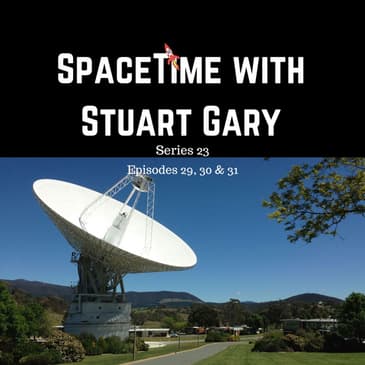
NASA Canberra Upgrade to Affect the Voyager 2 Spacecraft
The astronomy and space science news podcast.Stream podcast episodes on demand from www.bitesz.com/spacetime (mobile friendly). SpaceTime 20200406 Series 23 Episode 29*NASA Canberra upgrade to affect the Voyager 2 spacecraftNASA is undertaking a critical upgrade of its 70 metre Deep Space Network radio antenna near Canberra (Australia).*A whole new generation of European Launch Vehicles about the flyThe European Space Agency is preparing to begin flights with two new rocket launch systems this year the Ariane 6 and the Vega-C.*A new mission to study Giant Solar Particle StormsNASA has selected a new mission to study how the Sun generates and releases giant space weather events - known as solar particle storms.*More Chinese military spy satellites launchedChina has launched another three Yaogan-30 signet intelligence-gathering reconnaissance satellites.*The Science ReportClaims 42,000 people have died in Wuhan from COVID-19 rather than the 3,300 claimed by Beijing. Studies show the number of intensive care COVID-19 patients in Italy increased exponentially for 18 days.20 percent of people over 80 infected with COVID-19 likely to require hospitalization.Discovery of a new species of velociraptor in New Mexico.Could Australia have the longest continuous cliff line in the world?SpaceTime 20200408 Series 23 Episode 30*Best evidence yet for intermediate-sized black holes.Astronomers have their best evidence yet for the existence of intermediate-sized black holes -- a long sort after missing link in black hole observations.*A new planetary defense mission to smash an asteroidThe European Space Agency and NASA are teaming up for a mission to smash into as asteroid as part of a planetary defense test.*Solar wind is slowing beyond PlutoNew measurements by NASA’s New Horizons spacecraft has confirmed earlier data showing that the solar wind – the supersonic stream of charged particles emitted by the Sun – slows down the further away it gets.*First launch for the new U.S. Space ForceThe United Launch alliance has carried out its first mission for the newly constituted United States Space Force launching the sixth Advanced Extremely High Frequency- or AEHF satellite aboard an Atlas V rocket.*The Science ReportClaims that some COVID-19 patients who appear to have cleared the virus may still be harbouring it.Evidence that Beijing’s coverup of COVID-19 allowed it to stockpile medical supplies from other countries.East and West Antarctic ice sheets losing mass at unprecedented rates.While they can't pick out precise numbers, animals can comprehend that more is, well, more!COVID-19 What’s in a name.SpaceTime 20200410 Series 23 Episode 31*A new theory to explain how magnetars are madeNew computer simulations have shown astronomers how Magnetars – stellar corpses with the strongest magnetic fields in the known universe – could have evolved.*Japan’s Mission to the Martian moon PhobosThe Japan Aerospace Exploration Agency JAXA is planning a sample return mission to the Martian moon Phobos.*New worlds found beyond NeptuneAstronomers have discovered more than 300 new minor planets beyond Neptune.*Long March 7A failureChina has failed to place a new classified military spy satellite into orbit using its new generation Long March 7A rocket.*The Science ReportHeart damage common among patients hospitalised with COVID-19.More evidence suggesting bats were the most likely source for the coronavirus.Warnings COVID-19 may be able to spread in swimming centres.Discovery of three new species of fish-eating toothed pterosaurs.A new technique to ‘build’ meat grown in a laboratory.Homeopath accreditation being challenged in the British high court.For enhanced Show Notes including photos to accompany this episode, visit: http://www.bitesz.com/spacetimeshownotes