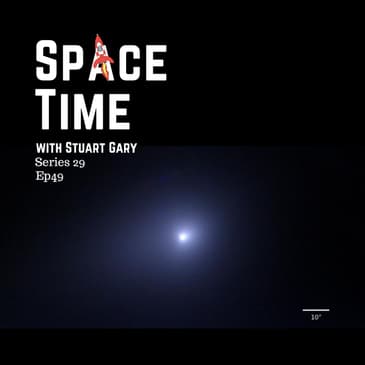


This is Spacetime Series twenty nine, Episode forty nine, for broadcast on the twenty fourth of April twenty twenty six. Coming up on Space Time, interstellar Comet three I Atlas is changing large craters, offering new clues about the origins of the strange asteroid Psyche, and fighting the growing threat of space junk. All that and more coming up on space Time. Welcome to space Time with Stuart Gary. A new study is discovered that the interstellar Comet three I Outlass appears to be undergoing a profound change in the composition of volatile gases it's emitting. The observations were made by the Subaru telescope in Hawaii, shortly after the alien comet met its closest approach to the Sun, known as perihelium. They showed changes in the ratio of carbon dioxide to water gasing from the comet's nucleus. This ratio change is much lower than that inferred by earlier observations using space based telescopes. The finding suggested the chemistry of the coma that's the atmosphere of gas and dust surrounding the nucleus is evolving over time and that's providing new clues about the comet's internal structure. The steadies. Lead author Yoshihiro Senaka from Kyoto Sanya University, says the change is consistent with the idea that the composition in the nucleus of three i atlas differs from that of its exterior, and as the comet head it up during its pass by the sun, gases started to escape from different parts of the nucleus. Now all this follows earlier observations before last year's perihelium using the Atta Kama Large Millimeter submillimeter Array radio Telescope ALMA, Chile. The ALMA scientists studied through our atlas as the sunlight was warming the comet's icy surface four perihelion, in the process triggering the release of gases and dust, forming the glowing coerma around its core. By analyzing this kerma, astronomers revealed the chemical fingerprints and the material it's composed of, allowing them to study how objects are made in different planetary systems. The authors focused on the faint millimeter fingerprints of two molecules, methanola type of alcohol and hydrogen cyanide and nitrogen bearing organic molecule commonly found in comets that ALMA data revealed that three I atlas is heavily enriched in methanol compared to hydrogen cyanide, far beyond what's typically seen in comets which are born in our own solar system until observing dates. The authors measured methanol to hydrogen cyanide ratios of about seventy and one hundred and twenty, placing three I atlas among the most methanol rich comets ever studied. These measurements imply that the icy material from three ialysis was either formed by or experienced very different conditions those which eight most comets in our own solar system now. Previous work by the James Webspace Telescope had already shown that three I outlass had a coma dominated by carbon dioxide when it was far from the sun, and these new ALMA results add methanol as another unusual detail in its chemical inventory. Alma's high resolution for imaging also allowed the authors to see how different molecules move away from the comet, revealing surprising differences between methanol and hydrogen cyanide. Hydrogen cyanide appears to come, for the most part, directly from the comet's cora nucleus, which is typical for comets in our Solar System. But methanol, on the other hand, appears to come from birth to nucleus and from ice particles in the coma. These tiny ice grains act like mini comets as the object moves closer to the Sun, where ice turns into gas and also releases methanol. Similar behavior has been observed in some Solar System comets, but this is the first time the physics of such detailed outgassing has been traced to an interstellar object. Three I Outlets is only the third confirmed objects seen passing through our Solar System from interstellar space. It follows one Imail MAUA and two IBORISV. Observations of these objects also revealed unusual properties. As astronomers continue to discover and study more interstellar objects, sciences understanding of planetary formation in other star systems continues to grow more interesting. This is space time still to come, large craters, offering new clues about the origins of the strange asteroid Psyche and fighting the growing threat posed by space junk. All that and more still to come on space time. Siders think large impact craters on the surface of the mysterious metallic asteroid sixteenth Psiche may provide new clues about its formation. Even two hundred years after the asteroids sixteen Psyche was first discovered, astronomers continue to be puzzled over its creation. Psyche is the tenth most massive object in the main asteroid built between Mars and Jupiter, and at two hundred and twenty five kilometers in diameter, it's the largest non metallic asteroid. Nassas Psyche mission will arrive at this strange world in twenty twenty nine, hoping to determine its origins. Psyching may be a liftover building block from early planetary formation, the planet having been shredded by violent collisions, or it may have been a planetary fragment that separated into separate layers before losing its rocky outer mantle. Other hypotheses suggest Psyche as an ancient remnant that either started out metal rich or became a blend of metal and rock after repeatedly smashing into other asteroids. Each of these scenarios just different implications for the origins of planets in the early Solar System. To investigate these possibilities, researches at the University of Arizona ran simulations to try and predict how a large crater located in near Psyche's north pole could have formed and the various competing scenarios. The findings, reported in GSR Planets outlines predictions designed to help scientists interpret the data which as as Psyche mission will collect when it arrives at the distant asteroid. Coupled with spacecraft observations, predictions may help settle the mystery of Psyche's origins once and for all. The studies lead author Namir Beijal says large impact basins craters excavate deep into an asteroid, giving clues about what its interior is made of. By simulating the formation of one of Psyche's largest craters, the authors are able to make some testable predictions for Psyche's overall composition when the spacecraft finally arrives. Fewer than ten percent of asteroids in the main built are metal rich, and of those, Psyche's by far the largest. Bijal says one of the main findings involves porosity, the amount of empty space inside the asteroid, which plays a significant role in how these craters form. Porosity is often ignored because it's difficult to include in models, but the simulations show it can strongly affect the impact process and shape of the craters left behind. When an asteroid is porous, it's more well, shall we say, crushable, and so the impact energy is officially absorbed. That leads to deeper, steeper craters with less ejected materials scattered across the surface. By comparing these simulated craters with what spacecraft observe, scientists will be able to investigate whether Psyche's interior is separated into layers of rock and metal or instead mixed into a jumble of materials rubble Pi style. This is all really important because scientists will never be able to get to the cause of Earth, Mars, or Venus, but they may be able to get a good idea of what a terrestrial planetary core looks like by studding Psyche. If Psyche does turn out to be an exposed planetary core and most of the rocky crust was blown away for some reason, it'll offer a window into a violent stage of planetary formation, which scientists cannot observe any other way. The Gallon colleagues tested two main interior structures for Psyche. One is a layered structure with a metallic core and a thin rocky metal, which likely formed if for violent collisions stripped away the outer layers. The other is a uniform mixture of metals and silicates created by a more catastrophic impact that mixed everything together rubble pil style, like some metal rich meteorites found on Earth. The authors used the best shape model of Psyche derived from telescope observations to create their three D target. They reproduced the formation of a specific and cavity in the model, about sixty kilometers wide and six kilometers deep, as a simulated impact in which Psychi was hit at speeds typical for asteroid belt collisions around six kilometers per second. They varied the size of virtual impactors and then tested the two models metal core and mixed rock and metal to see which could reproduce the creator's known dimensions. Each scenario produced slightly different crater shapes in the ject to pattern, The authors found that an impact of about six kilometers wide would create a crater of the right dimensions, regardless of its interior composition. The Psyche spacecraft carries instruments designed to study the asteroid's surface gravitational field, magnetic field, and composition. In addition to crater shapes which depend on internal structure and ferocity. The simulations also predicted other observable patterns, including variations in the density caused when the impacts compressed the asteroid's interior, and the distribution of metal rich debris lasted onto the surface. This is space time still to come fighting the growing thread of space junk, and later in the science report, a new study is pinpointed the likely origins of the spiced nutmeg. All that and more still to come on space time. Debris from spacecraft is becoming a growing problem in orbit. Nowadays, considerable time and effort is undertaken to track the millions of pieces of spent rocket stages, disused satellites, and collision or explosions or spacecraft debris currently orbiting our planet. It's a problem made worse by countries like China deliberately destroying spacecraft in orbit to test their anti satellite weapons systems, in the process, creating massive clouds of shrapnel, much of it too small to track, but still deadly were it to collide with a manned spacecraft Perdue. University engineer Caroline Freu is among a small army of researchers searching for ways to limit the threat of space junk. She's looking at ways of tracking space debris, especially as the number of deep space missions to the Moon increases in coming years. Right now and that is planning more than thirty Moon missions in the next few years alone, frew says, everywhere humans have gone in space, they've left space debris behind. Their research is considering how the latest spacecraft technology could affect the formation of space debris. See Unlike previous lunar spacecraft, rockets for upcoming lunar missions are likely to have nuclear thermal propulsion systems or to be more fuel efficient. The problem is if rockets with these systems collide or explode in space, their radioactive contents would disperse and become debris. True and colleagues have been modeling the consequences of radioactive debris in sis lunar orbit, finding that nuclear contaminated fragments from a nuclear thermal propulsion system could emit radiation kilometers away from an impact site on the Moon. Their models, reported in the Journal of Astronautical Sciences, indicate that these radiation levels could stay elevated for more than a year, threatening any man lunar base nearby space. Degree are the human made objects which are in space. You might think those are only a few, but there's actually a large number around the Earth and now even pushing further out all the way to the Moon. Once you launch the objects, even when the satellite is long dead, all the rocketed upper stage has fulfilled its mission, it stays in orbit. It does not automatically come down. Up to an altitude of about one thousand kilometers, there's drag. Meaning they lose energy. They might come down very very slowly. However, anything further out where our GPS satellites are, where our TV satellites are, there's no mechanism bringing them down. They can stay there forever. So we have basically three lines. We have the observations, we have the astrodynamics and the characterization. One thing we have added. To the research is no longer only looking in the near Earth space, but also looking at this is lunar space, which is further out. With all the new and exciting missions like Atomis, we are having more traffic into the lunar region around the Moon, but also all the space between the Earth and the Moon. While that is cool and exciting, it does create the problem that we have space to bring in that region as well. So, for one, we have the p Due Optical ground station where we actually take observations of the objects in Neuerth space and cislunar That includes the active satellites but also the space debris. We can do mission support for example, in that realm. And then we are looking for the astrodynamics. One is how do we keep the spacecraft safe? What is the probability of collision? How can we compute that efficiently? How can we aid and go no go decisions when a collision comes up, when there are fragmentation events like an explosion, where do the. Pieces even go? While in the New Earth space we have a better idea in cis lunar space, they can actually go to the Moon, they can come all the way back to the Earth, or just keep hanging out on the characterization. We want to see what can we learn about the objects beyond their center of mass. They're very far away. We are not getting a resolved picture of them. But how can we still know in which motion they are, what shape they have. That's important when you launch a mission and you lose contact. Are we still oriented that the solar panels still get energy? Are we in free tumbling motion? That's usually a bad sign. How can we recover from that? When do we have the antenna point in the direction that we can try to make contact or reboot. It's also relevant for active removal of space debris. If people are planning a mission to remove space debris. Go and grab it more or less. The better you know what pieces you're dealing with, what's the shape, how much rotation do they have, the better you can execute those missions. We have a number of challenges. One is large constellations. We have a larger number of active spacecrafts in space at the moment than ever before. This means they are flying relatively dense to each other, so we want to be aware avoiding collisions, but also be aware that we're not littering and leaving the space debris behind, and how to manage different interests that in that space. The other big challenge is this is lunar missions. The missions that are going to the Moon or to the l two lagrange from points like the Artemis mission that's creating traffic in an area of space which is not used to have a lot of missions going there, and then how to balance them, how to make them not run into each other, how to avoid having explosions in that space and having all the pieces flying around to the Moon, back to the Earth and everywhere in between. These are some of the challenges which are on the technical level, but also on the legal level. We are working mostly on the technical level to have solutions ready in order to tackle those problems. Working on space debris is usually considered like the spoiler sports people, because everybody wants to do the cool missions and actually go places and provide technologies, services or explore space. But the problem with debris is real. Everywhere humans have been going in space, we have been leaving behind space debris. In order to tackle the problem, one of the frontierss mitigations. To begin with, we are working that you think. About in your mission planning already, what's the end of life, where's the debris going? And how to tackle that problem. So because the fewer debris pieces we are creating, the better the problem in the end. That's Caroline Thrue from University and this is space time and time that to take another brief look at some of the other stories making us and Science this week. What the Science report. Scientists have found that all the men are more likely to add extra assault to their food, despite its known health risks. The findings are reported in the journal Frontiers in Public Health. Used survey data from eighty three hundred Brazilian adults aged over sixty and found twelve point seven percent of men nine point four percent of women added salt to their foods once they were cooked. The authors found that men who are not on diets to manage high blood pressure are the most likely to salt food after preparation. It seems living arrangements and dietary choices can significantly influence people's discretionary use of salt, with sixty two percent of men more likely to add salt if they live alone. On the other hand, for women who regularly ate fruits and vegetables, the likelihood of adding salt was some eighty one percent or forty percent lower, respectively. The authors say this might be because this group pays more attention to diet quality, reducing salt intake. We have a bit of good news now with a new study showing that after more than forty years since the end of commercial whaling, sightings of the world's two largest world species, the blue and fin whales, have increased in the southeastern Atlantic. The findings were reported in the African journal Marine Science, based on sixty years of confirmed sightings and strainings from the Mibia and the South African West Coast. They said that although overall numbers remain low, sightings of birth species have increased remarkably in recent years, with ninety five percent of observations recorded since twenty twelve. The results suggest that these ocean giants are slowly recovering from the devastating impact of twentieth century commercial whaling, a practice which pushed both species to the brick of extinction. However, the authors worn that ship strikes, entanglement in fishing gear, underwater noise, pollution, and climate change all remain serious threats to their survival. A new study has found that one of the world's most iconic spices, nutmeg, probably originated on the Bander Islands in eastern Indonesia. The findings, reported in the journal The Proceedings of the Rural Society, looked at the DNA of four hundred nutmeg plants across the Malaccas Archipelago, finding that genetic diversity is highest in the North Malaccas. Now normally genetic diversity's highest in a species area of origin, but this new analysis suggest that the plants originated much further south in the Bandar Islands in the South Malaccas, but that's also where the species has recently undergone a dramatic reduction in genetic diversity. The authors found the plants are likely to have moved north naturally between ten and fifteen thousand years ago, long before being spread far and wide as part of human trade. There are claims today that some of the world's oldest financial institutions are concerned over the destabilizing effect the discovery of UFOs and alien extraterrestrial visitations to planet Earth would have on the global economy. It's claimed a report to the Bank of England warns of financial collapse if and when the news comes out, assuming there is news, of course, But as the Skeptics timendum points out, firstly, there was no report, it was just a letter sent to the bank, and secondly, there is of course no news that UFOs or alien extraterrestrials have visited planet Earth. The headline read the Bank of England fearful of the US disclosing extraterrestrial Now that's not true the aspects of it. Someone who used to work at the Bank of England for ten years at the financial analyst, not exactly an astrophysicist or anything like that, has sent in a report to the head of the Bank of England unofficially because they don't work there anymore, stating that there's going to be an announcement soon. And this has been sort of said quite widely recently that the Donald Trump is going to release the truth about UFOs this year. Sometimes sometimes soon they will say this year, but yeah, and that once the truth of UFO is, the existence of them is revealed. This is what this letter says to the Bank of England, that it is likely to induce ontological shock and provoke psychological responses with material consequences. Before you go any further, what the heck is an ontological shock? So I think it's back to basics, actually back to the understanding of the nature of things. It's a shock to your very nature, to your soul. I'm not quite sure why, but the suggestion is that because once the alien existence has been revealed, it will show that earthly authorities are not totally in charge. I'm not for sure how that works. Some past performance that would be a good thing, wouldn't it. Well, yeah, get back quite relatively speaking is but supposedly these aliens have been around for a long time, at least that's ninety forty seven. Governments might have known about it. I'm not quite sure how big a shock this is going to be say that authorities aren't necessarily the front of wisdom. Not in the letter sent to the Bank of England says if the UAP an admisoide anomalous phenomena, it proves to be of non human origin, we may have to acknowledge the existence of a power or intelligence greater than any government and with potentially unknown intentions. It is entirely possible that the government leadership and their central banks have not been properly briefed on the topic that will not be surprised. So basically saying that when this announcement is made any day now, that it's going to shock the banks to their group places and realize that aliens have more influence over the world economy then than you might think that. The headline Bank of England being fearful uish disclosing no extraterrestrials, no proof. Therefore the headlines are r and the report given by someone who used to work at the Bank of England for ten years and hasn't worked there for a while, So it's not a Bank of eagling report that someone wrote on a lela. It's a head over blown. I think that's the skeptics timendum, and this is Spacetime and that's the show for now. Spacetime is available every Monday, Wednesday and Friday through bites dot com, SoundCloud, YouTube, your favorite podcast download provider, and from space Time with Stuart Gary dot com. Space Time's also broadcast through the National Science Foundation, on Science Own Radio and on both iHeartRadio and tune In Radio. And you can help to support our show by visiting the space Time Store for a range of promotional merchandising goodies, or by becoming a Spacetime Patron, which gives you access to triple episode commercial free versions of the show as well as there's lots of burnus audio content which doesn't go to weir, access to our exclusive Facebook group, and other rewards. Just go to space Time with Stewart Gary dot com for full details. You've been listening to Space Time with Stuart Gary. This has been another quality podcast production from bytes dot com
🚀 We would love your feedback. How's SpaceTime travelling...love it or hate it, we need to hear it all. Take the 1-minute survey and let us know what you think: Click Here