


This episode of SpaceTime is brought to you with the support of Squarespace. When it's time to get a presence online, go with the folks who support us...and build the best websites easily. No hassles. You can check out their special offer for SpaceTime listeners by visiting our special URL....Click Here
SpaceTime with Stuart Gary Gary - Series 29 Episode 7
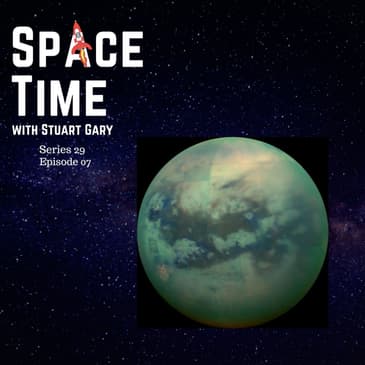
In this episode of SpaceTime, we delve into the intriguing possibilities surrounding the origins of life, including new findings from Saturn's moon Titan and the implications for our understanding of life beyond Earth. We also explore the latest research on Europa, one of Jupiter's moons, and uncover the sources of the sun's mysterious gamma rays.
Life's Building Blocks on Titan
A groundbreaking study reveals that Titan, Saturn's largest moon, exhibits unexpected chemical interactions at extremely low temperatures. Researchers found that hydrogen cyanide can mix with nonpolar substances like methane and ethane, challenging traditional chemistry principles. This discovery could provide insights into the prebiotic chemistry that may have preceded life on Earth, as Titan's environment mirrors that of early Earth.
Europa's Quiet Oceans
In a surprising turn, new calculations suggest that the vast subsurface ocean beneath Europa's icy crust may be lifeless. This research indicates that Europa lacks the geological activity, such as hydrothermal vents, necessary to sustain life. Lead author Paul Brian discusses how the moon's stable orbit around Jupiter limits the tidal forces that could drive geological processes, casting doubt on the moon's potential as a habitat for life.
The Source of Solar Gamma Rays
Astronomers have identified the origin of intense gamma radiation emitted during solar flares, linking it to high-energy electrons colliding with plasma in the solar corona. This finding, derived from observations of a significant solar flare in 2017, enhances our understanding of solar flare physics and could improve space weather forecasting.
www.spacetimewithstuartgary.com
✍️ Episode References
Journal of the Proceedings of the National Academy of Sciences
Nature Communications
Nature Astronomy
Become a supporter of this podcast: https://www.spreaker.com/podcast/spacetime-your-guide-to-space-astronomy--2458531/support.
(00:00:00) Scientists studying Saturn's moon Titan have discovered that normally incompatible substances can mix
(00:05:19) NASA will launch the Dragonfly mission to Titan in 2028
(00:13:36) NASA's Europa Clipper spacecraft will study icy moon Europa
(00:18:11) Astronomers have discovered that gamma rays generated by solar flares are caused by electrons
(00:21:58) Most people who take diabetes drug Mounjaro gain weight back after stopping
This is Spacetime Series twenty nine, Episode seven, for broadcast on the sixteenth of January twenty twenty six. Coming up on space Time, new questions about how life could have started. A new study rules out the likelihood of life in the seas under the frozen crusts of the Jovian Iceman Europa, and discovering where the Sun's mysterious gamma rays originate. All that and more Coming up on space Time. Welcome to space Time with Stuart Gary. Scientists studying Satin's moon Titan have discovered that normally incompatible substances can still be mixed under extremely cold temperatures. The unexpected findings, reported in the Journal of the Proceedings of the National Academy of Sciences PNAS, challenges our understanding of chemistry before life began. Titan is almost unique. It's the only known world in our Solar system other than Earth were rains that rain then forms streams and rivers, which eventually flow down into lakes and seas. But on Titan, the rain isn't water, its liquid methane and ethane see temperatures on Titan are so called water. There is frozen solid forming much of the planet's bedrock. Scientists have long been interested in Satin's largest orange colored moon, as its evolution can teach researchers more about our own planet and the earliest chemical steps towards life on Earth. Titan's cold environment and its thick nititrogen and methane rich atmosphere as many similarities to the conditions thought to have existed on the early Earth billions of years ago, so by studying Titan, scientists hope to find clues about the origins of life itself. The studies lead author Martin ram from Chalmers University of ta Technology in Sweden, says these new findings are providing fresh insights into the building blocks of life in extreme environments. Raming colleagues found that methane, ethane, and hydrogen syinide, which exists in large quantities in the atmosphere and on the surface of Titan, can interact in a manner that wasn't previously considered possible. That hydrogen cyanide, an exceptionally polar molecule, can form crystals with completely non polar substances such as methane and ethane is surprising because such substances normally remain strictly separate, much like water and oil. In chemistry, Polar substances consist of molecules with an asymmetrical charge distribution that is, a positive side and a negative side. Non Polar materials, on the other hand, have symmetrical charge distribution. Polar and non polar molecules rarely mix because polar molecules preferentially attract one another through electrostatic interactions. Ram says the discovery of the unexpected interaction between these substances could have affect how science understands Titan's geology and its strange landscapes of lakes, seas, and sand dunes. In addition, hydrogen cyanide is likely to play an important role in abartic creation of several of life's building blocks, such as amino acids, which are the building blocks of proteins, and nucleobases, which are needed for genetic code. Ramon colleagues wanted to find out what happens to hydrogen cyanide after it's created in Titan's atmosphere. Are there meters of it deposited on the surface of Titan, or has it interacted or reacted with its surroundings in some way? Now While this was going on in Scandinavia, scientists that NASA's Jet Proportion Laboratory in passing into California were conducting their own experiments, mixing hydrogen cyanide with methane and ethan at temperatures as low as ninety kelvin that's around minus one hundred and eighty degree celsius. Now. At these temperatures, hydrogen cyanide is a crystal and methane and ethane are liquids. When they studied these mixtures using laser spectroscopy, they found the molecules remained intact, but that something was still happening. I understand what. They contacted RAMS Group in Sweden, which conducted exclusive research into hydrogen cyanide. This led to experiments to determine if the measurements could be explained by a crystal structure in which methane or ethane is being mixed with hydrogen cyanide. The problem is that contradicts a key ruling chemistry like dissolves like, which basically means that it should not be possible to combine these polar and non polar substances. Raman colleagues use large scale computer simulations to test thousands of different ways of organizing the molecules in a solid state. They found that hydrocarbons had penetrated the crystal lattice of the hydrogen cyanide and formed stable new structures known as cocrystals, But they also discovered that this could only happen at very low temperatures like those on Titan. Hydrogen cyanide is common across the universe. It's found in large malae, ticular gas and dust clouds, implanetary atmospheres, and in comets. Ram says the findings may help scientists better understand what happens in other cold environments in space, and if other non polar molecules can also enter hydrogen SINI crystals, and if so, what that might mean for the chemistry preceding the emergence of life. Saturn's largest moon, Titan, is among the Solar System's most unusual worlds. It may share many features with Earth's early evolution. It's surrounded by a thick atmosphere composed mostly of nitrogen and methane, a composition that's thought to resemble the atmosphere on Earth billions of years ago before life emerged. Satellite and other radiation from space caused these molecules to react with each other, which is why Titan shrouded in a chemically complex orange colored haze of organic carbon rich compounds, and one of the main substances created this way is hydrogen cyanide. Titan has winds, weather, and seasons. Measurements also show that they might be light which liquid water reserves deep below the surface, which could at least in principle, support life. NASA will launch the Dragonfly mission to Tighten twenty twenty eight, reaching the Moon in twenty thirty four to study its surface, chemistry, meteorology, and topography great detail, and part of the rhetochopter's mission will be to study pre biotic chemistry, the chemistry that precedes life, and also to look for signs of life on the Moon. This report from Nasty. V, Saturn's largest moon, Titan, has a thick atmosphere and a frozen surface rich in organic molecules. In twenty thirty four, a NASA mission called Dragonfly will arrive at Titan and study its chemical makeup. Dragonfly is a rotocraft designed to visit multiple sites across the Moon's varied terrain. At each new landing site on Titan's surface. Dragonfly uses a pulse neutron generator and onboard gamma ray sensor to detect to key elements such as carbon and hydrogen in organic materials or oxygen in water ice. Dragonfly determines if there are well defined layers of these materials just below the lander. For a closer inspection, Dragonfly uses its drill to generate tailings from Titan's hard frozen surface. These surface samples can then be ingested through the pneumatic system carried with titan air into the chilled sample lines into the sample collection carousel. One of the carousel sample cups is placed in a pneumatic port. The cup captures the surface material from the cold air stream and transfers it to the chemical laboratory for measurement. Pulses from a laser release large organic molecules from the surface sample for analysis in the mass spectrometer. The mass spectrometer sorts molecules by mass and measures diagnostic fragments that tell Dragonfly the kinds of chemical components that are present in the surface and whether there are molecules of prebiotic interest. For those potential prebiotic samples, a new cup is placed into an oven and heated to release molecules into a gas chromatograph, where they are sorted for size and type before entering the mass spectrometer. This advanced separation of organic components includes isolating molecules with the same formula but different chiral arrangements or handedness. Having a preference for one handedness over another is a key biosignature for life on Earth. When the chemical analysis is complete, Dragonfly may choose to take another surface sample or find a new location on Titan to investigate. This is space time still to calm. Any study rules out the likelihood of life in the seas under the frozen crusts of the Jovian Iceman Europa, and discovering where mysterious GAMMERA emissions from the Sun begin. All that and more still to colm on space time. This episode of space Time is brought to you by Squarespace. If you've ever wanted to make your mark online, whether you're just getting started or ready to take your business to new heights, Squarespace is the all in one website platform specifically designed to help you stand out and succeed. With square Space, you can easily claim your domain, build a beautiful website, showcase your skills and products, and even get paid, all in one seamless place. Now, let's talk about design. With Squarespace. You don't need any coding experience to have a website that truly stands out. They're cutting edge design suite offers Blueprint a one, a smart website builder that creates a tailor made design based on your industry, your goals, and your personality, all in just a few easy steps. Or you can pick from a library of award winning templates and easily customize your site with draft and drop editing and stylish visuals. Every website, no matter your starting point, is fully flexible, visually stunning, and designed to help you look your very best online. So are you ready to get started? Head on the squarespace dot com slash space time for a free trial, and when you're ready to launch, use the offer code space time to save ten percent off your first purchase for a website or domain that square space dot com. Slash space time with the code space time, and of course there's a link to the offer coat in our show notes Build your space online with square Space. You're listening to space Time with Stuart Gary. A new study warns that the oceans beneath the frozen surface of the jervian icemoon Europa are likely to be quiet and lifeless. The findings, reported in the journal Nature Communications, are based on new calculations of the gravitational title forces being exerted on the Moon by Jupiter and how that would affect the Moon's internal structure. The Solar System's largest planet, the gas giant Jupiter, has nearly one hundred known moons, yet none have captured the imagination and interest of scientists quite like that of Europa. This ice shrouded world is thought to possess a vast subsurface liquid water ocean. For decades, scientists have wondered whether that ocean could harbor the right conditions for life, placing Europa on the top the list of Solar System bodies to explore. But now a new study is throwing cold water on the idea that Europa could support life on the seafloor. Using calculations that consider the Moon's size, the likely makeup of its rocky core, and the gravitational pull of Jupiter, the studies authors have concluded that Europa lacks the tectonic motion warm hydrothermal vents, or any other sort of underwater geological activity that would presumably be a prerequisite for life. The studi's lead author, Well Burned, from the Washington University in Saint Louis, says that if one were to explore this ocean world with a remote controlled submarine, he predicts you wouldn't see any new fractures, any active volcanoes, or any plumes of hot water on the seafloor. He says, based on his calculations, there's simply not a lot happening down there. Everything would be quiet, and on an icy word like Europa, a quiet seafloor might well mean a lifeless ocean without a submarine. Burning colleagues had to combine known facts about Europa with inferences drawn from geology on Earth and other bodies, including the Earth's ow Moon. The ice shell on Europe is thought to be around fifteen to twenty five kilometers thick, and the ocean covers the entire Moon at a depth up to one hundred kilometers. Even though Europa is slightly smaller than Earth's own moon, it holds much more water than all of Earth's oceans combined. Beneath that ice and water lies a rocky core analogous to Earth's, and while Earth's core still burns hot, Burn and colleagues have calculated that any heat from Europe's core would have escaped billions of years ago. The team also calculated the gravitational tidal forces from Jupiter, a pull that can be strong enough to keep a moon geologically alive. On its innermost large moon, Io, Jupiter's immense gravity stretches and compresses the Moon as it orbits around the gas giant, generating heat through friction and resulting in Io being the most volcanically active body in the Solar System. Burn points out the gravitational tible forces acting on Io are especially violent. That's because the Moon has an eccentric orbit around Jupiter, which takes it closer and then further away from the gas giant. That exaggerates the gravitational tidal forces acting. On the Moon. But Europa's orbit, on the other hand, is relatively stable and distant, consequently lessening the chances of any substantial tidal forces acting upon it. He admits, Europa likely does have some tidal heating, which is why it's not completely frozen, and it may well have had a lot more tidal heating in the distant past, but Burns says he's not I've seen any volcano shooting out of the ice today like you'd see on iiO, for example, and his calculations suggests that the tides simply aren't strong enough to drive any sort of significant geological activity at the seafloor. He believes Europa's quiet seaflow geology doesn't provide much support for any contemporary life below the ice now. Burn is still excited about the future chances of exploring Europa, especially with the Europa Clipper spacecraft, which will fly by the Moon in the spring of twenty thirty one. That mission will take close up images of Europa's surface and provide more precise measurements of its ice caps and the ocean beneath. Burn says those measurements should answer a lot of questions and provide more certainty. This report from That's a TV. The most exciting thing about Europa can be summarized in one word. Water. Now, think about all the water on Earth and double that that's what we think is on Europa. Don't need to go there to explore to understand is this place a habitable environment that could potentially support life. Getting close to Europa is a huge challenge. It sits in the worst possible radiation environment, trapped by. Juvenile Europa is a moon of Jupiter about the size of Earth's Moon, which has an icy surface that probably hides a subsurface ocean side. To think, Europa has the key ingredients to support life as we know it. Number one water, number two energy, and three essential chemical building blocks. For the first time ever, we're sending a spacecraft completely dedicated to studying this moon. The three main things that we're going to explore at Europa are the ice and the ocean and understand that intersection between the two. Study the chemical composition of the moon as well as the geology and whether it's active. Currently, Europa Clipper is not specifically a life search mission. We're going to understand than the potential habitability of Europa. The spacecraft has nine instruments and a gravity science investigation. Five of the instruments are called remote sensing instruments because they measure light reflected off Europa like a camera or a spectrometer. The other four instruments are measuring the environment around them, like sniffing gases or dust. Europa Clipper is the largest spacecraft NASA has ever built for a planetary emission. It weighs thirteen thousand pounds six and a half tons. That's like the size of a huge African elephant. And the solar arrays are massive. If you put the solar rays at the toes of the Statue of Liberty, the other end of the arrays would come up to the Statue of Liberty's crown. So not only are they big, these things are technological marvels. They are being bathed in radiation all the time and they have to survive the entire mission like. That, Jupiter's radiation environment is intense and Europa sits in the worst part of that environment. Jupiter acts like a giant particle accelerator. There are charge particles trapped in Jupiter's magnetosphere that rotate with it, and these particles slam against Europa and will slam into our spacecraft as well. We protect the spacecraft in two ways. Number One, we try to minimize the amount of time we spend in there, which is why we are orbiting Jupiter and just flying by Europa. The second way we protect against the radiation is by having an electronics vault that we put our computer instead of the other sensitive electronics inside, which is made of about a third of an inch of aluminum. With each fly by of Europa, the outside surface of the spacecraft sees the equivalent of a million chest X rays just as we're flying by. It's a pretty long trip to get to Jupiter from Earth, but not that bad from a planetary standpoint. From launch to the time we get to Jupiter is about five and a half years, and along the way we have a flyby of Mars and then another flyby of Earth to get gravity assists to slingshot the spacecraft out to Jupiter. This mission has been a long time coming, and we're so excited about what we're. Going to see when we get there. We are in a golden age of robotic spaceflight exploration. How could you not be excited about something as monumental as this. I am most excited about the potential to unlock the secrets of EUROPEA, the potential to really understand this crazy world that exists and has likely existed in this condition for four billionaires. And in that report from mass A TV, we heard from europe A Clipper project scientist Robert pappealado europe A Cliper Launch to Mars mission manage it Tracy Drain Clipper project manager Jordan Evans and Europea Clipper Telecom system Engineer Deepak Shrinivasane. This space time still to calm discovering the source of intense gamma radiation unleashed by the Sun, and later in the Science report, a new study shows that birds around the world as singing for nearly an hour longer than before on average due to light pollution. All that and more still to come on space time, astronomers have discovered that intense gamma radiation unleashed by the Sun during its most violent eruptions is caused by electrons colliding with plasma in the Solar corona Sun's upper atmosphere. The findings, reported in the journal Nature Astronomy, helped solve decades old mystery which is long puzzled scientists, namely the origin and cause of a previously unknown class of high energy particles observed during major solar flare events. The signals were traced back to a localized region in the Solar corona during a powerful X eight point two class flare which erupted back on September tenth, twenty seventeen, during which trillions upon trillions of tons of particles were released at energies of several million electron vaults. That's hundreds of thousands of times more energetic than typical solar flare particles, and they were moving at near the speed of light. The authors believed that these particles were generating gamma rays through a process known as Bremstra Loong, a mechanism in which low mass charged particles such as electrons amid high energy photons when they collide with material in the Sun's atmosphere. They say the discovery fills crucial gaps in science's understanding of solar flare physics, and it could improve models of solar activity, which ultimately could enhance space weather forecasting. The studies lead author Greg Reflashment from the New Jersey Institute of Technology. So scientists news solar flares produce a unique gamma ray signal, but the data alone couldn't reveal its source or how it was generated. Without that crucial information, Flashman and colleagues couldn't fully understand the particles responsible or evaluate any potential impact on space weather environments. But by combining gamma ray and microwave observations from the solar flare, they were able to have finally solved the puzzle. To find the source, the authors combined observations from the twenty seventeen flare using NASA's Fermi Gamma Ray Space Telescope and the expanded Owens Valley Solar Array Radio Telescope in California. Fermi provided crucial measurements of hyenergy gamma ray emissions during the flare, while Owens Valley delivered spatially resolved microwave imaging which captured the signals of accelerated particles of the solar corona. By analyzing these data sets together, Fleishman and colleagues identified three regions in the solar atmosphere microwave and gamma ray signals converged. This convergence pointed to a unique population of particles energized to millions of electron vaults. Fleischmann says that unlike typical electrons accelerated in solar flares, which usually decrease in number as their energy increases, this newly discovered population is unusual because most of these particles all have very high energy levels, in the order of millions of electron vaults with relatively few lower energy electrons present. The authors link the energy distribution of these particles directly to the observed gamma ray spectrum, pointing to bremstaleong emissions as the ellusive source of the gamma ray signals. The point of origin is near an area of magnetic field decay and intense particle acceleration, and it supports long standing theories about how solar flares accelerate particles to extreme energies and sustain them. But one big unknown is whether these particles are electrons or their antimatter counterpart positrons. Electrons have a negative charge, positrons a positive one, and measuring polarization of microemissions from similar events in the future could provide an affinitive way to tell them. Apart, this is space time, and time now to take another brief look at some of the other stories making us in science this week with the Science Report. A new study has found that most people who lose weight by taking the diabetes drug Manjarro end up gaining some of the weight back once they stopped taking the drug. Or report in the Journal of the American Medical Association examined a thirty six week clinical trial funded by the drugs manufacturer, some three hundred eight participants were switched to a placebo drug, allowing researchers to monitor how much weight they're gained back. Authors found that while these participants saw weight loss and health improvements while taking the drug, but in the year of receiving the placebo, eighty two percent who had originally achieved many full weight loss had regained at least twenty five percent of that weight, and the more weight participants gained, the more reversal the authors saw in other health improvements, including blood pressure, lestero levels, and fasting insulin. Scientists have set a new record in solar cell efficiency using eco friendly perovskite technologies. A report in the journal Nature Nanotechnology demonstrated the University of Queensland design of tin hallide provskite solar cell technology was capable of converting sunlight into electricity at a certified efficiency of sixteen point sixty five percent. That's nearly a full percentage point higher than the previous best for THHP solar cell figures. A new study has shown that birds around the world are now singing for nearly an hour longer on average due to light pollution. The findings, reported in the journal Science, analyzed millions of bird sung recordings covering more than five hundred bird speci that were active during daylight hours. They found that light pollution had a greater impact on birds with bigger eyes and those with openests, as well as migratory birds and those with larger geographical ranges. The authors say these birds were more likely to sing later in the evenings and earlier in the mornings as a direct result of light pollution. Well after linking paracetamol to an alleged increase in autism cases, United States Health and Human Services Secretary Robert Kennedy Junior is now claiming male circumcision can also cause the condition because the painkillers given to the child for undergoing the circumcision procedure. In other words, he's claiming male circumcision itself doesn't cause autism, but the painkillers do. His claims follow a Danish study in the Journal of the Royal Society of Medicine which shows that boys who were circumcised of a forty six percent higher likelihood of having autism. However, the study's own authors acknowledged several weaknesses in their research, including that although their evidence was compatible with a possible causal role of circumcision trauma, in some cases, no firm conclusions could be drawn because the data only showed correlation, not causation. Circumcision is being proven to dramatically lower the risk of contracting AIDS and other sexually transmitted diseases. Males who are not circumcised also have a slightly increased risk of penile skin issues, urinary tract infections, and penile cancers. Circumcision rates very dramatically, from nearly one hundred percent among people of the Jewish faith in Muslims to around eighty percent of the United States, sixty percent in Australia, forty percent in New Zealand, down to less than fifteen percent in most European countries in the UK, fourteen percent in China and India, and just nine percent in Japan. The skeptics Tim Mendum points out that, as well as other problems with the study, that Kennedy's citing it can explain autism and females. Moving on from RFK, suggesting that taylermal for paraceason well as it is from most countries. If the cause of autism was a core of autism when women take it during pregnancy. Is now also suggesting that circumcision is a cause for autisms because it's a painful experience. So when it's painful, you give the kit a painkiller, So therefore that increases the level of autism, which doesn't exactly explain how autism in girls is increasing, or that people who are culturally circumcised, generally the Jewish people in Israel, for instance, is not increasing autism. So the opposite is true of what you're saying. It's just grabbing at straws to try and find a reason for what many people regard as a scary condition. A lot of people regarded as it's pretty normal, natural if the spectrum covers a lot of different symptoms for people, but is one of them, and it can have a dealleterious effect on someone's ability to work in society, etc. But it's natural it happens. The studies that they use are extremely little, one off dodgy situations, often very unreliable. They show a correlation but not a causation, and that's one of the major issues BECAUSTS. It has come across with people saying that what correlates means as the cause I think us a lot of people who do. Is quite amusing chart showing the correlation between Nicolas Cage films and people suffocating. So correlation is not a good lodging in. Any of these things becaidy to be making policy on. So you have to look beyond that and try and find some sort of real causation issues. And these things are not causation issues. That's the skeptics timendum, and this is space Time, and that's the show for now. Space Time is available every Monday, Wednesday and Friday through bites dot com, SoundCloud, YouTube, your favorite podcast download provider, and from space Time with Stuart Gary dot com. Space Time's also broadcast through the National Science Foundation, on Science Own Radio and on both iHeartRadio and tune In Radio. And you can help to support our show by visiting the Spacetime Store for a range of promotional merchandising goodies, or by becoming a Spacetime Patron, which gives you access to triple episode commercial free versions of the show, as well as lots of burnus audio content which doesn't go to weir, access to our exclusive Facebook group, and other rewards. Just go to Space Time with Steward Gary dot com for full details. You've been listening to Space Time with Stuart Gary. This has been another quality podcast production from bytes dot com.