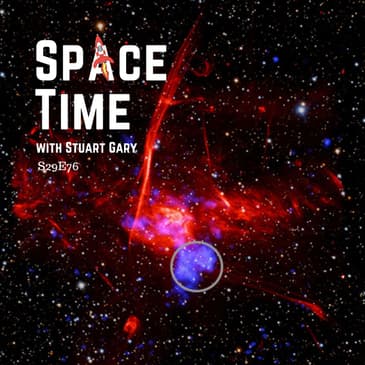


This is Spacetime Series twenty nine, episode seventy six, for broadcast on the twenty sixth of June twenty twenty six. Coming up on space Time, a possible supernova remnant discovered at the center of our galaxy, a new quantum view of the Big Bang, and work begins on a new Western Australian ground station for missions to the Moon. All that and more coming up on space Time. Welcome to space Time with Stuart Gary. Astronomers may have discovered a super nova remnant near the super massive black hole at the center of our galaxy. Super Nova remnants are the expanding remains of exploded stars. They provide elements like i and oxygen and silicon, which are critical for the formation of planets and for life as we know it. Nuclear effusion at the cause of stars creates elements from the hydrogen and helium that were abundant at the beginning of the universe. When massive stars explode at the end of their lives a supernovae, they send out these newly synthesized elements into the interstellar space medium, providing material for future generations of stars and planets. This new superin overrem that, if confirmed, would be one of the nearest ever seen to satur terras a star, the super massive black hole at the center of the Milky Way Galaxy, an exotic region crammed with massive stars, long threads of magnetic fields, and dense clouds of gas, all orbiting rapidly around the galactic center. The new findings reported in the Astrophysical Journal, based on data gathered by NASA's Chandra X ray space telescope, European Space Agencies XMM Mutant Space Telescope, as well as ground based radio observations by the MeCAT telescope in South Africa, and optical images from the Panstar's telescopes in Hawaii, Astronomers detected X rays emanating from a blob buried deep within the large cloud of expanding gas known as an H two region surrounding a massive young star located some twenty six thousand light years away. This BLOB's thought to be the remains of a star that exploded as a supernerva. The surrounding cloud of gas, called Sagittarius Sea, is a bright radio source. It's composed of ionized hydrogen, that is, hydrogen which has had its electron stripped away. If this is indeed a supernova remnant, then it's expanding at well over three million kilometers an hour and is at least one thousand, seven hundred years old. Previous observations had shown evidence of an expanding shell of gas surrounding Sagittarius Sea, and this gave astronomers a hint that a stellar explosion may well have occurred there. An alternative explanation for the X ray blob is that the hot gas comes from a collection of massive stars in the region, but the authors of this study think that's unlikely because the X ray mess from the blob is more than ten times spreader than the X ray emissions from large non stellar clusters with bright massive stars. The authors searched the x ray data look signs of increased amounts of key elements in the remnant, which would have been caused by the supernova blasting them into space. The trouble is they didn't find any, but that could simply imply that the stellar debris already mixed into the surrounding gas. This report from MESSATV. Sagittarius c astronomers may have found a supernova remnant near the Milky Way's center. If confirmed, this would be one of the closest known to the galaxy's giant black hole. NASA's Chandra and ESA's x MM Newton found evidence for this exploded star. Supernova remnants are critical for planets and life as we know it to form and thrive. The discovery is another example of the incredible science still being achieved by NASA's Chandris space telescope. In Florence, Italy. In the year sixteen oh nine, world changed. Using a small telescope, Galileo proved that the Earth is not distinct from the universe, but part of it, and he showed that there is much more to the universe than we see with the naked eye. In the twentieth century, astronomers made another revolutionary discovery that optical telescopes reveal only a portion of the universe. Telescopes sensitive to invisible wavelengths of light have detected microwave radiation from the Big Bang, infra red radiation from protoplanetary discs around stars, and X rays from explosions produced by black holes. We have booster ignition and lipped off. Of Columbia, reaching new height for women X ray astronomy. On July twenty third, nineteen ninety nine, the most powerful X ray telescope ever made began its exploration of the hot the universe. NASA's Chander X ray Observatory in orbit since nineteen ninety nine studies the high energy universe, where black holes, exploded stars, and mysterious matter hold sway. X ray telescopes like Chandra are not like telescopes you find in backyards or at the local observatory. In addition to being above the Earth's atmosphere, they need to have special mirrors to detect the X rays that pass through most objects. Let's listen to scientists Martin Elvis explain more about Chanderis technology. The main thing Chandra does is take these superb shop images. How does it do that? Well. X ray telescopes are different from optical telescopes. They have a very different shape. Well, in fact, they're really reflecting light in just the same way as optical light. It's just that with X rays you have to coax them into being reflected. If you have a normal mirror, you look at yourself in the mirror, and the light's going in and straight back, so it's being bounced through one hundred and eighty If you try that with X rays they just get absorbed, but you can get in specular reflection if you come into the grazing angle of a degree on this. Once you get that specular reflection, X rays act just like optical light. You can concentrate them and. Focus them no problem. Trouble is you're only bending the light through one degree on each reflection. Who we hided up having two reflections in our mirrors. That means that the light's only coming together very very slowly, So we tend out very long telescopes, most of it being just empty space. We're just waiting for the light to converge down to its focus. The bad thing about these mirrors is you're looking almost edge to end on at a cylinder, so the area of glass that the light's reflecting of is only inannulus. It's what we do is pile a whole bunch of telescopes nested one inside the other to build up the area. But basically you still have to polish a hundred times as much glass as you would for a normal optical telescope. So this one point two meter diameter Chandra mirror is focusing light down on to an exquisite point just one thousandth of an inch across. That's why Chandra's power. In addition to its special mirrors, Chander also travels in an unusual orbit around the Earth. Unlike its partner mission, the Hubble Space Telescope, Chander cannot be serviced by astronauts. That's because it does not circle relatively closely to Earth as Hubble does. Martin explains more about why Channer travels in unusual circles, or more accurately, ellipses. Chandra doesn't just go above the atmosphere because a third of the way of the Moon getting well away from the Earth, but can't get above the atmosphere twice, So why do we bother? The ounce is to be much more efficient at observing. It's only a small telescope, and we tend to have to observe a long time. But if we're down where the space station is, then wherever you want to look half the time, the Earth is in the way, not what you want if. You're looking at the next three telescope. So instead, if you can afford the energy to push you way out there, the Earth looks very small, and if you point almost anywhere without getting in the way, that's very useful for many observations, but mainly it doubles the efficiency of chander. Now that we've heard a little about how chander works, to Martin give us an introduction to X rays are produced in the universe. There are three different ways you can get matter to be that hot. One is simply an explosion like soup and ova, such as the one in nineteen eighty seventh, and the large matter l a cloud. What we see there is very fast moving gas that's hit material on the outside is now glowing with a shock at a few million degrees. The next way you can make X rays is a more complicated process, and that's by having very fast moving charged particles in a magnetic field. Basic law of physics is that any charged particle moving in a magnetic field, it's swirl around, and in doing so, it's accelerating around a bend and accelerating charge radiates. It turns out there are lots of places in the universe where we get magnetic fields and very fast moving we call relativistic particles. They're moving very close to the speed of light. The crab nebula, for instance, is powered by a pulsar at the center which has so much energy in it that the little wisps and things you see in the image which look like they're sort of swirling around the nebula, they answer whirling at all. They're moving outwards at extraordinary velocities. This type of X ray making mechanism we find very commonly also in quasars and blazers, which are things with these huge jets that come out maybe many times the size of a whole galaxy, and these are powered in X rays by the same mechanism. The third way of making X rays is perhaps the least likely. It's just dropping something down a hole. If you have a lot of mass somewhere like a planet, or better still, a neutron star or a black hole, and you drop something in, then it speeds up and when it hits the surface or some other gas coming from a different direction, it heats up. A space ship re entering the Earth's atmosphere does the same thing. It starts glowing very hot. Spacecraft is generating heat through friction with the air and slowing down, and that's just transferring the energy of its motion into heating. So it's a very simple process. Really. It just turns out that most of the X ray sources in the sky are powered this way. This is space time still to cam and you quantum view the Big Bang and w now underway on a new Westernstraan ground station for future missions to the Moon. All that and more still to come on space time. A new study could change what science knows about the Big Bang and the earliest moments of cosmic history. The findings, reported in the journal Physical Review Letters, writes a new way to understand how the universe began thirteen point eight billion years ago and how its rapid early expansion known as cosmic inflation, could have arisen naturally from a deeper, more complete theory of quantum gravity. To reach their conclusions, the authors developed a new way to try and combine gravity with quantum physics. Most existing explanations with the Big Bang rely on Albert Einstein's theory of gravity, and while general relativity has been very successful for more than a cent describing the universe on the cosmic scale, it breaks down at the extreme conditions that existed at the birth of the universe. To address this problem, the authors used what they call quadratic quantum gravity, which they say remains mathematically consistent even at extreme high energies similar to the kinds which would have been present during the Big Bang. They claim their approach offers a more unified picture that connects the earliest moments of the universe to the world tested cosmology scientists observed today. They found that the Big Bang's early expansion, this cosmic inflation, can emerge naturally from the simple, consistent theory of quantum gravity without adding any extra ingredients. Now, this early burst of expansions are central idea in modern cosmology that hopes to explain why the universe today looks pretty much the same in all directions. Their model also predicts a minimum amount of primordial gravitational waves, which are tiny ripples in space time geometry created in the first moments after the Big Bang. Now, if we can eventually detect them, these signals would offer a rare chance to test ideas about the universe's quantum origins. The studies lead author Naishaf Shorty from the University of Waterloo, Since the work shows that the universe's exclusive early growth could come directly from a deeper understanding of the theory of gravity itself, instead of adding new pieces to Einstein's theory. The rapid expansion emerges naturally once gravity is treated in a way that remains consistent at extremely high energies have short He says that even though the model deals with incredibly high energies, it leads to clear predictions that today's experiments could already start looking for upcoming galaxy surveys. Cosmic microwave background experiments and gravitational wave detectors are now becoming sensitive enough to test ideas that were once purely theoretical. At the same time, scientists defining limitations to the simplest models of the early Universe's expansion, increasing the need for new approaches grouded in fundamental physics. This space time still to come. Construction begins on a new Western Australian ground station for future missions to the Moon and later in the Science report, Japan sending a transformer robot to the lunar surface. All that and more still to come on space time. Instruction works now begun on Kongsburg's new twenty meter parabolic dish antenna ground station being established at Malowa in outback Western Australia. The company's partnering with Star Site to build and operate the new facility. Four hundred and fifty kilomet is north of Perth. Star site will then manage and maintain the installation, which is designed to support lunar missions. Kongsburg already operates over three hundred antennas at twenty eight sites around the world, including a mid latitude dish at Peterborough in South Australia's mid North that's designed to provide coverage across the entire Oceana region, and a twenty meters antenna optimized for deep space communications at Cojarina east of Geraldon. That cord arena site also houses the classified Australian and US National Security and Defense ground stations as part of the Signals, Intelligence and Eselon Networks Echelon's better known to civilians It's five eyes, This is space time, and time that I take another brief look at some of the other stories making news in science this week. With a science report, American Dutch researchers say a man with severe paralysis and speech difficulties caused by als has been able to use an implanted brain interface to operate a computer and speech system independently now for almost two years. Is the team in planeted electrodes into an area of the man's brain related to speech, which then decoded the data they received into text and cursor control. The man's now used this system for more than three eight hundred hours, communicating over one hundred and eighty three thousand sentences at an average of fifty six words per minute. A report in the journal Nature says research shows that these kinds of brain computer interfaces can be used without the need of assistance and for extended periods of time. Scientists eraising the alarm as a powerful heat wave in Antarctica is continuing to push temperatures up more than twenty degrees celsius above average for this time of year. On June the sixth, researchers at Argentina's s Perenza, based on the Trinity Peninsula, recorded a temperature at fifteen point four degrees celsius, breaking the previous June record by more than two degrees celsius. And you've got to remember, it's the middle of the Southern Hemisphere winter right now. So the anomaly of warm weather soaking the Antarctic peninsula is a clear warning that things simply aren't right. The warmth is linked to stronger westerly winds influenced by climate change. It's triggered rain on glaciers and widespread surface melting during what should be the depths of ANTARCTICUS cold season. At Arctica's ice is critical for global sea surface stability, and scientists are contending to monitor vulnerable areas such as the Sweits Glacier I. Meanwhile, the Colins glaciers already seen warm rain and active melting replace the usually deep snow and solid ice which is normally experienced this time of year. While a single heat wave won't cause antarcticas massive ice sheets to collapse, these extreme warm conditions are becoming more frequent and that's a concern. A new study warns that people who eat more ultra processed foods have a higher risk of heart disease and death. The findings, reported in the European Heart Journal, highlights the risk of obesity, diabetes, hypertension, chronic kidney disease, and death from heart disease, all of which have now been linked to eating large amounts of ultra processed foods. The authors are calling on doctors to talk to their patients about how much ultra processed food they're eating and give advice on how to reduce this intake. A palm sized sphere that can transform into a wheeled robot has been sent to the Moon by JACKSA, the Japan Aerospace Exploration Agency. A report in the journal Science Robotic says the tiny transformers already been active, taking lots of photos while trundling around the insight of its lun Orlando. The images were then transmitted to a second robot, which is designed to move around by hopping from one place to another, and then sent back to Earth. The engineers behind the project say these small light robots would be much easier to send into space and could independently explore cramped regions where bigger, boggier robots simply can't reach. The problem with psychology is everyone's different, so gaining solid insights into the human mind and behavior is difficult now. A report of the General Psychology Today has tried to make sense of a number of high profile tests trying to replicate past results which have failed to yield consistent outcomes. The resulting replication crisis as implications that might not actually reflect real phenomena, and as a result, has an impact on scientists trying to study human behavior. The skeptics ten Mendum says work's now being done to try and get the basics right and find common human characteristics more likely to hold up generally under tighter scrutiny. It psychology. You've got to sort of use the fairly loose definitions of hard and self science, right. The hard science for those things you can empirically test and give a yes or no answer or a replicable answer as well. So, yeah, physic and theology, and then there are the soft sciences, which is a pretty pejorative term, those things which are like sociology and you know, sort of political science and stuff. I mean, medicine can be half and half medicine per se. Obviously you can do a lot of testing and the empirical testing, but there's also the human element. Everyone's had a different life experience, Everybody has different gans, Everybody goes through different things in their lives and have different exposures and as a result suffers from different maladies and conditions and environmental factors. That's right. I mean, there areology, there are some aspects of medicine which you can test in the physical aspect, but yeah, there's a human element which is the variable. Psychology is all human elements and The question is how much testing and replicable testing can you do to move it into the quote hard post quote science sort of category. And there are discussions about that, and it's sort of loved in with sociology and things like that. One of the problems that's the curve actually recently is the reports about the difficulty in replicating past results, and it's finding that many of the studies that people relied on the past do not yield consistent outcomes. Replication is a key part of science. And societal norms are playing a huge role in it. Two we're seeing that with the debate on trans people at the moment where what was psychologically considered a correct response previously is now no longer considered a correct response. Yeah. I mean, there's also all sorts of responses about genetic backgrounds to behavior, various of the behaviors as to what the fount in nature of these things. Is there a testable physical thing or is it a variable, a highly variable thing like psychology. And they're saying that this replication crisis in psychology is that major issue, But then they're also looking at areas well, let's cut it back to those things we can trust, those sort of are pretty reliable. The first one is personality traits are largely stable in adults, where you're not going to change your character that much when you get past of your formative adolescent years. So you can almost think that trying to change someone's personality is going to be pretty difficult. If never changes spots. Yeah, that's right. That's one of the aspects that the people state the saying in their characteristics. Another one is that people are swayed by what they think most of their group thinks. So if they think their group would do this, even if that don't tested, if they think their group would do this, then they tend to go along with it. And that applies in many areas. Applies as science and all sorts of areas which are a bit Softerle's say, people seek in subtle ways to confirm their pretty existing beliefs. This is standard thing you spot in in skeptical areas, confirmation bias, even if there's the evidence is sort of against it. If I want this result to occur, if I expect this results of occur, this is preferable to my life philosophy, I will therefore tend to sort of lean towards it. That's when you reconstruct things to reconstruct the evidence around your belief. There's also people's choices are influenced by how options are framed, and this is classic. Instead of questionnaires and questions and things, you could easily say that this meat contains ten percent fat, but marketers would prefer to say this meat is ninety percent fat free. It sounds a lot better, right, It's the same thing, but it just sounds a lot better. So how you phrase a question, how you phrase the options people have can influence what they believe. And then there's other sort of things that they regard as pretty well agreed to. Some people will refer to authority even that that means hurting a stranger. But that sort of the old electric shock sort of theories, etc. Which were pretty pretty weird. Anyway, people may recall saying something they didn't Well, excuse me, this is skeptical territory through and through you with a lot of things. That's the Mandela thing, isn't it. That's right, that's right. Ther theory then, was that people were convinced that Nelson Mandela die in prison, then they heard about it, they knew when it happened. Is that well, of course he didn't that people were convinced that this was happening and they knew where they were when it happened. A blah blah blah. Memory is a very malleable thing. It's a very unreliable thing, which is why in court cases it's often argued about as to what people really saw and over the years, given immediately, the memory can be tricky. You observe what you remember, and I miss out a lot of other things over the years have totally changed. Discussing it with other people can totally change it as well. But that's one of the things they say is definite. I could have told you that in about five seconds, and the final one day day. This is that the scientific community has some ability to anticipate which findings will hold up. Now, whether they do that professionally or whether they do it from their own confirmation biases is a point. So there are various things, often failings in a way of some of the psychological truths, but these are suggesting that these are the only possible psychological truths that you can rely on, and that makes psychology as a science a bit problematical. And I'm sure there's a lot of people out there who would given psychologists who would agree that there's a lot of rigal worm in scientifics that have proof and that sort of stuff that's caused the problem of the time. Right, how well can you go with those sort of attitudes. That's the skeptggs Timindum, and this is Spacetime and that's the show for now. Space Time is available every Monday, Wednesday and Friday through at bites dot com, SoundCloud, YouTube, your favorite podcast download provider, and from space Time with Stuart Gary dot com. Space Time's also broadcast through the National Science Foundation, on Science Own Radio and on both iHeartRadio and tune In Radio. And you can help to support our show by visiting the space Time Store for a range of promotional merchandising goodies, or by becoming a Spacetime Patron, which gives you access to triple episode commercial free versions of the show, as well as lots of burnus audio content which doesn't go to weir, access to our exclusive Facebook group, and other rewards. Just go to space Time with Steward Gary dot com for full details. You've been listening to space Time with Stuart Garry. This has been another quality podcast production from bytes dot com
🚀 We would love your feedback. How's SpaceTime travelling...love it or hate it, we need to hear it all. Take the 1-minute survey and let us know what you think: Click Here