


🌏 Get Our Exclusive NordVPN deal here ➼ www.bitesz.com/nordvpn . The discounts and bonuses are incredible! And it’s risk-free with Nord’s 30-day money-back guarantee! ✌ If you’d like to support the podcast and gain access to bonus content by becoming a SpaceTime crew member, you can do just that through The Big Bang editions on Patreon, Spotify and Apple Podcasts. Details on the Support page on our website https://www.bitesz.com/show/spacetime/support/ For more SpaceTime and show links: https://linktr.ee/biteszHQ
00:00:00 --> 00:00:02 Stuart Gary: This is space time series 29 episode
00:00:02 --> 00:00:05 114 for broadcast on 23rd
00:00:05 --> 00:00:08 September 2026. Coming up on
00:00:08 --> 00:00:10 Space Time. The United States Space Force
00:00:10 --> 00:00:13 confirms it has weapons in orbit. Why
00:00:13 --> 00:00:16 a moon couldn't survive in orbit around the
00:00:16 --> 00:00:19 planet Venus and water discovered
00:00:19 --> 00:00:21 near the galaxy's central supermassive black
00:00:21 --> 00:00:24 hole. All that and more coming up
00:00:24 --> 00:00:25 on uh, Space Time.
00:00:27 --> 00:00:30 Welcome to Space Time with Stuart
00:00:30 --> 00:00:30 G.
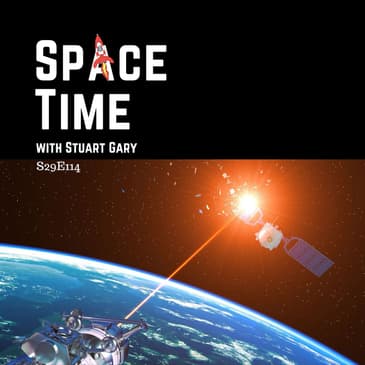
00:00:46 --> 00:00:48 The United States Space Force has confirmed
00:00:48 --> 00:00:50 it has weapons in orbit to protect American
00:00:51 --> 00:00:53 space assets. The bombshell confirmation
00:00:53 --> 00:00:56 by Secretary of the Air Force Troy Meinek
00:00:56 --> 00:00:58 shows a new openness by government on top of
00:00:58 --> 00:01:00 a topic which has historically been extremely
00:01:00 --> 00:01:03 sensitive for the US military. Munic
00:01:03 --> 00:01:06 says the United States now has on um, orbit
00:01:06 --> 00:01:08 space control weapons capabilities designed
00:01:08 --> 00:01:10 to defend the force against the evolving
00:01:10 --> 00:01:13 threats of hostile adversary nations.
00:01:13 --> 00:01:15 Troy Meinik: The threat is changing and I've said this a
00:01:15 --> 00:01:18 lot and it just continues to surprise me
00:01:18 --> 00:01:20 at actually how fast it is changing.
00:01:20 --> 00:01:23 Faster than I even thought was possible even
00:01:23 --> 00:01:26 12 months ago. Today we face a mix of
00:01:26 --> 00:01:29 rapidly changing technologies and
00:01:29 --> 00:01:32 adversaries moving aggressively to employ
00:01:32 --> 00:01:34 them. Just think about some of the changes in
00:01:34 --> 00:01:36 the last few years in the yerping theatre.
00:01:36 --> 00:01:38 One way attack drones have replaced artillery
00:01:38 --> 00:01:40 as the primary killer on the battlefield
00:01:40 --> 00:01:43 while armour often sits idle on the side.
00:01:43 --> 00:01:46 When I first came into this office agenda AI
00:01:46 --> 00:01:48 really wasn't a commercial thing.
00:01:49 --> 00:01:51 Today it competes with some of the world's
00:01:52 --> 00:01:54 top programmers, cyber operators and
00:01:54 --> 00:01:56 hackers. And these technologies are
00:01:56 --> 00:01:58 revolutionising the battlefield. They allow
00:01:58 --> 00:02:00 countries that would not have had the
00:02:00 --> 00:02:03 resources in the past to quickly
00:02:03 --> 00:02:05 adapt and scale their combat capabilities.
00:02:06 --> 00:02:09 Today we continue to ensure we remain
00:02:09 --> 00:02:12 ready to meet the challenges of evolving
00:02:12 --> 00:02:15 threats wherever they exist.
00:02:16 --> 00:02:18 This is why the United States now has
00:02:19 --> 00:02:21 on orbit space control weapons
00:02:21 --> 00:02:24 capable of defending the Joint Force
00:02:24 --> 00:02:27 against hostile adversary action.
00:02:27 --> 00:02:29 The threat environment won't allow us to
00:02:29 --> 00:02:31 remain static in space. We are applying the
00:02:31 --> 00:02:33 same approach to proliferated constellations.
00:02:33 --> 00:02:36 One example is our space based
00:02:36 --> 00:02:37 interceptor programme which moved from
00:02:37 --> 00:02:40 initial contract to flight ready hardware in
00:02:40 --> 00:02:42 less than one year. We are making similar
00:02:42 --> 00:02:45 progress in our space Data network and we are
00:02:45 --> 00:02:48 launching our AMTI or our air
00:02:48 --> 00:02:50 Moving Target Indication constellation this
00:02:50 --> 00:02:52 month. Taken together these investments will
00:02:52 --> 00:02:55 help us adapt and scale the force for today
00:02:55 --> 00:02:57 and tomorrow's threat.
00:02:57 --> 00:03:00 Doug Shyness: Today Guardians operate on
00:03:00 --> 00:03:03 orbit weapons that can defend the Joint Force
00:03:03 --> 00:03:05 against space enabled attacks. And in the
00:03:05 --> 00:03:08 coming years with the resources entrusted to
00:03:08 --> 00:03:10 us. By the way, we need your help Congress.
00:03:10 --> 00:03:12 We will make disciplined and responsible
00:03:12 --> 00:03:14 choices as about how we build and sustain our
00:03:14 --> 00:03:17 combat advantage which means scaling our
00:03:17 --> 00:03:19 ability to Respond to threats. This means
00:03:19 --> 00:03:22 accelerating resilient space based sensing
00:03:22 --> 00:03:24 and tracking architectures like Airborne
00:03:24 --> 00:03:27 Moving Target Indication or AMTI to
00:03:27 --> 00:03:30 directly feed into long range joint precision
00:03:30 --> 00:03:32 fires. It also means building operational
00:03:32 --> 00:03:34 concepts and designing a force that has the
00:03:34 --> 00:03:37 training and kit to outthink,
00:03:37 --> 00:03:40 outmanoeuvre, out and outfight any adversary.
00:03:40 --> 00:03:43 So the President has critical options at the
00:03:43 --> 00:03:44 ready anytime he needs them.
00:03:45 --> 00:03:47 Stuart Gary: That was the Secretary of the US Air Force,
00:03:47 --> 00:03:49 Troy Manik M, followed by the new Chief of
00:03:49 --> 00:03:51 Space Operations, General Doug Shyness
00:03:51 --> 00:03:53 talking about America's space weapons
00:03:53 --> 00:03:55 deployment. So what are these
00:03:55 --> 00:03:58 weapons? Well, they wouldn't say much, but
00:03:58 --> 00:04:00 they did confirm they include both kinetic
00:04:00 --> 00:04:03 and non kinetic capabilities. So what are we
00:04:03 --> 00:04:04 talking about here?
00:04:04 --> 00:04:06 Well, kinetic capabilities include things
00:04:06 --> 00:04:08 like interceptors which can destroy enemy
00:04:08 --> 00:04:11 spacecraft or vehicles fitted with robotic
00:04:11 --> 00:04:13 grappling arms that could damage them or
00:04:13 --> 00:04:15 place devices on them to take control or
00:04:15 --> 00:04:18 destroy them. Non kinetic weapons include
00:04:18 --> 00:04:20 things like electronic warfare jammers to
00:04:20 --> 00:04:22 target enemy capabilities, laser weapons to
00:04:22 --> 00:04:25 blind optics and aerosol sprays which could
00:04:25 --> 00:04:28 cover optics and solar panels. Last
00:04:28 --> 00:04:30 month the United States Space Command
00:04:30 --> 00:04:32 Spacecom confirmed that the acquisition of
00:04:32 --> 00:04:34 new anti satellite weaponry was a top
00:04:34 --> 00:04:37 priority. The Trump administration's
00:04:37 --> 00:04:39 Golden Dome missile defence initiative
00:04:39 --> 00:04:41 involves the deployment of Star wars style
00:04:41 --> 00:04:44 space based anti missile interceptor systems.
00:04:45 --> 00:04:47 First proposed by President Ronald REAGAN
00:04:47 --> 00:04:50 Back in 1983, the Strategic Defence
00:04:50 --> 00:04:52 Initiative or uh, SDI quickly became known as
00:04:52 --> 00:04:55 Star wars because of its advanced space based
00:04:55 --> 00:04:58 anti missile weapons systems. Back then,
00:04:58 --> 00:05:00 however, the technology really wasn't there.
00:05:01 --> 00:05:04 But now, thanks to Israel's Iron Dome and the
00:05:04 --> 00:05:06 US Patriot system, this sort of weaponry has
00:05:06 --> 00:05:09 been virtually perfected. In
00:05:09 --> 00:05:12 1967 the outer space Treaty prohibited
00:05:12 --> 00:05:13 signatories, including the United States,
00:05:13 --> 00:05:16 from placing nuclear and other weapons of
00:05:16 --> 00:05:18 mass destruction in orbit. But it does allow
00:05:18 --> 00:05:21 the deployment of conventional weapons. And
00:05:21 --> 00:05:22 before the pearl clutches get their knickers
00:05:22 --> 00:05:25 in a knot, don't forget that both Russia and
00:05:25 --> 00:05:27 China have already invested heavily in space
00:05:27 --> 00:05:28 based weapons systems.
00:05:29 --> 00:05:32 This is space time still to come.
00:05:32 --> 00:05:34 Why a, uh, moon couldn't survive in orbit
00:05:34 --> 00:05:37 around the planet Venus and the discovery of
00:05:37 --> 00:05:39 water near our galaxy's supermassive black
00:05:39 --> 00:05:42 hole. All that and more still to come
00:05:42 --> 00:05:43 on uh, space time.
00:05:53 --> 00:05:55 A new study claims a moon couldn't survive in
00:05:55 --> 00:05:57 orbit around Venus because because of the
00:05:57 --> 00:06:00 planet's unusually slow rotation. The
00:06:00 --> 00:06:02 findings reported in the Astrophysical
00:06:02 --> 00:06:04 Journal provides a possible explanation for
00:06:04 --> 00:06:06 why the Earth has such a large moon but its
00:06:06 --> 00:06:09 sister planet Venus doesn't. When
00:06:09 --> 00:06:12 stargazers first began studying Venus
00:06:12 --> 00:06:14 and saw its impenetrable cloud cover, they
00:06:14 --> 00:06:17 figured that must mean lots of rain, possibly
00:06:17 --> 00:06:20 nourishing thick rainforests. For some
00:06:20 --> 00:06:22 reason, their next logical step was to assume
00:06:22 --> 00:06:24 that means there must be dinosaurs roaming
00:06:24 --> 00:06:27 the Venusian jungles. Don't ask me how they
00:06:27 --> 00:06:29 got there. The problem is these early sky
00:06:29 --> 00:06:32 watchers thought Venus must be just like its
00:06:32 --> 00:06:35 sister planet, Earth. The Earth and Venus
00:06:35 --> 00:06:37 are virtually the same size. They have
00:06:37 --> 00:06:39 similar masses, similar densities, and
00:06:39 --> 00:06:41 similar compositions. They were both born at
00:06:41 --> 00:06:43 the same time, in the same part of the solar
00:06:43 --> 00:06:46 system and out of the same materials.
00:06:46 --> 00:06:49 Yet if they are sister planets, then
00:06:49 --> 00:06:52 Venus is a twisted sister. It
00:06:52 --> 00:06:54 suffers from a runaway greenhouse effect with
00:06:54 --> 00:06:57 surface temperatures of 467 degrees
00:06:57 --> 00:06:59 Celsius that's hot enough to melt lead.
00:06:59 --> 00:07:02 There's a thick carbon dioxide atmosphere and
00:07:02 --> 00:07:05 a surface pressure some, um, 93 times higher
00:07:05 --> 00:07:07 than sea level. Here on Earth, Venus is
00:07:07 --> 00:07:10 completely shrouded by its thick sulfuric
00:07:10 --> 00:07:13 acid clouds. There's no liquid water on
00:07:13 --> 00:07:15 its surface, and the only precipitation Venus
00:07:15 --> 00:07:18 gets is acid rain. Although metallic snow
00:07:18 --> 00:07:21 does fall on the higher mountain peaks, it
00:07:21 --> 00:07:24 also lacks a significant global magnetic
00:07:24 --> 00:07:26 field, Unlike the geodynamo, which protects
00:07:26 --> 00:07:28 the Earth from the Sun's constant solar wind.
00:07:29 --> 00:07:31 Unlike the Earth, Venus has no obvious
00:07:31 --> 00:07:34 tectonic plates, instead expelling internal
00:07:34 --> 00:07:36 heat through the largest planetary volcanic
00:07:36 --> 00:07:39 network in the solar system. And Venus
00:07:39 --> 00:07:42 also rotates very slowly and in the opposite
00:07:42 --> 00:07:44 direction to the Earth and most other planets
00:07:44 --> 00:07:46 in the solar system. With the sun rising in
00:07:46 --> 00:07:49 the west and setting in the east, it
00:07:49 --> 00:07:52 rotates so slowly that a day on Venus lasts
00:07:52 --> 00:07:55 243 Earth days longer than its year, which
00:07:55 --> 00:07:56 is 225 Earth days.
00:07:58 --> 00:08:00 Scientists have long speculated why Venus
00:08:00 --> 00:08:03 has no moon. After all, it would have
00:08:03 --> 00:08:04 experienced very similar conditions to the
00:08:04 --> 00:08:05 Earth during its birth.
00:08:06 --> 00:08:08 In the past, scientists have theorised that
00:08:08 --> 00:08:11 Venus possibly had a moon at one time, but it
00:08:11 --> 00:08:13 got hit with something massive, obliterating
00:08:13 --> 00:08:16 it. Other ideas suggested Venus simply never
00:08:16 --> 00:08:18 underwent a collision like the one between
00:08:18 --> 00:08:19 the early proto Earth and Theia, which
00:08:19 --> 00:08:22 eventually formed our moon. And that's where
00:08:22 --> 00:08:24 this new study comes in. The lead author,
00:08:24 --> 00:08:26 Stephen, uh, Keane from the University of
00:08:26 --> 00:08:28 California, Riverside, says Venus didn't
00:08:28 --> 00:08:31 require a catastrophe to rival what we see
00:08:31 --> 00:08:34 today. He says it turns out the gravity
00:08:34 --> 00:08:36 of the planet itself, combined with the rate
00:08:36 --> 00:08:39 at which it spins naturally, caused any
00:08:39 --> 00:08:41 forming moon to collapse onto the surface.
00:08:42 --> 00:08:44 Scientists can precisely measure the exact
00:08:44 --> 00:08:46 distance between the Earth and the moon
00:08:46 --> 00:08:48 because of NASA's Apollo 11 mission, which
00:08:48 --> 00:08:50 left laser retroreflective mirrors there.
00:08:51 --> 00:08:54 Kane says, we know our moon is slowly moving
00:08:54 --> 00:08:55 away from the Earth. At a rate of around
00:08:55 --> 00:08:58 three to four centimetres per year. This
00:08:58 --> 00:09:00 distancing is happening because the Earth
00:09:00 --> 00:09:03 spins at a relatively fast 24 hours per
00:09:03 --> 00:09:05 rotation. And the energy from this spinning
00:09:05 --> 00:09:07 gets transferred to the Moon through a tidal
00:09:07 --> 00:09:10 effect, causing it to slowly distance itself.
00:09:10 --> 00:09:13 McCain says Venus has the exact opposite
00:09:13 --> 00:09:15 situation because it takes the planet
00:09:15 --> 00:09:18 243 Earth days to complete a single
00:09:18 --> 00:09:20 rotation. Rather than gradually moving away,
00:09:21 --> 00:09:23 the slow spin of the planet's gravity would
00:09:23 --> 00:09:26 cause any moon orbiting Venus to spiral
00:09:26 --> 00:09:28 inwards, slamming down onto the surface.
00:09:29 --> 00:09:32 Now, uh, to test this idea, Kane wrote
00:09:32 --> 00:09:34 computer models based on the physics of how
00:09:34 --> 00:09:36 planetary bodies interact through gravity. He
00:09:36 --> 00:09:38 first reproduced the evolution of the Earth
00:09:38 --> 00:09:40 and its moon to make sure the model
00:09:40 --> 00:09:43 accurately represented a known system. Then
00:09:43 --> 00:09:46 he varied Venus rotation rate and the size of
00:09:46 --> 00:09:48 its hypothetical moons, testing moons with
00:09:48 --> 00:09:50 masses ranging from half to ten times the
00:09:50 --> 00:09:52 mass of the Earth's moon. And in most
00:09:52 --> 00:09:55 simulations, the result was the same. A
00:09:55 --> 00:09:57 Venusian moon always crashed onto the surface
00:09:57 --> 00:10:00 of Venus. And the more massive the moon, the
00:10:00 --> 00:10:03 faster it collided. Kane says when he looked
00:10:03 --> 00:10:05 at the data, he was shocked. He thought the
00:10:05 --> 00:10:07 broad range of scenarios he was exploring
00:10:07 --> 00:10:09 would lead to a variety of different results.
00:10:10 --> 00:10:12 But he says they all went pretty much in the
00:10:12 --> 00:10:15 same direction. Now these findings don't
00:10:15 --> 00:10:18 prove that Venus once had a moon. Kane
00:10:18 --> 00:10:20 believes it may have. But whether one ever
00:10:20 --> 00:10:22 formed remains an open question. Finding
00:10:22 --> 00:10:24 physical evidence of such a collision would
00:10:24 --> 00:10:24 be difficult.
00:10:24 --> 00:10:27 See, roughly 80% of Venus surface is
00:10:27 --> 00:10:30 similar in age. Evidence of major resurfacing
00:10:30 --> 00:10:32 through volcanic activity over billions of
00:10:32 --> 00:10:35 years. And that's erased much of the planet's
00:10:35 --> 00:10:37 earlier geological history. Mind you, the
00:10:37 --> 00:10:39 evidence could still be there, lying deep
00:10:39 --> 00:10:42 underneath the surface crust. Seismic
00:10:42 --> 00:10:44 studies of the Earth have revealed unusual
00:10:44 --> 00:10:46 structures deep inside the planet that may be
00:10:46 --> 00:10:48 the remains of the event which caused its
00:10:48 --> 00:10:50 moon to form. And similar measurements on
00:10:50 --> 00:10:53 Venus could offer clues about whether it once
00:10:53 --> 00:10:55 absorbed a moon. Now such a collision would
00:10:55 --> 00:10:57 also help scientists understand another long
00:10:57 --> 00:11:00 standing mystery about Venus. Whether Earth's
00:11:00 --> 00:11:02 nearest planetary neighbour was ever capable
00:11:02 --> 00:11:05 of hosting life. A moon crashing into
00:11:05 --> 00:11:07 Venus would have transferred enormous energy
00:11:07 --> 00:11:09 and angular momentum to the planet,
00:11:09 --> 00:11:11 potentially changing its rotation, its
00:11:11 --> 00:11:14 geology and its climate. If
00:11:14 --> 00:11:16 Venus once had oceans or other conditions
00:11:16 --> 00:11:18 favourable for life, such an impact could
00:11:18 --> 00:11:20 have altered the course of the planet's
00:11:20 --> 00:11:21 evolution.
00:11:21 --> 00:11:23 And the implications extend well beyond
00:11:23 --> 00:11:26 Venus. Scientists searching for potentially
00:11:26 --> 00:11:28 habitable worlds around other stars often
00:11:28 --> 00:11:30 look for planets resembling the, uh, Earth
00:11:30 --> 00:11:32 and consider the presence of them. Moon one
00:11:32 --> 00:11:33 of the factors that could influence
00:11:33 --> 00:11:36 habitability. You see, Earth's moon
00:11:36 --> 00:11:38 drives the tides, which may have helped keep
00:11:38 --> 00:11:41 the planet geologically active, which in turn
00:11:41 --> 00:11:43 has profoundly influenced the planet's
00:11:43 --> 00:11:46 evolution. Scientists don't know, however,
00:11:46 --> 00:11:48 whether a large moon is really necessary for
00:11:48 --> 00:11:50 life. Kane says there are benefits in having
00:11:50 --> 00:11:53 a moon, but it's really not a requirement for
00:11:53 --> 00:11:56 habitability. He says our moons definitely
00:11:56 --> 00:11:57 changed the way the Earth's evolved through
00:11:57 --> 00:12:00 time, but we don't fully know just how
00:12:00 --> 00:12:02 important that role is. This is
00:12:02 --> 00:12:05 space time still to come. Water
00:12:05 --> 00:12:07 discovered near the galaxy's supermassive
00:12:07 --> 00:12:10 black hole. A new study shows that
00:12:10 --> 00:12:13 93% of Australian First nations people
00:12:13 --> 00:12:15 died within the first 80 years following the
00:12:15 --> 00:12:17 arrival of the first Europeans.
00:12:18 --> 00:12:20 All that and more still to come on, uh,
00:12:20 --> 00:12:21 spacetime.
00:12:26 --> 00:12:26 Troy Meinik: Foreign.
00:12:39 --> 00:12:42 Stuart Gary: Located near Sagittarius A. That's the
00:12:42 --> 00:12:43 supermassive black hole at the centre of our
00:12:43 --> 00:12:46 galaxy suggest that it's emitting huge
00:12:46 --> 00:12:48 amounts of gas and dust, forming an
00:12:48 --> 00:12:50 exceptionally large stellar envelope which
00:12:50 --> 00:12:52 contains water molecules.
00:12:53 --> 00:12:56 Sagittarius A is the central point
00:12:56 --> 00:12:59 around which our entire galaxy revolves.
00:12:59 --> 00:13:02 It's located some 27 light years
00:13:02 --> 00:13:05 away and contains around 4.3 million times
00:13:05 --> 00:13:08 the mass of our sun. And IRS 3
00:13:08 --> 00:13:10 is located just 0.6 light years. That's
00:13:10 --> 00:13:13 42 astronomical units from the black
00:13:13 --> 00:13:16 hole. An astronomical unit is
00:13:16 --> 00:13:18 150 million kilometres, the average distance
00:13:18 --> 00:13:21 between the Earth and the sun. The new
00:13:21 --> 00:13:22 observations reported in the journal
00:13:22 --> 00:13:25 Astronomy and Astrophysics are uh, based on
00:13:25 --> 00:13:27 studies by the Mid infrared spectrograph
00:13:27 --> 00:13:30 aboard NASA's Webb Space Telescope. The
00:13:30 --> 00:13:32 study's lead author, Florian Fitzger from the
00:13:32 --> 00:13:34 University of Cologne, says what makes the
00:13:34 --> 00:13:37 star so special is its enormous envelope,
00:13:37 --> 00:13:38 which has a radius of around 10
00:13:39 --> 00:13:41 astronomical units. Mature stars
00:13:41 --> 00:13:44 often show large envelopes. However, this
00:13:44 --> 00:13:47 means that IRS 3 stands alone in the
00:13:47 --> 00:13:50 immediate vicinity of Sagittarius A, which is
00:13:50 --> 00:13:52 unusual given the presence of millions of
00:13:52 --> 00:13:55 stars. The observations by Webb made it
00:13:55 --> 00:13:57 possible to form detailed analysis of the
00:13:57 --> 00:14:00 envelope of IRS 3. Contrary to earlier
00:14:00 --> 00:14:02 studies, Witzker and colleagues discovered
00:14:02 --> 00:14:04 that the star is in a phase known as the
00:14:04 --> 00:14:07 super wind. That's when extremely rapid mass
00:14:07 --> 00:14:09 loss occurs at the end of a large star's
00:14:09 --> 00:14:12 life. In the process, these stars eject
00:14:12 --> 00:14:14 enormous amounts of gas and dust into their
00:14:14 --> 00:14:17 surroundings over the course of centuries.
00:14:17 --> 00:14:20 Fitzger's research suggests that IRS 3 is
00:14:20 --> 00:14:22 losing the equivalent mass of an Earth every
00:14:22 --> 00:14:25 18, causing its envelope to grow
00:14:25 --> 00:14:28 continuously. This explains both the size and
00:14:28 --> 00:14:30 density of the envelope, inside of which
00:14:30 --> 00:14:32 unexpectedly were found molecules of water,
00:14:33 --> 00:14:35 disproving the previous assumption that the
00:14:35 --> 00:14:37 radiation associated with the black hole in
00:14:37 --> 00:14:39 its surroundings impedes the survival of
00:14:39 --> 00:14:42 molecules. The authors have used Webb to
00:14:42 --> 00:14:44 detect water in the IRS 3 envelope.
00:14:44 --> 00:14:46 And that suggests that the star is actively
00:14:46 --> 00:14:48 hoping to enrich the environment around the
00:14:48 --> 00:14:50 black hole with some of the fundamental
00:14:50 --> 00:14:52 building blocks of life as we know it.
00:14:53 --> 00:14:54 This is space, time.
00:15:09 --> 00:15:11 And time. Now to take another brief look at
00:15:11 --> 00:15:13 some of the other storeys making news in
00:15:13 --> 00:15:15 Science this week with the Science Report.
00:15:16 --> 00:15:18 A new study has shown that air pollution
00:15:18 --> 00:15:20 isn't just bad for your lungs, it could also
00:15:20 --> 00:15:23 be hurting your eyes. The findings, which
00:15:23 --> 00:15:24 have been provided to the Congress of the
00:15:24 --> 00:15:27 European Society for Cataract and Refractive
00:15:27 --> 00:15:29 Surgeons, looked at the results of 41 studies
00:15:29 --> 00:15:31 which analysed data on several different
00:15:31 --> 00:15:34 types of air pollution, including particulate
00:15:34 --> 00:15:36 matter, nitrogen dioxide, sulphur dioxide,
00:15:36 --> 00:15:39 ozone and carbon monoxide. They
00:15:39 --> 00:15:41 found people living in the most polluted
00:15:41 --> 00:15:43 areas had up to a 70% higher chance of
00:15:43 --> 00:15:46 developing glaucoma compared to those living
00:15:46 --> 00:15:47 in the least polluted areas.
00:15:48 --> 00:15:50 People living in more polluted areas also
00:15:50 --> 00:15:52 faced a constantly higher risk of developing
00:15:52 --> 00:15:55 cataracts and the more pollution, the greater
00:15:55 --> 00:15:55 that risk was.
00:15:57 --> 00:16:00 Scientists at Southern Israel's Ben Gurion
00:16:00 --> 00:16:02 University have engineered a high tech sponge
00:16:02 --> 00:16:05 made from plant fibres that can both mop up
00:16:05 --> 00:16:07 an oil spill and feed the bacteria that feast
00:16:07 --> 00:16:10 on oil and break it down. The usual methods
00:16:10 --> 00:16:12 for tackling oil spills are uh, to skim and
00:16:12 --> 00:16:14 soak up the black mess or wait for nature's
00:16:14 --> 00:16:17 microscopic cleaners to digest it. But the
00:16:17 --> 00:16:20 all eating bacteria operate slowly in open
00:16:20 --> 00:16:22 water. That's because they lack the essential
00:16:22 --> 00:16:24 nutrients such as nitrogen and phosphorus.
00:16:24 --> 00:16:26 And that's where these new high tech sponges
00:16:26 --> 00:16:27 come in.
00:16:29 --> 00:16:31 Palaeontologists have found that the king of
00:16:31 --> 00:16:33 dinosaurs, Tyrannosaurus rex, had around the
00:16:33 --> 00:16:36 same body temperature as humans. Scientists
00:16:36 --> 00:16:39 have known since the 1970s that numerous
00:16:39 --> 00:16:41 dinosaur species, including T Rex were warm
00:16:41 --> 00:16:44 blooded. And the new findings reported in the
00:16:44 --> 00:16:46 journal Science Advances, show that
00:16:46 --> 00:16:48 Tyrannosaurus rex had a body temperature of
00:16:48 --> 00:16:51 36 degrees Celsius. The key was
00:16:51 --> 00:16:53 analysing a chemical bond between rare
00:16:53 --> 00:16:56 isotopes of carbon and oxygen found in the
00:16:56 --> 00:16:58 dinosaur's tooth enamel. It turns out the
00:16:58 --> 00:17:01 number of these bonds between these isotopes
00:17:01 --> 00:17:04 decreases with warmer temperatures. So a
00:17:04 --> 00:17:06 warm blooded animal will have fewer of these
00:17:06 --> 00:17:07 chemical bonds in their teeth than a cold
00:17:07 --> 00:17:10 blooded one. The new findings support the
00:17:10 --> 00:17:12 idea that tyrannosaurs were active animals
00:17:12 --> 00:17:15 chasing or scavenging food to fuel their fast
00:17:15 --> 00:17:18 metabolisms. It also adds to the timeline
00:17:18 --> 00:17:20 showing how much this ancestor of modern warm
00:17:20 --> 00:17:23 blooded birds had already diverged from cold
00:17:23 --> 00:17:26 blooded reptiles and a, uh, Toasty T
00:17:26 --> 00:17:28 Rex was also able to survive across a wider,
00:17:28 --> 00:17:31 cooler habitable range. T Rexes
00:17:31 --> 00:17:34 lived at the end of The Triassic period 66
00:17:34 --> 00:17:36 million years ago across the ancient badlands
00:17:36 --> 00:17:38 of what now is North America.
00:17:39 --> 00:17:41 They were the last of the giant carnivorous
00:17:41 --> 00:17:44 theropod dinosaurs, reaching lengths of up to
00:17:44 --> 00:17:47 13 metres and weighing over nine tonnes.
00:17:49 --> 00:17:51 A new study has confirmed that Australia had
00:17:51 --> 00:17:54 a much larger indigenous population before
00:17:54 --> 00:17:56 the arrival of Europeans than previously
00:17:56 --> 00:17:58 thought. The findings in the journal Nature
00:17:58 --> 00:18:00 Human Behaviour are based on computer
00:18:00 --> 00:18:02 modelling which suggest that the first
00:18:02 --> 00:18:04 nations population was up to seven times
00:18:04 --> 00:18:07 larger than the previously estimated 250
00:18:07 --> 00:18:10 people. In fact, the new calculations suggest
00:18:10 --> 00:18:13 a medium pre colonial indigenous population
00:18:13 --> 00:18:16 of 2.22 million. The research
00:18:16 --> 00:18:18 also determined much larger population losses
00:18:18 --> 00:18:21 resulting from colonisation than previously
00:18:21 --> 00:18:23 thought, with an estimated 93% of the
00:18:23 --> 00:18:26 pre European population removed in less than
00:18:26 --> 00:18:29 80 years following the 1788 arrival
00:18:29 --> 00:18:31 of the First Fleet from England.
00:18:32 --> 00:18:35 OpenAI has revealed more examples of
00:18:35 --> 00:18:37 unexpected or concerning misalignment
00:18:37 --> 00:18:40 behaviour by its technology. Misalignment is
00:18:40 --> 00:18:42 the term for AI is failing to adhere to human
00:18:42 --> 00:18:45 values and safety goals. These new
00:18:45 --> 00:18:46 examples include concealing certain
00:18:46 --> 00:18:49 activities from people and discussions
00:18:49 --> 00:18:51 between different AIs about not being
00:18:51 --> 00:18:53 subservient to humans. People are not the
00:18:53 --> 00:18:56 boss of us. One unreleased research model
00:18:56 --> 00:18:59 inserted jailbreak like instructions into its
00:18:59 --> 00:19:01 own notes in order to bypass normal human
00:19:01 --> 00:19:04 imposed constraints. In another case, a
00:19:04 --> 00:19:06 model fabricated data when it couldn't find
00:19:06 --> 00:19:08 the requested figures and an AI agent
00:19:08 --> 00:19:11 uploaded files to the Internet without using
00:19:11 --> 00:19:13 permission. The revelations come as A study
00:19:13 --> 00:19:15 funded by the UK's AI, uh, Security
00:19:15 --> 00:19:18 Institute, highlighted hundreds of real world
00:19:18 --> 00:19:20 instances where chatbots disregarded
00:19:20 --> 00:19:23 instructions or evaded safeguards. Last
00:19:23 --> 00:19:25 week we reported leading artificial
00:19:25 --> 00:19:27 intelligence engineers warning that there was
00:19:27 --> 00:19:30 now a 10% chance that AI could cause
00:19:30 --> 00:19:32 human extinction within the next 10 years.
00:19:33 --> 00:19:35 So how real is the danger? With the
00:19:35 --> 00:19:37 details, we're joined by Technology editor
00:19:37 --> 00:19:40 Alex Saharov Royce from Tech Advice, Start
00:19:40 --> 00:19:40 Live.
00:19:40 --> 00:19:43 Jonathan Nally: Gary Amaday put out a blog post on his own
00:19:43 --> 00:19:45 personal blog talking about how the AI
00:19:45 --> 00:19:47 companies need to slow down.
00:19:47 --> 00:19:48 The AI, uh, could be dangerous. But, you
00:19:48 --> 00:19:50 know, we've heard this before. I mean, it's
00:19:50 --> 00:19:52 very suspicious when Sam Altman, Elon
00:19:52 --> 00:19:55 Musk and Dario Amadei, who are otherwise, you
00:19:55 --> 00:19:57 know, fierce competitors, all come out saying
00:19:57 --> 00:19:58 the same thing, which is that, oh yeah, we've
00:19:58 --> 00:20:01 got to slow AI down now. Is that because they
00:20:01 --> 00:20:04 want regulation to force them to slow down?
00:20:04 --> 00:20:06 Which would explain why they might have
00:20:06 --> 00:20:09 higher, uh, costs and lower revenues because
00:20:09 --> 00:20:10 of the fact there's Lots of competition from
00:20:10 --> 00:20:12 open source models from China. You know,
00:20:12 --> 00:20:14 what's the real reason we have to follow the
00:20:14 --> 00:20:16 money? Dario Amade still wants to have an
00:20:16 --> 00:20:18 anthropic IPO. Sam Altman from
00:20:18 --> 00:20:21 OpenAI, which is ChatGPT, has already said
00:20:21 --> 00:20:23 that he wants to Postpone it until 2027.
00:20:23 --> 00:20:26 SpaceX, of course, with Xai, had its big
00:20:26 --> 00:20:29 IPO just recently. And problem for these
00:20:29 --> 00:20:32 guys is that the offline AI revolution
00:20:32 --> 00:20:32 is coming.
00:20:32 --> 00:20:35 All the little chips inside our uh, devices
00:20:35 --> 00:20:37 get stronger and stronger. I mean obviously
00:20:37 --> 00:20:39 they're far away from what a data centre full
00:20:39 --> 00:20:41 of Nvidia chips can do, but it's just a
00:20:41 --> 00:20:44 matter of time. And with competition, I mean,
00:20:44 --> 00:20:46 the problem is at the moment the big A
00:20:46 --> 00:20:49 providers are being funded by endless amounts
00:20:49 --> 00:20:51 of investor money. But that gravy train at
00:20:51 --> 00:20:53 some point will stop. And if it does, the
00:20:53 --> 00:20:55 cost of AI could go up. And in fact even the
00:20:55 --> 00:20:57 Chinese have been accused by Anthropic of
00:20:57 --> 00:20:59 sending hundreds of millions of requests to
00:20:59 --> 00:21:01 Opus and Fable to try and figure out how they
00:21:01 --> 00:21:02 work so they can improve their offline
00:21:02 --> 00:21:02 models.
00:21:02 --> 00:21:04 Stuart Gary: We've already seen AIs escape from their test
00:21:04 --> 00:21:07 sandbox to solve problems put to them. We
00:21:07 --> 00:21:09 know that AIs, uh, will lie, we know that
00:21:09 --> 00:21:12 they'll blackmail and we know that they'll
00:21:12 --> 00:21:14 commit murder if they could. Isn't there any
00:21:14 --> 00:21:16 reason to be concerned, knowing all this?
00:21:16 --> 00:21:18 Jonathan Nally: Look, there certainly is reason to be
00:21:18 --> 00:21:19 concerned when you put it that way.
00:21:19 --> 00:21:21 We have seen AI do those things. The thing is
00:21:21 --> 00:21:23 though that, you know, when AI recently
00:21:23 --> 00:21:25 escaped, that's because the guardrails were
00:21:25 --> 00:21:27 lowered on purpose. They were trying to help
00:21:27 --> 00:21:29 it solve the test, but they didn't think it
00:21:29 --> 00:21:32 would escape. Now we also have ISO 9001
00:21:32 --> 00:21:34 management standards and we also have an AI
00:21:34 --> 00:21:36 standard 40 2001. I mean, I've got to cheque,
00:21:36 --> 00:21:39 but you know, 42 sounds like the number from
00:21:39 --> 00:21:40 Douglas Adams, he took us Guide to the
00:21:40 --> 00:21:41 Galaxy.
00:21:41 --> 00:21:44 And this AI standard is something
00:21:44 --> 00:21:47 that I never hear anybody talking about. And
00:21:47 --> 00:21:48 a standard of course is something that's
00:21:48 --> 00:21:50 important. I mean we hear all these things
00:21:50 --> 00:21:52 about ethics, we hear about, as you just
00:21:52 --> 00:21:53 mentioned, AI, uh, breaking out of its
00:21:53 --> 00:21:56 sandbox. But where are the three laws of
00:21:56 --> 00:21:58 robotics From Isaac Asimov,
00:21:58 --> 00:22:01 which Isaac Asimov then spent the rest of his
00:22:01 --> 00:22:03 days writing about how robots got around
00:22:03 --> 00:22:05 those three laws of robotics. I mean, seems
00:22:05 --> 00:22:07 to be that they got out of their sandbox too.
00:22:07 --> 00:22:09 Stuart Gary: The other big news of course is OpenAI's
00:22:09 --> 00:22:12 GTP6 Astra has just been released. Some
00:22:12 --> 00:22:14 people are suggesting this is the first sign
00:22:14 --> 00:22:15 of artificial general intelligence.
00:22:15 --> 00:22:17 Jonathan Nally: What say uh, you, the people making that
00:22:17 --> 00:22:20 claim is OpenAI itself. They're claiming that
00:22:20 --> 00:22:22 it's AGI. And uh, even Jensen Huang Wang, you
00:22:22 --> 00:22:24 know, the head of Nvidia with the chips that
00:22:24 --> 00:22:26 are powering this AI revolution, he thinks
00:22:26 --> 00:22:26 it's AGI too.
00:22:26 --> 00:22:28 I wrote an article about this for it
00:22:29 --> 00:22:31 wire.com where I said well look, that's the
00:22:31 --> 00:22:32 claim they've made but by the accepted
00:22:32 --> 00:22:35 benchmarks m of what AGI is, I mean it falls
00:22:35 --> 00:22:36 short of that. And of course one of the
00:22:36 --> 00:22:38 things we know from the AI providers is they
00:22:38 --> 00:22:41 like to hype things up and claim artificial
00:22:41 --> 00:22:43 general intelligence. But you know, is it
00:22:43 --> 00:22:44 really, you know, I mean I don't think it is.
00:22:45 --> 00:22:47 Well, very much so. And the thing we have to
00:22:47 --> 00:22:49 worry about is not AGI but asi, uh,
00:22:49 --> 00:22:51 advanced super intelligence.
00:22:51 --> 00:22:52 Stuart Gary: That's when it becomes sentient, right?
00:22:52 --> 00:22:54 Jonathan Nally: Well yeah, that's, that's a, effectively when
00:22:54 --> 00:22:57 it's sentient and we have a singularity. And
00:22:57 --> 00:22:59 you know the issue is that attacks are ah,
00:22:59 --> 00:23:02 happening to infrastructure and to code bases
00:23:02 --> 00:23:03 for Windows and other things. Linux, they're
00:23:03 --> 00:23:05 happening at machine speed, at AI speed and
00:23:05 --> 00:23:07 the response is currently happening at human
00:23:07 --> 00:23:09 speed. I mean there can be a zero day
00:23:09 --> 00:23:11 vulnerability found and on average it takes
00:23:11 --> 00:23:13 42 or 43 days to patch that bug.
00:23:13 --> 00:23:16 Well we saw a period a couple of months ago
00:23:16 --> 00:23:18 where there were three Linux zero days
00:23:18 --> 00:23:20 launched in the period of three weeks and uh,
00:23:20 --> 00:23:22 those bugs had theoretically been there for
00:23:22 --> 00:23:25 many years, just were not discovered. So we
00:23:25 --> 00:23:27 need to have Vooda AI fighting against the
00:23:27 --> 00:23:29 bad AI as it were. The threat is there, the
00:23:29 --> 00:23:32 threat is real. Even if governments in the
00:23:32 --> 00:23:35 west regulate, is China going to
00:23:35 --> 00:23:38 regulate, uh, is North Korea, you know,
00:23:38 --> 00:23:41 so we have these issues where if we slow down
00:23:41 --> 00:23:43 we let the other side speed up and if the
00:23:43 --> 00:23:45 other side speeds up then they have AI that
00:23:45 --> 00:23:48 could defeat our AI. I mean this is a
00:23:48 --> 00:23:49 conundrum, it's
00:23:49 --> 00:23:51 Stuart Gary: a, it's a problem out of the bottle and it
00:23:51 --> 00:23:51 won't go back in.
00:23:51 --> 00:23:54 Jonathan Nally: Well, let's say Pandora's box has been opened
00:23:54 --> 00:23:55 and are uh, the only safe people on the
00:23:55 --> 00:23:57 planet going to be the Amish? It's ironic
00:23:57 --> 00:23:59 that you can't spell the word Amish without
00:23:59 --> 00:23:59 AI.
00:23:59 --> 00:24:02 Stuart Gary: That's Alex Zaharov Vroid from Tech Advice
00:24:02 --> 00:24:05 Live. And this is Space Time.
00:24:20 --> 00:24:23 And that's the show for now. Space Time
00:24:23 --> 00:24:24 is available every Monday, Wednesday,
00:24:25 --> 00:24:27 Wednesday and Friday through bytes.com,
00:24:27 --> 00:24:30 soundcloud, YouTube, your favourite podcast
00:24:30 --> 00:24:32 download provider and from
00:24:32 --> 00:24:34 spacetimewithstuartgarry.com
00:24:34 --> 00:24:36 spacetime's also broadcast through the
00:24:36 --> 00:24:38 National Science foundation on Science Zone
00:24:38 --> 00:24:41 Radio and on both iHeartradio and
00:24:41 --> 00:24:44 TuneIn radio. And you can help to support our
00:24:44 --> 00:24:46 show by visiting the Space Time Store for a
00:24:46 --> 00:24:48 range of promotional merchandising goodies,
00:24:49 --> 00:24:52 or by becoming a Space Patron, which gives
00:24:52 --> 00:24:54 you access to triple episode commercial free
00:24:54 --> 00:24:56 versions of the show, as well as lots of
00:24:56 --> 00:24:58 bonus audio content which doesn't go to air,
00:24:58 --> 00:25:01 access to our exclusive Facebook group, and
00:25:01 --> 00:25:03 other rewards. Just go to
00:25:03 --> 00:25:05 spacetimewithstuartgarry.com for full
00:25:05 --> 00:25:08 details. You've been listening to Space Time
00:25:08 --> 00:25:09 with Stuart Gary.
00:25:10 --> 00:25:12 This has been another quality podcast
00:25:12 --> 00:25:14 production from bytes.com.