


This episode is brought to you with thanks to Squarespace. Bring your stories to life with Squarespace, the easiest way to create an exceptional website, blog, portfolio, or online store. To take up our great offer and help support the show, just visit www.squarespace.com/spacetime or use the Promo Code SPACETIME at checkout.
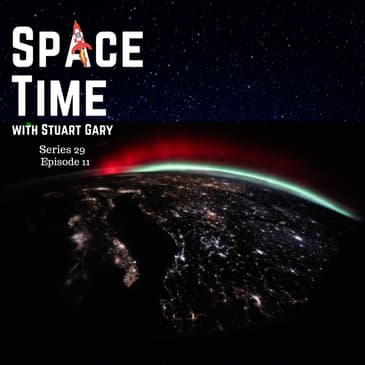
SpaceTime with Stuart Gary Gary - Series 29 Episode 11
In this episode of SpaceTime, we dive into the latest astronomical events, including a record-setting solar storm impacting Earth, the historic Artemis 2 mission preparing to return astronauts to the Moon, and groundbreaking evidence confirming an ancient asteroid impact in the North Sea.
Record-Breaking Solar Storm Strikes Earth
Planet Earth has recently experienced a massive geomagnetic storm triggered by an X1.9 class solar flare, followed by a coronal mass ejection. This event produced stunning auroras, visible as far north as Sydney and Brisbane. We discuss how such solar storms can affect technology on Earth and in space, including potential disruptions to communications and navigation systems, as well as the impact on satellites in low Earth orbit.
Artemis 2: A Historic Return to the Moon
NASA's Artemis 2 mission is gearing up to send astronauts back to the Moon for the first time in over 50 years. The crew will embark on a 10-day journey, orbiting the Moon and traveling further than any humans have before. We explore the mission's objectives, including testing spacecraft systems, practicing docking procedures, and conducting deep space science experiments, all while preparing for future lunar landings.
Proof of an Ancient Asteroid Impact
A decades-long debate over the origins of the Silverpit Crater in the North Sea has been resolved with new evidence confirming it was formed by an asteroid impact 43 to 46 million years ago. Utilizing seismic imaging and microscopic analysis, researchers have established this crater as a significant impact site, shedding light on the history of asteroid collisions on Earth and their implications for our planet's geological evolution.
www.spacetimewithstuartgary.com
✍️ Episode References
Nature Communications
NASA Reports
Become a supporter of this podcast: https://www.spreaker.com/podcast/spacetime-your-guide-to-space-astronomy--2458531/support.
(00:00:00) Record solar storm strikes Earth
(00:12:30) Artemis 2 mission prepares to send astronauts back to the Moon
(00:25:00) Evidence confirms asteroid impact in the North Sea
(00:35:15) New insights into Earth's climate from ancient geological events.
This is Spacetime Series twenty nine, Episode eleven, for broadcast on the twenty sixth of January twenty twenty six. Coming up on Spacetime, Planet Earth hit by another record setting solar storm. The itemis two mission ready to send astronauts back to the Moon for the first time in more than fifty years, and finally proof that an asteroid really did slam into the North Sea more than forty three million years ago. All that and more coming up on Spacetime. Welcome to space Time with Stuart Gary. Planet Earth's just been hit by another massive geomagnetic solar storm. The event was triggered by a powerful X one point nine class solar flare followed by a coronal mass ejection which pummel the planet, generating spectacular auroral activity. Charged particles slammed into Earth's magnetic field, producing the northern and southern lights, the Aurora Borealis and Aurora Strallis. In fact, the Aurora Australis were seen as fine auth as Sydney and Brisbane. Solar flares are ranked on a logarithmic scale in ascending strength, with each letter representing a ten fold increase in intensity. Listed as A B C, M, and X, which are the most powerful. The letters are then followed by a number the further refine the storm's intensity. This laterst solar flare was generated by a sunspot region known as AR forty three forty one. The event comes as the Sun begins its descent from solar maximum, the climax of its eleven year solar cycle. While solar flares and coronal mass ejections usually reach their most intense at solar max, they can continue to be very active during the early part of the waning period. The current solar cycle twenty five began back in November twenty nineteen, and it won't end until solar minimum sometime around twenty thirty, at which point the Sun's magnetic poles will flip polarity north pole becoming south and south pole north. The X one point nine class solar flare and the following coronal mass ejection were observed by the LASCO chronographs aboard the Joint European Space Agency NASA SOHO spacecraft, which monitors the Sun from the Lagrangian L one position, a sort of gravitational point of equilibrium where the pull of the Earth and Sun balance each other out thereby allowing a spacecraft to remain there without expending much fuel. The observations by the European Space Agency show the coronal mass ejection hit Earth at some seventeen hundred kilometres per second. Around twenty five hours after blasting out from the Sun, high energy particles in Earth's vicinity crossed the alarmed thresholds, showering the sun facing side of the planet, which was over the Americas. The high energy particle shower pecked in intensity on January nineteenth, reaching severe S four levels. That makes it one of the most intense solar storms since the October two thousand and three Halloween Storm, and it places it at the top of the list of the most intense radiation storms in the GOES spacecraft records that Halloween space where the event back in twenty oh three resulted in power blackouts in Sweden damages to power transformers across southern Africa. See When a solar flare erupts. The explosion can release as much energy as a billion nuclear bombs. A torrent of electromagnetic waves leaves the Sun traveling at the speed of light, arriving at Earth some eight minutes later, potentially disrupting shortwave radio transmissions and causing errors in navigation systems. Following on a fraction of an hour behind a high speed solar particles, including protons, electrons, and alpha particles. This radiation can harm astronauts in space. It can also damage space facecraft, short circuiting electrical systems. It can black out communications and navigation systems, and produce a cascade of secondary particles in its atmosphere that can cause areas with electronic components if they reach the ground. A solar flare is often accompanied by a large eruption of ionized gas from the Sun's outer atmosphere. This is the coronal mass ejection or CME. These create gusts of shark waves in the sol or wind, a continuous stream of charged particles flowing out from the Sun. These can take anything from eighteen hours to a few days to reach out planet. When a CEME arrives at Earth, it stresses the planet's magnetic field, causing what's known as a geomagnetic storm. This can make compass needles wonder and it can provoke damaging surges of electrical currents in long metallic structures such as power cables and pipelines now. Also during geomagnetic storms, particles from space travel along the planet's magnetic field lines into the upper atmosphere. There they collide with atoms and mo molecules, creating spectacular auroral light displays. But the currents injected into the atmosphere not only produce wonderful light shows, they also heat the Earth's upper atmosphere, making it swell and expand, and that can increase atmosphere drag on satellites in low Earth orbit. Satellite then needs to compensate for that drag using thrusters to regain an operational orbit, Otherwise its orbit will further decay, ultimately causing the satellite to break up in Earth's atmosphere. This space time still to come. Atomis too ready to send astronauts back to the Moon for the first time in more than fifty years, and proof that an asteroid did slam into the North Sea some forty three million years ago. All that and more still to come on space time. This episode of space Time is brought to you by squarespace, the platform that makes building an incredible online presence not just possible but effortless. Squarespace gives you all the tools you need to create a professional website, claim your perfect domain, promote your brand, and even get paid, all in one easy to use place. Whether you're showing off your portfolio, selling products, or booking clients, squarespace has you covered. If you're in the business of offering services, whether it's one on one consulting, workshops or unique experiences, squarespace streamlines everything from presentation right through to payment. You can design a site that beautifully showcases what you do best, sends sleek on brand invoices, and accept online payments. With these clients can even book time directly through your site using squarespaces built in scheduling tools, plus automation features like email campaigns help you keep your audience engaged without spending hours on administration. And here's where it gets really exciting. Squarespace is design and tools give everyone the power to create a website that looks like it came from a top tea design studio. Now, if you want to see how easy it is to bring your ideas to life online, visit squaespace dot com slash space time for a free trial, and when you're ready to launch, use the code space time at the checkout to save ten percent on your first purchase for a website of domain. That's square space dot com, slash space time promo code space Time, and of course we have a link in our show notes. This is Spacetime with Stuart Gary. NASA is giant Atamus two Moon rocket has finally rolled out onto the launch pad for next month's planned mission to send astronauts back to the Moon for the first time in more than half a century. It was nineteen seventy two when the crew of Apollo seventeen walked on the lunar surface, the last time humans visited the magnificent desolation of this alien world. Now, Itemis two won't land on the Moon. That'll have to wait for the Artemis three mission, slated for later next year or possibly twenty twenty eight, depending on how quickly SpaceX get their Starship Super Heavy operational. But the crew of Artemis two will orbit the Moon in the process, traveling further from Earth than humans have ever journeyed before. The ninety eight meter tall SLS Space Launch System rocket rolled out from nassa's Giant Vehicle Assembly Building at Dawn, mounted on top of its crawler transporter. Now that's the same building and one of the same crawler transporters that carried the Mighty Satin five moon rockets half a century earlier during the Apollo manned Moon program and later for the Space Shuttle program. The crawler slowly creeped along the six kilomet along roadway space Launch Complex thirty nine bter, traveling at just one point six kilometres per hour, and thousands of Kennedy Space Center workers and their families were gathered to witness the long awaited event. The flight will be only the second launch of the SLS rocket. The first was back in November twenty twenty two, when it's sent an unmanned Orion capsule and an orbit around the Moon, but concerns about the heat shield and other technical issues with the Orion spacecraft on that first flight forced scientists and engineers to carry out extensive re analyzes and additional testing before approval was given for this historic first man mission. The ten day flight will evaluate the spacecraft systems, practice docking procedures, test a radiation shelter, undertake several deep space science experiments, deploy a number of satellites, and make new observations of the Moon from a closer atage point than what human eyes have had in more than fifty years. But it doesn't end there. The Itemis two crew will travel over seven thousand frondred kilomets beyond the lunar far side before swinging back around and returning to Earth, splashing down in the Pacific Ocean. That'll make this mission the furthest humans have ever traveled from the Earth. This report from Massa TV. NASA's Artemis two is the first crude lunar mission in over fifty years. Four astronauts will venture around the Moon, preparing humanity for a long term lunar presence for scientific discovery and exploration. The ten day test flight will demonstrate a range of deep space exploration capabilities with crew. The mission will prove the Orion spacecraft is ready to keep astronauts alive in deep space and allow the crew and ground teams to practice operations essential to the success of future missions. On launch day, the Artemis two crew suits up, undergoes final checks, and rides in the crew transportation vehicles to launch Pad thirty nine B at NASA's Kennedy Space Center in Florida. Stacked on the mobile launcher. NASA's three hundred and twenty two foot tall SLS or Space launch System rocket with the Orion spacecraft awaits the crew having made its four mile journey from the vehicle assembly build holding on the crawler transporter to the pad. The launch team fills the SOLS propellant tanks with over seven hundred thousand gallons of liquid oxygen and liquid hydrogen, and verifies guidance, communications and avionics. At twelve seconds before liftoff, the hydrogen burnoff igniters fire. About six seconds later, the rocket's four RS twenty five engines ignite. When the countdown reaches zero, the umbilicals retract, giving SOLS and the crew in Orion the clearance to begin the journey. The six million pound Moon rocket produces eight point eight million pounds of thrust to accelerate towards space. Seventy five percent of this power comes from the two seventeen story solid rocket boosters, each producing three point six million pounds of thrust. About two minutes in the boosters are released, their solid propellant consumed. The core stage and its RS twenty five engines continue to propel Orion and the crew to space. After three minutes, the protective fairings surrounding Orion's service module are ejected, exposing its solar arrays. Six seconds later, the launch aboard system is ejected from Orion. The crew has safely reached Earth orbit, though they could still abort using service module engines. About eight minutes after launch, the SLS core stage engines shut down, and the interim Cryogenic Propulsion Stage or ICPS and Orion separate from the core stage. Orion and the ICPS are now flying free. Orion's four solar arrays deploy, powering the spacecraft and charging its batteries for when it moves out of direct sunlight during the journey to the Moon and back. After a ninety minute orbit, the engine of the rocket's upper stage or ICPS ignites to raise Orion to a high Earth orbit. The Artemis two crew and mission control in Houston then began a nearly twenty four hour systems check while the astronauts are still relatively close to Earth, familiarizing themselves with their new home for the next several days. Once in high Earth orbit, Orion separates from the upper stage. The expended ICPS and Orion stage adapter serve as a target for a manual handling test called the proximity operations demonstration, preparing future crews for rendezvous, docking, and undocking with other spacecraft. During the demonstration, Artemis two astronauts use cameras and line of sight through Orion's windows to pilot the spacecraft as they approach and back away, assessing Orion's handling qualities, hardware, and software. Following the demonstration, spacecraft data is collected to verify system performance such as life support, communications, and navigation, ensuring Orion and the crew are ready for the voyage ahead. About twenty three hours later, Orion's service module performs the Translunar Injection burn or TLI, pushing oryon out of Earth orbit and on an approximately four day trip to the Moon. Ultimately, the crew's Figure eight flight path extends more than two hundred and thirty thousand miles from Earth. During the trip, the astronauts continue to evaluate the spacecraft systems and practice emergency procedures like testing the radiation shelter. The Autumus two crew travels about four thousand, six hundred miles beyond the Moon, becoming the first humans to lay eyes on the lunar far side in over fifty years. Their observations will help us prepare for future missions at the Moon. During this period, there will be an anticipated communication blackout between mission control and the spacecraft. As the crew returns from the far side of the Moon, Orion is drawn home by Earth's gravity in a free return trajectory, ensuring a fuel efficient four day trip. Before entering the atmosphere, Orion's crew module separates from the service module twelve thrusters ensure Orion is properly oriented. At an altitude of about seventy five miles from Earth's surface, Orion and the crew enter Earth's atmosphere at a speed of nearly twenty five thousand miles per hour, decelerating at a rate up to four times the force of gravity. The crew will feel four times heavier than they do on Earth. Orion's heat shield protects the spacecraft from temperatures of about five thousand degrees fahrenheit, about half as hot as the surface of the Sun. To slow its descent, Orion begins a precise deployment sequence of eleven parachutes. Three forward bay cover parachutes first separate the protective thermal cover that sits over the chutes. Two drogues slow and stabilize the crew module then cut free three pilot chutes lift the three main parachutes. Deployed in an altitude of nine thousand feet and traveling one hundred thirty miles per hour, these shoots slow the crew module to a speed of less than twenty miles per hour. After traveling more than five hundred and ninety five thousand nautical miles, Orion splashes down in the Pacific Ocean, about fifty nautical miles from the California coast, just sixteen minutes after entering Earth's atmosphere. After splash down, a recovery team that includes the US Navy, Air Force, and NASA approaches Orion. The team ensures it's safe for the crew to exit before divers help the astronauts onto an inflatable front porch, hoist them into helicopters, and fly to the recovery ship. Orion is towed into the ship for its return to Kennedy Space Center. Their mission complete, the crew is flown back to land and step on solid ground for the first time in ten days. This is Artemis two. This is space time still to come. Finally, proof that an asteroid did it the North Sea more than forty three million years ago and later in the Science report, new evidence shows the collision between Central and South America occurred far earlier and previously thought. All that and more still to come on space time. A decade's long scientific debate over the origins of the Silver Pit Crater in the southern North Sea has finally been resolved following new evidence confirming that it was caused by an asteroid or comet which impacted the Earth somewhere between forty three and forty six million years ago. The findings were reported in the journal Nature Communications, based on seismic imaging, microscopic analysis of rock samples, and numerical modeling. The studies lead author, it was D. Nicholson from the Heratua University, says it's the strongest evidence yet that Silver Pit was indeed an impact crater. The Silverpit Crater sits some seven hundred meters below the seabed in the North Sea, around one hundred and thirty kilometers off the Yorkshire coast. Ever since its discovery back in two thousand and two, the three kilometre wide crater, which is surrounded by a twenty kilometa wide zone of circular fault lines, has been at the center of a heated debate among geologists. Initial studies suggested that it was an impact crater. The scientists who discovered it pointed to its central peak, its circular shape, and concentric fault rings, all character sticks often associated with hypervelocity impacts. However, alternative theories argue that the creater structure was caused by salt moving deep below the crater floor, or possibly due to the collapse of the seabed because of volcanic activity. In two thousand and nine, geologists put the credit's formation to the vote and decided against the impact crater hypothesis, but this new evidence has now proved them all wrong. Nicholson and colleagues used newly available seismic imaging data and evidence from below the seabed to finally prove the impact theory. The samples from an oil well in the area also revealed shocked quartz and feldspar crystals at the same depth as the crater floor. That's clear evidence of an impact event. The authors suspect the impact was caused by what they believed was a one hundred and sixty meter wide asteroid hitting the seabed at a shallow angle from the west. Within seconds. It created a one and a half kilomet high curtain of rock and water that then collapsed back into the sea, creating a tsunami more than one hundred meters high. Nicholson says Silver Pit is a rare and exceptionally well preserved hypervelocity impact crater. These are rare because the Earth is such a dynamic planet, with plate tectonics and erosion destroying almost all traces of most of these sorts of events. In fact, there are only around two hundred confirmed impact craters on land, and only thirty three have been identified beneath the ocean. Scientists can use these findings to better understand how asteroid impact shaped out planet throughout history, as well as predicting what's going to happen the next time we suffer an asteroid collision. The conformation of Silver Pit as an impact crater places it alongside structures such as the more famous Chick Saloob Crater in Mexico that's the one link to the mass extinction of all the dinosaurs other than birds sixty six million years ago, and then the Deer Crater off the West African coast, which was only recently also confirmed as an impact site. This is space time, and time now to take a brief look at some of the other stories making us in science this week with a science report. A new study has found no evidence of a link between taking paracetamol during pregnancy and an increased risk of babies developing autism. The findings, reported in the Lancet Medical Journal, counter earlier claims by United States Health and Human Services Secretary Robert Kennedy Jr. That such a link did exist. The new findings are based on forty three previous studies, which were then reanalyzed with data pilled from seventeen of them. Crunching the numbers, the authors found there was no link between taking paracetamol during pregnancy and the risk of babies developing autism, spectrum disorder, attention deficit hyperactivity disorder, or any other intellectual disabilities. In fact, the lack of a link held true when researchers selected only the most robust studies, or only those with at least five years of follow up. The World Meteological Organization has confirmed that twenty twenty five was one of the three warmest years on record. The confirmation continues the current streak of extraordinary global temperatures. In fact, the past eleven years have been the eleven warmst years on record four planet Earth. The findings are based on analysis of eight key data sets, two of which ranked twenty twenty five as the second warmest year in the one hundred and seventy six year record, while the other six ranked it as the third warmest year. A new study claims the main tectonic collision between Central and South America occurred far earlier than previously thought. The findings, reported in the General Earth and Planetary Physics, provides fresh insights into the timing of what was one of the most important tectonic activities to have shaped the Americas. The authors reached the can inclusions after analyzing the magnetic properties of volcanic rocks from the northern Andes of Columbia, confirming that the main collisional stages occurred earlier than previously thought, before about ten million years ago. The research is focused on the Mayo Scene volcanic rocks, which are approximately twelve to six million years old from the Comba Volcanic Province located in central Columbia. These rocks were formed during a critical interval when the South American plate was interacting with a continental part of Central America. A survey by All Star Home indicates that one in six Americans believe supernatural activity is happening in their own homes. Furthermore, one out of five people in the survey reported they've experienced unexplained or unusual occurrences in their house. Now, a paranormal investigator has come out with a guide for how to live with ghosts. The Skeptics timendum says the ghost hunter's advice is to treat them with respect, don't antagonize them, just talk to them normal, say things like I realize you want to be hit to. The easue I was had with with ghosts and hauntings is that there's so many of them cases examples that you wonder, surely them must be better evidence somewhere. I mean, what I've found is that there's so many cases all the time. There's not a pub in England which doesn't have a ghost. There's not a museum in America or a theater that doesn't have a ghost. There's so many cases of hauntings, etcetera, that there should be better evidence for the existence of ghosts, and there's not. All the evidence are pretty poor and this is what you're finding. That people are seen something they can't explain, so therefore they try and explain it with something which is drawn out of a bag somewhere, and it's sad that it happens. One in six Americans, according to one survey, think that supernatural activity is happening in their home, whether they're less educated or more educated. The thing you learn in the skeptics of pretty quickly is that it doesn't matter what sort of qualifications people have, including of a nobel price, they can still believe so he thinks or certainly unwarranted things. There is no reason to believe some of these things. But the culture at the moment, the climate at the moment for belief in ghosts is heer it. What sort of advice did paranormal investigators. Give you, Well, well, you have to realize that if you get a paranormal investigator and they're not going to say is your house haunted? They're going to say your house is haunted, and what do we do about it? Now? One of them thinks you bring in an exorcist or a clergyman or something like that that throws and holy water around, and that might get rid of it, But generally most of them say you've got to live with it. The ghosts that we're probably not going to vinew a lot of harm, or the ghost act in different ways, and they have different corporeal natures and all sorts of things like that. I'm saying, if you talk to it nicely, don't antagonize them, just talking to them saying I realize you want to be here too, so that's okay. Or I'm having a bit of a problem with this, could you leave please, which is not the way that ghosts are often portrayed in scary films. Ghosts in scary films are apt to sort of kill you and take you down to help. There are various ways that people seem to know that they're places haunted. Things move, doors, move in the wind, there's cold spots, et cetera. Something raffles here there, there's a squeaky floorboard. Pets might be reacting to a ghost that they see that you can't. There was one in the story I recently read that there's one particular Psycha commending saying you have to use your critical thinking and figure out what else it could be before you jump through Oh my house as a ghost, and then she says houses are regularly haunted, so she's got a rested interest in making sure the houses are order. And therefore we will suggest to you bit a consulting practice. That's a skeptics timendum. And this is Spacetime, and that's the show for now. Space Time is available every Monday, Wednesday and Friday through at bites dot com, SoundCloud, YouTube, your favorite podcast download provider, and from space Time with Stuart Gary dot com. Space Time's also broadcast through the National Science Foundation, on Science Own Radio and on both iHeartRadio and tune In Radio. And you can help to support our show by visiting the space Time Store for a range promotional merchandising goodies, or by becoming a Spacetime Patron, which gives you access to triple episode commercial free versions of the show, as well as lots of burnus audio content which doesn't go to weir, access to our exclusive Facebook group, and other rewards. Just go to space Time with Stewart Gary dot com for full details. You've been listening to space Time with Stuart Gary. This has been another quality podcast production from bytes dot com