
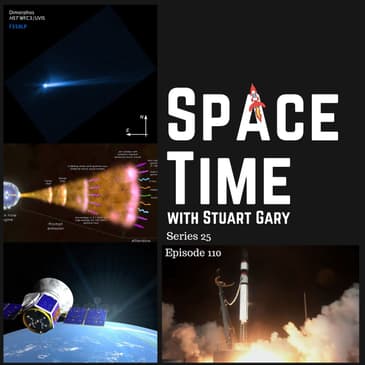


SpaceTime Series 25 Episode 110
*Scientists change an asteroid’s orbit.
Scientists have altered the orbit of a celestial object for the first time in history.
*Huge Gamma Ray Burst detected
Astronomers have just detected a record-breaking Gamma Ray Burst.
*TESS spacecraft placed in safe mode
NASA's planet-hunting TESS spacecraft has been placed into safe mode after a sudden computer glitch.
*Rocket Lab sets a new launch record
Rocket Lab has broken its annual launch record carrying out its eighth mission this year.
*The Science Report
Scientists teach a dish of living human and mouse brain cells to play pong.
The first COVID-19 vaccines designed to target Omicron are now being rolled out across Australia.
Earth’s population will officially reach eight billion people on November 15th, 2022.
Skeptics guide to the predictions of the Queen's passing.
Listen to SpaceTime on your favorite podcast app with our universal listen link: https://spacetimewithstuartgary.com/listen
For more SpaceTime and show links: https://linktr.ee/biteszHQ
If you love this podcast, please get someone else to listen to. Thank you…
To become a SpaceTime supporter and unlock commercial free editions of the show, gain early access and bonus content, please visit https://bitesz.supercast.com/ . Premium version now available via Spotify and Apple Podcasts.
For more podcasts visit our HQ at https://biteszhq.com
Your support is needed...
SpaceTime is an independently produced podcast (we are not funded by any government grants, big organisations or companies), and we’re working towards becoming a completely listener supported show...meaning we can do away with the commercials and sponsors. We figure the time can be much better spent on researching and producing stories for you, rather than having to chase sponsors to help us pay the bills.
That's where you come in....help us reach our first 1,000 subscribers...at that level the show becomes financially viable and bills can be paid without us breaking into a sweat every month. Every little bit helps...even if you could contribute just $1 per month. It all adds up.
By signing up and becoming a supporter at the $5 or more level, you get immediate access to over 280 commercial-free, double, and triple episode editions of SpaceTime plus extended interview bonus content. You also receive all new episodes on a Monday rather than having to wait the week out. Subscribe via Supercast (you get a month’s free trial to see if it’s really for you or not) ... and share in the rewards. Details at Supercast - https://bitesznetwork.supercast.tech/
Details at https://spacetimewithstuartgary.com or www.bitesz.com
S25E110 AI Transcript
Stuart: This is Spacetime Series 25, episode 110 for broadcast on the 17 October 2022 coming up on space time scientists changed the orbit of a celestial object for the first time in history. Astronomers have just detected a recordbreaking Gamma Marae burst and ah, NASA's Planet Hunting test spacecraft placed into safe mode following a sudden computer glitch. All that and more coming up. I'm, uh, spacetime.
Guest: Welcome to Spacetime with Stuart Gary.
Stuart: Scientists have altered the orbit of a celestial object for the first time in history. Observations using an array of ground and spacebased telescopes have confirmed that the impact of NASA's Dart spacecraft into the asteroid dimorphus successfully changed the 160 m wide moonlet's orbit around its host asteroid, Didymos. Prior to the collision, dimorphus took 11 hours and 55 minutes to complete one orbit around the 780 meters wide Diddy Moss. But following Dart's impact, dimorphus's orbit around Diddymoss was cut by some 32 minutes, shortening it down to 11 hours and 23 minutes. Astronomers say this measurement has a margin of uncertainty of approximately plus or minus two minutes. But it still far exceeds the 1% or ten minutes scientists were hoping for before its encounter, NASA defined a minimum successful orbital period change around Diddymoss of 73 seconds or greater. But the early data suggest Dart surpassed that minimum benchmark by more than 25 times. This marks humanity's first time purposely changing the motion of a celestial body and the first fullscale demonstration of asteroid deflection technology. Dart took nine months to travel the 11 million m kilometers to renderve with its target. NASA Administrator Bill Nelson says the mission is a watershed moment in planetary defense and shows how NASA is trying to protect the Earth from whatever the Universe throws at us. Meanwhile, the director of NASA's planetary science Division, Laurie Glaze described the result as an important step towards understanding the full effect of Dart's impact with its target asteroid. As the new data comes in day by day, astronomers will be able to better understand and assess whether or not a mission like Dart could be used in the future to help protect planet Earth from a collision with a large asteroid heading directly towards us. The investigative team is still acquiring data from groundbased observations around the world. They're updating the periodsity measurements with frequent observations in order to improve its precision. Focus now is shifted towards measuring the efficiency of momentum transfer from Dart's, uh, roughly 22 530 km h collision with its target. This includes further analysis of the ejector, uh, the many tons of asteroid or rock displaced and launched into space by the impact. Turns out the recoil from the splash debris has substantially enhanced Dart's push against Amorphous. It's acting a little bit like a jet of air streaming out of a balloon, setting the balloon in the opposite direction. To successfully understand the effect of this recoil from the ejector more information on the asteroid's physical properties, such as the characteristics of its surface and how strong or weak it is will be needed. These issues are still being investigated. Astronomers will continue stunning imagery of diamorphus from Dart's terminal approach and from the Italian space agency's Lysia Cube, a light Italian CubeSat for imaging of asteroids. This will help approximate the asteroid's mass and shape roughly four years from now. The European Space Agency's hero mission is also planned to conduct detailed surveys of both dimorphus and Diddy moss with a special focus on the crater left by Darts collision and a precise measurement of Dimorphus's mass. Professor Stephen Tinge from Curtin University says that by any measure, the Dart mission has been a tremendous success. The idea of deflecting an asteroid for planetary defense has been around for a long time at its even inspired numerous science fiction disaster movies. But now the engineering and science have caught up. Tingai says if in the future an asteroids found to be on a collision course with the Earth and astronomers have enough warning, a next generation mission based on dark experience could well save the Earth and humanity from significant losses.
Guest: Pretty ambitious, uh, mission run by NASA. Ah, with the involvement of the Italian Space Agency, they launched, uh, the mission, the spacecraft back in November. The object of the mission was to collide the spacecraft with an asteroid in an attempt to change its trajectory. And this was the very first test of planetary defense techniques. That is what you see in the movies, redirect an asteroid so that it doesn't hit the Earth. Uh, so this asteroid had no chance of coming anywhere near the Earth, but it was a test of the technique so that in the future, if there was some chance of an asteroid impact, we basically now have proven techniques to attempt to avoid that. The orbit was changed, it was changed by 32 minutes, which is an enormous change. So well above the thresholds for success and a really spectacular demonstration of the technique. There was a lot of uncertainty as to what the result of the impact would be because it depends on all of those uncertain factors. So exactly where the spacecraft hits, how hard it hits, and really uncertain the composition of the asteroid itself and how the asteroid would react to the impact. So that the test that's been undertaken is going to provide an enormous amount of information on those characteristics, is really going to help provide detailed planning and detailed scenarios. If we ever had to do this for real.
Stuart: Ejector plumes a lot larger than, uh, a lot of people were expecting. That must be telling us something about the internal structure of Diamorphus. Obviously much more of a, uh, dust pile or a rock pile asteroid than a solid rock.
Guest: What really surprised me about the immediate aftermath of the collision was just how spectacular the debris plume that the cloud of material that was ejected from the collision was. I'm not sure what I was exactly expecting. But I was amazed that even small telescopes from Earth could observe and pick up the enormous plume of debris, cloud debris that was produced by the, by the impact. It was absolutely astonishing. There are some incredible videos from relatively small telescopes that observe the event. That was an enormous crowd of debris that was ejected and it actually ended up acting a bit like a gun that has a recoil. So the ejector were, uh, thrown out in one direction and that actually the conservation of momentum means that, uh, the asteroid itself goes in the other direction. So that was, I guess, from my point of view, a little bit unexpected. And it does show that this particular asteroid, and probably many asteroids, are fairly loosely aggregated. Small rocks and large rocks and dust and pretty loosely held together. That deadly cloud has evolved into a, uh, quite long tail that is now following the asteroid through the solar system.
Stuart: This is an asteroid pair which isn't a threat to Earth right now, but they still are near Earth asteroids and they've got lots of friends out there as well. I think the latest count is what, 30,000 near Earth asteroids.
Guest: There are a lot of asteroids and they vary in size and therefore would vary in their impact if they ever hit the Earth. Uh, happily, the types of asteroids that would really challenge the existence of civilization if they hit Earth, uh, they're sort of in the 1000 meters plus diameter range and there's something less than a thousand of those sized objects. And happily, we know about 95% of them in a lot of detail already. There's 5% probably that we have not yet identified or cataloged. And maybe it's those that pose the biggest risk. At the smaller end of the size scale, there's a huge number of objects that could impact the Earth, uh, in the tens of meters category. Not life threatening for Earth, but would cause a bit of a mess if they occurred over a populated area. We probably only have cataloged about 30% of those types of objects, roughly speaking. So there are a lot of risks out there, but most of them are, uh, relatively minor risks. Happily, we understand pretty well the really big objects in, uh, the asteroid class.
Stuart: Nevertheless, every month I do a report somewhere either on radio or in the show about an asteroid that astronomers have just noticed after it swept past. Obviously, a lot of these are ones coming from the direction of the sun.
Guest: The type of impact that could really threaten civilization come around with a spacing of hundreds of thousands of years. So, uh, there's no immediate threat. And what astronomers call a closed call, a normal person in the street probably wouldn't call a close call. If something comes closer than the Moon, we tend to get a little bit excited, but still a long way away. And generally speaking, these are relatively small objects. So, no, it's not something that keeps me awake at night. Maybe I sleep 1% better these days knowing that a mission like that was successful.
Stuart: Do we need a proper space watch type of operation or the Southern hemisphere? There's a very good one in the Northern Hemisphere, but nothing south of the Equator.
Guest: Well, there have been some fairly substantial programs in the past that have, um, operated from the Southern hemisphere and there is still some activity, but obviously there's a, ah, bigger concentration of land mass and resources in the Northern Hemisphere. So I would say, yes, we probably do need more of that planetary defense surveillance from the south. I think we could do more of it all over the planet, actually. And it's not like these facilities are really all that massively expensive. Even with a relatively small telescope, some pretty effective surveillance can be done. So a worldwide network of small but capable facilities could go a long way.
Stuart: That's Professor Stephen Tinge from Curtin University. And this is Spacetime. Still to come, astronomers have just detected a massive recordbreaking gamma ray burst and NASA's Punted Hunting test spacecraft has been placed into safe mode following a sudden computer glitch. All that and more still to come on Space Time. Astronomers have just detected a recordbreaking gamma ray burst. The event, which reached Earth on October 9, has been cataloged its GRB 22 ten nine A. It was initially detected in Xrays, picked up by NASA's Swift GammaRay Space Telescope. Then other telescopes began focusing on the source of the blast. It was so powerful that astronomers originally thought it must have occurred fairly nearby. However, uh, followup observations showed that it actually originated in a dusty galaxy more than two 4 billion lightyears away. The burst was so bright, it's now believed to have been the most energetic gamma ray burst ever detected, with up to 18 terra electron volts. Gemma Anderson from Curtin University's note of the International Center for Radio Astronomy Research says while its closeness makes it appear to be brighter than it really is, it's still possibly the most intrinsically bright gamma ray burst ever seen. Astronomers are now training their telescopes on the burst's location to study the evolution of this blast and its afterglow across as many electromagnetic wavelengths as possible in order to better understand the event. GammaRay bursts are the most powerful explosions in the Universe since the Big Bang, 1380 2 billion years ago. These blasts release as much energy in a few seconds as the sun will produce in 10 billion years. Short period gamma ray bursts, which are less than around 2 seconds, make up roughly 30% of all gamma ray bursts are hypothesized to be produced by the merger of two neutron stars in a closed binary system. As they crash into each other, they produce a kilanova and transform into a stellar mass black hole. Long period GammaRay bursts, usually lasting more than about 2 seconds, make up the other 70% of all GammaRay bursts. They're hypothesized to be generated by the core collapsed death of the universe's largest stars in what a termed a hypernova, or a super luminous supernova. These either mark the birth of a stellar mass black hole or a highly magnetized neutron star called a magneta. This is spacetime. Still to come, NASA's Planet Hunting test spacecraft placed into safe mode following a computer glitch. Rocket Lab sets a new launch record. And later in the Science report, researchers in Melbourne have taught a dish of living human and mouse brain cells to play pong. All that and more still to come on space time, NASA's Planet Hunting test spacecraft has been placed into safe mode following a sudden computer glitch. Mission managers say Tess unexpectedly went into safe mode, halting its observations following a reset of the spacecraft's flight computer. They say the probe is stable and observations yet to be transmitted to Earth appear to be safe. Test circles the Earth in a highly elongated orbit, relaying data only when nearest to the Earth. Uh, the Transiting Exoplanets Survey Satellite, or test mission, was launched in 2018 as a followup to the Kepler spacecraft hiding for planets orbiting stars beyond our solar system. Test searches for planets using the transit method, looking for a regular dip in light coming from a star. That dip possibly being caused by a planet passing or transiting in front of that star, as seen from Tessa's position in space. Originally designed to operate for two years, tessas continued to survey the skies, identifying over, uh, 250 confirmed exoplanets and detecting thousands of candidate worlds, all adding to science's. Now 50 strong list of exoplanets. Rocket Lab has broken its annual launch record, carrying out its 8th mission this year. The company's previous record was set in 2020, when it undertook seven launches in a single calendar year. The it argo's up from here. Night Launch saw the electron rocket blast into the sky from Pad B at Launch Complex One on the Mahaya Peninsula of New Zealand's north island, east coast. The mission was Rocket Lab's 31st electron launch overall, with a company having undertaken a launch every month since April. The itago's up from here mission for General Atomics Electromagnetic Systems. Carried the Gazelle satellite loaded with the Argos four advanced data collection payload. That's an International Earth Observation collaboration payload between several United States government departments, including Noah, the National Oceanographic and Atmospheric Administration, NASA and the French Space Agency, and S Kale stations.
Guest: We are go for auto sequencer. LD is go for lunch. LD shadow, confirm go for lunch. Confirm go for lunch. Vehicles on internal power. AFTs is green and enabled for flight. Lockslow complete. Locksmith research. All helium anti gas string disabled.
Speaker D: Stage one. Stage two rest for flight.
Guest: High flow engine purge enabled. Deluge activated. Ten, 987-6543, one.
Speaker D: Uh, last 38 seconds. And our 31st electron has lifted off from the pad at Rocket Lab launch complex. One electron is powering its way to orbit. For General Atomics, the next milestone after liftoff is Max Q, or maximum aerodynamic pressure. This is the moment during launch when the forces on electron are at their peak, causing the most amount of stress on the rocket.
Guest: Clear up max Q. HP. Battery discharge. Domino.
Speaker D: That's confirmation from Mission control. Electron has successfully throttled down, pass through Max Q and ramped backup ahead of stage separation. We're currently traveling at over 2000, an altitude of over 20. Next three milestones happen in relatively quick succession within seconds of each other. First things first is Miko or main engine cutoff. The nine Rutherford engines will throttle down and then shut down completely before step two of this sequence. Separation of the first and second stages isnah the first stage drop away from the stage two body. And lastly, to continue our journey to orbital insertion, we'll see ignition of the single Rutherford engine on Electrons. Second stage continuing the journey to deliver the Gazelle spacecraft to its destination.
Guest: Miko confirmed stage separation successful.
Speaker D: Stage ignition. We've had successful Miko separation and stage two ignition. Now that we've passed through the harshest part of Earth's atmosphere, we no longer need to protect the payloads so we can eject the fairing halves to save some mass. Faring has successfully ejected. Stage two is continuing nominally with its General Atomics payload to orbit. The vehicle is currently at uh over 120 altitude and reaching speeds of more than 8500 km/hour.
Guest: Guidance is nominal.
Speaker D: Stage two propulsion is nominal. Everything is looking great. At the start of our stage two burn, electron power through space at over nine 0 km/hour. Nose propellant levels depleting slowly with about 76% of liquid oxygen and 75% of RP one Kerosene remaining. Those familiar with our 3D printed engines will know that Rutherford engines use batteries to power their propellant pump bats. Much like anything that runs on batteries, that power source gets depleted and soon a fresh battery is required to keep things going. The process of switching out this power source miss flight is what we call the battery hotswap. It's the propulsion still nominal. hotswap successful and battery hot swap is confirmed where we switched out the depleted batteries from feeding the Rutherford pumps on the second stage engine with a new one. The pumps are driven by an electric motor which provides fuel and oxidizer to the combustion chamber. Spinning at a rate of over 420 rpm, the stage two engine is powering the General Atomics payload to its destination orbit at 750 km above Earth at an inclination of 98 degrees, the Sun's Synchronous Orbit, or SSO. This allows the satellite to be positioned over the same location on Earth at the same solar time every day. We're well above the common line now and on our way to orbit. The vehicle with payload is healthy. Currently traveling at speeds of over 180 km h and an altitude of over 290 km, our first mission from LC Two in Wallops, Virginia is slated for the end of this year, and we're all very excited to baptize our third launch pad in Fire from those nine Brotherford engines. A quick update from Mission Control for our 31st Electron mission. It all goes up from here. Electron is cruising at a speed of over 22,000 km h and it's in an altitude of just over 300 km with just a 10% locks remaining and 10% RP One remaining. We're coming up on Sico, or second engine cutoff ahead of Kickstage separation.
Guest: Ben and Santona, 27 seconds remaining.
Speaker D: Sico confirmed.
Guest: Nominated transfer office. Stage three separation confirmed.
Speaker D: Much like Main engine cut off, the stage two Rutherford has now throttled down before the stage separates from the Kickstage as it continues on to payload deployment in the next 40 minutes or so, stage Two and the Kickstage now have separated. The Kickstage will now enter what we call a coast phase. For the next 45 minutes or so, the Kickstage will be in an elliptical orbit around Earth before the Curie engine ignites and raises the Kickstage's perigee to put us in a circular sunsynchronous orbit. From here, we'll deploy General atomics Gazelle satellites.
Stuart: Argos Four joins a network of other Argos payloads now in orbit, designed to collect data to provide scientists with a better understanding of Earth's physical and biological environment. This includes the planet's weather and climate, its biodiversity and ecosystems, as well as assist with maritime security, offshore pollution and humanitarian assistance. Rocket Lab remains on track to continue its monthly launch cadence for the rest of the year, with missions scheduled to continue to launch from New Zealand, as well as the inaugural mission from the new launch complex to at NASA's Wallops Island Flight Facility on the Virginian MidAtlantic coast. This is spacetime and time now to take a brief look at some of the other stories making news in Science this week with a science report. Scientists in Melbourne have taught a dish of living human and mouse brain cells to play pong. The dish, containing some 8000 neurons linked to a computer, were provided with electrical stimulation and feedback as they learnt changing their firing patterns to respond to a virtual ball based on the tennislike arcade game. The authors say their neurons took just five minutes to learn how to play pong using a shared language of electrical stimulation. Interestingly, they used less and less energy as they got better at the 1970s era video game, being less likely to be aced and having longer rallies. A uh report in the journal Neuron says this type of computer interface with neurons in a dish will be useful for studying the underlying principles of neural circuit function. The authors say the research shows that they can interact with living biological neurons in such a way that compels them to modify their neural activity. The author's next play to see how alcohol and drugs affect their dish brain as they're calling it by getting them drunk and then seeing if they end up playing pong more poorly. The first COVID-19 vaccines designed to target Omicron are now being rolled out across Australia. The pneumoderna vaccine comprises the mRNA from the original COVID-19 variant as well as the Omicron BA one. Those over 18 who have not had their recommended booster doses can choose this new vaccine. It's likely to be the first of many bivalent vaccines, with others including one targeting Omochrome BA four and BA five, still under consideration for approval in Australia. So far, almost six 9 million people have been killed by the covert 19 coronavirus since it was first detected near China's Wuhan Institute of Urology around September 2019. However, the World Health Organization says the true death toll is now likely to be over 15 million, with almost 620,000,000 confirmed cases globally. While the Lancet Commission, a panel of world leading experts in policy and disease management, estimates that around 18 million people have now died because of COVID uh, 19. The United Nations says the Earth's population will officially reach 8 billion people on November 15, 2022. That's just a month from now. On that day, Australia's population will be at 26 million, papua New Guinea at 9 million, new Zealand at 5 million, and the rest of the Pacific and Oceana region at 4 million. Meanwhile, the North American continent's population will have reached 602,000,000, dominated by the United States with 335,000,000, mexico, with 132,000,000 and Canada, with 39 million. Across the big pond in Europe, the population next month will hit 750,000,000 people. That's more than twice the size of the United States. A century ago, Europe's population was around 30% of the world's total. Now it's less than 10%. Russia is by far the largest country, with 146,000,000, followed by Germany, with 84 million, the UK, with 69 million, france, with 66, italy, with 60 million and Spain, with 47 million. But by far the most populated region on the planet will be Asia, which this time next month will house some 4.7 billion people, dominated by the Goliaths of China, with 1.45 billion, and India, with 1.41 billion people. But, uh, by next year, that'll change, with India surpassing China to become the world's most populous nation. The two Asian supergiants are followed by Indonesia, with 280,000,000, pakistan, 231,000,000, bangladesh, 168,000,000 and Japan, 126,000,000 people. Though Japan's population is shrinking across the Indian Ocean, africa remains the second most populous continent, with 1.4 billion people. And Nigeria has the largest population of any country there, with 218,000,000 inhabitants. It also has the continent's largest economy and based on current growth rates, nigeria's largest city, Lagos, but even emerges as the world's top mega city by the end of the decade. Africa's other most populous nations are Ethiopia on 118,000,000, egypt on 107,000,000, the Democratic Republic of Congo, with 96 million, tanzania, with 64 million, and South Africa on 61 million people. Africa also has by far the lowest M medium age of any of the continents. Meanwhile, South America is a total population of 439,000,000, which is dominated by Brazil, which makes up nearly half of that total with 216,000,000 people. That's followed by Colombia with 52 million and Argentina with 46 million. The next global population milestone, 9 billion, is likely to be reached sometime in the 2030s. Last month's tragic passing of Her Majesty Queen Elizabeth II has, of course, reverberated around the world, except, it seems, in the spirit world with those who see the future completely miss that one. Now, one could well be forgiven for thinking that those so, uh, gifted may well have foretold of such a significant event being laid out before them there on the celestial plane. But Tim Minham from Australian Skeptic says most clairvoyance missed it. And the few that did predict a death got the year wrong. They got the day wrong, they got the month wrong. They just got it all wrong.
Guest: Well, as you know, we carried out a major study of psychic predictions looking at, uh, I think it was 3800 predictions made over the last 21 years. Over 200 different psychics. These are all in Australia. Cost as many media formats as we could find. So pretty comprehensive. The royals featured, uh, fairly reasonably amongst all the predictions as they do. Not quite as good as celebrities and politics and sports, but, uh, of the royals, a lot of those were Kate and William and Harry and Megan and all that sort of stuff because there was a number on the Queen, uh, I think it was about 26 who made predictions about the Queen. And, um, I'm a bit surprised to say that, uh, 22 of them were wrong. Three were, uh, expected results. The queen will die eventually. And, uh, one was so vague he couldn't decide. Uh, but according to the Sears the psychics, the Queen was either going to die or abdicate. If it's the price in 2004, you might have missed that in 20. 10, 20, 12, 20, 13, 20, 14, 20, 18, 20, 19, 20 00 and 22,025. And no one said 2022, they're off. And so all those are made predictions. We're bad predictions.
Stuart: The death of Her Majesty has got to be a huge event in the psychic calendar. In terms of tapping into the cosmic stream of information out there. I'm surprised no one noticed it.
Guest: Yeah, we are surprised that no one actually predicted September 8, 2022 as a death date, even though the poor queen was sort of 96, I believe it was. So it's pretty much on the card, uh, skeptic card. Um, but the fact that they didn't I mean, obviously a lot of them were saying she was going to die in a certain year and she was going to abdicate and give way to child, et cetera. But they all got it wrong. And the only ones who really came close with said the Queen's go dice them soon is a bit of a vague term, um, but yeah, they didn't do well at all. And they're now making predictions about Charles of course, about how well he's going to go.
Stuart: Um, you say about King Charles, well.
Guest: The future is a bit mixed actually. Some of saying he's going to sort of pass on the crown to uh, William within the next year or half eight years. Or one was saying that he'll be around for the next 70 years, which is sort of pretty hopeful for how old he's going to be. Another one was saying that uh, he's going to be old. Uri Gella, our favorite Uri Geller reckons he's going to be the best king in the universe. Which considering Uri Geller's success rate is bit of a worrying for Charles, I'm sure. But they're all over the place. Some of them are saying he will abdicate and give part of his powers to William which means they don't understand what abdicate means. But the classic one is Mystic Veg who throws Asparagus into the air and casts the future based on that bit like, you know, the I Ching, your cast, etcetera. She throws Asparagus, I don't know why, maybe she's in the pay of the I think it's wrong. I think it's right. A bit softer for the heck of their cook. She's ah, probably in the pay of big Asparagus. But she's reckoning that uh, he will go next year.
Stuart: So they have to range it's before we finish up. For now, psychics Deborah Davies she spotted something interesting in a photo of the Queen taken just days before her passing.
Guest: She did very much quits are quite amazing actually. Um, she was looking at photos taken to the Queen in her lounge room at Belmont or whatever, the reception room where she had just met the new UK Prime Minister Liz Trust. And then she was looking at some of the photos that was that released after the fact and she saw and these are still photos notice and m not videos. She saw in some of the photos the image of an angel. These are still photos and you look at flames and they make a whole lot of different shapes at any time. But she saw the image of an angel which worried her very much that something was going to happen to the queen and lo and behold, a day or so later she died.
Stuart: I thought it was the Grim Reaper, not an angel who ever a visit.
Guest: Uh, well yeah I think you found a whole bit of a theory. Well maybe an angel was coming to collector.
Stuart: Uh that's tremendous. I'm Australian Skeptics and that's the show for now. Spacetime is available every Monday, Wednesday and Friday through Apple Podcasts, itunes, Stitcher, Google Podcast, Pocket Casts, Spotify, Acast, Amazon Music, Bytes.com, SoundCloud, YouTube, your favorite podcast download provider. Uh and From Spacetime with Stuart Gary.com. Spacetime is also broadcasts through the National Science Foundation on science. Owned radio and on both iHeartRadio and Tune in radio. And you can help to support our show by visiting the Spacetime store for a range of promotional merchandising goodies. Or by becoming a spacetime patron, which gives you access to triple episode, commercial free versions of the show, as well as lots of bonus audio content which doesn't go to air, access to our, uh, exclusive Facebook group and other rewards. Just go to spacetime with Stuart Gary.com for full details. And if you want more space time, please check out our blog, where you'll find all the stuff we couldn't fit in the show, as well as heaps of images, news stories, loads of videos and things on the web I'd find interesting or amusing. Just go to spacetime with Stuartgarry Tumblr.com. That's all one word and that's Tumblr without the e. You can also follow us through at Stuart Gary on Twitter, uh, at Spacetime with Stuart Gary on Instagram, through our, uh, Spacetime YouTube channel and on, um, Facebook. Just go to Facebook.com spacetime with Stuartgarry and Spacetime is brought to you in collaboration with Australian Sky and Telescope magazine, Your Window on the Universe. You've been listening to Spaced time with Stuart Gary.
Guest: This has been another quality podcast production from Bitesz.com.