



- Curiosity's Stunning Discovery: NASA's Mars Curiosity rover has discovered rocks made of pure sulphur on the red planet. This unprecedented find has scientists excited and puzzled, as they investigate the geological history of Mars.
- Ancient Earth Rocks: New research shows that some of Earth's oldest rocks are more widespread than previously thought. Mineral deposits near the Western Australian town of Coeli have been dated to 3.44 billion years, offering new insights into Earth's ancient history.
Follow our cosmic conversations on X @stuartgary, Instagram, YouTube, and Facebook. Join us as we unravel the mysteries of the universe, one episode at a time.Sponsor Offer: This episode is proudly supported by NordVPN. Secure your digital journey across the cosmos with a VPN service you can trust. Find your stellar security solution at https://www.bitesz.com/nordvpn.Listen to SpaceTime on your favourite podcast app including Apple Podcasts, Spotify, YouTube Music, or wherever you get your podcasts.Support SpaceTime:- Become a supporter of SpaceTime: https://www.bitesz.com/show/spacetime/support/
- www.bitesz.com
- 00:00:00 - This is spacetime series 27, episode 91, for broadcast on 29 July 2024
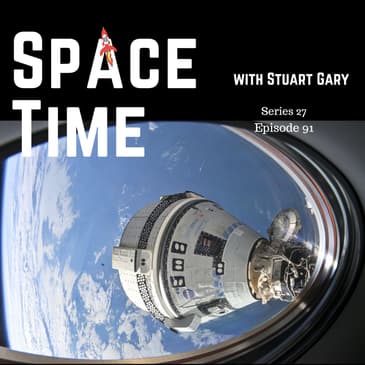
- 00:00:46 - Helium leaks and faulty thrusters hampered SpaceX Starliner mission to ISS
- 00:06:56 - NASA's Mars Curiosity rover has discovered rocks made of pure sulphur on Mars
- 00:12:16 - New study shows some of planet Earth's oldest rocks are far more widespread
- 00:17:32 - Zircons are fantastic timekeepers because they have an inbuilt clock
- 00:24:00 - Idea is thinking about, you know, on the early earth, was
- 00:28:51 - New study finds human induced climate change has driven increasing rainfall variability globally
- 00:36:30 - Spacetime is available every Monday, Wednesday and Friday through Apple podcasts
[00:00:00] This is SpaceTime Series 27 Episode 91 for broadcast on the 29th of July 2024. Coming up on SpaceTime… Still no return date for Starliners Stranded Crew, Curiosity makes a stunning surprise on the red planet Mars, and the world's oldest rocks found
[00:00:19] to be far more widespread than previously thought. All that and more coming up on SpaceTime! Welcome to SpaceTime with Stuart Gary. There's still no return date for Boeing's trouble-plagued Starliner spacecraft, which will remain docked to the International Space Station for several more weeks, or possibly
[00:00:55] even another month. Butch Wilmore and Sonny Williams launched way back on June 5th on the first manned test flight of the brand new Starliner CST-100 spacecraft on what should have been a trouble-free routine mission to certify the vehicle to join SpaceX's Dragon
[00:01:12] capsule in transporting crews to and from the International Space Station. However, a combination of helium leaks and faulty thrusters hampered the flight to the orbiting outpost, eventually forcing a manual docking rather than the automated arrival
[00:01:26] originally planned. And that's turned what was meant to be an eight-day mission into what so far has been a seven-week marathon. All the problems are in the Starliner's service module, which is jettisoned just before re-entry. It then burns up in the atmosphere.
[00:01:42] So instead, if NASA and Boeing technicians want to find out what's gone wrong, they need to use a spare Starliner service module at the White Sands Missile Ranch in New Mexico to determine what the problems are and if they can be remedied sufficiently for the
[00:01:56] crew to return to Earth. They'll then need to check the best they can with the spacecraft in orbit before any re-entry is attempted. The problem is five of Starliner's thrusters, used to provide fine orbital maneuvering, failed to kick in during the spacecraft's
[00:02:10] approach to the space station after being automatically deselected by Starliner's onboard computers. The crew were able to restart four of them and then undertake the docking to the space station's Harmony module manually. Tests on the ground with the spare service
[00:02:25] module at White Sands have identified degradation issues in both the fuel and liquid oxygen valves in the reaction control system thrusters. Teflon was discovered eroding from the seals, causing the ejector poppets to clog and deform. Mission managers say the problems are only
[00:02:41] affecting thrusters that control orientation, not the more powerful ones used for de-orbiting. And they believe the remaining thruster seals should remain intact long enough for the return to Earth, although as a precaution there'll be no manual flying of the Starliner spacecraft so as to
[00:02:56] avoid any undue stress on the thrusters. However, further ground evaluations will be conducted over the next week and alternative orbital maneuvering thrusters on the spacecraft are likely to be employed anyway. Also as an added precaution and something which is likely to become standard in
[00:03:12] the future, the Starliner crew will carry out a hot fire test at the thrusters prior to any undocking in order to ensure the systems are working nominally. The journey to the orbiting outpost was also hampered by a persistent helium leak. That was actually detected before the launch
[00:03:27] but it wasn't considered serious enough to abort the mission. However, during the ascent to orbit and once in orbit further helium leaks developed, raising concerns. Helium's an inert non-combustible gas and it's used to pressurize the propulsion system. Tests at White Sands identified degraded
[00:03:46] seals caused by oxidizer permeation. As Starliner actually carries 10 times more helium than what it needs for its flight, mission managers believe there's still enough in reserve for the return trip to Earth. Managers are also planning a de-orbit burn evaluation which will be carried
[00:04:02] out later this week as part of the ongoing re-evaluation process and that will be followed by a formal review which could set an official undocking time and date for the return to Earth.
[00:04:14] Both NASA and Boeing insist the current plan is to return the stranded crew to Earth aboard the Starliner. However, they've been unable to rule out using an alternative spacecraft for the flight if needed. Now that would most likely mean adding extra seats aboard Boeing's competitor SpaceX's
[00:04:31] Dragon capsule which is also docked to the space station. NASA says that's the advantage of developing two different flight systems as part of the commercial crew contract. While on station the Starliner crew members are joining with the seven Expedition 71 crew members in helping out with
[00:04:47] day-to-day tasks and scientific experiments. These have included carrying out ultrasound tests, exploring the use of microgravity to produce higher quality optical fibers, investigating fluid physics such as surface tension in order to address challenges in watering and nourishing
[00:05:04] plants being grown in space and gene sequencing experiments in microgravity. They've also changed out pumps on the urine to water recycling system and undertaken an inventory of the food supplies currently available on station. That could become crucial depending how much time they're stuck there.
[00:05:22] The extra time on stations also allowed the team to complete an extensive checklist on the Starliner including its use as a safe haven in case of emergencies aboard the space station and also checking out how its life support system performs with additional people on board.
[00:05:37] NASA awarded both SpaceX and Boeing commercial crew transport contracts in 2014. The idea was to develop two separate spacecraft and launch systems to ferry crew to and from the space station following the early retirement of the space shuttle fleet in 2011. SpaceX began
[00:05:55] transporting crews back in 2020 but Boeing have had multiple problems with their Starliner spacecraft managing only two unmanned orbital flights prior to the current mission. The first in December 2019 failed to reach the correct orbit and was almost destroyed during its re-entry
[00:06:11] because of a series of computer programming failures that were only caught at the last moment. The second flight in May 2022 seemed to go fairly smoothly, only a few minor issues aboard but far more serious problems became apparent once back on the ground and that delayed the first manned
[00:06:28] test flight for two years. The last few years haven't been good for Boeing while with a series of airliner crashes, doors being blown out at altitude and tires falling off aircraft it doesn't
[00:06:40] look like things are going to get any better anytime soon. This is Space Time. Still to come, Curiosity makes a stunning surprise on the red planet Mars and it seems the world's oldest rocks
[00:06:53] are far more widespread than originally thought. All that and more still to come on Space Time. NASA's Mars Curiosity rover has discovered rocks made of pure sulfur on the red planet. It's the first time such a discovery has ever been made on Mars. Scientists were stunned when the
[00:07:26] car-sized six-wheeled rover drove over a rock which then cracked under its weight, opening up to reveal spectacular yellow sulfur crystals. Since October 2023, the rover's been exploring a region of Gale Crater rich with sulfates, a kind of salt that contains sulfur and forms as water evaporates.
[00:07:45] But where past detections have involved sulfur-based minerals, in other words a mix of sulfur and other materials, this rock Curiosity accidentally cracked open is made of elemental or pure sulfur. It isn't clear what relationship if any the elemental sulfur has with other sulfur-based
[00:08:01] minerals in the area. While we generally associate sulfur with the odor of rotten eggs thanks to its hydrogen sulfide gas, elemental sulfur is odorless. It forms in only a narrow range of conditions which
[00:08:13] scientists haven't associated with the history of this location on Mars. And Curiosity's found a lot of it, an entire field of bright rocks that look similar to the one the rover crushed. Curiosity project scientist Ashwin Vasavada from NASA's Jet Propulsion Laboratory in Pasadena, California,
[00:08:31] says finding a field of stones made of pure sulfur is a lot like finding an oasis in the desert. It shouldn't be there and now the scientists will need to explain it. It's one of several discoveries that Curiosity's made while it's been off-roading within the Gettys Valley's channel,
[00:08:47] a groove that winds down part of the five kilometer high Mount Sharp, the base of which the rover's been ascending since 2014. Mount Sharp is like a Martian geology textbook with each layer of the mountain representing a different geological period in Martian history. Curiosity's mission is
[00:09:05] to study where and when the planet's ancient terrain could have provided the nutrients needed for microbial life, if that ever existed on Mars. Initially spotted from space years before Curiosity's launch, the Gettys Valley's channel has always been one of the primary reasons the science team
[00:09:22] wanted to visit this part of Mars. Scientists think the channel was carved out by flows of liquid water and debris that left a ridge of boulders and sediments extending some four kilometers down the mountainside below the channel. The goal has always been to develop a better
[00:09:37] understanding of how this freeze-dried world evolved billions of years ago, and while recent clues have helped there's still much to learn from this incredible dramatic landscape. Since Curiosity's arrival at the channel earlier this year, scientists have been studying whether ancient flood waters or
[00:09:55] landslides built up the large amounts of debris that rise up here from the channel's floor. The latest clues from Curiosity suggest that both played a role. Some paths were likely left by
[00:10:06] violent flows of water and debris from a time when Mars was a warmer, wetter world, while others appear to be the result of more local landslides, and those conclusions are based on the types of
[00:10:17] rocks found in the debris mounds. Whereas stones carried by water flows become rounded like river pebbles, some of the debris mounds are riddled with more angular rocks that may have been deposited by dry avalanches. Eventually water soaked into all the material that settled there. Chemical reactions
[00:10:35] then caused by this water bleached white halo shapes into some of the rocks, and erosions from wind and sand has revealed these halo shapes over time. It was clearly not a quiet period on Mars, with multiple floods down the channel including some energetic flows and boulder-rich events.
[00:10:53] All this evidence of water is continuing to tell scientists a very complex story, far more complex than what they expected to find. While the sulfur rocks were too small and brittle to be sampled with
[00:11:04] a drill, a large rock named Mammoth Lakes was spotted nearby. Mission managers had to search for a part of the rock that would allow the rover to do a safe drill, and also find a parking spot
[00:11:15] on the loose sloping surface. After Curiosity bored a hole in the rock, it was its 41st on the red planet by the way, it placed the powderized material into its spectrometer for analysis so that scientists can determine what minerals the rock's made of. Curiosity has now left Mammoth
[00:11:32] Lakes and it's off to see what other surprises are awaiting it yet to be discovered within this wild channel country. This is Space Time. Still to come, the world's oldest rocks found to be
[00:11:45] more widespread than previously thought, and later in the science report a new study shows that climate change has driven increased rainfall variability over 75% of the planet's land masses. All that and more still to come on Space Time. A new study has shown that some of planet Earth's
[00:12:19] oldest rocks are far more widespread than previously thought. The findings reported in the journal Communications, Earth and Environment show that mineral deposits uncovered deep underground the western Australian town of Coley, south of Perth, are some 3.44 billion years old.
[00:12:36] And that places them in a similar age range to crystals found 900 kilometers north in the outback Murchison region. The study's lead author Chris Kirkland from Curtin University says the new findings are providing a rare glimpse into Earth's ancient history. Kirkland says exploring ancient
[00:12:53] continental crust is challenging as most of it's buried deep underground. In Australia, ancient planetary crust is mainly known to be in the Murchison region. However, recent studies by Kirkland and colleagues have found new evidence of similar age crystals near Coley while dating
[00:13:09] zircon crystals that were brought to the surface in a younger magma. The authors were surprised to discover that these zircon crystals are 3.44 billion years old. And it doesn't end there. Similar grains have now also been found in sands from the Swan River in Perth, providing further
[00:13:26] evidence that this entire area of ancient crust extends well beyond the Murchison. The oldest minerals found in the planet's crust are zircon crystals found in archaea metamorphosized sedimentary rocks from the Jack Hills region of outback Western Australia. Analysis of the zircon
[00:13:44] consistently provides dates of more than 4 billion years, with the oldest being measured at 4.4 billion years. That means they were formed just 100 million years after the giant impact between the proto-Earth and a Mars-sized planet called Theia, which created the Earth and Moon 4.5 billion
[00:14:01] years ago. The rocks in which that zircon originally formed would have been some of the very oldest continental crust to exist. Unfortunately, the original rocks that supplied these zircons are mostly long gone. The oldest intact rocks found on Earth today are from the Acasta
[00:14:16] Guinese complex of northwestern Canada. The uranium-lead dating of zircon crystals from these rocks reach into the Hadean aeon at 4.2 billion years. There are also rocks from the Greenstone Belt in northern Quebec. They don't contain zircons, as it's mafric to ultramafric in composition
[00:14:33] and represents ancient ocean crust. Alternate isotopic dating techniques have yielded a much older date, reaching all the way back to the Hadean of 4.31 billion years ago. However, debates continue within the scientific community about the true age of these rocks, and so
[00:14:50] investigations are continuing. Meanwhile, geologists are continuing to search Archean cratons for slivers of Hadean crust in order to further advance science's understanding of the Earth's earliest evolution. Kirkland says this new discovery at Cauley highlights how modern
[00:15:07] techniques can be used to unlock some of the planet's most ancient secrets. The interesting thing is that you know most of the deep cratonic basements, that's the very old rocks we're interested in looking at, are covered by this pile of younger sediments sitting on top. But
[00:15:22] occasionally we get rocks called dikes, which are intrusive rocks that come from very deep and they punch through and they bring with them this record of the lower crust with them. And that's why we
[00:15:32] were interested in these rocks and sampled them because we thought, hey, they might be carrying some unusual or different information with them, which they did. It's the normal case with these intrusive rocks that they come from very deep and they quite frequently pick up bits of other
[00:15:48] material in the crust from very low down, up to 50 or 60 kilometers down, and then they bring it up to the surface. So it's like a cheap sample return mission from the depths. So obviously we could
[00:15:58] never drill to these depths. So by using these younger magmas that give this sample from great depth, the interesting thing is we don't normally find crystals as old as this. They're normally completely absorbed within the new magma. So we got very fortunate because these older grains were
[00:16:14] sheathed, they were in this armor of other younger material that kind of protected them on their way up to the surface. This was from within the mantle, that's how deep it is? Yeah, the original magma
[00:16:25] probably came from the mantle, but on its pathway up in the lower crust, it will pick up bits of the lower crust and carry them all the way to the surface that then allow us to investigate the
[00:16:35] lower bit of the continental crust. And that's where we find these very old ages dating back to about 3.4 billion years ago, which gives us something to compare to the oldest rocks on the continent of Australia. They're the Jack Hills rocks you're talking about there? Yeah, they're
[00:16:51] rocks within the Murchison area near Jack Hills. So we make a distinction as geologists between rocks and minerals. So the minerals at Jack Hills in the same area are up to 4.4 billion years
[00:17:04] old, so the oldest remnants of material on our planet. But rocks in Australia date back to only, I say only, but date back to 3.7 billion years ago. So that's the individual rocks themselves
[00:17:16] rather than the broken down crystals. Yeah, I think the Canadians are the ones who like to say, hey, we're the ones. Yeah. I once got a very stern talking to by a geologist because of the
[00:17:27] difference between rocks and minerals. I know that now. So tell me about your discovery. How do you date something inside a zircon? Yeah, that's right. So we took a small sample of the
[00:17:41] rock, we crushed it up, and we also took slices of that rock to be able to shine light through it. So they're called thin sections, and by looking at that thin section, it gives us the ability to
[00:17:53] understand the petrography of these different minerals. And what we found were these zircons, which are fantastic timekeepers because they've got an inbuilt clock within them, which we'll talk about. But they were surrounded by another mineral which protected them and preserved them,
[00:18:06] that other mineral is called titanite. That's a titanium silicate mineral. But both zircon and titanite are great because they contain uranium, and uranium decays to lead over time. And that's really important for us as geologists because that gives us an inbuilt clock. And by using a laser
[00:18:22] beam shooting into this thin section of a rock, targeting the individual crystals on the little portions of the grains, we were able to determine ages both for the surrounding armor of titanite, but also these old crystals within the titanite, which we call inclusions. And that's where we got
[00:18:38] this 3.4 billion year old age, which correlates to rocks we see outcropping in Mount Nair, which is about 700 kilometers north of Perth. And the dike itself that we looked at was 200 kilometers south of Perth. So it really massively extends this area of ancient crust we see in
[00:18:56] Western Australia in the deep geology. This is actually quite a huge craton you're looking at, isn't it? Yeah, it is. It's a massive craton. It's where most of Australia's gold is found and
[00:19:06] mined out of. It contains granite, so your stuff that you get your normal kitchen benchtop made of. And they're about mainly about 2.6 to 2.8 billion years old. But we occasionally find older bits of continental crust within that assemblage of older rocks. And it's really the kind of core
[00:19:22] of Australia, if you like. So a lot of Australia, especially Western Australia, got built out of this block on the Western age of the continents in the Archean times where we basically have the development of granites and magmas being built onto the edge of this all-cratonic block.
[00:19:38] What does that tell us about the evolution of the planet's crust on this part of the planet? Yeah, it's quite important actually because it allows us to understand the processes that go together to create continental crust. So continental crust is that buoyant kind of scum
[00:19:52] that floats on oceanic crust. So the continental crust is buoyant. It sits above water and it's where the habitable part of the planet is. It's where we live and it's possibly critical for developing terrestrial life forms, so land-dwelling life forms. The reason it's important in Australia
[00:20:07] is it gives us this window back into the processes that formed that early continental crust, which is mainly processes around melting and magma production and how we go from an early planet that was mainly oceanic-like crust, so lots of iron and magnesium, and how that chemically differentiated
[00:20:25] into buoyant lighter-coloured granites that float on top like the scum, if you like, that we live on and that holds most of our mineral resources as well. And so you've got this basaltic crust,
[00:20:37] which is subducting back down into the mantle and as it does so, it's pushing a lot of stuff up. Exactly, that's exactly right. So that's a process we call partial melting, so that iron and magnesium
[00:20:48] rich basaltic material when it melts will differentiate. So some of it will sink, but some of it will float and the material that floats is the lighter coloured material and that's the granitic stuff and that's what forms continental crust. But how in detail that process happened
[00:21:03] is actually the subject of quite a lot of scientific debate at the minute. Some people talk about subduction, like you just talked about. Other people just talk about it sinking under its own weight
[00:21:12] without the need to clash plates together and then other people talk about the importance even of meteorite impact as a process of providing energy to cause that melting. So we differentiate the planet and stratify the planet. So we take all the denser material downwards and the lighter material
[00:21:28] rises and that differentiation creates these red chemical reservoirs that are kind of important for both our atmosphere, our climate, but our chemistry of our water, but also the chemistry of the rocks and minerals within the planet itself. And the cycling between these different chemical reservoirs
[00:21:45] is kind of one of the things that maybe makes Earth special and suitable for life. Earth is special, it's the only place we know of for sure that has tectonic plate activity. Does
[00:21:55] that make you yearn to maybe visit other worlds like the Moon or Mars where this sort of thing doesn't happen? Yeah, absolutely. As a geochronologist, as someone who specializes in dating rocks, the planet, especially Earth's Moon, are quite special because they allow us to look
[00:22:09] at processes that might be similar to processes that happened on the early Earth. For example, the Moon contains a record that stretches back probably further than we can access on Earth simply because Earth is recycling itself with plate tectonics. But the Moon, because it doesn't
[00:22:24] have plate tectonics, allows us this window into earlier processes and that's one of the key things I mentioned earlier of why impacting might be important because we can see that record very
[00:22:33] clearly on the Moon, but on the Earth, because of the process of plate tectonics, that record is being continuously erased even though it must have happened. The Apollo 14 astronauts brought back samples from the Moon which were originally from Earth that was ejected, thrown up into space
[00:22:48] following an impact and that was dated at 4.4 billion years. So yeah, going to the Moon will give us some good information on some of the oldest material on Earth. Yeah, absolutely, because
[00:22:58] the Moon serves as this archive of processes that happened on the early Earth, so it's a treasure trove of information. Also, I mean we can look at meteorites from other bodies that might have hit
[00:23:09] the Earth such as Martian meteorites and that can give us ideas about processes happening on Mars which might correspond to similar processes on the early Earth when there was different tectonic regimes. I'm fascinated by the fact that there are these two planets, Earth and Venus, and yet they
[00:23:26] have such totally different methods of cooling. The Earth does it through tectonic activity, Venus doesn't have tectonic activity, there's no evidence of it there. Instead, the only cooling on Venus seems to be volcanic. Yeah, that's really interesting and another observation about Venus
[00:23:42] is we can look and we can see some of the patterns in terms of large blocks, I'll use the word crust, but large parts of the surface of Venus tend to show this kind of egg carton kind of pattern,
[00:23:53] but we also notice that similar egg carton type pattern, for example, in places like the Pilbara and then that starts ideas thinking about on the early Earth with the early Earth cooling
[00:24:03] in a very different mode, a very different process to how it's cooling now. So it cools now mainly through processes that involve subduction, so one plate being taken down underneath another plate which produces granitic magma, but in the early Earth maybe the role of impact was much more
[00:24:18] important and maybe that had process related to a different style of process. There's very few places on the planet that we can go back and look at these sorts of processes, but fortunately in
[00:24:30] Western Australia we have records of this ancient material preserved both in the Pilbara and in the Narya region, but now also it looks like we've got a record of that early crust formation processes
[00:24:42] in the deep geology and we can maybe access that through these younger magmas that are punching up from deep within the planet and bringing with them this information. Why didn't Venus have plate
[00:24:52] tectonics? And one of the hypotheses is that the planet is just too warm, the crust is too malleable, hasn't had a chance to harden enough to begin the plate tectonic process. Yeah, yeah,
[00:25:02] there's ideas that you know in the early Earth the thermal conditions were a lot hotter, we had a much higher impact flux, so much more thermal energy, so convection was more vigorous and we had material being transferred between these different geochemical reservoirs much faster. We also
[00:25:19] have to remember the planet hadn't differentiated as much, so it hadn't separated as much, so it's this kind of long pathway from this you know early formed body into a differentiated planet with all
[00:25:29] these different reservoirs that led to us being able to talk here today, it's quite remarkable. Is that why there's so much investigation into working out when the first continents formed on
[00:25:41] Earth? Yeah, I think it's a it's kind of a great scientific debate. I think there's quite a lot of effort being put into it because of two reasons. One is that the evidence is quite sparse, so you
[00:25:50] can, you know, testing hypotheses takes time but there can be quite a range of different hypotheses put forward. The evidence is quite limited because we talked about you know the planet is resurfacing itself with plate tectonics, so we're losing information, but also it's actually relevant for
[00:26:06] quite a lot of mineral exploration as well and that's now becoming more important because the critical minerals and the transition towards a green economy, but these old crustal blocks tend to be very important because they concentrate metals on areas that they've been fractured and
[00:26:19] cracked and what happens is we have fluids that pick up metals and they get concentrated along these fractures and cracks and that's where we tend to get most of the big mineral resources,
[00:26:28] but it you know generally quite a lot of especially gold, iron ore, but some of the critical metals like lithium tend to be associated with these older crustal blocks. The magic of all this is
[00:26:40] that there are these zircon crystals. Yeah, that's absolutely true because I talked a little bit about the grains being protected under nearly every other circumstance we've seen within these iron and magnesium rich dikes, so they're mythic magma, they're basaltic magma, dark coloured rocks
[00:26:57] that intrude into light coloured rocks, those sorts of things that you see as long sheets, you know if you go for a walk over any exposed rocks you see them quite frequently. Normally they dissolve zircon, so the only reason these little crystals have been preserved is that they
[00:27:10] were inside this armour of a different mineral that was more chemically stable within that magma and that doesn't happen very frequently. So we got very lucky in finding these little inclusions that have brought with them so much history with them. Basically zircons, they contain a little bit
[00:27:24] of uranium, not very much but enough that over time that uranium will decay to lead. So by looking at the isotopic ratio of uranium to lead we've got this inbuilt clock because we understand the decay
[00:27:35] rate, the rate of change between those two different isotopes. Now what's important about zircon is at the start when that crystal grows it hits lead so it doesn't incorporate any lead at
[00:27:45] the start. The only lead that's in our zircon crystal has come from the decay of uranium and that's why it's such a good clock because you could imagine if we had a different mineral that
[00:27:53] grew and incorporated both uranium and lead that kind of clock is slightly broken because there's some lead already at the start and we're only interested in the lead that's produced from the
[00:28:02] decay of uranium. So that's why zircon is such a good timekeeper because all the lead has come from the decay of uranium and we know the rate of that change therefore we've got this inbuilt clock
[00:28:12] and also zircon grows in lots of different types of magma so because it's kind of ubiquitous it provides this really useful time capsule into the deep time history of our planet. That's Professor Chris Kirkland from Curtin University and this is Space Time.
[00:28:44] And time now to take a brief look at some of the other stories making news in science this week with a science report. A new study has found that human-induced climate change has driven increasing rainfall variability over 75 percent of the Earth's land mass. The findings reported
[00:29:02] in the journal Science found the effects were especially prominent in Australia, Europe and Eastern North America and they're largely driven by increasing atmospheric moistening and decadal scale changes in atmospheric circulation. The study used a global daily precipitation data set
[00:29:18] that showed that the variability in daily precipitation has been increasing. These increases in precipitation variability mean wetter wet periods and drier dry periods. Warm air can hold far more water vapor than cold air and so if the atmosphere as a whole heats up then it will
[00:29:35] hold more water vapor which means there's more water available for rainfall. The authors found that daily variability has increased by 1.2 percent per decade globally. They say rapid and wide swings between climate extremes not only challenge weather and climate prediction systems but also
[00:29:53] have a cascading impact on human society. Have you ever misremembered something or mixed up two events from your past when thinking about them? It's a bit like the famous Mandela effect when
[00:30:06] you ask people if they remember where they were and what they were doing when they first heard the news that Nelson Mandela had been assassinated. Most people always remember exactly where they
[00:30:15] were and what they were doing at that time. Well a new study claims cuttlefish can also mix up their memories. A report in the journal iScience claims researchers encourage cuttlefish to develop false
[00:30:28] memories using tubes of their favorite food which is shrimp and also other tubes containing a less favorite food crab. Didn't know they were so finicky. Cuttlefish have already been recognized as the only
[00:30:39] invertebrates able to remember and then recall what's happened to them in the past but it was previously unknown if they rely on a reconstructive process which involves mentally reconstructing the event by associating different features that were present during the original event. This process
[00:30:55] however can result in the formation of false memories and according to the authors of the study they were able to give the cuttlefish false memories of seeing their favorite food. Oh and
[00:31:06] for the record Nelson Mandela was not assassinated. He lived a long and fruitful life before dying at the ripe old age of 95 from natural causes. Archaeologists are proposing that Egypt's oldest
[00:31:20] pyramid, the Pyramid of Dogea also known as the Step Pyramid may have been built with the help of a unique hydraulic lift system using water to raise giant blocks into place. The Pyramid of Dogea was
[00:31:32] built around 4550 years ago yet exactly how the massive 300 kilogram monolith blocks were lifted into place has remained a mystery. A new analysis reported in the journal PLOS One suggests that a previously unexplained nearby structure called the Giza el-Mudeir enclosure may have been a dam for
[00:31:52] water and another series of compartments dug into the ground outside the pyramid may have served as a water treatment facility. The water may then have been directed into two shafts within the pyramid where its force could have been used to lift building blocks into place. The UFO community's
[00:32:10] current favorite UFO fan and last year's winner of the Skeptic's Bent Spoon Award, journalist Ross Coulthard is now claiming that the 45th president of the United States Donald J Trump should be in
[00:32:21] fear of his life because of what he knows about UFOs. Tim Mendham from Australian Skeptic says Coulthard's claim was made months before the infamous actual assassination attempt three weeks ago and as far as we know aliens from another planet weren't involved. Yeah it's interesting
[00:32:37] actually because Ross of course is an Australian journalist he's been a Walkley award winner he's been highly praised etc etc but lately... That says a lot about the Walkleys doesn't it? It says a lot
[00:32:48] he's lately he's in the last couple of years of course he's been a promoter of UFO conspiracies he seems sincere in his beliefs quite frankly he's certainly doing well out of it he's got
[00:32:56] a couple of books out about that sort of thing but I think he's pretty sincere but what he said recently in I think it was the end of May start of June something like that he gave a talk to the
[00:33:05] scientific coalition for UAP studies, UAP being unidentified either aerial or anomalous phenomena but keep seeing me just swap it over in which he sort of gave a long description of all the UFO conspiracies so now back to UFOs UFO conspiracies that have been on and on and on
[00:33:22] especially he was head of the interview with David Grush who's the guy who's claiming that the American government has all this stuff hidden away aliens alien tech all that sort of thing even
[00:33:31] though he's never seen it but he's had it on good authority so Coulthard is following is really third or fourth hand on this but he's made a living out of describing this and you know this talk he gave
[00:33:40] to this convention which we went for an hour and a half actually so it's quite a bit of work at the end of it he suddenly made the comment that Donald Trump now this was in May June right was in trouble
[00:33:51] he's scared Ross Coulthard said that Trump is scared he's scared they're going to kill him that's what I've been told I'm not kidding you I'm not making this up this is serious and he's not talking
[00:33:59] about the Democrats here I take it is not well every president ever since the second world war has supposedly had the information the secret about UFOs and most of them have made fun of it the
[00:34:09] very suggestion but I don't know I haven't actually heard Trump talk about that what majestic MJ12 well there's a whole range of them there's a whole range of different investigations for things I
[00:34:18] think a lot of majestic was a bit of uh hyperbole wasn't it anyway Ross Coulthard is making this claim it's nothing particularly new but in fact it's interesting that he's you know referred to
[00:34:26] Trump being scared or said they're going to kill him and then not that long afterwards he has this assassination attempt I don't think anyone's suggesting that the the lone gunman was actually trying to kill him because of UFO knowledge well the secret service apparently didn't see him on
[00:34:39] the roof there although everyone else did is that apparently yeah does that mean he was an interdimensional being good question now it's interesting there's no indication that that the
[00:34:47] rather sad figure who tried to shoot him was a UFO or you an alien or a UFO believer or something but it always makes me interesting that why are people scared of this knowledge I mean Ross keeps
[00:34:57] claiming he can reveal at any time reveal these hidden enormous craft that are buried under buildings etc but he's not he hasn't he's waiting for someone else to reveal it that's what I keep
[00:35:07] saying do it Ross do us a favor right reveal all this stuff if you barely know about it the proud name of journalism and honesty exactly uh integrity yeah unvarnished truth blah blah blah
[00:35:20] he reckons he knows these things he knows where these for instance these up to 12 or 14 enormous spacecraft are buried under other buildings he knows where they are he's just not going to say
[00:35:30] this is all reminding me of story I told you about off air about Biden doing so badly in the presidential debate a couple of weeks ago because he was hit by a directed energy weapon yeah that
[00:35:40] was one suggestion the Havana syndrome um which is sort of supposedly this thing that started off with radio waves microwaves being beamed to the American embassy and people being taken off sick
[00:35:50] etc and then it was extended into other countries where these same beams these that are called the Havana syndrome appears everywhere and now everybody's using it whether it's regarding sort of politicians or embassy staff or CIA or whichever if that becomes a bit of a buzzword
[00:36:05] that everyone's using this to influence other people I had someone who came to me when you say buzzword did you mean the pun there or not uh I'll claim credit for it I found someone came to me
[00:36:13] recently suggesting that uh someone who's predicting lottery numbers which I get quite a lot people like that come to me it's sending out uh Havana syndrome he sent the Havana syndrome against
[00:36:22] the Australian government which I don't have to see if he can be there but it's become a buzzword and now everybody's jumping on the bandwagon that's Tim Indom from Australian Skeptics and that's the show for now Space Time is available every Monday Wednesday and Friday
[00:36:53] through Apple Podcasts iTunes, Stitcher, Google Podcasts, Pockercasts, Spotify, Acast, Amazon Music, Bytes.com, SoundCloud, YouTube, your favorite podcast download provider and from spacetimewithstuartgary.com Space Time is also broadcast through the National Science Foundation on Science Zone Radio
[00:37:14] and on both iHeart Radio and TuneIn Radio and you can help to support our show by visiting the Space Time store for a range of promotional merchandising goodies or by becoming a Space Time
[00:37:26] patron which gives you access to triple episode commercial free versions of the show as well as lots of bonus audio content which doesn't go to air access to our exclusive Facebook group and
[00:37:36] other rewards just go to spacetimewithstuartgary.com for full details and if you want more Space Time please check out our blog where you'll find all the stuff we couldn't fit in the show as well as
[00:37:47] heaps of images, news stories, loads of videos and things on the web I find interesting or amusing just go to spacetimewithstuartgary.tumblr.com that's all one word and that's tumblr without the e
[00:38:01] you can also follow us through at Stuart Gary on Twitter at Space Time with Stuart Gary on Instagram through our Space Time YouTube channel and on Facebook just go to facebook.com forward space time with Stuart Gary you've been listening to Space Time with Stuart Gary
[00:38:18] this has been another quality podcast production from bytes.com