
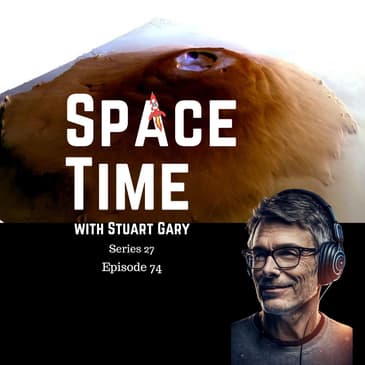



First, astronomers have discovered water frost on the solar system's tallest volcanoes, including Olympus Mons on Mars. This groundbreaking find challenges existing ideas about the red planet's climate dynamics and suggests the presence of water frost near the Martian equator for the first time. The study, led by Domus Valentinus, reveals that this frost is incredibly thin, likely only 100th of a millimeter thick, and consists of at least 150,000 tons of water that cycles between the surface and the atmosphere during the cold seasons.
Next, we delve into the European Space Agency's Proba-3 mission, which aims to study the sun's outer atmosphere or corona. This innovative mission involves two spacecraft flying in formation to create an artificial solar eclipse, allowing for sustained study of the sun's faint coronal atmosphere. The mission will launch aboard an Indian PSLV rocket from the Satish Dhawan Space Centre and will demonstrate the precise positioning of two orbiting platforms.
Finally, Virgin Galactic has successfully completed its final space tourism flight before a two-year pause to upgrade its fleet. The Galactic 7 mission carried two pilots and two passengers to the edge of space, marking the end of operations for VSS Unity. The company will now focus on developing its next-generation Delta-class space planes, which are expected to enter commercial operations in 2026.
Follow our cosmic conversations on X @stuartgary, Instagram, YouTube, and Facebook. Join us as we unravel the mysteries of the universe, one episode at a time.
Sponsor Offer
This episode is proudly supported by NordPass. Secure your digital journey across the cosmos with a password manager you can trust. Find your stellar security solution at https://www.bitesz.com/nordpass.
Listen to SpaceTime on your favourite podcast app including Apple Podcasts, Spotify, YouTube Music, or wherever you get your podcasts.
Support SpaceTime
Become a supporter of SpaceTime: https://www.bitesz.com/show/spacetime/support/
www.bitesz.com
[00:00:00] This is SpaceTime Series 27 Episode 74, for broadcast on the 19th of June 2024. Coming up on SpaceTime… Waterfrosts discovered on the solar system's tallest volcanoes. We look at Europe's Probe 3 mission to study the Sun. And Virgin Galactic completes its final space tourism flight
[00:00:20] for a two-year pause in operations as they prepare new spacecraft. All that and more coming up on SpaceTime. Welcome to SpaceTime with Stuart Gary. Astronomers have detected patches of waterfrost on top of the Red Planet's Tharsis volcanoes, including Olympus Mons, the biggest volcano in the solar system.
[00:00:58] The discovery, reported in the journal Nature Geoscience, marks the first time that frost has been identified near the Martian equator. The new findings challenge existing ideas on the Red Planet's climate dynamics. The study's lead author, Domus Valentinus, who did his research while at the University of Bern
[00:01:17] and is now with Brown University, says scientists thought it was improbable for frost to form around the Red Planet's equator as the mix of sunshine and thin atmosphere would keep temperatures during the day relatively high at both the surface
[00:01:30] and on the mountaintop. That's very unlike what one could see on Earth, where it's common to see frosty and even snow-covered peaks. Valentinus hypothesises that what's being observed may be a remnant of an ancient climate cycle on
[00:01:44] modern-day Mars, a cycle where you had precipitation and maybe even snowfall on these volcanoes in the past. Still, the observations suggest that the frost is present for only a few hours after sunrise before it evaporates in the sunlight. And the frost is incredibly thin, likely only one hundredth
[00:02:01] of a millimetre thick – that's about the width of a human hair. Still, it is quite vast, insisting of at least 150,000 tonnes of water that swaps between the surface and the atmosphere every day during the cold seasons. And when you think about it, that's equivalent to roughly 60 Olympic-size
[00:02:18] swimming pools. The Tharsis region of Mars hosts numerous tall volcanoes which tower above the surrounding plains, often reaching heights ranging from one to two times that of Earth's Mount Everest. The biggest is of course Olympus Mons. It's as wide as France, and it stands over 21.9 kilometres
[00:02:38] or 72,000 feet in height – that's about two and a half times the elevation of Mount Everest above sea level. The frost is sitting in the calderas of these now-extinct volcanoes. Calderas are large hollows at the summit of a volcano created out of past eruptions. Valentinus and colleagues think
[00:02:57] that the way the air is circulating above these mountains is creating a unique micro-climate which allows thin patches of frost to form. They believe modelling how the frost forms could allow scientists to reveal more about Mars' remaining secrets, including understanding where water
[00:03:13] exists and how it moves. It would also help scientists understand the planet's complex atmospheric dynamics, which is essential for future exploration of the Red Planet and for the search for possible signs of life there. The authors detected the frost using high-resolution
[00:03:29] colour images from the European Space Agency's Mars Trace Gas Orbiter. The findings were then validated using independent observations from ESA's Mars Express Orbiter. And the effort wasn't simple. It involved analysing more than 30,000 images to both initially find the frost and then
[00:03:47] confirm its existence. Valentinus filtered the images based on where and when they were acquired. It was this meticulous approach which helped isolate spectral signatures indicative of water frost and where it formed on the Martian surface. This is Space Time. Still to come, we examine
[00:04:05] Europe's new Probe 3 mission to study the Sun, and Virgin Galactic completes its final spaceflight or near-space flight before it undertakes a two-year pause to prepare new spacecraft. All that and more still to come on Space Time. The European Space Agency is getting ready to launch its Probe 3
[00:04:39] mission to study the Sun. Probe 3 will see two spacecraft flying in formation to study the Sun's outer atmosphere, Corona. The mission will open up the Sun's faint surrounding coronal atmosphere for sustained study. You see, normally the Corona is rendered invisible by the extreme brightness
[00:04:58] glare of the Sun. The technology demonstrated consists of two independent three-axis stabilised spacecraft, a coronagraph spacecraft and an occulta spacecraft. The pair will fly close to each other on a highly elliptical orbit around the Earth with an aperture of 60,500 km
[00:05:14] in altitude. By flying in tight formation just 144 metres apart, the occulta will precisely cast its shadow over the coronagraph's telescope, blocking out the Sun's direct light. This will allow the coronagraph to image the faint solar corona in visible, ultraviolet and polarised light for up
[00:05:33] to six hours at a time. As well as the primary coronagraph instrument, the mission will also carry an absolute radiometer for measuring total solar irradiance. Probe 3 will launch aboard an Indian PSLV rocket from the Shatish Dhawan Space Centre in the Bay of Bengal coastline later this
[00:05:50] year. The experiment will also be the perfect method of demonstrating the precise positioning of two orbiting platforms, and that will be achieved using a novel combination of guidance technologies. This report from ESA TV. In 1999 there was a total solar eclipse of the Sun in
[00:06:09] the north of France and I remember at that time how fantastic this was. And now to work on a project where we want to create the condition of a total solar eclipse for me it's really fantastic and
[00:06:22] resonates with this memory from a long time ago. The Sun itself at its surface it's about 6 000 degrees, it could be like lava but the corona itself it's millions of degrees so it's three
[00:06:41] order of magnitudes higher. We have something that is not dense but very hot and this is what needs to be better understood. The solar limb or the edge of the Sun is the best accessible during
[00:06:53] total solar eclipses. With Probe 3 we create an artificial solar eclipse in space and this will be done about 50 times a year and for six hours every orbit. We can observe the region that is rather unexplored by the scientists and there's a coronagraph. This instrument has been designed
[00:07:14] to look at all the fine scale structures and also what we call coronal mass ejections which are bursts and explosions of plasma from the Sun and this is critical to fully understand why this corona
[00:07:26] is so hot for instance, why we have solar winds that are accelerated that far and this is really important for what we call the space weather. What's interesting about this mission is of course
[00:07:38] the incredible technological leap it's an incredibly exciting time for everyone. For this mission we had to advance and develop new technologies, new sensors, new algorithms, new onboard software. First of all we don't have one satellite but we have two satellites so we have the complexity of
[00:07:59] having them to fly in formation together. Formation flying is the ability to fly several objects in a coordinated way so you can think about a squadron of airplanes flying together during
[00:08:13] or a flock of migrating birds in a v-shape. Probe 3 is a millimeter level accuracy mission so if one satellite moves ever so slightly the other one needs to move in the exact same way so that they
[00:08:25] maintain a rigid formation so they are linked. Proba is an acronym which means a project for onboard autonomy but proba also means in latin let's try and in that report from ESA TV we heard
[00:08:44] from Probe 3 project manager Damien Galana from ESA, ESA systems engineer Raphaël Roguet, Probe 3 chronograph principal investigator André Zoukhoff from the Royal Observatory of Belgium, Probe 3 systems engineer Esther Batista-Bertaguez from Telespazio Belgium, Probe 3's operations engineer
[00:09:02] Marie Beckmann from RedWire Space and Probe 3 systems and software engineer Tidi Boschanov from Vidroziet Belgium. This is Space Time. Still to come, Virgin Galactic completes its final space tourism flight before a two-year pause and later in the science report a new study shows that women
[00:09:22] on a Mediterranean diet are far less likely to die early. All that and more still to come on Space Time. Virgin Galactic has successfully completed its last suborbital flight before undertaking a two-year pause of space tourism operations to upgrade its fleet. News of the hiatus comes as
[00:09:55] rival Blue Origin resume their space tourism flights following a forced two-year break following the destruction of one of the New Shepard boosters on an unmanned science mission. Virgin Galactic's Galactic 7 mission carried two pilots and two passengers to the edge of space
[00:10:11] on a 50-minute joyride. You know all our lives we're looking down on our phones, we're looking down at the streets where we're driving to and we never look up. I'm most excited about looking at the earth getting the overview effect and it provides
[00:10:27] perspective. It will allow us to understand some of the basic human physiology we were never able to understand before. From the moment I arrived over here I thought I'm already in space floating. Today's flight is an international research mission as well as a private astronaut journey.
[00:10:48] You're here today for VSS Unity's last commercial flight. It is the largest crowd to join us for a launch since Unity 22. Now on to Galactic 7. Are you guys ready? Oh yeah. It's time.
[00:11:04] Okay we're gonna follow me out to the nose of the ship all right. Good luck guys. The twin-fuselage White Knight 2 jet-powered mothership carrying the wing space plane below its central spar climbed to an altitude of 13,500 meters or 44,500 feet above the New Mexico desert before
[00:11:22] drop launching the rocket-powered VSS Unity. All the preparation I've done ever since I was little it all adds up and all of it has built up to this moment. Release release release. Shortly after its release the wing space plane fired up its hybrid rocket engine and quickly
[00:11:40] accelerated vertically soaring to almost three times the speed of sound as it climbed up towards the edge of space. Welcome to space. Once at apogee passengers were able to enjoy a few minutes of
[00:11:55] weightlessness and admire the curvature of the earth before gliding back to the ground for a conventional runway landing. Coming in on a perfect glide slope 500 feet above the field. Once again Virgin Galactic returning new astronauts to planet earth. Concluding VSS
[00:12:13] Unity's final space mission paving the way for the next generation of commercial spaceflight. This was the seventh commercial flight for Virgin Galactic and it was also the final flight for Unity which will now be replaced by a pair of new so-called Dota class next generation spaceplanes.
[00:12:36] They'll undergo several years of testing with the aim of entering commercial operations in 2026. While similar in general appearance and design to Unity the new Delta spaceplanes will carry six passengers compared to the current four. Seat prices are still set somewhere around the vicinity
[00:12:53] of $600,000 each with up to 125 flights per year now being projected. Meanwhile their main competitor in the suborbital space tourism market Blue Origin has returned to flight status following a two-year grounding after the destruction of one of their New Shepard spacecraft boosters during an unmanned
[00:13:11] scientific flight back in 2022. The New Shepard booster caught fire shortly after launch during the September 12th flight however the capture which was loaded with scientific equipment ejected safely. The Federal Aviation Administration's investigation found the fault to
[00:13:27] have been caused by an overheating engine nozzle. A successful unmanned test flight last December paved the way for New Shepard to return to flight status. Six space tourists were aboard the capsule for mission NS25, the seventh human flight into space by the company from its west Texas launch
[00:13:45] complex. Final countdown let's turn over to mission control let's light this candle. Eight seven six five four command engine start two one zero ignition As we go through this flight there are a couple of milestones here the first one
[00:14:06] will be max q that's when the dynamic pressures are the highest on the vehicle we go from 100% power pull it back a little bit as we go through max q and then ramp her back up to 100%.
[00:14:19] Okay maximum pressure 50 000 feet max g should be in about 10 seconds. Max q has been confirmed New Shepard's 25th mission to space so far a nominal flight we have gone through max q 100,000
[00:14:35] feet and the vehicle will continue to climb under full power of the BE-3 engine. The next milestone will be main engine cut off. There we go main engine cut off confirmed. Now with the main engine cut off with the BE-3 you excuse me the BE-3 engine turned off
[00:14:56] the vehicle continues to climb up towards its apogee its highest altitude in the flight of the vehicle. This time the booster rocket performed faultlessly releasing the capsule as planned during the ascent. Separation of the capsule from the booster has been confirmed
[00:15:12] and zero g has started for our astronauts. Meanwhile the capsule at space tourist continued to climb reaching the edge of space. Shortly here we're going to let them unbuckle and enjoy the beauty of floating around in zero g but of course the spectacular views out of those windows
[00:15:31] and I'll say that having passed over 330,000 feet they are over the Karman line so welcome to space astronauts. Unlike Virgin Galactic Spaceship Two which doesn't quite reach the Karman line of 100 kilometers that's 328,000 feet and the official start of space New Shepard's capsule easily passes
[00:15:50] through that boundary. And there we go apogee just about 347,000 feet or so at this point our astronauts are still enjoying that beautiful zero g up in their capsule all six crew just officially became astronauts so exciting. The rocket is going to beat the capsule back down
[00:16:12] to the ground it is more aerodynamically shaped and once it hits atmosphere we've got a multitude of aerodynamic surfaces that are going to guide it back to its landing pad just two miles north
[00:16:25] of the launch pad and then just a little bit afterwards we have the crew capsule which will also come back down into that west Texas valley for a nice soft landing. The booster that is headed down the drag fins the drag brakes that have just deployed
[00:16:44] those cut the speed of the booster in half also at the top of the rocket the forward fins they kind of look like pie slices one on each quadrant that helps keep the vehicle stable and there we
[00:16:57] go BE-3 engine relight landing gear deployed. And touchdown welcome home New Shepard what a beautiful flight to space and back for that booster. Very quickly thereafter the uh the forward fins
[00:17:18] come back in the drag brakes come back in you look like you just fuel her up and launch her from there and get ready to go again but the show is not over the crew capsule has deployed
[00:17:31] its guide parachutes and its mains. After reaching its apogee it begins falling back to earth re-entering the atmosphere deploying its parachutes for a desert landing. Everything looking nominal on today's flight however on this occasion one of the three parachutes failed to fully inflate possibly
[00:17:50] resulting in what would have been a harder than expected touchdown. Uh looks like we do have two parachutes that have full inflation the third is not quite fully in uh inflated there it is touchdown of the crew capsule a beautiful flight for our rocket for our
[00:18:06] crew capsule for our six new astronauts Mason, Sylvain, Ken, Carol, Gopi and Ed welcome home everybody. Still Blue Origin aren't concerned they say the capsule is designed to safely land even with just
[00:18:21] one single parachute operational. This is um this is part of the design we're one of the in fact the we're talking about my first webcast the first webcast that we did we actually we tested a shoot
[00:18:34] out there are multiple redundant uh factors in this uh in this system and so landing with two parachutes is perfectly okay for this system. This is Space Time and time now to take another
[00:19:05] brief look at some of the other stories making use in science this week with a science report. A new study claims that women who stuck to a Mediterranean diet were 23 percent less likely to die prematurely compared to women on other diets. The findings reported in the Journal of
[00:19:21] the American Medical Association follow research of more than 25,000 American women who were followed for up to 25 years finding that women on the Mediterranean diet tended to have a much healthier metabolism and this resulted in lower inflammation, a higher proportion of healthy body
[00:19:38] fats, better blood sugar control and a lower body mass index compared to those on other diets. Scientists have discovered the biggest genome to date belongs to a species of fern. A report in the journal iScience claims that the fork fern,
[00:19:55] Tomicebacteris oblanciblate, contains some 160 billion base pairs. That's 11 billion more than the previous record holder, the flowering plant Paras japonica and some 50 times more than the human genome. It's not known why the fern evolved that way or how it accesses the relatively small
[00:20:13] proportion of DNA that it actually needs. Scientists have found that wild African savannah elephants appear to address each other using specific calls for each individual member and when you think about it that's exactly the same way as humans use names. A report in the
[00:20:32] journal Nature, Ecology and Evolution used artificial intelligence to analyze some 469 rumbling elephant calls and found the AI correctly identified which elephants were being addressed in over a quarter of cases. That's higher than when the AI was fed control audio for comparison.
[00:20:49] They then played recordings of the calls to the elephants, some of which were originally addressed towards the elephant being called while others weren't. Amazingly, elephants including one family known to researchers as the Spice Girls approached the speaker faster and were more likely to answer
[00:21:04] with their own calls when the recorded call had originally been addressed towards them. The authors say that this suggests that elephants know their own and other elephants' names. Other animals including dolphins are known to address each other by imitating the sounds made by the
[00:21:19] animal they're calling. But like humans, elephants' name calls are distinct from any sound made by the elephant they're calling. However, so far as we know, none of the elephants studied were called Dumbo. Microsoft has been forced to bow to public pressure and disable its controversial Windows
[00:21:37] recall feature by default on its Copilot Plus PCs. The feature which has been slammed by experts as a major security and privacy risk uses AI to create a searchable digital memory of everything ever
[00:21:49] done on your Windows computer. It was originally designed to be active by default and would have required users to go through a maze of files and check boxes in order to opt out of the software.
[00:22:01] Trouble is there were reports that malware designed to steal Windows recall data has already been developed. So now Microsoft are finally having a rethink, at least temporarily. With the details we're joined by technology editor Alex Zaharov-Wright from TechAdvice.live.
[00:22:18] A few days ago Microsoft said that they were listening to all of the concern about Windows recall being the ability to take a screenshot every three seconds of your PC and allow you to
[00:22:30] search through everything that you've ever done on your PC by semantic search. So instead of knowing specifically which words were in a document or what the name of it was or some specific identifying information, you could simply say, hey I remember seeing something about my dog
[00:22:46] three weeks ago where there was this blue dress that I was searching for or there was this brown handbag and you could sort of describe something you knew about what you were looking for. And
[00:22:54] because the screenshots were being taken and analyzed by AI to recognize items and images and objects, you'll be able to much more easily find things that you didn't have specific details about. The way the human mind thinks of things and doesn't necessarily always know the specifics. And
[00:23:10] so Microsoft said look we're going to link this to the Windows Hello authentication system so your fingerprint or your face even if someone else is using your computer unless the system could identify that it was you searching for that it wouldn't share it. And Microsoft clearly thought
[00:23:24] this was going to be enough to get people to be less concerned about the security concerns about Windows recall and the calls for Windows recall to be recalled itself. But in a blog post
[00:23:34] on the 13th of June in the US, the 14th in Australia, Microsoft has now decided that even though the Windows PCs with the CoPilot Plus PC designation with the Qualcomm chips were launching
[00:23:46] on June the 18th, they're now pushing back the availability of the Windows recall feature and to the coming weeks. And initially it will be part of the Windows Insider Program which you need to sign
[00:23:57] up for in your Windows Update section of your computer. And they're going to more fully test it and they're not launching it as they intended straight away. They're listening to feedback and
[00:24:05] they've recalled it as it were temporarily. And they want to really make sure they get this right because they think this is going to be a really big selling point for people to want to choose one of
[00:24:14] the new CoPilot Plus PCs over the ones that don't have that feature and over Macs or Android devices. I think the key question is going to be how easy will it be for people to turn that feature off?
[00:24:24] Do they have to go searching through a half a dozen files to find it or is it a big red button there on the desktop? That's really what the bottom line is going to be for Windows and Microsoft.
[00:24:33] Yeah, well part of the way that Microsoft is going to deal with that is that when you set up a Windows Plus CoPilot PC for the first time, because you won't be able to upgrade your existing PC to that,
[00:24:44] it's going to have to be a new one with these new chips, which are not on the market yet as we are speaking. The setup process will allow you to determine whether you want it on or off and by
[00:24:52] default it will be off. So unless you have specifically stated that you want it on, it will be off. And secondly, there'll be a taskbar icon showing you when Windows recall is taking screenshots
[00:25:02] and you can easily tap that to turn it off. You can go through the recordings it has made and delete things. If you are searching in the in-private, the privacy section of your browser,
[00:25:12] it will automatically be switched off. They're trying to do everything to make this system one that is useful, that can't be used to hack you, they won't allow any of what's being recorded to
[00:25:21] train internal AI models. Everything has to be happening on device, nothing gets sent to the cloud. So look, it's a great idea but clearly when Microsoft has issues in securing its own Outlook systems from being hacked, like its own systems, let alone the ones of other companies,
[00:25:35] Microsoft talks about security being the first priority and trust is the greatest thing, but Microsoft has had that trust broken many times. So you can talk about its Bluetooth security chips and all sorts of things, but naturally people are not taking
[00:25:50] Microsoft's promises of face value. They thought they'd made changes last week and the last couple of days of the recording, they've made more changes. Now you have to accept it as part of
[00:25:58] a beta program. So the average person won't get it for some weeks if not months yet, but they do intend to fully roll it out and if there are going to be more security concerns in the future, we're
[00:26:07] just going to have to deal with those at the time, but you are not forced to use it if you don't want to. That's Alex Sahara-Vroid from TechAdvice Start Live and that's the show for now. Space Time is available every Monday, Wednesday and Friday through Apple Podcasts iTunes,
[00:26:37] Stitcher, Google Podcasts, Pocket Casts, Spotify, Acast, Amazon Music, Bytes.com, SoundCloud, YouTube, your favorite podcast download provider and from Spacetime with Stuart Garry.com. Spacetime is also broadcast through the National Science Foundation on Science Zone Radio
[00:26:56] and on both iHeart Radio and TuneIn Radio. And you can help to support our show by visiting the Spacetime store for a range of promotional merchandising goodies, or by becoming a Spacetime Patron which gives you access to triple episode commercial free versions of the show, as well as
[00:27:12] lots of bonus audio content which doesn't go to air, access to our exclusive Facebook group and other rewards. Just go to Spacetime with Stuart Garry.com for full details. And if you want more
[00:27:24] Spacetime, please check out our blog where you'll find all the stuff we couldn't fit in the show, as well as heaps of images, news stories, loads of videos and things on the web I find interesting
[00:27:34] or amusing. Just go to Spacetime with Stuart Garry dot Tumblr dot com. That's all one word and that's Tumblr without the E. You can also follow us through at Stuart Garry on Twitter, at Spacetime with Stuart Garry on Instagram, through our Spacetime YouTube channel,
[00:27:51] and on Facebook. Just go to Facebook.com forward slash Spacetime with Stuart Garry. You've been listening to Spacetime with Stuart Garry. This has been another quality podcast production from Bytes.com.