
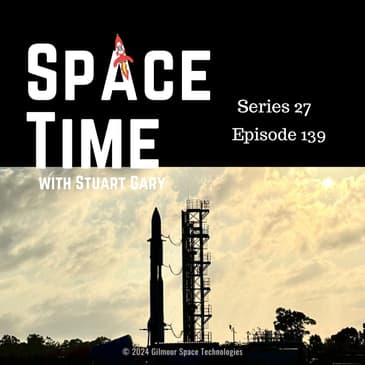



*Gilmore Space Cleared for Orbital Launch
The Australian Space Agency has granted Gilmore Space the final approval needed to conduct its maiden orbital test flight of the Ares rocket from the Bowen Spaceport in North Queensland. This launch will mark the first orbital test flight of an Australian-made rocket from Australian soil, showcasing a new hybrid propulsion system developed by the company.
*Discovery of Red Monster Galaxies in the Early Universe
Astronomers have identified three ultra-massive galaxies, each nearly the size of the Milky Way, that reached their colossal size within the first billion years of the universe's existence. These findings, reported in Nature, challenge existing models of galaxy formation and suggest a more efficient star formation process in the early universe.
*Signs of an Ancient Martian Ocean
China's Mars rover, Zhurong, may have found evidence supporting the theory that Mars' northern hemisphere was once covered by a vast ocean. The terrain around Zhurong's landing site includes features that could indicate past water or ice activity, suggesting a Martian ocean existed billions of years ago.
The Science Robert
Archaeologists in Israel have uncovered 12,000-year-old pebbles that may be precursors to the wheel, potentially pivotal in the evolution of rotating technologies. Meanwhile, the COP 29 climate summit highlights the ongoing rise in fossil emissions, with China remaining the largest polluter. Additionally, a study finds that frequent snoring in tweens is linked to behavioural issues, and a lack of conceptual clarity may explain beliefs in the paranormal.
www.spacetimewithstuartgary.com
www.bitesz.com
🌏 Get Our Exclusive NordVPN deal here ➼ www.bitesz.com/nordvpn. Enjoy incredible discounts and bonuses! Plus, it’s risk-free with Nord’s 30-day money-back guarantee! ✌
Check out our newest sponsor - Old Glory - Iconic Music and Sports Merch and now with official NASA merch. Well worth a look....
Become a supporter of this Podcast for as little as $3 per month and access commercial-free episodes plus bonuses: https://www.spreaker.com/podcast/spacetime-with-stuart-gary--2458531/support
00:00 This is space Time Series 27 Episode 139 for broadcast on 18 November 2024
00:46 Australian Space Agency gives final approval for Gilmore Space to launch Ares rocket
02:31 ERIS is a three stage orbital launch vehicle powered by hybrid rocket engines
08:49 Gilmore is developing a rocket called ERIS which will go into orbit
12:42 Gilmore Space Technologies have plans to launch an ERIS satellite from Bowen
15:39 Three ultra massive galaxies discovered by NASA's Webb Space Telescope
23:39 Ancient pebbles from Israel may have paved way for wheel invention
24:42 New study finds teens who frequently snore more likely to have behavioural problems
✍️ Episode References
Event Horizon Telescope Collaboration
[Event Horizon Telescope](https://eventhorizontelescope.org/)
National Astronomical Observatory of Japan
[NAOJ](https://www.nao.ac.jp/en/)
Monthly Notices of the Royal Astronomical Society
[MNRAS](https://academic.oup.com/mnras)
NASA Cassini Mission
[Cassini Mission](https://www.nasa.gov/mission_pages/cassini/main/index.html)
Planetary Science Journal
[PSJ](https://iopscience.iop.org/journal/
3338)
6--- University of Hawaii
[University of Hawaii](https://www.hawaii.edu/)
NASA Goddard Space Flight Centre
[NASA Goddard](https://www.nasa.gov/goddard)
Montreal Protocol
[Montreal Protocol](https://ozone.unep.org/treaties/montreal-protocol)
Nature Geoscience
[Nature Geoscience](https://www.nature.com/ngeo/)
Macquarie University
[Macquarie University](https://www.mq.edu.au/)
[00:00:00] This is SpaceTime Series 27 Episode 139, for broadcast on the 18th of November 2024.
[00:00:07] Coming up on SpaceTime, Gilmore Space given the green light to launch to orbit,
[00:00:12] mysterious red monster galaxies discovered in the early universe,
[00:00:17] and has China's Mars rover found signs of an ancient Martian ocean?
[00:00:22] All that and more coming up on SpaceTime.
[00:00:26] Welcome to SpaceTime with Stuart Gary
[00:00:45] The Australian Space Agency has given final approval for Gilmore Space
[00:00:50] to undertake its first orbital test flight of the company's new Ares rocket
[00:00:54] from the Bowen spaceport in North Queensland.
[00:00:57] The company had hoped to launch earlier this year, but had to wait for the official green light by Acer.
[00:01:03] The company's CEO, Adam Gilmore, says the approval will allow the Gold Coast-based operation
[00:01:08] to attempt the first orbital test flight of an Australian-made rocket from Australian soil.
[00:01:14] Gilmore hoped to launch their 25-metre-tall Ares rocket before the end of the year.
[00:01:19] The company successfully completed a major wet dress rehearsal of the launch vehicle in September,
[00:01:24] progressing the countdown all the way down to T-minus 10 seconds.
[00:01:28] The upcoming test flight 1 will be the first of several planned test launches to reach orbit with Ares,
[00:01:34] which uses a new hybrid propulsion system developed by the company for its first and second stages.
[00:01:40] Since starting its rocket program in 2015,
[00:01:43] Gilmore Space has expanded to more than 200 employees,
[00:01:46] built a local supply chain of more than 300 Australian companies,
[00:01:50] attracted significant private investment,
[00:01:52] gained support from local, state and federal governments,
[00:01:54] and actively engaged communities across the region.
[00:01:58] Its new Bowen spaceport at Abbott Point will initially provide access to low and mid-inclination orbits.
[00:02:05] Brian Greenham, head of avionics with Gilmore Space Technologies,
[00:02:08] says it's been a long wait for the official government approval,
[00:02:11] and the company's ready to fly.
[00:02:13] Look, at the moment we're aiming for mid-December,
[00:02:16] but you know, as launchers often do, they uncover problems,
[00:02:19] and it's likely with our first vehicle we might encounter some,
[00:02:22] but it might push out into January, but me and the team,
[00:02:25] we're working super duper hard to try and get that launch in December if we can,
[00:02:29] because it'd be a good Christmas present.
[00:02:31] So tell me about the Ares launch vehicle.
[00:02:32] Yep. So Ares is a three-stage orbital launch vehicle.
[00:02:36] It's designed to lift a couple hundred kilos into low Earth orbit,
[00:02:40] and basically what makes her a bit different from a lot of other launch vehicles
[00:02:44] is that she's predominantly powered by hybrid rocket engines.
[00:02:48] So we have four hybrid rocket engines on the first stage,
[00:02:51] a single hybrid on the second stage,
[00:02:53] and the upper stage is a liquid, locked kerosene engine.
[00:02:57] And that's basically they give us that final push into orbit.
[00:02:59] It's a completely Australian design launch vehicle,
[00:03:02] everything from the electronics and software that my team does
[00:03:06] through to the engines and tanks and structures of other departments in Gilmore do.
[00:03:11] It's all been designed and built here in Australia.
[00:03:13] So when it lifts off,
[00:03:15] it'll be the first Australian built rocket to launch from Australian soil,
[00:03:18] which is pretty fantastic, pretty groundbreaking.
[00:03:21] Now, when you say hybrid, what does that mean?
[00:03:23] What is hybrid rocket fuel?
[00:03:25] Yeah, basically it means that the rocket has different states of matter to burn together.
[00:03:29] So we use a liquid oxidizer and a solid fuel.
[00:03:33] So normally you'd have a liquid fuel and a liquid oxidizer like LOX and kerosene.
[00:03:40] We use basically a plastic and a liquid oxidizer.
[00:03:44] And that basically means that when the engine's just sitting there not being used,
[00:03:48] fuel is not volatile.
[00:03:49] It's completely safe.
[00:03:50] You can go up and touch the fuel and it won't do anything to you,
[00:03:54] which means that it makes handling the rocket a lot easier.
[00:03:57] The fuel is in the form of pellets, isn't it?
[00:03:59] It's actually what we call a grain.
[00:04:01] Right.
[00:04:01] And the grain is a large cylinder of fuel.
[00:04:05] So basically somewhat similar to a solid rocket motor, you know,
[00:04:10] where you cast an entire motor into a big long donut shape.
[00:04:14] And then we have something similar inside our engine.
[00:04:17] And can it be restarted once it's started or once it's turned on, it's got to burn out?
[00:04:21] Yeah.
[00:04:22] So a hybrid rocket engine has some of the benefits of a liquid rocket engine in that you can throttle
[00:04:27] and you can restart.
[00:04:28] Obviously this mission, the design of this mission is that we start the engines and we continue to burn
[00:04:33] until we've used up all the fuel and oxidizer and then we turn them off.
[00:04:36] So we're not intending to do a restart with the hybrid this time, but it's totally possible to do with hybrid engines in general.
[00:04:43] So we call the engines a serious engine, like the start.
[00:04:46] Yeah.
[00:04:47] And so there's four serious main engines on stage one.
[00:04:50] It's just quite a, yeah, it's quite a cool design.
[00:04:54] There's electric pumps, which are feeding the oxidizer into those engines.
[00:04:59] So there's pretty big rocket inside there.
[00:05:01] You've got four big battery packs that are sort of similar size, you know,
[00:05:05] a Tesla battery pack can fit a person inside that section of the rocket.
[00:05:09] If you were to do work on it, moving up to the second stage is a really interesting packaging for the rocket.
[00:05:14] So it's a single serious hybrid engine, but it's actually got a toroidal tank, which encompasses the engine.
[00:05:20] So I think that a really great packaging solution keeps the rocket a bit shorter, which is good.
[00:05:25] Otherwise it ends up with a really long slender rocket, which isn't great for bending.
[00:05:29] Yeah.
[00:05:29] And then the stage three is a good rocket engine.
[00:05:31] So it's much, much smaller.
[00:05:33] It just provides a high efficiency kick to get us into the final orbit.
[00:05:36] And how do you control it?
[00:05:38] Is it all gimballed?
[00:05:38] Yeah.
[00:05:39] So it's also pretty unique in our control.
[00:05:41] We actually use vernier thrusters.
[00:05:43] Sorry, some of your listeners have seen the photos.
[00:05:45] You may see eight thrusters sticking out the bottom of stage one.
[00:05:50] And basically they're wired to control the rocket attitude.
[00:05:53] And then we also have vernier thrusters on stage two.
[00:05:57] Another eight of them, just a bit smaller and optimized for higher altitude.
[00:06:01] The third stage is a, is a gimbal design.
[00:06:03] So it's much easier to do gimballing with a liquid rocket engine because you can give the
[00:06:07] entire engine, whereas the serious motors are quite large.
[00:06:11] So it's quite difficult to, to gimbal those.
[00:06:13] But yeah, the verniers are the only control method that we use to control the attitude of
[00:06:19] the rocket.
[00:06:19] And what about the burn time for each stage?
[00:06:22] It's around about two minutes.
[00:06:24] The burn time a little bit less.
[00:06:26] So they can be altered, of course, if you needed to, but for this mission, they burn for
[00:06:30] about two minutes.
[00:06:31] Obviously you can vary the amount of oxidizer going into the hybrid rocket engine.
[00:06:35] But for our optimal trajectory, it's around about two minutes.
[00:06:38] As you said, the initial AERIS will be a 200 kilogram payload.
[00:06:41] So will eventually you'd be looking at adding strap on boosters to increase payload capacity
[00:06:46] or altitude?
[00:06:47] So for us, we've got sort of like a block upgrade path coming ahead.
[00:06:53] So similar to what SpaceX did with the Falcon vehicles, we'll be continuing to iterate the
[00:06:58] AERIS launch vehicle to find reliability, performance improvement, and slowly get that payload up to
[00:07:05] something that competitive in the market and then useful for the customers that we've got lined up.
[00:07:10] So yeah, over the next two, three launch vehicles, they'll probably look pretty similar to the one that we've got.
[00:07:16] And then we'll probably do a major block upgrade, which will change some of the larger structures
[00:07:20] on the vehicle and will change the way that the rocket looks.
[00:07:23] So we're doing that and we're sort of doing it concurrently as well.
[00:07:26] So the second launch vehicle is incorporating design improvements from the manufacturing of the first vehicle,
[00:07:32] even though we haven't flown the first vehicle yet.
[00:07:35] And then we're flying the first vehicle and incorporating the learnings from launch into the third vehicle that we're building
[00:07:41] so that we can continuously improve the rocket and have a better chance of getting to orbit on the second chance
[00:07:47] and then better performance, better payload on subsequent rockets as well.
[00:07:51] We mentioned the Falcon 9 earlier, of course, once you talk about that, you've got to talk about reusable rockets.
[00:07:57] Even Electron is looking at parachuting their rockets back to Earth after use.
[00:08:02] Are those sort of things down the line?
[00:08:04] Yeah, I think one day we'll look at doing reusability.
[00:08:06] I think it's a fundamental part of being competitive in the space industry as these new reusable launch vehicles come online.
[00:08:15] But at the moment, yeah, we're focused on getting to orbit for the first time.
[00:08:17] Get there first.
[00:08:18] Yeah, exactly.
[00:08:20] Yeah, we've got to get there first and then we can start exploring some of those really cool technologies like reusability.
[00:08:25] I know you've got customers lined up already.
[00:08:27] That must be good news.
[00:08:29] Yeah, it's good to have people lining up to launch with us.
[00:08:32] We've had a really positive response from getting the launch license.
[00:08:36] So they're excited to see us fly.
[00:08:37] Yeah, we're just excited to prove our capability.
[00:08:40] And then if we don't make it to orbit this first time, find out why and apply those improvements to the next launch vehicles going forward so that we can start flying our customers.
[00:08:49] And what's the trajectory for the launch?
[00:08:51] Yeah, so we're going up for a fairly low orbit.
[00:08:54] So we're looking to 200 to 300 kilometers.
[00:08:58] We're doing an equatorial orbit with inclinations around about 20 degrees.
[00:09:02] And that will see us lift off that bowline in North Queensland, head out over the Coral Sea, go out over the Pacific Ocean, and then do a couple of orbits around the planet with our third stage transmitting telemetry back to us.
[00:09:15] So pretty standard sort of trajectory, just a direct injection to orbit.
[00:09:20] Nothing too fancy.
[00:09:21] It's a test flight.
[00:09:22] So we want to just exercise all the systems as best we can and see how far we make it.
[00:09:26] Is there a separate dummy payload on top of the third stage or is the third stage it?
[00:09:30] Basically, the third stage is it.
[00:09:32] It is the test flight is the payload.
[00:09:34] So this flight's all for us to see how well the system performs.
[00:09:39] I think we might have something fun put up on there later on, but we haven't said anything about that yet.
[00:09:43] Rockets about 23, 24 meters tall, about two meters in diameter on the first stage and narrows down to about 1.5 meters diameter on the second stage in payload bearing.
[00:09:55] So it's pretty small as far as I go.
[00:09:57] It's a bit bigger than Electron, but a lot smaller than Falcon 9.
[00:10:01] Well, Electron's proved to be really good for the New Zealanders at roughly four launches a year, four or five launches a year.
[00:10:07] They're doing fantastic.
[00:10:08] Yes.
[00:10:08] I think they recently had their 50th launch not that long ago, which is a super fantastic milestone.
[00:10:14] Incredible rocket, incredible company.
[00:10:16] I have a bunch of friends who work over at Rocket Lab.
[00:10:19] They've all sent me messages and we got our launch license and they're cheering us on over there.
[00:10:23] I think the space industry is a pretty small community and we all know each other and we're all excited to see people progressing and making achievements, new launch vehicles going up.
[00:10:34] So it's nice to have the support from the guys over the ditch.
[00:10:37] And yeah, we hope they keep having continued successful launches of Cork.
[00:10:40] With the success of the Electron, Rocket Lab are already developing their next rocket, the Neutron.
[00:10:46] That won't be launched from New Zealand.
[00:10:47] That'll be launched from Virginia.
[00:10:49] Much bigger project, much more ambitious project.
[00:10:52] Much more reusable.
[00:10:52] Yeah.
[00:10:53] Including the payload bay itself.
[00:10:55] Yep.
[00:10:55] Are you guys looking that far in advance already or are you guys at this stage just focusing on getting the AERIS flying?
[00:11:02] Look, I mean, practically this is, you know, we're working hard to make sure that we can get AERIS operational.
[00:11:08] You know, it's our first rocket, like I said, the first rocket that's been developed in Australia.
[00:11:12] So a lot of time and energy is going into building up our own knowledge, our company's expertise in rocketry.
[00:11:20] So that's our main focus at the moment.
[00:11:22] But we've got really big ambitions at Gilmore.
[00:11:25] We want to do human space flight at some stage.
[00:11:28] So we're always looking towards the future.
[00:11:30] I think we're, reusability is a big part of the future of rocketry.
[00:11:34] So it's something that we'd like to do in the future.
[00:11:36] But right now we're just focused on getting to orbit for the first time.
[00:11:40] I'll be looking forward to receiving my notice to airmen.
[00:11:43] Yes, absolutely.
[00:11:44] Keep an eye out for your, you know, Tim, don't want anyone flying or driving their boat into the collision zones.
[00:11:50] That'll hold us up.
[00:11:51] Not safe for them either.
[00:11:52] Is there a production line of air is already on the factory floor?
[00:11:56] Yeah.
[00:11:57] So the first rocket's obviously up at the launch site.
[00:11:59] And so that one's getting ready to fly.
[00:12:02] The second rocket is getting built on the factory right now.
[00:12:05] We've already finished a number of the major structures and the engines for the second flight.
[00:12:10] And a whole bunch of integration activities going on for that rocket right now.
[00:12:14] So I can look across the factory floor right now.
[00:12:17] I can see main tanks and large structures for that rocket.
[00:12:20] What do you build the rockets out of?
[00:12:21] Are they carbon fiber or?
[00:12:22] So we've gone pretty conventional.
[00:12:24] The major structures of our rocket are all mostly aluminium.
[00:12:27] We do utilize composites around the rocket for various things, you know, for engines,
[00:12:33] for structures where we need it.
[00:12:35] And then we've got your exotic materials like Inconel and titanium on a case-by-case basis
[00:12:40] for engines and those components.
[00:12:42] We've talked a lot about the rocket.
[00:12:44] What about the launch facilities themselves?
[00:12:46] What's at Bowen?
[00:12:47] Well, we call it the Bowen Orbital Space Port or BOSS for short.
[00:12:51] Bowen's a great little seaside town up in northern Queensland.
[00:12:55] And it's a facility that's designed for Gilmore.
[00:12:59] So it can support the AERIS launch vehicle.
[00:13:02] We've got a launch pad.
[00:13:03] We've got the tower there, all of the propellant storage facilities.
[00:13:06] We have some on-site ground test facilities as well for doing large propulsion tests.
[00:13:11] I spend most of my time during launch activities up in the launch control center, which is a
[00:13:16] couple of kilometers up the road.
[00:13:18] And that's a little space where we have all of the consoles for launch operations and a
[00:13:24] bunch of the telemetry system as well for our receive antennas for the telemetry that's
[00:13:29] coming down to the rocket.
[00:13:29] That's all coming in and being displayed on software that we've designed and written ourselves
[00:13:34] here at Gilmore.
[00:13:36] It's just a pretty cool little facility.
[00:13:37] Bowen's a really nice place as well.
[00:13:39] It's a pretty popular little tourist spot.
[00:13:41] So you can see the launch site from Flagstaff Hill, which is in town there.
[00:13:46] And so, yeah, hopefully as we get closer and a bit more certain, we'll know the launch date.
[00:13:50] People will be able to see the rocket launching from Bowen itself.
[00:13:53] Yeah, that's what Southern Launch are doing with Whalers Way there.
[00:13:56] As they're getting ready for each launch, they're letting the public know that we've
[00:14:00] got a launch coming up either at Whalers Way or Canimba.
[00:14:03] Yep, Canimba, yep.
[00:14:04] And people can go there at a safe distance and watch the whole thing take place.
[00:14:08] Yeah, it's pretty cool that you can go and potentially do that in Australia now.
[00:14:12] Yeah, definitely in Cape Canaveral or Texas or Virginia or Vanderbilt.
[00:14:22] Yeah, yep.
[00:14:23] It's a great peninsula.
[00:14:24] It's pretty cold and windy.
[00:14:25] And I've been over to Kennedy as well.
[00:14:27] It's a fantastic facility, but I don't think anything's going to beat being able to go
[00:14:32] to the Great Barrier Reef and watch a rocket launch and then, you know, go out and enjoy
[00:14:36] the amazing actual wonders that are there.
[00:14:39] So it's a pretty sweet spot.
[00:14:40] I remember seeing rocket launches from Woomera and that was not fun.
[00:14:45] Yeah, pretty hot.
[00:14:46] Some of the guys here have been out to Woomera on other, you know, vehicle test campaigns
[00:14:50] and it's obviously a historic place for Australian rocketry.
[00:14:54] Yeah, when you see Lake Hart and the two launch pads that were there or the edifices that
[00:14:59] are left there now, you realise what a huge scale that was on.
[00:15:02] Yeah, I think it was Blue Streak was the rocket.
[00:15:06] Like we surprisingly share a lot of similarities with those rockets and hopefully this time we
[00:15:12] can keep it going and continue to launch vehicles from Australia.
[00:15:15] Of course, RESAP made Australia the third country in the world to launch a satellite
[00:15:20] from its own soil.
[00:15:21] Pretty amazing that we could do that.
[00:15:23] One step, Woomera was the second biggest spaceport in the world after Cape Canaveral.
[00:15:28] Yeah.
[00:15:28] It was a cadence, yeah.
[00:15:29] Yeah, it's impressive.
[00:15:31] One day again, who knows?
[00:15:32] Yes, hopefully soon from Boeing.
[00:15:34] That's Brian Greenham, head of avionics with Gilmore Space Technologies.
[00:15:38] And this is space-time.
[00:15:41] Still to come, astronomers discover three ultra-massive galaxies each nearly as big as the Milky Way,
[00:15:47] which have amazingly already reached that size within the first billion years of the universe's
[00:15:52] existence.
[00:15:53] And has China's Mars rover found signs of an ancient Martian ocean?
[00:15:59] All that and more still to come on space-time.
[00:16:18] Astronomers have discovered three ultra-massive galaxies, each nearly as big as the Milky Way,
[00:16:23] which had already reached that size within the first billion years of the universe's existence.
[00:16:28] The surprising discovery, reported in the journal Nature, raises new questions about how galaxies
[00:16:34] can grow so large so quickly.
[00:16:36] The findings suggest that the formation of stars in the early universe must have been far more efficient
[00:16:42] than previously thought, challenging existing galaxy formation models.
[00:16:45] The three red monster galaxies were identified during observations by NASA's Webb Space Telescope
[00:16:52] as part of the FRESCO program, which is systematically analysing a complete sample of emission-line galaxies
[00:16:58] within the first billion years of cosmic history.
[00:17:02] Emission-line galaxies are ones emitting strong spectral emission lines,
[00:17:06] which use different wavelengths of light to tell astronomers about the chemical composition of the source
[00:17:11] and how fast they're moving towards or away from us.
[00:17:14] These emission lines appear as bright lines in spectral wavelengths standing out against the darker background of the spectrum.
[00:17:21] The presence of the emission lines enabled the authors to accurately pin down the distances to these galaxies.
[00:17:27] And the strength of the emission lines allowed them to reliably measure the amount of stars contained in each galaxy.
[00:17:33] Due to their high dust content, which is giving these three massive galaxies a distinctive red appearance in the web images,
[00:17:39] the three red monsters.
[00:17:42] The study's lead author, Meng Yuen Zhao from the University of Geneva, says the new findings are reshaping science's understanding of galaxy formation in the early universe.
[00:17:51] And finding three such massive beasts among the sample poses a tantalising puzzle.
[00:17:56] See, many processes in galaxy evolution have a tendency to introduce what astronomers refer to as a rate-limiting step
[00:18:04] in how efficiently gas can be converted into stars.
[00:18:07] Yet somehow these red monsters appear to have swiftly evaded most of these hurdles.
[00:18:12] Until now it was believed that all galaxies form gradually within large halos of dark matter.
[00:18:18] It's the dark matter halos which capture gas into gravitationally bound structures.
[00:18:23] Typically, roughly 20% of this gas at most is then converted into stars and galaxies.
[00:18:29] However, the new findings are challenging this view, revealing that massive galaxies in the early universe
[00:18:35] may have grown far more rapidly and efficiently than previously thought.
[00:18:39] Details in the FRESCO study was captured through slitless spectroscopy using Webb's near-infrared camera,
[00:18:45] a surveying method that allows light to be captured and unraveled into its constituent wavelength
[00:18:50] for all objects within the viewing field.
[00:18:53] And this makes it an excellent method for measuring accurate distances and physical characteristics of galaxies.
[00:18:59] By analysing galaxies included in the FRESCO survey, scientists found that most galaxies fit existing models.
[00:19:06] But they also found these three surprisingly big galaxies, each with stellar masses comparable to today's Milky Way galaxy.
[00:19:13] And of course, it took the Milky Way 13.8 billion years to reach this size.
[00:19:19] Yet these galaxies have achieved similar masses in just a billion years.
[00:19:23] It also means they're forming stars nearly twice as efficiently as lower mass galaxies from the same epoch,
[00:19:29] or ordinary galaxies at later times in cosmic history.
[00:19:33] While these new findings don't conflict with the standard cosmological model,
[00:19:36] they do raise questions for galaxy formation theories,
[00:19:39] specifically the issue of too many massive galaxies in the early universe.
[00:19:44] It means current models will need to consider unique processes
[00:19:47] that allow some early massive galaxies to achieve very efficient star formation
[00:19:52] and thus form incredibly rapidly in the early universe.
[00:19:56] As astronomers study these galaxies in more depth,
[00:19:59] they'll undoubtedly uncover new insights into the conditions that shaped the universe's very earliest epochs.
[00:20:05] It means these red monsters discovered by Webb are just the beginning of a new era in our exploration of the early universe.
[00:20:13] Future observations using Webb and also ALMA,
[00:20:16] the Atacama Large Millimeter Submillimeter Array Radio Telescope in Chile,
[00:20:21] will provide further insights into these ultra-massive red monsters,
[00:20:24] and hopefully reveal larger samples of such sources.
[00:20:29] This is space-time.
[00:20:31] Still to come, has China's Mars rover found signs of an ancient Martian ocean?
[00:20:37] And later in the science report,
[00:20:38] archaeologists in Israel have uncovered what appears to be the precursor to the wheel,
[00:20:44] probably the most important invention in human history.
[00:20:47] All that and more still to come on space-time.
[00:21:05] Beijing claims its Mars Zhirong rover has found new evidence to support the idea that the red planet's northern hemisphere
[00:21:12] was once the floor of a vast Martian ocean.
[00:21:16] Orbital images by American and European spacecraft have already imaged what appear to be ancient coastline seashores and beaches
[00:21:24] surrounding the vast northern lowlands.
[00:21:26] This ancient ocean may have covered up to a third of the Martian surface.
[00:21:31] The Zhirong rover landed on the Martian northern hemisphere's utopia Planitia back in 2021,
[00:21:37] where previous indications of an ancient ocean billions of years ago had been detected.
[00:21:43] The studies lead author, Boo Wu from the Hong Kong Polytechnic University,
[00:21:47] says the terrain around Zhirong's landing site included pitted cones, polygonal troughs and etched flows.
[00:21:54] A report in the journal Nature says the crater-like pitted cones could have been created by mud volcanoes.
[00:22:00] These are often formed in areas where there had been water or ice.
[00:22:04] The authors estimate that if it is signs of an ocean,
[00:22:08] that ocean would have been created by flooding nearly 3.7 billion years ago.
[00:22:12] But as the Martian atmosphere thinned and the planet cooled,
[00:22:15] the ocean would have frozen, etching out the coastline before disappearing around 3.4 billion years ago.
[00:22:21] However, other scientists have pointed out that features similar to a coastline
[00:22:26] could have been created by strong Martian winds blowing around sediment for billions of years,
[00:22:31] gradually wearing down rocks to look like a seashore.
[00:22:35] Meanwhile, three Chinese Tarkonauts have returned safely to Earth
[00:22:39] following their six-month stay aboard Beijing's Tiangong space station.
[00:22:43] China's state-run Xinhua news agency claims the trio arrived back on Earth in good condition
[00:22:49] after touching down aboard their Shenzhou-18 capsule in the Dongfeng landing zone of Inner Mongolia.
[00:22:55] They had flown to the space station back in April
[00:22:58] and were met last month by their Shenzhou-19 replacements during a five-day handover before returning to Earth.
[00:23:04] Beijing are now working closely with Moscow on a new manned program to the Moon,
[00:23:10] which will include establishing a joint Sino-Russian base at the lunar South Pole.
[00:23:15] This is Space Time.
[00:23:33] And time now to take a brief look at some of the other stories making news in science this week with the Science Report.
[00:23:39] The wheel was the most important invention in human history,
[00:23:44] but the identity of those who invented it has always been a mystery.
[00:23:48] Now, archaeologists in Israel have discovered their first clue.
[00:23:53] Scientists have uncovered 12,000-year-old pebbles from an archaeological dig site in northern Israel
[00:23:58] which appear to be the precursors to what would eventually result in the invention of the wheel.
[00:24:04] A report in the journal PLAS ONE says scientists studied a collection of over 100 mostly limestone donut-shaped rocks,
[00:24:12] each of which had a hole drilled in the middle.
[00:24:14] The items date back to the transition into the Neolithic period,
[00:24:18] long before the Bronze Age, by which time cartwheels had become common.
[00:24:22] The authors suspect that these drilled stones were used as spindle whirls for making cloth,
[00:24:27] and they then reinforced this theory by successfully using replicas to spin flax.
[00:24:33] Scientists say these tools may have paved the way for later rotating technologies,
[00:24:38] such as the potter's wheel and ultimately the cartwheel.
[00:24:42] The latest update from the COP29 climate summit in Baku, Azerbaijan,
[00:24:47] has been told that fossil emissions are continuing to rise due to ongoing growth in coal, oil and natural gas use.
[00:24:54] The Earth Science Data report says that while collective efforts have seen total carbon emissions from fossil fuels
[00:25:01] and land use change plateau over the past decade, mostly due to a decline in the emissions from deforestation,
[00:25:07] the change was not enough to drive emissions down.
[00:25:10] In fact, the concentration of carbon dioxide in the atmosphere is set to reach 422.5 parts per million this year.
[00:25:18] That's 2.8 parts per million above the 2023 figure and 52% above pre-industrial levels.
[00:25:25] The World Meteorological Organization says China remains the world's biggest carbon dioxide polluter,
[00:25:31] producing a third of the world's total output.
[00:25:34] It amounts to more than 10.2 million tonnes annually.
[00:25:39] A new study has found that tweens who frequently snore are more likely to have behavioural problems.
[00:25:46] The findings reported in the Journal of the American Medical Association follow earlier studies
[00:25:50] which link snoring to both behaviour and learning problems in younger children.
[00:25:54] But less was known about what happens to this link in later childhood.
[00:25:59] So, scientists analysed data from a teen brain development study comparing snoring frequency with behaviour and brain function.
[00:26:07] The research involved some 12,000 children with an average age of 10 at the start of the survey
[00:26:12] who were followed up for five years.
[00:26:14] Now during that time period the number of participants dropped to just 4,668.
[00:26:20] Still, the authors found that frequent snoring was associated with behavioural problems,
[00:26:25] but not with brain function or learning problems.
[00:26:29] They say these behavioural problems did not increase over time
[00:26:32] and snoring in general decreased among the group throughout the study period.
[00:26:37] A new study suggests that a lack of conceptual clarity
[00:26:41] might tend to mistakenly attribute living characteristics to inanimate objects
[00:26:46] and that in turn could be linked to a greater likelihood of believing in the paranormal.
[00:26:52] Tim Mendham from Australian Skeptic says
[00:26:54] the psychological pattern could help explain why supernatural beliefs are so common
[00:26:59] despite the lack of hard evidence.
[00:27:01] Yeah, there's a common thing that people often say called pareidolia
[00:27:03] which is where you see images in just random shapes.
[00:27:07] The classic is the man and the moon.
[00:27:08] Now that's one aspect of this.
[00:27:10] This particular study that's done by psychologists
[00:27:13] is looking at broader view of this.
[00:27:14] This is called ontological confusion.
[00:27:16] Gesundheit.
[00:27:17] Yeah, the ontological meaning the nature of being, of what something is, if you like.
[00:27:21] And he was suggesting that some people make a problem
[00:27:24] differentiating between a thing and something more abstract.
[00:27:27] That would lead to the belief in the paranormal.
[00:27:29] So a thing being an object, a person, an actual physical thing
[00:27:33] as opposed to a sound or an abstract idea or something which is more ephemeral.
[00:27:38] And normally when you grow up you can differentiate between physical things and non-physical things.
[00:27:42] From a very young age you can differentiate between things and abstract ideas.
[00:27:46] So you know when there's a person there, when there's a toy there, etc.
[00:27:50] And you differentiate.
[00:27:51] When I was five I once had my mum buy me a pair of shoes because I felt sorry for them.
[00:27:56] Exactly, yes.
[00:27:57] So you can attribute sort of emotions to things.
[00:27:59] But if you carry that on into later life, it's called an ontological confusion.
[00:28:03] They're suggesting that this is almost like a clinical condition.
[00:28:06] That people have trouble differentiating between a thing and a concept.
[00:28:10] And suggesting as you say that shoes can be happy or sad or a rock can have an emotion.
[00:28:14] People can start seeing reactions where they want to see reactions.
[00:28:18] So anything which is subjective or quirky experiences or technical glitches in recording devices
[00:28:22] or just general misperceptions can become defined, if you like, as the paranormal.
[00:28:27] If something goes wrong, therefore they presume there's a reason for that.
[00:28:30] Like if a computer goes wrong or your screen goes wrong or something, you...
[00:28:34] You've got to bash it.
[00:28:35] Yeah, you do.
[00:28:36] You have to bash it three times and it works.
[00:28:38] But if you're bashing a ghost, if you're suggesting that it's a ghost interfering,
[00:28:40] then you have this slight problem between the real world, the physical world and the non-physical world.
[00:28:45] And that's where this study came from.
[00:28:47] I've looked at a lot of previous studies that actually covered about 16,000 people from 11 countries,
[00:28:52] across different cultures if there were differences.
[00:28:54] But they're saying it's pretty much quite common for this condition to exist.
[00:28:57] So it's a psychological issue, not a cultural one.
[00:29:00] Yes, it's almost like a very human psychological issue.
[00:29:03] Yeah, it's one explanation for why people might believe in the paranormal
[00:29:07] because they're basically just mistaking one thing for another.
[00:29:09] And it's almost saying that you can't help it.
[00:29:11] And that it might be worse in some people than others.
[00:29:13] This meta study, so I was looking at a lot of previous studies, 25 of them,
[00:29:17] shows some sort of indication that this actually might be a condition worth looking at.
[00:29:21] That's Tim Mendham from Australian Skeptics.
[00:29:39] And that's the show for now.
[00:29:41] Spacetime is available every Monday, Wednesday and Friday through Apple Podcasts, iTunes, Stitcher, Google Podcasts, Pocket Casts, Spotify, Acast, Amazon Music, Bytes.com, SoundCloud, YouTube, your favorite podcast download provider and from Spacetime with Stuart Gary dot com.
[00:30:00] Spacetime's also broadcast through the National Science Foundation on Science Zone Radio and on both iHeart Radio and TuneIn Radio.
[00:30:08] And you can help to support our show by visiting the Spacetime store for a range of promotional merchandising goodies or by becoming a Spacetime patron,
[00:30:18] which gives you access to triple episode commercial free versions of the show, as well as lots of bonus audio content, which doesn't go to air access to our exclusive Facebook group and other rewards.
[00:30:28] Just go to Spacetime with Stuart Gary dot com for full details.
[00:30:33] You've been listening to Spacetime with Stuart Gary.
[00:30:36] This has been another quality podcast production from Bytes dot com.