
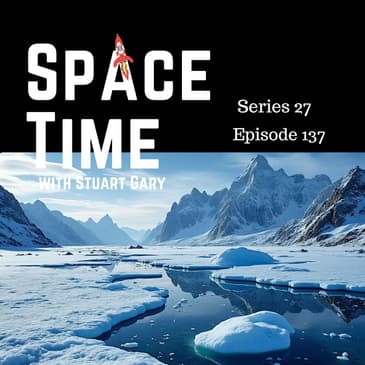



*The Earth: A Giant Slushie?
New research reveals that Earth once experienced a "slushy" period following its snowball Earth phase. Published in the Proceedings of the National Academy of Sciences, the study by Virginia Tech scientists suggests that as the planet thawed, it transitioned into a slushy state, marked by high carbon dioxide levels and rapid melting. The findings offer fresh insights into Earth's climate evolution and the resilience of life under extreme conditions.
*Phobos Eclipses the Sun
NASA's Mars Perseverance rover has captured a rare celestial event: the Martian moon Phobos eclipsing the Sun. Using its Mastcam-Z camera, Perseverance observed the tiny moon transiting the Sun from its position in Jezero Crater. This remarkable event highlights the ongoing challenges and discoveries as the rover ascends the crater's rim.
*SpaceX Dragon Boosts ISS
For the first time, NASA has utilized the SpaceX Dragon capsule to boost the International Space Station into a higher orbit. This maneuver, using Dragon's Draco thrusters, is part of a broader strategy to maintain the station's altitude and test future deorbit capabilities. The mission also delivered over 2,700 kg of supplies and scientific equipment, including a wooden cubesat and human tissue samples for aging research.
The Science Report
A new study attributes last year's global temperature spike primarily to El Nino, rather than climate change. Meanwhile, scientists discover a 161-million-year-old giant tadpole fossil, shedding light on the evolution of frogs and toads. Additionally, research indicates that popular music in the US has become simpler since the 1950s. Plus, global cell phone sales show regional variations post-COVID, with notable growth in the US, Europe, and Australia.
www.spacetimewithstuartgary.com
www.bitesz.com
🌏 Get Our Exclusive NordVPN deal here ➼ www.bitesz.com/nordvpn. Enjoy incredible discounts and bonuses! Plus, it’s risk-free with Nord’s 30-day money-back guarantee! ✌
Check out our newest sponsor - Old Glory - Iconic Music and Sports Merch and now with official NASA merch. Well worth a look....
Become a supporter of this Podcast and access commercial-free episodes plus bonuses: https://www.spreaker.com/podcast/spacetime-with-stuart-gary--2458531/support
00:00 This is space Time Series 27, episode 137 for broadcast on 13 November 2024
00:47 New research suggests that as the planet thawed, it went slushy
04:46 NASA's Mars Perseverance rover captures rare Phobos eclipse of the Sun
07:15 NASA uses SpaceX Dragon cargo ship to boost International Space Station to higher altitude
14:38 Study says El Nino Southern Oscillation caused global temperatures spike last year
16:55 Scientists in South America have discovered the fossilized remains of a 161 million year old tadpole
18:33 New figures show that global cell phone sales dropped following the COVID pandemic
[00:00:00] This is SpaceTime Series 27 Episode 137, for broadcast on the 13th of November 2024.
[00:00:06] Coming up on SpaceTime…
[00:00:08] A new study shows the Earth was once a giant slushy,
[00:00:12] scientists watch in amazement as the Martian moon Phobos eclipses the Sun,
[00:00:17] and a SpaceX Dragon capsule used to boost the space station into a higher orbit for the first time.
[00:00:24] All that and more coming up on SpaceTime.
[00:00:28] Welcome to SpaceTime with Stuart Gary.
[00:00:47] A new study has found that planet Earth once went through a global slushy period.
[00:00:52] Previous evidence has already shown that our planet has experienced several so-called snowball Earth events,
[00:00:58] during which time the entire globe was frozen over with a covering of ice and snow.
[00:01:03] The last snowball Earth took place between 635 and 650 million years ago.
[00:01:08] But that raises an interesting question. What happened next?
[00:01:12] The new research, reported in the journal of the Proceedings of the National Academy of Sciences,
[00:01:17] suggests that as the planet thawed, it went slushy.
[00:01:20] The findings are based on work by a scientist at Virginia Tech,
[00:01:24] which provides the first direct geochemical evidence of a slushy Earth.
[00:01:27] More scientifically, it's referred to as the Plume World Ocean Era,
[00:01:32] a time when sky-high carbon dioxide levels forced the frozen Earth into a massive rapid melting period.
[00:01:39] The study's lead author, Tien Gan, says the results have important implications
[00:01:42] for understanding how Earth's climate and ocean chemistry changed after the extreme conditions of the last global ice age.
[00:01:49] Scientists believe global temperatures began to drop,
[00:01:53] and the polar ice caps began to creep around the hemispheres between 635 and 650 million years ago,
[00:01:59] as the growing ice sheets reflected more and more sunlight back into space,
[00:02:04] setting off a spiral of plunging temperatures.
[00:02:07] The authors believe that at least a quarter of the ocean volume was frozen
[00:02:11] due to extremely low carbon dioxide levels.
[00:02:13] And when the surface ocean sealed, a chain of reactions shuddered to a stop.
[00:02:19] The water cycle locked up.
[00:02:21] That resulted in no evaporation and very little rain or snow.
[00:02:25] And without water, there was a massive slowdown in a carbon dioxide consuming process
[00:02:30] known as chemical weathering, where rocks erode and disintegrate.
[00:02:34] Without weathering and erosion, carbon dioxide began to amass in the atmosphere and trap heat.
[00:02:40] Eventually, over millions of years,
[00:02:41] carbon dioxide levels were once again high enough to break the snowball Earth syndrome.
[00:02:46] And the authors of this study believe that when that ended,
[00:02:50] it probably ended catastrophically, with heat suddenly starting to build up very rapidly.
[00:02:55] The ice caps began to recede, and the Earth's climate backpedaled furiously.
[00:02:59] They say that over a mere 10 million years,
[00:03:02] average global surface temperatures swung from minus 45 degrees Celsius to plus 48 degrees Celsius.
[00:03:08] But the thing is, their research shows that the ice didn't melt and remix with seawater at the same time.
[00:03:15] The research findings paint a very different world, with vast rivers of glacial water rushing like a sort of reverse tsunami from the land into the sea,
[00:03:24] then pooling on top of the extra salty, extra dense ocean water.
[00:03:28] Now, in order to test this idea of their prehistoric world,
[00:03:32] the authors looked at a set of carbonate rocks that formed as the global ice age was ending.
[00:03:37] They then analyzed the relative abundance of lithium isotopes recorded within these carbonates.
[00:03:42] Now, according to the Plume World Ocean theory,
[00:03:45] the geochemical signatures of fresh water would be stronger in rocks formed under near-shore meltwater conditions,
[00:03:52] than in rocks formed offshore beneath a deep salty sea.
[00:03:55] And that's exactly what the authors observed.
[00:03:58] The new findings bring the limit of environmental change into better focus,
[00:04:03] providing scientists with additional insights into the frontiers of biology
[00:04:06] and the resiliency of life under extreme conditions, hot, cold and slushy.
[00:04:11] This is space-time.
[00:04:14] Still to come, scientists watch in awe as the Martian moon Phobos eclipses the sun,
[00:04:19] and NASA have used the SpaceX Dragon cargo ship to boost the International Space Station up into a higher orbit for the first time.
[00:04:27] All that and more still to come on Space Time.
[00:04:45] Scientists working with NASA's Mars Perseverance rover have just experienced a rare Phobos eclipse of the sun.
[00:04:52] The event was captured by the rover's Mascam-Z camera as the tiny Phobos moon transited in front of the sun.
[00:05:00] Mars' two moons, Phobos and Deimos.
[00:05:03] And Perseverance was just in the right position on Jezero crater
[00:05:07] to be able to point its camera up towards Phobos as it passed overhead and transited directly in front of the sun.
[00:05:14] It was a stunning moment.
[00:05:16] During the past week, Perseverance has continued climbing up Jezero crater's rim,
[00:05:21] and this steep ascent through the Martian regolith has continued to prove to be a slow drive
[00:05:26] with the worlds continuing to slip on the steepest areas.
[00:05:30] Mission managers have described it as trying to run up a hill of sand on a beach.
[00:05:35] All this means science and engineering teams are working closely together
[00:05:38] to plan slow and steady drives through this tricky terrain.
[00:05:42] But there have been some interesting gains.
[00:05:45] Driving through a region known as the Mount Rainier Quadrangle,
[00:05:48] mission managers identified a relatively obstacle-free path to reach the crater rim,
[00:05:53] which they've designated the Summerland Trail,
[00:05:55] aptly named for a popular hiking trail that ascends Mount Rainier.
[00:05:59] Perseverance is tracking to the next waypoint near an outcrop of rocks called Pico-to-Cuno,
[00:06:04] where the science team hopes to perform its next proximity investigations using its Pixel instrument
[00:06:09] and the now back-online Sherlock instrument.
[00:06:12] While roving the Summerland Trail, Perseverance is constantly observing the surrounding terrain.
[00:06:18] SuperCam and MassCam-Z have been observing rocks on the ground and on a distant hill known as Crystal Creek.
[00:06:24] And it was during these observations that Perseverance was able to turn its eyes to the sky
[00:06:30] and make observations of the Sun and the atmosphere, including the solar transit of Phobos.
[00:06:36] This is space-time.
[00:06:38] Still to come, NASA has used the SpaceX Dragon capsule for the first time
[00:06:42] to boost the International Space Station up into a higher orbit.
[00:06:46] And later in the science report, a new study has confirmed that it was El Niño, not climate change,
[00:06:52] which was the primary cause of last year's spike in global temperatures.
[00:06:56] All that and more still to come on Space Time.
[00:07:15] NASA have used the SpaceX Dragon cargo ship for the first time
[00:07:19] to boost the International Space Station up into a higher orbit.
[00:07:22] The station normally orbits at an altitude of around 400 kilometres.
[00:07:27] However, even the limited amount of atmospheric drag from the rarefied air at these altitudes
[00:07:32] can cause some gradual orbital decay.
[00:07:35] And so, visiting space shuttles were always used to boost the space station
[00:07:39] back up to higher altitudes during their visits.
[00:07:42] Once the space shuttles were retired,
[00:07:45] American Cygnus and Russian Progress cargo ships took over that role.
[00:07:49] But now, NASA asked SpaceX to undertake the task
[00:07:52] using the Dragon cargo ship's aft-facing Draco thrusters for a 12-and-a-half-minute burn.
[00:07:58] As well as lifting the space station to a higher altitude,
[00:08:01] the re-boost test will also aid in developing SpaceX's United States de-orbit vehicle.
[00:08:06] That will eventually be used in 2030 to de-orbit the International Space Station
[00:08:10] and ensure that it burns up in the atmosphere at a safe location.
[00:08:14] By using the Dragon to boost the space station up into a higher altitude,
[00:08:19] mission managers can undertake specific orbital trajectory and velocity tests
[00:08:23] and carefully observe the results.
[00:08:25] NASA is also believed to be testing its ability to manoeuvre the space station
[00:08:29] using just Cygnus and Dragon spacecraft.
[00:08:32] That's in the event that the Russian orbital segment,
[00:08:35] which historically has handled the re-boosting and manoeuvring of the space station,
[00:08:39] is ultimately abandoned or detached from the U.S. orbital segment by Moscow.
[00:08:44] Moscow have repeatedly stated that they want to leave the International Space Station project.
[00:08:48] However, they keep changing the timing of when they're going to leave
[00:08:52] because of ongoing delays in the construction of their own new space station.
[00:08:56] When they do eventually leave, possibly in 2028,
[00:08:59] at least that's the latest estimate,
[00:09:01] it's likely they'll take the Russian orbital segment of the space station with them.
[00:09:05] The space station altitude boost was just one of the highlights
[00:09:08] of NASA's SpaceX CRS-31 mission to the orbiting outpost.
[00:09:13] The flight aboard a Falcon 9 rocket from Pad 39A at the Kennedy Space Center in Florida
[00:09:18] docked with the forward-facing port of the Harmony module.
[00:09:21] On board the Dragon cargo ship were some 2,762 kilograms of food, supplies and scientific equipment.
[00:09:29] The cargo manifest included some 961 kilograms of crew supplies,
[00:09:34] 917 kilograms of scientific equipment and experiments,
[00:09:38] 171 kilograms of new space walking equipment,
[00:09:41] 238 kilograms of space station hardware and 20 kilograms of computer resources.
[00:09:46] The new technology includes equipment to study the solar wind,
[00:09:51] a study looking at the behaviour of Staphylococcus biofilms in microgravity
[00:09:55] that could yield new insights into infection prevention in space,
[00:09:59] exploring the germination of spinach seeds in space,
[00:10:02] potentially leading to improved space-based agriculture,
[00:10:05] and analysing the effects of powdered hydration products in space.
[00:10:10] Other projects are looking at the development of brine shrimp in microgravity
[00:10:13] as part of an aquaculture study and using nematodes to evaluate how effectively these small worms
[00:10:19] can combat insect pests in space.
[00:10:21] The Dragon capsule is also carrying Antarctic moss to study the effects of cosmic radiation
[00:10:26] and microgravity on plant biology.
[00:10:29] There's a cold welding device aboard as well.
[00:10:32] It'll test metal bonding in microgravity and a material science investigation
[00:10:36] to understand how space environments alter different substances.
[00:10:40] These studies are all designed to increase science's knowledge base for long-duration space missions
[00:10:45] and potential human settlement on other worlds.
[00:10:48] But probably the most unusual experiment brought up by the Dragon capsule
[00:10:52] was the world's first wooden satellite developed by students at Kyoto University.
[00:10:57] The 10x10cm cubesat, called Lignosat, is equipped with sensors to test its strength and durability
[00:11:04] and to see how it reacts to the strain of the space environment.
[00:11:07] It'll be launched from the space station in about a month.
[00:11:11] Scientists expect the wooden material to burn up when the device re-enters the Earth's atmosphere,
[00:11:15] potentially providing a new way to avoid generating metallic particles
[00:11:19] when retired satellites return to Earth.
[00:11:22] Meanwhile, Oxford University's Space Innovations Lab has set up its first human tissue samples.
[00:11:27] It's part of a science package designed to study the effects of microgravity on the human aging process.
[00:11:34] This research could help people better cope with the biological effects of long-duration space flight.
[00:11:39] This report from the University of Oxford.
[00:11:42] Power and lift off.
[00:11:44] Astronauts in the International Space Station, they have a problem with their muscles,
[00:11:48] so muscles atrophy, they have problems with their bones, so they lose the bone.
[00:11:52] They have a problem with articulation and also their immune system.
[00:11:55] So when we look at all this, we think they might have kind of accelerating aging.
[00:12:01] If the astronauts have this problem in a very short time, while we need 14 years in Earth,
[00:12:08] this will give us a huge opportunity to understand aging and maybe we find actually a way to treat
[00:12:14] several age-related diseases.
[00:12:16] They were enthusiastic about going to space and they had the right ideas of what to do and what to test.
[00:12:22] What more perfect situation could you have?
[00:12:25] To study the pathway of aging in this way, we were also the first to do this, from my knowledge.
[00:12:31] So what we do, we take cells from patients and we put them back together in a controlled environment.
[00:12:38] So the idea is to mimic the organ and where you could put all the cells present in the true tissue.
[00:12:45] We want to kind of use our cellular base system to model this and model the joints specifically in space
[00:12:50] using microgravity as an accelerant for the aging process.
[00:12:53] And then we're going to send some of them to the International Space Station
[00:12:58] and other will stay in Earth because we need to compare.
[00:13:02] That's the plan, we just put them in the smaller tubes and send it to the ISS. Very easy.
[00:13:08] This partner company called IceCube gives us a box which is connected with computers, with cameras, with lights.
[00:13:18] The students here at Botner can walk into the Space Innovation Lab,
[00:13:22] which is our connection to the International Space Station, and get data that's downloaded and look at it right away.
[00:13:29] We would be able really to control all the samples every second, every minute.
[00:13:34] This is the sunrise in orbit right now. It's very impressive. You picked a very good time for this.
[00:13:39] On day three of my PhD, I'm flying to the Kennedy Space Center to hail up on a rocket launch. It's very surreal.
[00:13:45] It is very cool. We are all excited.
[00:13:51] I watched science fiction. I watched Captain Kirk and he would be on a planet and he would call Scotty.
[00:13:58] With this phone right now, I can do exactly that. I can call an astronaut on the International Space Station
[00:14:05] and talk to them and implement some really neat experiments and activities that will lead, I think, to enhancing our quality of life as we age.
[00:14:15] So in my lifetime, that was total science fiction and it's now a reality.
[00:14:23] And in that report from Oxford University, we heard from Principal Investigator Gada Alsala from Oxford Space Innovations Lab,
[00:14:30] former NASA Chief Scientist James Green, and Vincent Gautier and Declan Moran, also from Oxford Space Innovations Lab.
[00:14:38] This is Space Time.
[00:14:40] And time now to take another brief look at some of the other stories making news in science this week with the Science Report.
[00:15:01] A new study by scientists with the University of Miami has identified the recent El Niño Southern Oscillation
[00:15:07] as the primary cause of last year's spike in global surface temperatures rather than human-induced climate change.
[00:15:15] The findings, reported in the journal Atmospheric Chemistry and Physics,
[00:15:18] are based on an analysis of models that allow the Earth's climate to evolve without any influence from human activity.
[00:15:24] It showed a 10% chance of a spike in temperatures occurring when an El Niño event is preceded by a long La Niña, as happened in 2022-23.
[00:15:35] Global temperatures last year reached unprecedented levels, with many regions experiencing extreme heat,
[00:15:41] which contributed to one of the hottest years on record.
[00:15:43] The year saw remarkable temperature anomalies, especially in Europe and parts of the Middle East,
[00:15:49] where heat waves brought record highs often exceeding 40 degrees Celsius.
[00:15:52] The oceans also reached higher than normal temperatures, resulting in weather extremes such as intense storms and prolonged droughts in various parts of the world.
[00:16:02] The authors say the new findings don't take away from the fact that human emissions of greenhouse gases are responsible for the long-term warming trend,
[00:16:09] and that this warming will continue until the net emission of carbon dioxide and other greenhouse gases is brought to zero.
[00:16:30] The world's biggest carbon dioxide polluter, producing almost a third of the total global output, amounting to more than 10.2 million tonnes annually.
[00:16:42] That's almost double that of the United States, which is in second place, and four times that of India, which is in third place.
[00:16:51] Australia is in 16th position.
[00:16:55] Scientists in South America have discovered the fossilised remains of a 161 million-year-old giant tadpole.
[00:17:01] A report in the journal Nature indicates the amphibian was around 16 centimetres long.
[00:17:07] The discovery adds to science's understanding of the evolution of frogs and toads, because key features of today's tadpoles, including their filter feeding system, are present in these ancient counterparts.
[00:17:18] The fossils remarkably well-preserved, with the head, eyes, nerves, a limb, and most of the body and part of the tail all visible.
[00:17:27] The presence of the limb suggests that this tadpole was close to becoming an adult when it met its unfortunate demise.
[00:17:33] The authors say the fossil shows that the two-stage life cycle and dramatic metamorphosis were already present in frogs and toads at least 161 million years ago.
[00:17:45] A new study has found that music from the most popular songs each year in the United States have become simpler and less complex in their form since the 1950s.
[00:17:55] The findings, published in the journal Scientific Reports, analysed the most prominent melodies from songs that reached the top five positions on the US Billboard year-end singles music charts each year between 1950 and 2022.
[00:18:09] They say as time went by, the complexity of song rhythms and the variation in pitch decreased, while the average number of notes played per second increased.
[00:18:19] They noted big decreases in 1975 and the year 2000, which they speculate could be from the rise of new wave, disco and stadium rock in the 70s, and then hip-hop and audio looping into the noughties.
[00:18:32] New figures show that global cell phone sales have dropped in the wake of the COVID pandemic.
[00:18:38] But the data also shows the drops aren't uniform, but instead are regionally based.
[00:18:44] With the details, we're joined by technology editor Alex Saharov-Royt from TechAdvice.life.
[00:18:49] Yeah, well, look, during the pandemic, obviously sales went up.
[00:18:53] Then once the pandemic was over, sales dropped quite a lot because people just didn't need new devices.
[00:18:58] But we're now a couple of years on from the pandemic, we're nearly in 2025.
[00:19:02] And Kantar, one of the big market research firms, has launched their smartphone operating system quarterly data.
[00:19:08] And they say that year on year, their sales have dropped about 2%.
[00:19:13] Now, this is driven by weaker demand in mainland China and Japan.
[00:19:17] But there have been strong growth in smartphone sales in the US, 21%.
[00:19:21] And in Europe's top five markets, it's grown by 13%.
[00:19:25] And in Australia, where we are, it's grown by 19%.
[00:19:27] These stats don't take into account the launch of the new iPhone 16 range because they're for the third quarter of 2024.
[00:19:35] So in this timeframe, iPhone 15 series has continued to be the most popular smartphone range.
[00:19:40] Interestingly, in European top five markets in the US, Australia and Japan, this was the iPhone 15.
[00:19:46] So this is basically the regular model that didn't have the faster chip than the five times optical zoom with three cameras.
[00:19:52] But in mainland China, the iPhone 15 Pro Max was the top selling model.
[00:19:56] And then you've got a range of usually Samsung Galaxy devices.
[00:20:00] But in mainland China, we also saw Huawei's purer range, kind of their biggest mid range that had done very well too.
[00:20:07] But China's a distorted market because Google Play is not available there.
[00:20:10] They have a range of their own app stores.
[00:20:12] And in fact, in China, I was actually in Shenzhen, the Silicon Valley of China in early October.
[00:20:18] And I got to see the triple screen phone and compare it with the Google Pixel folding phone.
[00:20:22] And each of the slices were thinner than each side of the Google Pixel fold.
[00:20:27] But when you put it all together, a triple screen phone with the giant camera thing on the back was a bit thicker.
[00:20:32] But still, it was very cool to be able to unfold a 6.9 inch device into a 10 inch tablet.
[00:20:38] So Huawei is doing very well in the US.
[00:20:40] But until somebody in the US allows Huawei to have access to Google Play,
[00:20:45] then it's unlikely we're going to see too many Huawei devices sold around the world.
[00:20:49] And now that Trump's been inverted back in to power,
[00:20:51] I don't think we're going to see Huawei being given access to Google Play again.
[00:20:56] Yeah, but the concern with Huawei, of course, has always been what information they're pulling from you
[00:21:01] and what they're not telling you.
[00:21:02] Well, that's very true.
[00:21:03] And, you know, another company that's tough with the same fate was ZTE,
[00:21:07] which was a Chinese brand that Telstra sold a lot of in Australia,
[00:21:11] with their own branded Telstra-branded phones that were ZTE.
[00:21:14] They had some of these tradish phones, also ZTE.
[00:21:17] So Huawei and ZTE have been the two companies that have been really targeted.
[00:21:20] But a number of other Chinese brands have, you know, sailed on through no problems.
[00:21:24] Oppo, Wevo, Bonovo is the company that owns Motorola
[00:21:28] and they do very well in Australia.
[00:21:30] But yes, Huawei was accused of leaking secrets to the Chinese government.
[00:21:35] That's Alex Saharov-Royt from techadvice.life.
[00:21:39] And that's the show for now.
[00:21:56] Space Time is available every Monday, Wednesday and Friday through
[00:21:59] Apple Podcasts, iTunes, Stitcher, Google Podcasts, Pocket Casts, Spotify, Acast, Amazon Music,
[00:22:06] Bytes.com, SoundCloud, YouTube, your favourite podcast download provider
[00:22:11] and from SpaceTimeWithStewartGary.com.
[00:22:15] Space Time is also broadcast through the National Science Foundation
[00:22:18] on Science Zone Radio and on both iHeart Radio and TuneIn Radio.
[00:22:23] And you can help to support our show by visiting the Space Time store
[00:22:26] for a range of promotional merchandising goodies.
[00:22:29] Or by becoming a Space Time patron, which gives you access to triple episode commercial-free
[00:22:34] versions of the show, as well as lots of bonus audio content which doesn't go to air,
[00:22:39] access to our exclusive Facebook group and other rewards.
[00:22:42] Just go to SpaceTimeWithStewartGary.com for full details.
[00:22:47] And if you want more Space Time, please check out our blog where you'll find all the stuff
[00:22:51] we couldn't fit in the show, as well as heaps of images, news stories, loads of videos and
[00:22:56] things on the web I find interesting or amusing.
[00:22:58] Just go to SpaceTimeWithStewartGary.tumblr.com.
[00:23:03] That's all one word and that's Tumblr without the E.
[00:23:06] You can also follow us through at Stuart Gary on Twitter,
[00:23:10] at SpaceTimeWithStewartGary on Instagram,
[00:23:12] through our Space Time YouTube channel.
[00:23:15] And on Facebook, just go to Facebook.com forward slash SpaceTimeWithStewartGary.
[00:23:20] You've been listening to Space Time with Stuart Gary.
[00:23:23] This has been another quality podcast production from Bytes.com.