
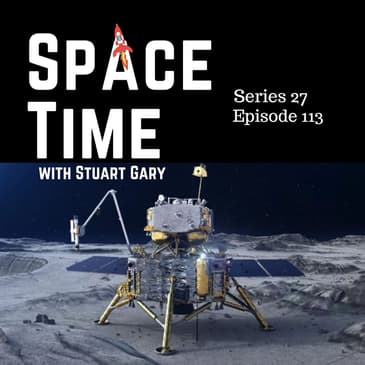


*Recent volcanism on discovered on the Moon Scientists have discovered evidence of volcanism on the lunar surface as recently as 125 million years ago. *The Strange phenomena people will see at Moon's south pole When astronauts return to the Moon’s surface as part of the Artemis 3 mission to the Lunar south pole, they’ll experience a very different environment to that which the Apollo astronauts witnessed more than half a century ago. *A new crew arrives at the International Space Station The Russian Soyuz MS-26 capsule has successfully docked with the International Space station just three hours after its launch aboard a Soyuz 2.1a rocket from the Baikonur Cosmodrome in in the central Asian republic of Kazakhstan. *The Science Report Study shows up to 19% of dementia cases could be linked to vision problems. Over 52 million tonnes of plastic dumped into the environment every year. The growing amount of incorrect AI generated data being generated. Alex on Tech: are the new iPhone 16s worth it?
www.spacetimewithstuartgary.com
www.bitesz.com
Become a supporter of this podcast: https://www.spreaker.com/podcast/spacetime-with-stuart-gary--2458531/support.
[00:00:00] [SPEAKER_01]: This is spacetime series 27,713 for broadcast on the 18th of September 2024. Coming up on spacetime, recent Volcanism discovered on the Moon, the strange phenomena people are likely to see when they finally walk on the Moon's south pole.
[00:00:18] [SPEAKER_01]: And a new crew arrives aboard the International Space Station, all that and more coming up on spacetime.
[00:00:45] [SPEAKER_01]: Scientists have discovered evidence of Volcanism on the lunar surface as recently as 125 million years ago.
[00:00:52] [SPEAKER_01]: The findings reported in the journal Science, suggests the Moon was volcanically active for far longer than previously thought with volcanoes erupting as recently as when dinosaurs were walking on Earth.
[00:01:04] [SPEAKER_01]: There's extensive geological evidence of ancient Volcanic activity on the Moon, but exactly how long this Volcanism persisted has been unclear until now.
[00:01:13] [SPEAKER_01]: The new evidence is based on radioicetop dating of three volcanic glass beads, which were found in lunar soils collected by the Changi-Five Sapper Return Mission.
[00:01:24] [SPEAKER_01]: The dating of lunar volcanic basalt samples returned to Earth by both the American Apollo and Soviet Union lunar missions or delivered to Earth as lunar meteorites have already shown that lunar basaltic volcanism continued until at least 2.9 to 2.8 billion years ago.
[00:01:40] [SPEAKER_01]: Earlier in analysis of lunar samples returned by a China's Changi-Five Mission,
[00:01:45] [SPEAKER_01]: had already demonstrated that basaltic volcanism still persisted on the Moon until at least 2.9 billion years ago.
[00:01:52] [SPEAKER_01]: Remembrance sensing observations had indicated potentially even younger volcanism,
[00:01:56] [SPEAKER_01]: possibly dating to the Copernican era at least 800 million years ago.
[00:02:01] [SPEAKER_01]: A ruptions of gas rich magma can generate magma fountains and these produce sub-millimeter size glass beads.
[00:02:08] [SPEAKER_01]: These beads could potentially be deposited over a fairly wide area,
[00:02:12] [SPEAKER_01]: and subsequently be transported even further away across the lunar surface by impact events.
[00:02:18] [SPEAKER_01]: Researchers with the Institute of Geology and Geophysics at the Chinese Academy of Sciences identified
[00:02:23] [SPEAKER_01]: three volcanic glass beads while studying some 3000 glass beads in lunar soil samples,
[00:02:28] [SPEAKER_01]: carefully examining textures and elemental compositions, including their sulfur-icitor ratios.
[00:02:33] [SPEAKER_01]: The signatures of the three volcanic glass beads differed from those of other glass beads,
[00:02:38] [SPEAKER_01]: which have been caused by impact events thus providing a criteria for distinguishing volcanic
[00:02:43] [SPEAKER_01]: glasses from impact glasses. The scientists then used uranium-led dating for the three volcanic
[00:02:49] [SPEAKER_01]: glass beads showing that they had formed some 123 million years ago, give or take 15 million years.
[00:02:56] [SPEAKER_01]: The findings mean that the radioicitor dating of the three Changi-Five volcanic glass beads
[00:03:01] [SPEAKER_01]: provides the first definitive evidence of 123 million-year-old volcanism on the lunar surface.
[00:03:08] [SPEAKER_01]: This is space time. Still to come, the strange phenomena people will see when they arrive
[00:03:14] [SPEAKER_01]: at the Moon South Pole and a new crew arrives aboard the International Space Station.
[00:03:20] [SPEAKER_01]: All that and more are still to come, on space time.
[00:03:38] [SPEAKER_01]: When astronauts return to the Moon's surface as part of the item's three mission to the lunar
[00:03:43] [SPEAKER_01]: South Pole, the little experience of very different environment that which the Apollo astronauts
[00:03:48] [SPEAKER_01]: witnessed more than half a century ago. Instead of regular periods of day and night with the Earth's
[00:03:53] [SPEAKER_01]: blue orbs, a constant companion in the Vover Black skies, landing near the Moon South Pole will mean
[00:03:59] [SPEAKER_01]: a strangely hovering sun and giant shadows. See near the Moon South Pole, astronauts will see
[00:04:05] [SPEAKER_01]: dramatic shadows that at 25 to 50 times longer than the objects casting them. That's because
[00:04:11] [SPEAKER_01]: the Sun's light will strike the lunar surface at a very low angle, hanging just a few degrees
[00:04:16] [SPEAKER_01]: above the horizon. As a result, astronauts won't be seeing any sun rises or sun sets.
[00:04:23] [SPEAKER_01]: Instead, they'll simply watch it hover near the horizon as it moves horizontally across the sky.
[00:04:29] [SPEAKER_01]: Because sunlight at the Moon's South Pole skims the surface horizontally,
[00:04:33] [SPEAKER_01]: at brushes crater rims but doesn't always reach their floors.
[00:04:37] [SPEAKER_01]: Some deep craters haven't seen the light of day for billions of years,
[00:04:40] [SPEAKER_01]: so temperatures there could dip to minus 168 degrees Celsius. That's nearly three times colder
[00:04:46] [SPEAKER_01]: than the lowest temperatures recorded in Antarctica. At the other extreme, areas in direct sunlight
[00:04:52] [SPEAKER_01]: such as the crater rims or which temperatures are more than 55 degrees Celsius. And of course
[00:04:58] [SPEAKER_01]: the Moon, unlike the Earth, doesn't have a thick atmosphere to scatter blue light, so the daytime
[00:05:03] [SPEAKER_01]: sky on the Moon will always be black. So astronauts will see a star contrast between the dark sky
[00:05:09] [SPEAKER_01]: and the bright ground. The Adamus Moon walkers will find a rugged landscape that takes skill to
[00:05:15] [SPEAKER_01]: traverse. See, the Moon has mountains, valleys, and canyons just like on Earth. But the most
[00:05:21] [SPEAKER_01]: notable feature for astronauts on the surface will be the Moon's millions of craters. And
[00:05:26] [SPEAKER_01]: neither South Pole those gaping craters together with the long shadows will make it difficult for
[00:05:31] [SPEAKER_01]: astronauts to traverse and navigate. However, some other unique features on the Moon will see
[00:05:37] [SPEAKER_01]: more familiar to those who remember the Apollo missions. The first will be Luna dust and its
[00:05:42] [SPEAKER_01]: regolith. It coats the Moon's surface and looks like fine, very soft, talcum powder. But looks
[00:05:49] [SPEAKER_01]: can be deceiving. See, Luna regolith is formed when meteorodes hit the Moon's surface, melting
[00:05:55] [SPEAKER_01]: and shattering rocks into tiny, sharp pieces. Now because the Moon doesn't have any erosion
[00:06:00] [SPEAKER_01]: so to speak, there's no moving water or wind to smooth out these regolith grains so they simply
[00:06:06] [SPEAKER_01]: stay sharp and scratchy, posing a risk to astronauts in their equipment. One of the reasons
[00:06:11] [SPEAKER_01]: the Adamus crews will have new spacesuits is because the suits worn by the Apollo astronauts
[00:06:16] [SPEAKER_01]: were being damaged by the sharp dusty Luna surface. And because the Moon has no atmosphere to
[00:06:21] [SPEAKER_01]: speak of, its surface is exposed to plasma and radiation from the Sun. As a result of this,
[00:06:27] [SPEAKER_01]: static electricity tends to build up on the surface exactly the same way as it does when you
[00:06:32] [SPEAKER_01]: shuffle your feet against a carpet of floor. Then when you touch something, you transfer that
[00:06:37] [SPEAKER_01]: charge by way of a small static electric shock. I know that's annoying, but on the Moon this
[00:06:43] [SPEAKER_01]: transfer could short-circuit electronics. And this talcum powder like Moon dust can also make its
[00:06:49] [SPEAKER_01]: way into the astronauts living quarters. That's because the static electricity causes a distinct
[00:06:54] [SPEAKER_01]: space suits. When the Apollo astronauts complete their EVAs on the Luna surface and took off
[00:07:00] [SPEAKER_01]: their space suits once back in their Luna modules, they all noticed a strange metallic smell.
[00:07:06] [SPEAKER_01]: That was the Luna dust. It's the smell of the Moon. And it's dangerous because this does
[00:07:12] [SPEAKER_01]: to so fine it can get into your lungs in airways and that could cause long-term health problems.
[00:07:18] [SPEAKER_01]: So, NASA's been developing new methods to keep the dust at bay using resistant textiles,
[00:07:23] [SPEAKER_01]: filters and a shield that employs an electric field to remove dust from surfaces.
[00:07:29] [SPEAKER_01]: Back in 1972 while doing an EVA on the Luna surface, Apollo 16 astronaut Charles Duke
[00:07:35] [SPEAKER_01]: hammered a core sample tube into the Moon surface until it met a rock and wouldn't go any further.
[00:07:41] [SPEAKER_01]: Then the hammer flew out of his hand. He made four attempts to pick it up by bending down
[00:07:47] [SPEAKER_01]: and leaning to reach for it. Eventually gave up and returned to the rover to get tongues and finally
[00:07:52] [SPEAKER_01]: pick up the hammer successfully. An Artemis Moon walkers will face similar challenges. The Apollo
[00:07:58] [SPEAKER_01]: crews found it easier to bunny hop or kangaroo hop as they moved across the Luna surface.
[00:08:03] [SPEAKER_01]: The Artemis crews will undoubtedly do the same. That's because gravity won't pull them down as
[00:08:09] [SPEAKER_01]: forcefully as it does on Earth. See, the Moon's only a quarter of the size of the Earth with
[00:08:14] [SPEAKER_01]: six times less gravity. So, simple activities like swinging a rock hammer to chip of samples
[00:08:19] [SPEAKER_01]: will feel very different. While the hammer will feel lighter to hold, it's inertia won't
[00:08:24] [SPEAKER_01]: change leading to a strange sensation for astronauts. Of course, the lower gravity has perks too.
[00:08:31] [SPEAKER_01]: Astronauts won't be weighed down by their hefty spaces and apparently bunny hopping across the
[00:08:36] [SPEAKER_01]: Luna surface is just plain fun. When the Artemis astronauts look up at the sky from the Luna
[00:08:42] [SPEAKER_01]: surface they'll see their home planet the Earth shining back at them. And just like us mere
[00:08:47] [SPEAKER_01]: Earthlings see different phases of the Moon's round a month, astronauts on the Moon will see
[00:08:52] [SPEAKER_01]: an ever-shifting Earth. But the Earth's phases will occur opposite to the Moon's. When the Earth's
[00:08:58] [SPEAKER_01]: experiences are new Moon, a full Earth will be visible from the Luna surface. And finally,
[00:09:03] [SPEAKER_01]: because the Moon's smaller than the Earth, its horizon will look shorter and closer. That is someone
[00:09:08] [SPEAKER_01]: standing on level ground on the Earth's surface, the horizon's about five kilometers away.
[00:09:13] [SPEAKER_01]: But to astronauts on the Moon, it'll only be two kilometers away, making their surroundings
[00:09:18] [SPEAKER_00]: seem more confined. More from the STV. I'm Arne Wright. I work in the scientific
[00:09:25] [SPEAKER_00]: visualization studio at NASA's Goddard Space Flight Center, a computer model of the view
[00:09:30] [SPEAKER_00]: at the South Pole of the Moon. This is like a time lapse to show the motion of the Sun and the Earth
[00:09:34] [SPEAKER_00]: and how the shadows change over time. Things don't rise and set in the usual way here. The Sun
[00:09:40] [SPEAKER_00]: travels around the horizon, never getting more than a degree and a half above or below it.
[00:09:45] [SPEAKER_00]: So they're always warm shadows. And from here, the Earth appears to be upside down and
[00:09:51] [SPEAKER_00]: rotating backwards. But that's just because of our point of view. The Earth doesn't move much in
[00:09:57] [SPEAKER_00]: the Moon's sky. It's always in roughly the same place, just sort of bobbing around. That's true
[00:10:03] [SPEAKER_00]: everywhere on the near side of the Moon. It's a consequence of the Moon always pointing the same
[00:10:07] [SPEAKER_00]: way towards Earth. It takes about a month for the Sun to make a complete circuit around the
[00:10:12] [SPEAKER_00]: horizon, and every so often it'll pass behind the Earth, creating an eclipse. On Earth that would
[00:10:19] [SPEAKER_00]: be a total lunar eclipse of the Moon passing through the shadow cast by the Earth. But if you're
[00:10:24] [SPEAKER_00]: standing on the Moon, it's in a eclipse of the Sun. The terrain at the South Pole is especially
[00:10:30] [SPEAKER_00]: rugged. It's unlike never reaches the crater floor. So temperatures there are around 300 degrees
[00:10:36] [SPEAKER_00]: below the low zero Fahrenheit. Model of the terrain is made possible by lunar reconnaissance
[00:10:41] [SPEAKER_00]: orbit, which has been mapping the surface of the Moon from lunar orbit since 2009.
[00:10:47] [SPEAKER_00]: The maps will be incredibly important for exploring the Moon and locating water and other
[00:10:51] [SPEAKER_01]: resources there. This is space-time. Still to come, a new crew arrive on the International Space Station,
[00:11:00] [SPEAKER_01]: and later in the Science Report, a new study shows that up to 19% of dementia cases could be linked
[00:11:06] [SPEAKER_01]: to vision problems, or that and more still to come on space-time.
[00:11:26] [SPEAKER_01]: The Russian Soyuz MS-26 capsule is successfully docked with the International Space Station just three
[00:11:31] [SPEAKER_01]: hours after its launch aboard a Soyuz 2-1A rocket from the back end or Cosmodrome in the
[00:11:36] [SPEAKER_02]: Central Asian Republic of Kazakhstan. Countdown clocks are ticking backward for the launch of the Soyuz
[00:11:41] [SPEAKER_02]: MS-26 spacecraft atop. It's Soyuz booster at 11.23 AM Central Time, 12.23 PM Eastern Time,
[00:11:49] [SPEAKER_02]: 9.23 PM in PICONOR. We now have Injun sequence start. The second of Biblical Tower is now separating.
[00:12:03] [SPEAKER_02]: But Injun's are at max. For us, booster, ignition, full throttle and we have lift off of
[00:12:09] [SPEAKER_02]: Pettit, O'Chinen and Wagner. Now on their way to the International Space Station as part of a two-war
[00:12:14] [SPEAKER_02]: bid journey. We are seeing a good vehicle problem at the ground at the airport. Vehicle performance
[00:12:20] [SPEAKER_05]: is continuing to look good. Now just over a minute into the A-Swanche.
[00:12:40] [SPEAKER_02]: On their sneak a yacht pitch and roll, put it down range.
[00:12:48] [SPEAKER_02]: Blossie is over 1,100 miles per hour. Everything continuing to proceed as planned.
[00:12:55] [SPEAKER_02]: Just a few seconds, the escape tower will be jettisoned.
[00:13:00] [SPEAKER_02]: We now see First-Age separation. We crew members reported they are feeling well and we
[00:13:10] [SPEAKER_02]: are having a good pitch roll and jaw of the vehicle. We are 4 minutes and 45 seconds into
[00:13:15] [SPEAKER_02]: today's flight. We have about 4 minutes of powered flight remaining.
[00:13:27] [SPEAKER_02]: And we just saw Second-Age separation in the Third-Stage Hats ignited.
[00:13:34] [SPEAKER_02]: Soy is now being propelled by the single engine of the Soy's third stage.
[00:13:42] [SPEAKER_02]: And we have confirmation of Third-Stage separation. The single liquid-fueled
[00:13:48] [SPEAKER_02]: engine has shut down and has dropped away at an altitude of about 126 miles.
[00:13:53] [SPEAKER_02]: And we have confirmation that the solar rays and an antenna has been deployed.
[00:13:58] [SPEAKER_01]: The mission carrying two Russian cosmonauts in an American astronaut
[00:14:01] [SPEAKER_01]: docked automatically with the space station's Resvent modules in their airport using
[00:14:05] [SPEAKER_01]: Russia's 2.5 orbit fast-run of a flight path. The mission had been delayed since March,
[00:14:11] [SPEAKER_01]: when an automated warning system halted the launch after detecting a voltage drop in the
[00:14:16] [SPEAKER_01]: power system. The new crew will remain on station as part of the Expedition 71 72 mission until March
[00:14:23] [SPEAKER_01]: 25. This is space time. Now for another brief look at some of the other stories making
[00:14:45] [SPEAKER_01]: using science this week with the science report. A new study has found that between
[00:14:50] [SPEAKER_01]: five and 19 percent of dementia cases in the United States could be linked to vision problems.
[00:14:56] [SPEAKER_01]: The findings reported in the Journal of the American Medical Association
[00:14:59] [SPEAKER_01]: means treatment and prevention for those vision problems also has the potential to reduce
[00:15:04] [SPEAKER_01]: dementia rates. Pre-resource research had already identified that vision impairment
[00:15:09] [SPEAKER_01]: could be a mutifiable risk factor for dementia. So the authors of this new study used data from
[00:15:15] [SPEAKER_01]: 2007-167 older adults participating in the long-term health study to calculate how many
[00:15:21] [SPEAKER_01]: dementia cases within that group could be linked back to a vision impairment. They found that
[00:15:26] [SPEAKER_01]: up to 19 percent of dementia cases within the group could be attributed to at least one vision
[00:15:31] [SPEAKER_01]: impairment with contrast sensitivity issues most strongly linked to dementia. Now the researchers
[00:15:37] [SPEAKER_01]: admit their study can't prove that vision issues caused dementia in their participants.
[00:15:43] [SPEAKER_01]: But it is possible that if you could prevent these vision problems from occurring the first place,
[00:15:47] [SPEAKER_01]: fewer people would go on to develop dementia. A new global inventory of plastic pollution has shown
[00:15:55] [SPEAKER_01]: that over 52 million tons of plastic is dumped into the environment every year, and it's mostly
[00:16:01] [SPEAKER_01]: occurring through littering and richer countries and uncollected waste in less wealthy ones.
[00:16:06] [SPEAKER_01]: The findings reported in the Journal of the Nature model macro plastic pollution in more than
[00:16:11] [SPEAKER_01]: 50,000 cities where plastic enters the environment rather than being contained in waste management
[00:16:16] [SPEAKER_01]: systems. They found that although low in middle-income countries generated much less plastic
[00:16:22] [SPEAKER_01]: per person per day as low as a fifth of some high-income countries, more of that was left
[00:16:27] [SPEAKER_01]: uncolected or went into uncontrolled dumps, resulting in a far higher level of plastic pollution.
[00:16:33] [SPEAKER_01]: The authors say there were could inform the ghost stations on the UN plastic's treaty,
[00:16:38] [SPEAKER_01]: which should include both minimization of plastic at the source and improved waste management
[00:16:43] [SPEAKER_01]: collection. A new study warns that trusted but incorrect machine learning information is
[00:16:50] [SPEAKER_01]: entering human conversations and it's all thanks to the rise of artificially intelligence
[00:16:54] [SPEAKER_01]: large language models. A report in the Journal of the Royal Society opens science points out
[00:17:00] [SPEAKER_01]: that the legal protection against this is unclear. Oxford University researchers found that
[00:17:06] [SPEAKER_01]: truth-related legal obligations often don't apply to the private sector,
[00:17:11] [SPEAKER_01]: and usually cover platforms or people not hybrid such as chatbites. To fill this gap,
[00:17:16] [SPEAKER_01]: they're proposing a new broad legal requirement that large language model providers minimise
[00:17:22] [SPEAKER_01]: careless speech and avoid centralized private control of the truth. They can do this through
[00:17:27] [SPEAKER_01]: transparency and public involvement, and probably also by getting rid of their work programmers.
[00:17:35] [SPEAKER_01]: Apple's released its new iPhone 16 but other changes really worth it. With the details
[00:17:41] [SPEAKER_01]: we're joined by technology editor Alex Harrell of Royce from TechAdvise. We have the iPhone 16 and
[00:17:47] [SPEAKER_04]: 16 Pro and obviously have things like better cameras, more battery life but really the big change
[00:17:52] [SPEAKER_04]: is the introduction of AI. Now although Samsung and Google have launched their new phones with
[00:17:59] [SPEAKER_04]: AI features that we're ready to go and working straight away. Apple's AI features will take
[00:18:04] [SPEAKER_04]: the next few months to arrive. In October there will be an 18.1 update to iOS and iPad OS which
[00:18:11] [SPEAKER_04]: will bring in the sort of writing tools to help you rewrite information and create images that we've
[00:18:17] [SPEAKER_04]: seen with chatchip and T, but this will be on device. But it will only be available for the iPhone 16
[00:18:23] [SPEAKER_04]: range Pro or non-pro and for the iPhone 15 Pro and Pro Max. So all the devices will not get this.
[00:18:30] [SPEAKER_04]: Whereas with Google, any Android device can download Google Gemini which is their version of
[00:18:36] [SPEAKER_04]: chatchip T. So a lot of people that don't want to spend $10 on a brand new phone will probably
[00:18:41] [SPEAKER_04]: find the Android side of things more active because they can upgrade their existing phones to use
[00:18:46] [SPEAKER_04]: the AI. Nevertheless there's obviously those improvements which are going to be a greatest interest
[00:18:50] [SPEAKER_04]: to those you have an iPhone that is several years old. The days of getting WiS Bank incredible
[00:18:56] [SPEAKER_04]: updates year on year and no longer there despite the fact that the companies like to say
[00:19:00] [SPEAKER_04]: that well are improved chip and improve battery life is worth a year and you change most people
[00:19:04] [SPEAKER_04]: keep their phones for several years. There is a new physical camera button but that you can press
[00:19:09] [SPEAKER_04]: and half press and slide your finger across to change from the different cameras, zoom links and
[00:19:14] [SPEAKER_04]: changed it for field. Those who are really into their cameras that will be a good reason upgrade.
[00:19:18] [SPEAKER_04]: For other people who just want to phone to make phone calls and use basic apps who are going
[00:19:22] [SPEAKER_04]: to look at those new devices and think well maybe I'll wait a bit longer. We also have the new
[00:19:26] [SPEAKER_04]: AirPods Air Pods Air Pods version 4. We redesigned to have longer battery life that there's
[00:19:31] [SPEAKER_04]: a second version of the AirPods 4 that has noise cancellation without needing a little silicon
[00:19:37] [SPEAKER_04]: tips. Some people thought there might be an AirPods Pro 3 so isn't the AirPods Pro 2 will be upgraded
[00:19:42] [SPEAKER_04]: within the next couple of months to be a full hearing aid medical grade device. So,
[00:19:48] [SPEAKER_04]: unusually you will not have to buy a whole new Apple device to get these features. Anyone
[00:19:52] [SPEAKER_04]: with the gisting AirPods Pro 2 will be able to switch on the hearing aid for medium to mild hearing
[00:19:58] [SPEAKER_04]: loss and there's no Apple Watch Ultra 3 but the Apple Watch Ultra 2 will get this ability to
[00:20:04] [SPEAKER_04]: detect sleep apnea once the authority from the medical authorities comes through in the next month
[00:20:10] [SPEAKER_04]: or two and the new Apple Watch series 10 is finite. The finished Apple Watch yet obviously it's not
[00:20:14] [SPEAKER_04]: a sinner's one of those super things watches but it is thinner than before and it also has this
[00:20:19] [SPEAKER_04]: new sleep apnea feature. We don't have the blood glucose monitoring yet we don't have the ability
[00:20:25] [SPEAKER_04]: to check your blood pressure yet we see some of those features like blood pressure on other
[00:20:29] [SPEAKER_04]: watches that's coming in the feature but a very nice series of upgrades from Apple with a lot
[00:20:34] [SPEAKER_04]: of the air features yet to come in both next month and over the course of the next year.
[00:20:38] [SPEAKER_01]: That's Alex Harrowroyd from Tech Advice, Start Life and that's the show for now.
[00:20:59] [SPEAKER_01]: The space time is available every Monday, Wednesday and Friday through Apple Podcast iTunes
[00:21:04] [SPEAKER_01]: Stitcher, Google Podcast, Pocketcasts, Spotify, Acasts, Amazon Music, Bite Start Calm,
[00:21:11] [SPEAKER_01]: SoundCloud, YouTube, your favorite podcast download provider and from spacetime with StuartGerry.com
[00:21:18] [SPEAKER_01]: Space Times also broadcast through the National Science Foundation on Science Zone Radio
[00:21:23] [SPEAKER_01]: and on both I-Heart Radio and Tune in Radio and you can help to support our show by visiting the
[00:21:29] [SPEAKER_01]: spacetime store for a range of promotional merchandising goodies or by becoming a space time patron
[00:21:35] [SPEAKER_01]: which gives you access to triple episode commercial free versions of the show as well as lots
[00:21:40] [SPEAKER_01]: of burnous audio content which doesn't go away access to our exclusive Facebook group and other rewards.
[00:21:46] [SPEAKER_01]: Just go to spacetime with StuartGerry.com for full details and if you want more space time please check
[00:21:52] [SPEAKER_01]: out our blog where you'll find all the stuff we couldn't fit in the show as well as heaps of
[00:21:59] [SPEAKER_01]: letters and things on the way by finding just doing a amusing. Just go to spacetime with StuartGerry.tumbler.com
[00:22:06] [SPEAKER_01]: that's all one word and that's tumbling without the E. You can also follow us through
[00:22:11] [SPEAKER_01]: at StuartGerry on Twitter, at spacetime with StuartGerry on Instagram through our spacetime YouTube
[00:22:17] [SPEAKER_01]: channel and on Facebook just go to facebook.com forward slash space time with StuartGerry.
[00:22:24] [SPEAKER_03]: You'd be listening to space time with StuartGerry. This has been another quality podcast
[00:22:29] [SPEAKER_03]: production from Bytes.com