

Become a supporter of this podcast: https://www.spreaker.com/podcast/spacetime-with-stuart-gary--2458531/support.
[00:00:00] [SPEAKER_00]: This is SpaceTime Series 27 Episode 110 for broadcast on the 11th of September 2024.
[00:00:07] [SPEAKER_00]: Coming up on SpaceTime, the gigantic asteroid impact which shifted Ganymedes Axis,
[00:00:13] [SPEAKER_00]: a new way to measure the spin of a supermassive black hole,
[00:00:16] [SPEAKER_00]: and NASA's solar sail mission tumbling in orbit. All that and more coming up on SpaceTime.
[00:00:24] [SPEAKER_01]: Welcome to SpaceTime with Stuart Gary
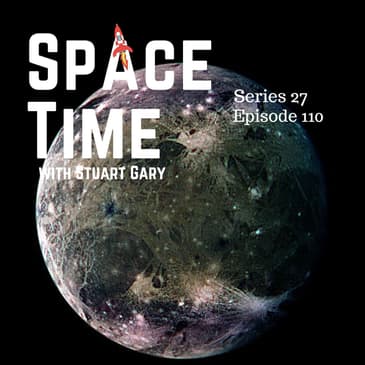
[00:00:43] [SPEAKER_00]: A new study claims that the solar system's largest moon, the Jovian giant moon Ganymede,
[00:00:49] [SPEAKER_00]: was hit by a massive asteroid four billion years ago shifting its axis. The findings,
[00:00:54] [SPEAKER_00]: published in the Journal of Scientific Reports, describe the event as one of the biggest asteroid
[00:00:59] [SPEAKER_00]: impacts with clear traces in the solar system. The collision involved an asteroid roughly
[00:01:04] [SPEAKER_00]: 20 times larger than the KT Boundary Vane asteroid impact which 66 million years ago
[00:01:10] [SPEAKER_00]: triggered Earth's fifth mass extinction event wiping out 75 percent of all life on the planet
[00:01:15] [SPEAKER_00]: including all the non-avian dinosaurs. Ganymede is larger than the planet Mercury and has a
[00:01:21] [SPEAKER_00]: liquid water ocean beneath its icy crust. Like the Earth's moon, it's gravitationally
[00:01:26] [SPEAKER_00]: tidally locked meaning it always shows its same face to the planet it's orbiting,
[00:01:31] [SPEAKER_00]: and thus it also has a far side. Now on large parts of its surface,
[00:01:36] [SPEAKER_00]: the moon's covered by furrows that form concentric circles around one specific spot,
[00:01:42] [SPEAKER_00]: and that led researchers back in the 1980s to conclude that that must have been the result
[00:01:46] [SPEAKER_00]: of a major impact event. The study's lead author Hirata Nayuk from Kobe University says
[00:01:52] [SPEAKER_00]: the Jovian moon's Io Europa Ganymede and Callisto all have interesting individual
[00:01:57] [SPEAKER_00]: characteristics but what caught his attention was those furrows on Ganymede. Nayuk says
[00:02:03] [SPEAKER_00]: astronomers know that this feature was created by an asteroid impact roughly four billion years
[00:02:07] [SPEAKER_00]: ago but they're unsure of exactly how big the impact was and what effect it left on the moon.
[00:02:14] [SPEAKER_00]: See data from this remote object is scarce making research very difficult
[00:02:18] [SPEAKER_00]: but Nayuk realized that the location of the impact almost precisely on the meridian furthest
[00:02:23] [SPEAKER_00]: away from Jupiter. He says this discovery has similarities to an ancient impact event
[00:02:29] [SPEAKER_00]: on Pluto evidence which was detected by NASA's New Horizons spacecraft. That event caused the
[00:02:34] [SPEAKER_00]: dwarf planet's rotational axis to shift and according to Nayuk it implies that Ganymede too
[00:02:40] [SPEAKER_00]: had undergone such a reorientation. Nayuk was then able to calculate the kind of impact that
[00:02:46] [SPEAKER_00]: would have caused Ganymede's reorientation to happen. He found that an asteroid roughly 300
[00:02:51] [SPEAKER_00]: kilometers across, that's about 20 times the size of the one which hit the earth 65 million
[00:02:56] [SPEAKER_00]: years ago, would have created a transient crater between 1400 and 1600 kilometers in diameter.
[00:03:03] [SPEAKER_00]: Transient craters are widely used in lab and computational simulations.
[00:03:08] [SPEAKER_00]: They're actually cavities produced directly after a crater excavation and before material
[00:03:12] [SPEAKER_00]: settles in and around the crater. According to the author's simulations only an impact of
[00:03:17] [SPEAKER_00]: this size would have made it likely that the change in the distribution of mass could cause
[00:03:22] [SPEAKER_00]: the moon's rotational axis to shift to its current position. This giant impact must have
[00:03:27] [SPEAKER_00]: had quite a significant effect on the early evolution of Ganymede but the thermal and
[00:03:32] [SPEAKER_00]: structural effects of the impact on the interior of the giant moon haven't yet been
[00:03:36] [SPEAKER_00]: investigated. Ganymede is the final destination of ESA's two spacecraft mission. If everything
[00:03:42] [SPEAKER_00]: goes well the probe will enter orbit around the moon in 2034 and will make observations for
[00:03:47] [SPEAKER_00]: six months, sending back a wealth of data that could help answer New York's questions.
[00:03:53] [SPEAKER_00]: Needless to say we'll keep you informed. This is space time. Still to come, a new way to measure
[00:04:00] [SPEAKER_00]: the spin of a supermassive black hole and NASA's solar sail mission tumbling through space.
[00:04:06] [SPEAKER_00]: All that and more still to come on space time. Astronomers have found a new way to
[00:04:26] [SPEAKER_00]: measure how fast the black hole's spinning by using the wobbly aftermath of its stellar
[00:04:31] [SPEAKER_00]: feasting. This new method reported in the journal Nature takes advantage of a black hole
[00:04:36] [SPEAKER_00]: tidal disruption event. A tidal disruption event happens when a star gets too close
[00:04:41] [SPEAKER_00]: to a black hole and the black hole's powerful gravitational influence literally rips the star
[00:04:46] [SPEAKER_00]: apart, shredding it into pieces in the process releasing huge amounts of energy.
[00:04:52] [SPEAKER_00]: As the star is ripped apart by the black hole's immense gravitational tidal forces,
[00:04:56] [SPEAKER_00]: half of the star is usually blown away into deep space. The other half is flying around the
[00:05:01] [SPEAKER_00]: black hole forming an intensely hot accretion disk of rotating stellar material. As this
[00:05:07] [SPEAKER_00]: material revolves around the black hole it's being crushed and torn apart at the subatomic
[00:05:12] [SPEAKER_00]: level in the process releasing vast amounts of energy in x-rays. The study's authors have
[00:05:18] [SPEAKER_00]: shown that the wobble of this newly created accretion disk is key to working out the
[00:05:26] [SPEAKER_00]: spin of a nearby supermassive black hole by tracking the pattern of x-ray flashes that
[00:05:31] [SPEAKER_00]: the black hole was producing immediately following a tidal disruption event. The team
[00:05:35] [SPEAKER_00]: followed the flashes over several months and determined that they were likely the signal of
[00:05:40] [SPEAKER_00]: a bright-heart accretion disk that wobbled back and forth as it was being pushed and
[00:05:44] [SPEAKER_00]: pulled by the black hole's own spin. By tracking how the disk's wobble changed over time
[00:05:49] [SPEAKER_00]: the authors could work out how much the disk was being affected by the black hole's spin
[00:05:53] [SPEAKER_00]: and in turn how fast the black hole itself was spinning. Their analysis showed that the black
[00:05:59] [SPEAKER_00]: hole was actually spinning at less than 25 percent of the speed of light. The study's
[00:06:04] [SPEAKER_00]: lead author Deraish Pasham from the Massachusetts Institute of Technology MIT says the new method
[00:06:09] [SPEAKER_00]: could be used to gauge the spins of hundreds of black holes in the local universe. If
[00:06:14] [SPEAKER_00]: scientists can survey the spins of numerous black holes nearby they can start to understand
[00:06:19] [SPEAKER_00]: how these gravitational giants evolved over the history of the universe. They could also
[00:06:24] [SPEAKER_00]: estimate the overall distribution of black hole spins and understand the long-standing question
[00:06:29] [SPEAKER_00]: of how they evolve over time. Every black hole has an inherent spin that's been shaped by its
[00:06:34] [SPEAKER_00]: cosmic encounters over time. For instance if a black hole had grown through mostly accretion,
[00:06:40] [SPEAKER_00]: brief instances of when some material falls onto the disk would have caused the black hole
[00:06:43] [SPEAKER_00]: to spin up to quite high speeds. Now by contrast if a black hole grows mostly through merging with
[00:06:49] [SPEAKER_00]: other black holes each merger would slow things down as one black hole spin meets up and against
[00:06:55] [SPEAKER_00]: the spin of the other. Now because of their intense mass and gravity as a black hole spins
[00:07:00] [SPEAKER_00]: it quite literally drags the surrounding fabric a space time around with it. Now this frame
[00:07:06] [SPEAKER_00]: dragging effect is an example of lens thuring precession, a long-standing theory that
[00:07:11] [SPEAKER_00]: the black hole spins describes the ways in which extremely strong gravitational fields such as those
[00:07:15] [SPEAKER_00]: generated by a black hole can pull the surrounding fabric a space time with it. Now normally this
[00:07:21] [SPEAKER_00]: effect wouldn't be obvious around the black hole because these objects normally don't emit
[00:07:25] [SPEAKER_00]: any light, that's why they're called black holes. But in recent years physicists have proposed
[00:07:30] [SPEAKER_00]: that in instances such as during a tidal disruption event scientists might have a chance
[00:07:35] [SPEAKER_00]: to track the light from stellar debris as it's being dragged around and using that they
[00:07:40] [SPEAKER_00]: might be able to measure the black hole spin. The idea is that during a tidal disruption event
[00:07:45] [SPEAKER_00]: a star could fall onto a black hole from any direction generating a disc of white hot
[00:07:49] [SPEAKER_00]: shredded material that will be tilted or misaligned with respect to the black hole spin axis.
[00:07:54] [SPEAKER_00]: Basham says imagine the accretion disc is a tilted doughnut that's been spinning around
[00:07:59] [SPEAKER_00]: the doughnut hole and that doughnut hole has its own separate spin. As the disc encounters
[00:08:04] [SPEAKER_00]: the black hole spin it wobbles as the black hole pulls it into alignment. Now eventually
[00:08:09] [SPEAKER_00]: the wobbling will subside as the accretion disc settles into the black hole spin. Scientists predicted
[00:08:15] [SPEAKER_00]: that a tidal disruption event's wobbling disc should therefore be a measurable signature of
[00:08:19] [SPEAKER_00]: the black hole spin. But the key to all this was to have the right observations. You see the
[00:08:25] [SPEAKER_00]: only way you can do all this is that as soon as the tidal disruption event goes off you need
[00:08:30] [SPEAKER_00]: to get your telescope looking at the object continuously for really long periods of time so
[00:08:35] [SPEAKER_00]: you can probe all kinds of time scales ranging from minutes to months. For the past five years
[00:08:41] [SPEAKER_00]: Basham and colleagues looked for tidal disruption events that were bright enough and near enough
[00:08:45] [SPEAKER_00]: to quickly follow up and track for signs of lens stirring precession. Then in February 2020
[00:08:51] [SPEAKER_00]: they got lucky. The Zwicky transient facility detected AT2020 OCN, a bright flash emanating
[00:08:58] [SPEAKER_00]: from a galaxy about a billion light years away that was instantly spotted in the telescope's
[00:09:03] [SPEAKER_00]: optical band. Now from this optical data the flash appeared to be the very first moments following
[00:09:08] [SPEAKER_00]: a tidal disruption event. Being both bright and relatively close by, at least in cosmological
[00:09:13] [SPEAKER_00]: terms, Basham suspected that this particular tidal disruption event might be the ideal candidate
[00:09:19] [SPEAKER_00]: to look for signs of disc wobbling and possibly even measure the spin of the black hole
[00:09:23] [SPEAKER_00]: in the host galaxy's core. Of course the key was catching this really early on because this
[00:09:29] [SPEAKER_00]: precessional wobble would only be present early on. Any later and the disc wouldn't be wobbling anymore.
[00:09:34] [SPEAKER_00]: Now luckily the authors discovered that NASA's NICER telescope was able to catch the tidal
[00:09:39] [SPEAKER_00]: disruption event and continuously kept an eye on it over the following months. NICER, the
[00:09:44] [SPEAKER_00]: neutron star interior composition explorer, is an x-ray telescope mounted on the International
[00:09:49] [SPEAKER_00]: Space Station. It's used to measure x-ray radiation around black holes and other extreme
[00:09:55] [SPEAKER_00]: gravitational objects. Basham and colleagues then looked through NICER's observations of
[00:09:59] [SPEAKER_00]: AT2020-OCN over 200 days following the initial detection of the tidal disruption event.
[00:10:06] [SPEAKER_00]: They discovered that this event emitted x-rays that appeared to peak every 15 days for several
[00:10:10] [SPEAKER_00]: cycles before eventually petering out. Now they're interpreting these peaks as times when
[00:10:16] [SPEAKER_00]: the tidal disruption event's accretion disc was wobbling face on, meeting x-rays directly
[00:10:21] [SPEAKER_00]: towards NICER's telescope before wobbling away as they continue to emit x-rays. It's sort of
[00:10:26] [SPEAKER_00]: similar to waving a flashlight towards and away from somebody every 15 days. The authors then
[00:10:32] [SPEAKER_00]: took this pattern of wobbling and worked it into their original theory for lens-theoring
[00:10:36] [SPEAKER_00]: precession. Based on estimates the black hole's mass and that of the disrupted star,
[00:10:41] [SPEAKER_00]: they were able to come up with an estimate for the black hole's spin, less than 25%
[00:10:45] [SPEAKER_00]: speed of light. These results mark the first time that scientists have used observations
[00:10:51] [SPEAKER_00]: of a wobbling disc following a tidal disruption event to estimate the spin of a supermassive
[00:10:56] [SPEAKER_00]: black hole. More on this report from the Massachusetts Institute of Technology.
[00:11:15] [SPEAKER_02]: Due to strong gravitational effects, this misaligned disc precesses and this manifests
[00:11:21] [SPEAKER_02]: as quasi-periodic brightness changes in the x-ray band. Over time, the accretion disc will
[00:11:27] [SPEAKER_02]: come into alignment and the changes in brightness of the x-rays will diminish.
[00:11:32] [SPEAKER_02]: Astronomers led by Diraj Pasham have observed one such event that repeats every 15 days.
[00:11:39] [SPEAKER_02]: Assuming these modulations are due to a general relativity induced effect
[00:11:43] [SPEAKER_02]: called lens-theoring precession, they estimate that the black hole is spinning and dragging
[00:11:49] [SPEAKER_02]: the space time around it at a rate of less than 25% the speed of light. This is space time.
[00:11:56] [SPEAKER_00]: Still to come, NASA's solar cell mission tumbling in orbit and later in the science
[00:12:00] [SPEAKER_00]: report, semaglutide found to reduce the risks of heart failure and dying from any cause
[00:12:06] [SPEAKER_00]: including COVID-19. All that and more still to come on Space Time.
[00:12:27] [SPEAKER_00]: NASA says its advanced composite solar cell system spacecraft is currently tumbling or
[00:12:32] [SPEAKER_00]: wobbling through space which may have impacted its orbit. The mission successfully erected
[00:12:37] [SPEAKER_00]: its foiled solar cell in orbit last week after a failed attempt a few days earlier.
[00:12:42] [SPEAKER_00]: However, observations show the spacecraft is now tumbling or wobbling in orbit.
[00:12:46] [SPEAKER_00]: The mission was designed to test a new type of solar sail, one that could eventually propel
[00:12:51] [SPEAKER_00]: spacecraft using photon pressure from the sun. This technology could one day transport
[00:12:56] [SPEAKER_00]: spacecraft to the edge of the solar system and beyond faster and cheaper than existing
[00:13:00] [SPEAKER_00]: chemical rocket engines. This latest test known as ACS-3 was launched aboard a Rocket Lab
[00:13:06] [SPEAKER_00]: Electron rocket from New Zealand's Mahea Peninsula on April 23rd. The satellite was
[00:13:12] [SPEAKER_00]: placed in a 965km high low-Earth orbit. The mission uses a sail that's folded up
[00:13:18] [SPEAKER_00]: stored aboard a microwave oven-sized CubeSat spacecraft. The solar cell is deployed using
[00:13:24] [SPEAKER_00]: a series of folding composite booms that are 75% lighter and more resistant to
[00:13:29] [SPEAKER_00]: solar radiation than those used on previous solar cell missions. The first attempts
[00:13:33] [SPEAKER_00]: to unfurl the 80 square metre Silver Falls solar cell back on August 26th were abandoned
[00:13:39] [SPEAKER_00]: after 25 minutes because onboard power monitors detected higher than expected motor currents.
[00:13:44] [SPEAKER_00]: After reviewing the issue, a second more successful attempt was made last week.
[00:13:49] [SPEAKER_00]: Images of the spacecraft from the ground confirm the cell had properly deployed.
[00:13:54] [SPEAKER_00]: However, they also showed that the spacecraft was dramatically brightening and dimming at
[00:13:58] [SPEAKER_00]: regular intervals suggesting that it was slowly tumbling or wobbling through space.
[00:14:03] [SPEAKER_00]: And its orbit has also shifted unexpectedly. Now right now mission managers are claiming
[00:14:08] [SPEAKER_00]: tumbling wasn't unexpected and it's simply part of the planned sail deployment sequence,
[00:14:13] [SPEAKER_00]: which they say should be corrected in coming weeks. Needless to say we'll keep an eye on it.
[00:14:19] [SPEAKER_00]: This is space time.
[00:14:37] [SPEAKER_00]: And time now to take another brief look at some of the other stories making
[00:14:40] [SPEAKER_00]: use in science this week with the science report.
[00:14:43] [SPEAKER_00]: A new study has shown that semaglutide, a diabetes drug that's now become best known
[00:14:48] [SPEAKER_00]: for its weight loss properties, can reduce the risk of heart failure events and cardiovascular
[00:14:52] [SPEAKER_00]: death in people with diabetes and chronic kidney disease.
[00:14:56] [SPEAKER_00]: The findings reported in the Journal of the American College of Cardiology is based on an
[00:15:01] [SPEAKER_00]: analysis of data from previous clinical research called the FLOW trial, finding that semaglutide
[00:15:06] [SPEAKER_00]: could reduce the risk of heart failure by 27% and reduce the risk of death by any cause by 29%.
[00:15:13] [SPEAKER_00]: A second study in the same journal found that semaglutide can also help improve the changes
[00:15:18] [SPEAKER_00]: to heart structure associated with obesity which can often lead to heart failure.
[00:15:22] [SPEAKER_00]: The authors say this points to how the drug might be working to benefit people with obesity
[00:15:27] [SPEAKER_00]: related heart failure.
[00:15:30] [SPEAKER_00]: Meanwhile another study in the same journal also looking at semaglutide found that people who
[00:15:35] [SPEAKER_00]: are overweight or obese have a reduced risk of dying from any cause by taking the drug,
[00:15:40] [SPEAKER_00]: including COVID-19 compared to those not taking weight loss medications.
[00:15:45] [SPEAKER_00]: The authors were looking at death data from semaglutide trials involving some
[00:15:49] [SPEAKER_00]: over 17,500 participants over the age of 45 who were either overweight or obese.
[00:15:55] [SPEAKER_00]: Half were randomized to receive semaglutide weekly while the other half took a placebo.
[00:16:00] [SPEAKER_00]: Over an average follow-up of just over three years,
[00:16:03] [SPEAKER_00]: researchers found that 833 patients died.
[00:16:06] [SPEAKER_00]: But participants taking semaglutide had a far lower risk of death from any cause as well
[00:16:11] [SPEAKER_00]: as from heart related deaths. The most common non-heart related cause of death was from an
[00:16:16] [SPEAKER_00]: And researchers say these also occurred at a lower rate in the semaglutide group.
[00:16:21] [SPEAKER_00]: Participants taking semaglutide were just as likely to be infected with COVID-19 as
[00:16:26] [SPEAKER_00]: other patients but they were less likely to have serious complications or die as a result
[00:16:31] [SPEAKER_00]: of the virus.
[00:16:33] [SPEAKER_00]: A new study claims current screen time before sleep recommendations for kids
[00:16:37] [SPEAKER_00]: are neither achievable nor appropriate.
[00:16:40] [SPEAKER_00]: A report in the Journal of the American Medical Association claims the findings
[00:16:44] [SPEAKER_00]: are based on camera observations of kids over four consecutive nights measuring screen time
[00:16:49] [SPEAKER_00]: before bed of 79 11 to 14 year olds.
[00:16:53] [SPEAKER_00]: They found that screen time in the two hours before bed had no association with
[00:16:57] [SPEAKER_00]: most measures of sleep health. However, screen time once in bed,
[00:17:02] [SPEAKER_00]: especially interactive activities such as playing games or multitasking was associated with less
[00:17:06] [SPEAKER_00]: sleep. The results indicate that current recommendations of absolutely no screen time
[00:17:12] [SPEAKER_00]: before sleep might be a bit much for kids and sleep effects may be more dependent on the type
[00:17:18] [SPEAKER_00]: of screen time instead.
[00:17:21] [SPEAKER_00]: Apple's new iPhone 16 has just been released with new design changes,
[00:17:25] [SPEAKER_00]: a new AI processor and upgraded cameras. With the details we're joined by technology
[00:17:30] [SPEAKER_00]: editor Alex Sahar of Royd from techadvice.life.
[00:17:34] [SPEAKER_03]: Okay so the new iPhone 16s have been launched. You can go to apple.com and watch
[00:17:39] [SPEAKER_03]: the live keynote. You can go to youtube.com slash apple and watch it there. I highly recommend
[00:17:44] [SPEAKER_03]: you do that. There's lots of AI. Now the problem with the AI is that a lot of the AI features
[00:17:48] [SPEAKER_03]: won't come until 2025. That includes Siri version 2.0 where you can talk to Siri like
[00:17:53] [SPEAKER_03]: you're talking with chat gpt. This is in stark contrast to Google whose new Pixel 9 Pro
[00:17:59] [SPEAKER_03]: and the Pro Fold already have Gemini Live and can do all the AI stuff out of the box
[00:18:03] [SPEAKER_03]: straight away. And in fact I've been playing with the new Pixel 9 Pro Fold and it's glorious.
[00:18:07] [SPEAKER_03]: Normal sized phone when it's folded shut but when it's opened up it's this beautiful thin device and
[00:18:13] [SPEAKER_03]: Apple is not scheduled to launch one of those until potentially 2026 or beyond. But they will
[00:18:18] [SPEAKER_03]: want to have a screen that has no crease. And Apple has also launched its new Apple Watch 10,
[00:18:23] [SPEAKER_03]: 10th series and also the Apple Watch Ultra 3. Now have you done the Alexa test yet? I
[00:18:29] [SPEAKER_03]: haven't but I've seen a number of videos where you ask Alexa about President Trump and
[00:18:34] [SPEAKER_03]: sorry I can't get political and then you ask it about Kamala Harris and you get all this
[00:18:38] [SPEAKER_03]: information about how she's a great person. And already Alexa has apologised and said oh
[00:18:43] [SPEAKER_03]: you know it was an error but it's a funny thing. That's the only reason they're apologising.
[00:18:47] [SPEAKER_03]: Well the thing is it's always funny how these errors always seems to go against
[00:18:51] [SPEAKER_03]: Trump or against conservatives and for the Democrats. So it's yet another case. I mean
[00:18:56] [SPEAKER_03]: Brock came out straight away and was able to explain who both candidates were without
[00:19:01] [SPEAKER_03]: problems. And there was another test I saw online where one of the posters on X was
[00:19:05] [SPEAKER_03]: giving a description of basically a democratic socialist slash communist type of government.
[00:19:10] [SPEAKER_03]: And initially ChatGBT was according to this poster giving all sorts of weird answers but
[00:19:15] [SPEAKER_03]: Brock straight away said well this is basically a communist type of government. So other people
[00:19:19] [SPEAKER_03]: came along and they asked ChatGBT and it seemed to be giving more intelligent answers.
[00:19:23] [SPEAKER_03]: But we're definitely living in this strange time where the AI is being programmed by
[00:19:29] [SPEAKER_03]: you can't go in yourself yet and determine whether you want your AI to have a
[00:19:34] [SPEAKER_00]: totally neutral bent or for it to look at. Why doesn't Jeff Bezos simply sack these idiots
[00:19:39] [SPEAKER_00]: who are doing this programming? It reflects badly on his company. Well it does but he's now
[00:19:44] [SPEAKER_03]: basically retired, he's doing other things, he's new origin. I mean he's not involved in
[00:19:50] [SPEAKER_03]: the day-to-day at Amazon anymore. No he's not going in here either but he does have a CEO
[00:19:54] [SPEAKER_03]: and the CEO is looking after these things. But the problem is that sometimes the CEOs might
[00:19:58] [SPEAKER_03]: be of one political flavor and yet the people working for them are of the other. And that's
[00:20:03] [SPEAKER_03]: what happened at Twitter. I mean Elon Musk was able to sack 80% of the staff and X is running
[00:20:08] [SPEAKER_03]: better than ever. In fact they just launched the X app for your TV. If you have a smart TV
[00:20:12] [SPEAKER_03]: you can now download X and this is going to be changing X into more of a video platform.
[00:20:18] [SPEAKER_03]: Just like YouTube is this fantastic repository of all this incredible knowledge, so too will
[00:20:22] [SPEAKER_03]: X become that sort of a platform. I mean you can do it now but now with the X app
[00:20:26] [SPEAKER_03]: you can fire it up on your TV, use your remote control and be watching many of the things. There
[00:20:31] [SPEAKER_03]: are so many different live events and people's channels are now on X. I'm actually going to be
[00:20:37] [SPEAKER_03]: doing more X videos myself as well as publishing it to YouTube and Rumble but there's lots of
[00:20:41] [SPEAKER_03]: movement happening and we still haven't seen Grok version 3. Now Elon Musk just announced
[00:20:47] [SPEAKER_03]: Colossus which is 100,000 H100 Nvidia chips. It was completed in 122 days and it will be
[00:20:55] [SPEAKER_03]: version 3. Grok 2, the beta version and the beta Grok 2 mini has now been launched. If you've
[00:21:01] [SPEAKER_03]: got X and you pay for the premium you can play with it but the whole impact of AI 2025 is
[00:21:06] [SPEAKER_03]: going to see massive changes in how we use our computers and technology and interact with AI
[00:21:11] [SPEAKER_00]: on pretty much every platform. That's Alex Zaharov-Royd from TechAdvice.life.
[00:21:31] [SPEAKER_00]: And that's the show for now. Spacetime is available every Monday, Wednesday and Friday
[00:21:36] [SPEAKER_00]: through Apple Podcasts, iTunes, Stitcher, Google Podcasts, Pocket Casts, Spotify, Acast,
[00:21:43] [SPEAKER_00]: Amazon Music, Bytes.com, SoundCloud, YouTube, your favorite podcast download provider and from
[00:21:50] [SPEAKER_00]: Spacetime with Stuart Gary dot com. Spacetimes also broadcasts through the National Science
[00:21:55] [SPEAKER_00]: Foundation on Science Zone Radio and on both iHeart Radio and TuneIn Radio. And you can
[00:22:01] [SPEAKER_00]: support our show by visiting the Spacetime store for a range of promotional merchandising goodies
[00:22:07] [SPEAKER_00]: or by becoming a Spacetime patron which gives you access to triple episode commercial free
[00:22:12] [SPEAKER_00]: versions of the show as well as lots of bonus audio content which doesn't go to air,
[00:22:17] [SPEAKER_00]: access to our exclusive Facebook group and other rewards. Just go to Spacetimewithstuart
[00:22:22] [SPEAKER_00]: gary dot com for full details. You've been listening to Spacetime with Stuart Gary. This
[00:22:28] [SPEAKER_01]: has been another quality podcast production from Bytes.com.