
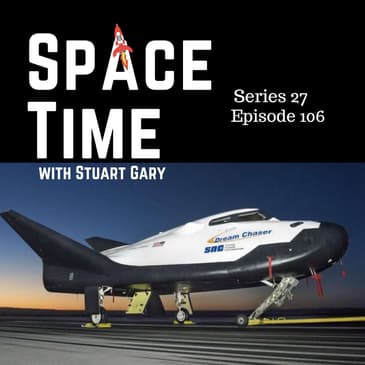



00:00:00 - Sierra Space have confirmed that their new Dream chaser orbital space plane won't fly
00:08:07 - Scientists have for the first time successfully measured a planet wide electrical field
00:17:17 - Perth based consortium unveils prototype of lunar rover for NASA
00:18:59 - Australia has agreed to manufacture and service cruise missiles at a new facility
00:20:22 - Drug currently used to treat type two diabetes could potentially reduce risk of dementia
00:22:23 - There are growing reports of people experiencing what people call time slipping
For more SpaceTime, visit our website at www.spacetimewithstuartgary.com
www.bitesz.com
Become a supporter of this podcast: https://www.spreaker.com/podcast/spacetime-with-stuart-gary--2458531/support
Sponsor Links:
NordPass
ProtonMail & Security
Malwarebytes
NordVPN
[00:00:00] [SPEAKER_01]: This is SpaceTime Series 27 Episode 106 for broadcast on the 2nd of September 2024.
[00:00:07] [SPEAKER_01]: Coming up on SpaceTime, the new Dream Chaser orbital space planes launch delayed until next year.
[00:00:13] [SPEAKER_01]: NASA discovers a long sought after global electric field on planet Earth.
[00:00:18] [SPEAKER_01]: And the latest Australian Lunar Rover unveiled.
[00:00:22] [SPEAKER_01]: All that and more coming up on SpaceTime.
[00:00:26] [SPEAKER_05]: Welcome to SpaceTime with Stuart Gary.
[00:00:46] [SPEAKER_01]: Sierra's space have confirmed that their new Dream Chaser orbital space plane won't fly until next year.
[00:00:52] [SPEAKER_01]: Once in operation, the unique winged lifting body design will provide additional cargo capacity on missions to the International Space Station
[00:01:00] [SPEAKER_01]: as part of NASA's Commercial Resupply Services contract,
[00:01:03] [SPEAKER_01]: which already sees SpaceX Dragon and Northrop Grumman Cygnus cargo ships service the orbital outpost.
[00:01:10] [SPEAKER_01]: Like Dragon, Dream Chaser is designed to be reusable and was originally developed as a manned spacecraft.
[00:01:17] [SPEAKER_01]: It'll fly aboard United Launch Alliance's new Vulcan Centaur rocket off Pad 41 at the Cape Canaveral Space Force Base in Florida.
[00:01:25] [SPEAKER_01]: But delays in getting the first Dream Chaser, called Tenacity, through NASA's lengthy approval process
[00:01:30] [SPEAKER_01]: has resulted in added pressure being put on United Launch Alliance by the US Space Force.
[00:01:36] [SPEAKER_01]: They want the new Vulcan Centaur certified for military operations as soon as possible.
[00:01:41] [SPEAKER_01]: That now means that instead of waiting for Tenacity to be ready to fly on Vulcan,
[00:01:46] [SPEAKER_01]: the Vulcan will instead be launched carrying a dummy payload.
[00:01:49] [SPEAKER_01]: Vulcan was meant to be flying back in 2021, but ongoing technical issues meant its inaugural flight was delayed until earlier this year.
[00:01:58] [SPEAKER_01]: Much to the concern of the US Space Force, which is a growing backlog of military missions, awaiting Vulcan certification.
[00:02:05] [SPEAKER_01]: Dream Chaser Tenacity arrived at the Kennedy Space Center on May 20 from the Neil Armstrong Test Facility
[00:02:11] [SPEAKER_01]: at the Glenn Research Center in Cleveland, Ohio.
[00:02:14] [SPEAKER_01]: The punishing testing program at Armstrong included vibration tests on what's the world's highest capacity
[00:02:20] [SPEAKER_01]: and most powerful spacecraft shaker system located inside the Agency Space Environments Complex.
[00:02:26] [SPEAKER_01]: This exposed the spacecraft to all sorts of conditions it'll experience during its launch and reentry.
[00:02:33] [SPEAKER_01]: Further testing at the In-Space Propulsion Facility saw the stack exposed to low ambient pressures and temperatures
[00:02:39] [SPEAKER_01]: ranging from minus 101 degrees Celsius up to more than 148 degrees Celsius.
[00:02:45] [SPEAKER_01]: When it does finally fly, the Dream Chaser, together with its Shooting Star cargo module,
[00:02:51] [SPEAKER_01]: will transport up to 544 kilograms of supplies and cargo on regular missions to the space station.
[00:02:58] [SPEAKER_01]: And Dream Chaser will return to Earth after each mission, landing conventionally on the former Kennedy Space Center space shuttle runway
[00:03:04] [SPEAKER_01]: carrying up to 1,750 kilograms of returned experiments and equipment.
[00:03:10] [SPEAKER_01]: Now Dragon cargo ships bring experiments back to Earth as well, capabilities neither the Cygnus cargo ship nor the Russian Progress cargo ship have.
[00:03:18] [SPEAKER_01]: But unlike the Dragon, the gentler runway landing undertaken by Dream Chaser will allow the return to Earth
[00:03:25] [SPEAKER_01]: of more delicate equipment and experiments which could be damaged in a rougher high-G capsule splashdown.
[00:03:31] [SPEAKER_01]: With the early retirement of the space shuttle in 2021, Dream Chaser is now the only spacecraft NASA currently funds
[00:03:38] [SPEAKER_01]: that's capable of maneuvering within the atmosphere.
[00:03:42] [SPEAKER_01]: The Dream Chaser design isn't new. In fact it goes back over 60 years with its origins
[00:03:47] [SPEAKER_01]: in the United States Air Force 1957 X-20 Dinosaur manned spacecraft which had gone into production
[00:03:54] [SPEAKER_01]: would have been launched on top of a modified Titan III rocket.
[00:03:58] [SPEAKER_01]: NASA continued its development during the 1960s and early 70s with a range of experimental spacecraft based on the same common design.
[00:04:06] [SPEAKER_01]: These include the Northrop M2, the Martin X-23 Prime, the Martin Marietta X-24 and the Northrop HL-10.
[00:04:14] [SPEAKER_01]: And during the 1990s NASA used the same basic design again, this time to develop the HL-20 experimental space plane
[00:04:22] [SPEAKER_01]: which would eventually evolve into the X-38 Emergency Crew Return Vehicle
[00:04:27] [SPEAKER_01]: which was designed to act as an emergency escape pod aboard the International Space Station.
[00:04:32] [SPEAKER_01]: It was designed to be capable of being transported to the space station mounted inside the payload bay of a space shuttle.
[00:04:39] [SPEAKER_01]: It would then be docked to the orbiting outpost until needed.
[00:04:42] [SPEAKER_01]: However that project was cancelled in 2002 following NASA budget cuts.
[00:04:48] [SPEAKER_01]: With all the work done on the project, private company Sierra Nevada, now Sierra Space, took over development of the design.
[00:04:56] [SPEAKER_01]: And as the project progressed, NASA contracted Sierra Space for an initial seven cargo missions to the orbiting outpost.
[00:05:04] [SPEAKER_01]: Right now a second Dream Chaser spacecraft is under construction.
[00:05:08] [SPEAKER_01]: Both Dream Chasers will be capable of flying at least 15 missions over a 10 year lifespan.
[00:05:14] [SPEAKER_01]: A third Dream Chaser was also built that was an engineering demonstrator for ground and flight verification and validation tests.
[00:05:22] [SPEAKER_01]: Right now Sierra Space also has plans for a fully operational manned version of Dream Chaser as well.
[00:05:28] [SPEAKER_01]: It'll be designed to carry crew into low Earth orbit.
[00:05:31] [SPEAKER_01]: The company also plans to use Dream Chaser to launch and build its own orbiting space station
[00:05:36] [SPEAKER_01]: before NASA retires the International Space Station around 2030.
[00:05:40] [SPEAKER_01]: And the story doesn't end there.
[00:05:42] [SPEAKER_01]: The United Nations is looking at contracting Sierra Space to develop a Dream Chaser to undertake a series of UN orbital science experiments.
[00:05:52] [SPEAKER_01]: As I mentioned earlier, Dream Chaser doesn't come alone.
[00:05:55] [SPEAKER_01]: It also has a mated cargo module called the Shooting Star.
[00:05:59] [SPEAKER_01]: Shooting Star is actually a fully independent spacecraft which can be attached to the space plane before launch in order to increase cargo capacity.
[00:06:08] [SPEAKER_01]: Shooting Star is fitted with two docking ports, one at each end, that allows it to attach to the rear of the Dream Chaser at one end and to the space station at the other.
[00:06:16] [SPEAKER_01]: This means Shooting Star can act as an additional module for astronauts working aboard the International Space Station.
[00:06:22] [SPEAKER_01]: It can hold cargo before it's transferred to other areas of the space station or be used for experiments.
[00:06:28] [SPEAKER_01]: Shooting Star also carries external mounting points for three additional cargo containers, making it ultra-flexible.
[00:06:36] [SPEAKER_01]: But unlike the reusable Dream Chaser which returns to Earth after each mission landing on a conventional runway,
[00:06:42] [SPEAKER_01]: Shooting Star is designed to burn up on reentry.
[00:06:45] [SPEAKER_01]: So as its mission runs to an end, it, like Cygnus and Progress, will be loaded with trash and then released to burn up in Earth's atmosphere.
[00:06:53] [SPEAKER_01]: Meanwhile, the Pentagon is looking at using the Shooting Star cargo module as the basis for an autonomous unmanned military space station
[00:07:01] [SPEAKER_01]: which would be used for research and development work as well as training and operational missions in low Earth orbit.
[00:07:07] [SPEAKER_01]: If this plan goes ahead, Sierra Space will redesign the module to include guidance, navigation and control systems for sustained free flight operations.
[00:07:16] [SPEAKER_01]: The military version would host specialized payloads, undertake experimental testing, manufacturing and assembly techniques in microgravity and carry a range of logistics.
[00:07:26] [SPEAKER_01]: Longer term plans could include higher elliptical and geosynchronous orbits around the Earth as well as more distant lunar orbits.
[00:07:34] [SPEAKER_01]: Needless to say, we'll keep you informed.
[00:07:37] [SPEAKER_01]: This is Space Time.
[00:07:39] [SPEAKER_01]: Still to come, NASA discovers a long sought after global electric field on Earth and Australia's latest lunar rover unveiled.
[00:07:48] [SPEAKER_01]: All that and more still to come on Space Time.
[00:08:07] [SPEAKER_01]: Scientists have for the first time successfully measured a planet-wide electrical field thought to be as fundamental to Earth as its gravitational magnetic fields.
[00:08:16] [SPEAKER_01]: Known as the ambipolar electric field, scientists first hypothesized its existence over 60 years ago, claiming it drove how the planet's atmosphere can escape above Earth's north and south poles.
[00:08:28] [SPEAKER_01]: Confirmation of the field's existence was made using observations undertaken by a suborbital NASA rocket launched from Norway's Svalbard rocket range.
[00:08:36] [SPEAKER_01]: A report in the journal Nature says the mission's measurements confirmed the existence of the ambipolar field and quantified its strength, revealing its role in driving atmospheric escape and shaping the planet's ionosphere, an ionized layer of the upper atmosphere.
[00:08:52] [SPEAKER_01]: Understanding the complex movements and evolution of Earth's atmosphere provides scientists with new clues not only about the history of the planet but it also gives new insights into the mysteries of other planets, hoping to determine which ones might be habitable for life.
[00:09:06] [SPEAKER_01]: Since the 1960s, spacecraft flying over Earth's poles have detected a stream of particles flowing from the atmosphere into space.
[00:09:15] [SPEAKER_01]: Theorists had long predicted this outflow which they called the polar wind, spurring research to understand its causes.
[00:09:21] [SPEAKER_01]: Some amount of outflow from our atmosphere was expected.
[00:09:25] [SPEAKER_01]: You see, intense unfiltered sunlight should cause some particles to degas and escape into space, sort of like steam evaporating from a pot of boiling water.
[00:09:33] [SPEAKER_01]: But the observed polar wind was far more mysterious.
[00:09:38] [SPEAKER_01]: Many particles within it were cold, with no signs that they had been heated, yet they were travelling at supersonic speeds.
[00:09:45] [SPEAKER_01]: The study's lead author and principal investigator, Glenn Collinson from NASA's Goddard Space Flight Center in Greenbelt, Maryland, says something must be drawing these particles out of the atmosphere, and scientists suspect that some sort of yet-to-be-discovered electrical field could be at work.
[00:10:01] [SPEAKER_01]: The hypothesized electrical field would be generated at the subatomic scale.
[00:10:07] [SPEAKER_01]: It was expected to be incredibly weak, with its effects only felt over a few hundred kilometres.
[00:10:12] [SPEAKER_01]: But for decades, detecting it was beyond the limits of existing technologies.
[00:10:18] [SPEAKER_01]: Then in 2016, Collinson and colleagues developed a new instrument which they believed was finally up to the task of measuring Earth's ambipolar field.
[00:10:26] [SPEAKER_01]: The instrument was designed to be mounted on a suborbital rocket flight launched from the Arctic.
[00:10:33] [SPEAKER_01]: In a nod to the ship that carried Ernest Shackleton on his famous 1914 voyage to Antarctica, the authors named their mission Endurance.
[00:10:41] [SPEAKER_01]: The scientists then set course for Svalbard, formerly known as Spitsberg, a Norwegian archipelago just a few hundred kilometres from the North Pole and home to the northernmost rocket range on Earth.
[00:10:51] [SPEAKER_01]: Svalbard is the only rocket range where you could fly through the polar wind and make the needed measurements.
[00:10:58] [SPEAKER_01]: So on May 11, 2022, Endurance was launched, reaching an altitude of 768 kilometres before splashing down 90 minutes later in the Greenland Sea.
[00:11:09] [SPEAKER_01]: Across the 518 kilometre altitude range where it collected data, Endurance measured a change in electric potential of 0.55 volts.
[00:11:18] [SPEAKER_01]: Now, Collinson admits half a volt is almost nothing. It's only about as strong as a watch battery.
[00:11:24] [SPEAKER_01]: But it also just happens to be the right amount to explain the polar wind.
[00:11:29] [SPEAKER_01]: Hydrogen ions, the most abundant type of particle in the polar wind, experience an outward force from this field 10.6 times stronger than gravity.
[00:11:37] [SPEAKER_01]: Now, that's more than enough to counter gravity. In fact, it's enough to launch them upwards into space at supersonic speeds, which is exactly what had previously been observed.
[00:11:46] [SPEAKER_01]: And heavier particles could also get a boost. Oxygen ions at the same altitude, immersed in this half-volt field, weigh half as much as they normally would on the ground.
[00:11:56] [SPEAKER_01]: In general, the authors found that the ambipolar field increases what's known as the scale height of the ionosphere by 271%,
[00:12:04] [SPEAKER_01]: meaning the ionosphere remains denser to greater heights than it would without the field.
[00:12:09] [SPEAKER_01]: Collinson describes it as being like a conveyor belt, lifting the atmosphere up into space.
[00:12:14] [SPEAKER_01]: He says the ambipolar field is a fundamental energy field to the planet, alongside that of gravity magnetism.
[00:12:21] [SPEAKER_01]: And it may have continuously shaped the evolution of its atmosphere in ways scientists can only now begin to explore.
[00:12:28] [SPEAKER_01]: Because it's created by the internal dynamics of an atmosphere, similar electric fields are expected to exist on other planets, including Venus and Mars.
[00:12:37] [SPEAKER_01]: Collinson says any planet with an atmosphere should have an ambipolar field.
[00:12:41] [SPEAKER_02]: Three, two...
[00:12:46] [SPEAKER_02]: This is the Endurance rocket ship, and she's about to discover something incredible and fundamental about the Earth.
[00:12:53] [SPEAKER_02]: So why here? What makes Earth this special place that we all call home?
[00:12:57] [SPEAKER_02]: One of the reasons may be due to the energy fields that our planet creates.
[00:13:03] [SPEAKER_02]: So the first one's gravity. You're very familiar with gravity.
[00:13:06] [SPEAKER_02]: It's important for life because it's holding our atmosphere on.
[00:13:09] [SPEAKER_02]: If you don't have enough gravity, your atmosphere tends to escape to space like at Mars.
[00:13:15] [SPEAKER_02]: The second field is the magnetic field.
[00:13:17] [SPEAKER_02]: It's this shield that's protecting our planet from the stream of particles that comes from the sun.
[00:13:23] [SPEAKER_02]: So our rocket has discovered and finally measured number three.
[00:13:27] [SPEAKER_02]: It's called the ambipolar field, and it's an agent of chaos.
[00:13:31] [SPEAKER_02]: It counters gravity and it strips particles off into space.
[00:13:34] [SPEAKER_02]: Whenever spacecraft have flown over the poles of the Earth,
[00:13:38] [SPEAKER_02]: they felt this supersonic wind of particles called the polar wind flowing out into space.
[00:13:44] [SPEAKER_02]: There must be some invisible force lurking there responsible for this outflow.
[00:13:49] [SPEAKER_02]: But we've never been able to measure this before because we haven't had the technology.
[00:13:52] [SPEAKER_02]: So we built the Endurance rocket ship to go looking for this great invisible force, right?
[00:13:58] [SPEAKER_02]: This ambipolar electrical field for the first time.
[00:14:00] [SPEAKER_02]: So we were expecting to hopefully find the source of this polar wind,
[00:14:04] [SPEAKER_02]: but what we weren't expecting was this other thing that it does to our skies and to the atmosphere, which is just so profound.
[00:14:13] [SPEAKER_02]: There's only one launch site in the world far enough north to actually try and launch into this thing.
[00:14:18] [SPEAKER_02]: And it's in the very north of this tiny island called Svalbard.
[00:14:22] [SPEAKER_02]: It's just off the coast of the north of Norway, which meant a little bit of a trek to get it to the launch site.
[00:14:36] [SPEAKER_03]: About to sail today from Langebyen to Nielsen, up the coast for about 14 hours.
[00:14:48] [SPEAKER_04]: We had a couple of days of being completely whited out and now it's calm in this beautiful country.
[00:14:54] [SPEAKER_04]: I have a feeling this might be the day.
[00:15:00] [SPEAKER_02]: Solar. Solar go. Radar. Go. Mission control, this is Endurance. Go flight. We are go for launch.
[00:15:09] [SPEAKER_02]: I think we're about to launch a rocket.
[00:15:24] [SPEAKER_02]: During the 15 minute suborbital flight, we successfully measured this ambipolar field for the first time.
[00:15:31] [SPEAKER_02]: When you add up all of the strength of it over the whole flight, the whole potential drop is only about half a volt.
[00:15:37] [SPEAKER_02]: That's nothing right? That's about as strong as one of those tiny little watch batteries.
[00:15:41] [SPEAKER_02]: But that's exactly the amount that you need to explain this polar wind escape, this outflow.
[00:15:49] [SPEAKER_02]: Because we measured it for the first time, we can actually understand the role it plays in the atmosphere.
[00:15:56] [SPEAKER_02]: And despite being weak, it's incredibly important. It counters gravity and it basically lifts the skies up.
[00:16:02] [SPEAKER_02]: It's like this conveyor belt lifting the atmosphere up into space.
[00:16:08] [SPEAKER_02]: So like us, you're probably left with a lot of questions, right? What does this field do? What's it for?
[00:16:13] [SPEAKER_02]: How has it shaped the planet? And I can't tell you yet.
[00:16:18] [SPEAKER_02]: This field is so fundamental to understanding the way the planet works.
[00:16:23] [SPEAKER_02]: It's been here since the beginning alongside gravity and magnetism.
[00:16:26] [SPEAKER_02]: It's been lofting particles to space and stretching up the sky since the beginning.
[00:16:33] [SPEAKER_02]: It's probably had an impact on the evolution of the atmosphere, but I can't tell you how much yet.
[00:16:37] [SPEAKER_02]: May even have left a mark on the oceans. How much I don't know.
[00:16:41] [SPEAKER_02]: This field is a fundamental part of the way Earth works.
[00:16:45] [SPEAKER_02]: And now we've finally measured it, we can actually start to ask some of these bigger and exciting questions.
[00:17:00] [SPEAKER_01]: And this is space time.
[00:17:03] [SPEAKER_01]: Still to come, a new Australian lunar rover unveiled.
[00:17:07] [SPEAKER_01]: And later in the science report, Australia has agreed to manufacture and service cruise missiles at a new facility now being built at Williamtown, north of Newcastle.
[00:17:17] [SPEAKER_01]: All that and more still to come on Space Time.
[00:17:36] [SPEAKER_01]: A Perth-based consortium has revealed a prototype of their proposed new Australian lunar rover as part of NASA's Artemis Moon missions program.
[00:17:44] [SPEAKER_01]: The 20 kilogram Australian Remote Operations for Space and Earth, or ARROWS consortium vehicle,
[00:17:50] [SPEAKER_01]: which is only slightly larger than a suitcase, would be used on the Moon as part of what would be the first full-scale lunar resource extraction mission.
[00:17:59] [SPEAKER_01]: It would collect data on lunar regolith together with samples that could ultimately be used to produce oxygen.
[00:18:05] [SPEAKER_01]: That oxygen would be in support of a permanent manned lunar base.
[00:18:09] [SPEAKER_01]: The oxygen could be used both for breathing and also as an oxidizer for propellant.
[00:18:14] [SPEAKER_01]: The solar-powered four-wheeled rover is equipped with a camera, scientific sensors, and a scoop to collect samples.
[00:18:20] [SPEAKER_01]: And it would be remotely operated from Earth.
[00:18:23] [SPEAKER_01]: The vehicle's suspension system would allow it to deal with the Moon's rough terrain, getting over boulders and steep slopes.
[00:18:30] [SPEAKER_01]: The prototype is part of NASA's Moon to Mars initiative, which aims to further grow the astray in space industry.
[00:18:36] [SPEAKER_01]: It comes eight months after the ELO2 consortium presented their RIPLE prototype.
[00:18:41] [SPEAKER_01]: The two consortia were each given federal funding under the Trailblazer program to develop a lunar rover concept for NASA in support of the Artemis Moon to Mars missions.
[00:18:51] [SPEAKER_01]: The ELO2 consortium's semi-autonomous prototype lunar rover, the ROUVEUR, was unveiled in Adelaide earlier this year.
[00:18:59] [SPEAKER_01]: This is Space Time.
[00:19:17] [SPEAKER_01]: And time now to take a brief look at some of the other stories making news in science this week with the Science Report.
[00:19:23] [SPEAKER_01]: Australia has agreed to manufacture and service cruise missiles at a new facility now being built at Williamtown, north of Newcastle.
[00:19:31] [SPEAKER_01]: The Naval Strike Missiles or NSM are an anti-ship and anti-land cruise missile with a range of around 250 kilometres and capable of carrying a 120 kilogram warhead.
[00:19:42] [SPEAKER_01]: They're currently deployed aboard Australia's ANZAC class frigates and will soon be fitted to its Aegis class destroyers.
[00:19:49] [SPEAKER_01]: Their Joint Strike Missile or JSM counterpart are designed to be air launched from F-35 Lightning to Joint Strike Fighters.
[00:19:58] [SPEAKER_01]: The new plant will begin production in 2027, manufacturing around 100 missiles a year under licence from the Norwegian firm Kongsberg.
[00:20:06] [SPEAKER_01]: Australia is one of several Asia Pacific nations dramatically increasing defence spending.
[00:20:11] [SPEAKER_01]: It's the latest in the string of Australian defence projects in the wake of the dramatic escalation in China's military spending and Russia's invasion of Ukraine.
[00:20:22] [SPEAKER_01]: A new study has shown that a drug currently used to treat type 2 diabetes could potentially reduce the risk of dementia.
[00:20:29] [SPEAKER_01]: Because type 2 diabetes has already been associated with an increased risk of dementia, researchers paired up over 100,000 Koreans aged between 40 and 69 who already have type 2 diabetes.
[00:20:40] [SPEAKER_01]: Half of them were being treated with an SGLT2 inhibitor while the other half were using a DPP4 inhibitor.
[00:20:48] [SPEAKER_01]: The authors then monitored dementia diagnosis within the group.
[00:20:52] [SPEAKER_01]: A report in the British Medical Journal found that 1,172 patients were diagnosed with dementia during the study period.
[00:20:59] [SPEAKER_01]: But they found that those using the SGLT2 inhibitor had a 35% reduced risk of dementia compared to those using the DPP4 inhibitors and the reduced risk of P2B stronger for those who had been using the SGLT2 inhibitors for longer.
[00:21:16] [SPEAKER_01]: A new study has shown that dogs can understand words from soundboard buttons.
[00:21:21] [SPEAKER_01]: The findings reported in the Journal PLOS One represent the first empirical study emerging from the world's largest longitudinal project on button-trained pets.
[00:21:31] [SPEAKER_01]: The research undertaken by the University of California San Diego involved two complementary experiments.
[00:21:37] [SPEAKER_01]: The first was conducted in person, with researchers visiting 30 dogs at their homes across the country in order to test their responses to soundboard buttons.
[00:21:46] [SPEAKER_01]: The second experiment utilized citizen science, where 29 dog owners conducted the trials themselves at their homes under remote guidance.
[00:21:55] [SPEAKER_01]: Overall, the study showed that dogs trained to use soundboards responded appropriately to words like play and outside regardless of whether those words were spoken by their owners or triggered by pressing a button.
[00:22:07] [SPEAKER_01]: This suggests that dogs are not merely reading their owner's body language or presence but are indeed processing language.
[00:22:14] [SPEAKER_01]: The findings show that words matter to dogs and that they respond to words themselves and not just associated clues.
[00:22:23] [SPEAKER_01]: Well, it seems the good folk of jolly old England may be getting a little bit too jolly with growing reports of what people are calling time-slipping.
[00:22:32] [SPEAKER_01]: Now if this is the first time you've heard that expression, you're not alone.
[00:22:35] [SPEAKER_01]: Apparently, time-slipping is a phenomenon being experienced by lots of people who suddenly find themselves travelling backwards in time for a few seconds before returning to the present day.
[00:22:46] [SPEAKER_01]: Tim Mendham from Australian Skeptic says those claiming to experience time slippage are more likely affected by factors such as tiredness, hunger, fear, excitement or alcohol and drugs.
[00:23:05] [SPEAKER_00]: You're walking down the street or you're getting into a building or perhaps going into a pub and suddenly you think you're in a different time, like decades or centuries different time.
[00:23:13] [SPEAKER_00]: Cases of people who were saying, I suddenly found myself walking down the street in London, since a lot of English things actually, walking down the street in London and suddenly I'm surrounded by old buildings and cobblestones and that sort of thing.
[00:23:23] [SPEAKER_01]: Yeah, but it's in London. That's what London looks like.
[00:23:25] [SPEAKER_00]: Except for the show.
[00:23:26] [SPEAKER_00]: Suddenly I turn around and it's back to 21st century. Others said that they've noticed this for a while.
[00:23:31] [SPEAKER_00]: There are supposedly some places where it happens a lot. They could almost make it a tourist destination. Others suggested some immediate thing and someone's saying they walked out of a wedding just to get some fresh air, walked back in.
[00:23:41] [SPEAKER_00]: Everyone suddenly wearing crinolines and all this sort of stuff blinked their eyes and has gone. So various suggestions for what might be happening.
[00:23:47] [SPEAKER_00]: Hallucinations, how fragile our human perception really is. And that's known as in witness cases, witnesses are known to be very unreliable.
[00:23:54] [SPEAKER_00]: They think they see things as cognitive bias. You want to sort of see this stuff. Others suggest that you drink too much or you're tired. Anyway, altered states of consciousness for whatever reason.
[00:24:03] [SPEAKER_00]: Like when you're falling asleep or waking up and you have that weird sort of sensation that perhaps you're seeing things there or that doesn't explain when you're walking along.
[00:24:10] [SPEAKER_00]: Electromagnetic field always comes up as an explanation. And I don't know if that would actually work or not from a great distance.
[00:24:16] [SPEAKER_00]: So talking about one of these sites is notoriously over a junction of the other tube, the underground station.
[00:24:22] [SPEAKER_00]: So that would put out a lot of electromagnetic radiation, but it would everywhere. I think I would suggest that hallucination, wishful thinking.
[00:24:29] [SPEAKER_01]: That's Tumindam from Australian Skeptics.
[00:25:12] [SPEAKER_01]: And you can help to support our show by visiting the space time store for a range of promotional merchandising goodies or by becoming a space time patron, which gives you access to triple episode commercial free versions of the show as well as lots of bonuses.
[00:25:31] [SPEAKER_01]: Audio content, which doesn't go to where access to our exclusive Facebook group and other rewards.
[00:25:37] [SPEAKER_01]: Just go to space time with Stuart Gary dot com for full details.
[00:25:41] [SPEAKER_01]: You've been listening to space time with Stuart Gary.
[00:25:44] [SPEAKER_05]: This has been another quality podcast production from bites dot com.