


00:00:00 - This is spacetime series 27, episode 105 for broadcast on 30 August 2024
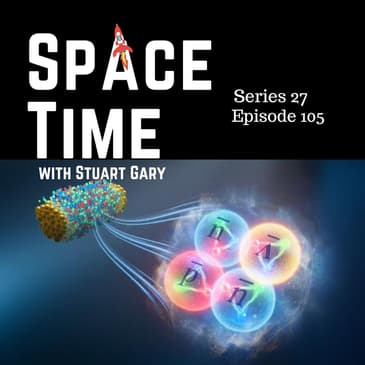
00:00:26 - Scientists at Brookhaven National Laboratory have discovered a new antimatter hyper nucleus
00:05:03 - Rocket booster explodes during test at British spaceport; no one injured
00:12:21 - Julia Lowe: We put people in virtual reality environments to study food preferences
00:16:36 - 5% of people are consuming products that are potentially toxic to livers
00:18:23 - Social position and income are linked to your food preferences, study finds
00:19:44 - The editor of the pop paranormal website Higgypop says he's sceptic
00:23:17 - Spacetime is available every Monday, Wednesday and Friday through various podcasting platforms
Episode Special Guest:
Julia Low from RMIT University in Melbourne, Australia
For more SpaceTime, visit our website at www.spacetimewithstuartgary.com
www.bitesz.com
Become a supporter of this podcast: https://www.spreaker.com/podcast/spacetime-with-stuart-gary--2458531/support
Sponsor Links:
NordPass
ProtonMail & Security
Malwarebytes
NordVPN
[00:00:00] [SPEAKER_03]: This is SpaceTime, Series 27, Episode 105, for broadcast on the 30th of August 2024.
[00:00:07] [SPEAKER_03]: Coming up on SpaceTime, discovery of the heaviest antimatter hypernucleus ever created,
[00:00:13] [SPEAKER_03]: a spectacular rocket engine explosion at the United Kingdom's new spaceport,
[00:00:18] [SPEAKER_03]: and we look at why food tastes bad in space.
[00:00:22] [SPEAKER_03]: All that and more coming up on SpaceTime.
[00:00:25] [SPEAKER_00]: Welcome to SpaceTime with Stuart Gary.
[00:00:45] [SPEAKER_03]: Physicists with the Star Collaboration have for the first time ever observed a new antimatter hypernucleus
[00:00:51] [SPEAKER_03]: known as anti-hyperhydrogen-4.
[00:00:54] [SPEAKER_03]: The new particle was created at the US Department of Energy's Brookhaven National Laboratory's
[00:00:59] [SPEAKER_03]: RIC Relativistic Heavy Ion Collider.
[00:01:02] [SPEAKER_03]: The experiments reported in the journal Nature represent the most massive antimatter hypernucleus ever discovered.
[00:01:08] [SPEAKER_03]: It's an important scientific advancement on our journey to try and understand
[00:01:13] [SPEAKER_03]: one of the most basic questions of the universe.
[00:01:16] [SPEAKER_03]: There's almost no difference between matter and antimatter other than their electrical charge.
[00:01:21] [SPEAKER_03]: See, current physics assumes that the properties of matter and antimatter are symmetrical
[00:01:26] [SPEAKER_03]: and that equal amounts of both matter and antimatter were created
[00:01:30] [SPEAKER_03]: at the birth of the universe in the Big Bang 13.8 billion years ago.
[00:01:35] [SPEAKER_03]: However, there's a problem.
[00:01:36] [SPEAKER_03]: You see, matter and antimatter annihilate each other when they come into contact.
[00:01:41] [SPEAKER_03]: And so the universe and everything in it should have quickly disappeared
[00:01:44] [SPEAKER_03]: in a blinding purple flash of gamma radiation microseconds after it formed.
[00:01:50] [SPEAKER_03]: Yet for some reason it clearly didn't and we live in a universe full of matter
[00:01:54] [SPEAKER_03]: rather than one full of antimatter.
[00:01:57] [SPEAKER_03]: And scientists have no idea why that's the case.
[00:02:00] [SPEAKER_03]: Some physicists speculate some mysterious physical mechanism
[00:02:04] [SPEAKER_03]: caused annihilation of most of the matter and antimatter,
[00:02:07] [SPEAKER_03]: but for some reason one in ten billion matter particles survived.
[00:02:11] [SPEAKER_03]: And it's these particles which form the matter universe we see today.
[00:02:16] [SPEAKER_03]: In today's matter-dominated universe, antimatter is extremely rare
[00:02:19] [SPEAKER_03]: because it is easily annihilated by surrounding matter.
[00:02:23] [SPEAKER_03]: Artificially producing antimatter is difficult.
[00:02:26] [SPEAKER_03]: Producing antimatter nuclei and antimatter hypernuclei,
[00:02:29] [SPEAKER_03]: formed by combining several antibaryons, are even more difficult to make.
[00:02:34] [SPEAKER_03]: Since the Darroch equation indicated the existence of antimatter in 1928,
[00:02:39] [SPEAKER_03]: scientists have discovered six types of antimatter hypernuclei
[00:02:42] [SPEAKER_03]: over nearly a century.
[00:02:44] [SPEAKER_03]: And this is where the relativistic heavy-ion collider at Brocaven comes in.
[00:02:48] [SPEAKER_03]: It's designed to accelerate heavy-ion particles in beams
[00:02:52] [SPEAKER_03]: to nearly the speed of light and then make them collide.
[00:02:56] [SPEAKER_03]: These collisions are meant to simulate the sorts of conditions
[00:02:59] [SPEAKER_03]: that existed in the early universe shortly after the Big Bang.
[00:03:03] [SPEAKER_03]: They produce fireballs with temperatures of several trillion degrees,
[00:03:06] [SPEAKER_03]: which contain approximately equal amounts of matter and antimatter.
[00:03:10] [SPEAKER_03]: As the fireball rapidly expands and cools,
[00:03:13] [SPEAKER_03]: some of this antimatter manages to escape annihilation with matter
[00:03:16] [SPEAKER_03]: and can therefore be detected by the star detector.
[00:03:20] [SPEAKER_03]: Anti-hyperhydrogen-4 is composed of one antiproton,
[00:03:23] [SPEAKER_03]: two antineutrons, and one anti-lambda hyperon.
[00:03:27] [SPEAKER_03]: Lambda baryons are a family of subatomic hadron particles
[00:03:30] [SPEAKER_03]: containing one up quark, one down quark,
[00:03:33] [SPEAKER_03]: and a third quark from a higher flavour.
[00:03:36] [SPEAKER_03]: A hyperon is a baryon containing one or more strange quarks
[00:03:39] [SPEAKER_03]: these are the ones of the higher flavour we were just talking about,
[00:03:42] [SPEAKER_03]: but no charm, bottom or top quarks.
[00:03:45] [SPEAKER_03]: Due to the presence of the unstable anti-lambda hyperon,
[00:03:48] [SPEAKER_03]: anti-hyperhydrogen-4 decays after travelling just a few centimetres.
[00:03:53] [SPEAKER_03]: After analysing experimental data from approximately 6.6 billion
[00:03:57] [SPEAKER_03]: heavy ion collision events, the authors were able to reconstruct
[00:04:00] [SPEAKER_03]: anti-hyperhydrogen-4 from its decay products,
[00:04:03] [SPEAKER_03]: anti-helium-4 and a pi meson,
[00:04:05] [SPEAKER_03]: identifying a signal for around 16 anti-hyperhydrogen-4.
[00:04:10] [SPEAKER_03]: The pi meson, or pion for short, is the lightest meson
[00:04:13] [SPEAKER_03]: and an important component of cosmic rays,
[00:04:16] [SPEAKER_03]: existing in three forms based on charge.
[00:04:18] [SPEAKER_03]: The authors were also able to measure the lifetime of anti-hyperhydrogen-4
[00:04:23] [SPEAKER_03]: and found no significant difference when compared to that
[00:04:26] [SPEAKER_03]: of its corresponding matter particle, hyperhydrogen-4,
[00:04:29] [SPEAKER_03]: further verifying the symmetry between matter and anti-matter properties.
[00:04:34] [SPEAKER_03]: This is space time.
[00:04:36] [SPEAKER_03]: Still to come, a spectacular rocket engine explosion
[00:04:39] [SPEAKER_03]: on Britain's new spaceport
[00:04:41] [SPEAKER_03]: and we look at why food tastes so bad in space.
[00:04:45] [SPEAKER_03]: All that and more still to come on Space Time.
[00:05:03] [SPEAKER_03]: A first stage rocket booster has exploded in a spectacular fireball
[00:05:08] [SPEAKER_03]: during a hot fire test at Britain's new Saxe-a-Vaud spaceport
[00:05:12] [SPEAKER_03]: in northern Scotland.
[00:05:13] [SPEAKER_03]: Damage to the launch pad was minimal
[00:05:15] [SPEAKER_03]: and no one was injured in the blast on the remote island of Ernst.
[00:05:19] [SPEAKER_03]: The booster was being tested by the German rocket manufacturer
[00:05:22] [SPEAKER_03]: Rocket Factory Alsburg, which hopes to undertake Britain's
[00:05:25] [SPEAKER_03]: first vertical rocket launch into orbit from the complex later this year.
[00:05:28] [SPEAKER_03]: The failure comes three months after the company carried out
[00:05:32] [SPEAKER_03]: a successful engine test at the same site.
[00:05:35] [SPEAKER_03]: Saxe-a-Vaud is the first licensed vertical spaceport in Britain.
[00:05:39] [SPEAKER_03]: This space time.
[00:05:41] [SPEAKER_03]: Still to come, why food tastes so bad in space
[00:05:44] [SPEAKER_03]: and later in the science report, a new study reports
[00:05:47] [SPEAKER_03]: that 5% of people are consuming products
[00:05:49] [SPEAKER_03]: that are potentially toxic to their livers.
[00:05:52] [SPEAKER_03]: All that and more still to come on Space Time.
[00:06:09] [SPEAKER_03]: A new study may finally help explain why astronauts are constantly
[00:06:14] [SPEAKER_03]: reporting that their meals taste bad or at the very least bland in space.
[00:06:20] [SPEAKER_03]: The findings reported in the International Journal of Food Science and Technology
[00:06:23] [SPEAKER_03]: examine common food aromas and could help improve not just
[00:06:27] [SPEAKER_03]: the nutritional intake for crews in space,
[00:06:29] [SPEAKER_03]: but also the diets of isolated people here on Earth,
[00:06:33] [SPEAKER_03]: including those in nursing homes.
[00:06:34] [SPEAKER_03]: Previous research had already shown that aroma plays a big role
[00:06:39] [SPEAKER_03]: in the flavour of food.
[00:06:41] [SPEAKER_03]: So, scientists decided to test how people's perception of vanilla
[00:06:44] [SPEAKER_03]: and armoured extracts as well as limon essential oil changed
[00:06:48] [SPEAKER_03]: from the normal environment on Earth to that of a confined setting
[00:06:51] [SPEAKER_03]: such as the International Space Station,
[00:06:54] [SPEAKER_03]: which for these tests was simulated for participants
[00:06:56] [SPEAKER_03]: with the use of virtual reality goggles.
[00:06:59] [SPEAKER_03]: The study's lead author Julia Lowe from RMIT University says
[00:07:02] [SPEAKER_03]: participants found that both vanilla and almond aromas were more intense
[00:07:06] [SPEAKER_03]: in the International Space Station's simulated environment
[00:07:10] [SPEAKER_03]: than under normal ground conditions.
[00:07:12] [SPEAKER_03]: However, they found no change in intensity for the lemon scent.
[00:07:16] [SPEAKER_03]: The authors found a specific sweet chemical in the aromas of vanilla
[00:07:19] [SPEAKER_03]: and almond called benzaldehyde could explain the change in perceptions,
[00:07:24] [SPEAKER_03]: in addition to an individual's sensitivity to a particular smell.
[00:07:28] [SPEAKER_03]: Lowe says a greater sense of loneliness and isolation
[00:07:30] [SPEAKER_03]: may also be playing a role.
[00:07:33] [SPEAKER_03]: This is the first study involving a large sample size of participants,
[00:07:36] [SPEAKER_03]: thereby also allowing the researchers to capture variations
[00:07:39] [SPEAKER_03]: of individuals' personal experience of aromas and taste in isolated settings.
[00:07:44] [SPEAKER_03]: Lowe says the findings show that spatial perception
[00:07:47] [SPEAKER_03]: played a significant role in how people smelled aromas.
[00:07:50] [SPEAKER_03]: And this complements the results of other studies
[00:07:53] [SPEAKER_03]: on the topic of astronauts' eating experience in space,
[00:07:56] [SPEAKER_03]: including the phenomenon of fluid shift.
[00:07:58] [SPEAKER_03]: You see, weightlessness causes fluids to shift from the lower extremities
[00:08:02] [SPEAKER_03]: of the body to the upper parts,
[00:08:04] [SPEAKER_03]: and this creates facial swelling and nasal congestion
[00:08:07] [SPEAKER_03]: that affects one's sense of smell and taste.
[00:08:10] [SPEAKER_03]: The symptoms typically begin to disappear within a few weeks
[00:08:13] [SPEAKER_03]: of being on board the space station.
[00:08:15] [SPEAKER_03]: But despite that, astronauts were still not enjoying their food,
[00:08:18] [SPEAKER_03]: even after fluid shift effects were gone.
[00:08:21] [SPEAKER_03]: That suggests there's something more going on.
[00:08:23] [SPEAKER_03]: Former astronaut instructor and co-researcher Gayle Iles,
[00:08:26] [SPEAKER_03]: also with RMIT, says that despite carefully designed diet plans,
[00:08:31] [SPEAKER_03]: astronauts aboard the space station
[00:08:33] [SPEAKER_03]: were simply not meeting their daily nutritional requirements,
[00:08:36] [SPEAKER_03]: something which is dangerous on any long-term mission.
[00:08:40] [SPEAKER_03]: And with upcoming MAD Artemis missions
[00:08:42] [SPEAKER_03]: likely to involve long-duration space flights,
[00:08:45] [SPEAKER_03]: especially when people go to Mars,
[00:08:46] [SPEAKER_03]: that presents a serious concern.
[00:08:49] [SPEAKER_03]: So scientists need to understand the problems with diet and food
[00:08:52] [SPEAKER_03]: and how crew can better interact with their meals.
[00:08:54] [SPEAKER_03]: Lo says the study's results could help personalise people's diets,
[00:08:59] [SPEAKER_03]: especially in socially isolated situations,
[00:09:02] [SPEAKER_03]: both on Earth and in space.
[00:09:04] [SPEAKER_01]: It is well known that astronauts do not enjoy their food in space.
[00:09:08] [SPEAKER_01]: We've seen this in the literature,
[00:09:09] [SPEAKER_01]: which suggests that astronauts do not actually meet
[00:09:12] [SPEAKER_01]: 100% of their nutritional requirements.
[00:09:14] [SPEAKER_01]: So what we are trying to do is to try and kickstart this in Australia.
[00:09:19] [SPEAKER_01]: So we don't have a nice, high-fived budget,
[00:09:21] [SPEAKER_01]: so we're just thinking how can we get this started?
[00:09:23] [SPEAKER_01]: And one of my particular interests is on understanding
[00:09:26] [SPEAKER_01]: how the eating environment itself could impact
[00:09:29] [SPEAKER_01]: on how people choose different kinds of food.
[00:09:31] [SPEAKER_01]: We have seen this in sensory and consumer studies
[00:09:34] [SPEAKER_01]: that they found that if you eat in different environments,
[00:09:36] [SPEAKER_01]: that may yield very different responses,
[00:09:38] [SPEAKER_01]: especially when you're eating in a more quiet eating environment.
[00:09:42] [SPEAKER_01]: So we're trying to replicate this in a spaceflight eating environment,
[00:09:45] [SPEAKER_01]: if you think about it.
[00:09:46] [SPEAKER_01]: International Space Station kind of feels like
[00:09:49] [SPEAKER_01]: when you are in a confined, locked-up room.
[00:09:52] [SPEAKER_01]: So we replicated this using virtual reality,
[00:09:55] [SPEAKER_01]: and we are trying to understand if people smell different types of fruit differently.
[00:09:58] [SPEAKER_03]: When I talk to kids about being an astronaut or something like that,
[00:10:02] [SPEAKER_03]: first question is how do you get out of the toilet in space?
[00:10:05] [SPEAKER_03]: Every kid wants that.
[00:10:06] [SPEAKER_03]: And the second question is what sort of foods do you eat in space?
[00:10:10] [SPEAKER_03]: That's changed a lot over the years from originally astronauts simply ate pastes,
[00:10:14] [SPEAKER_03]: because the paste would stick together and it wouldn't float around.
[00:10:18] [SPEAKER_03]: Nowadays they have a far more varied diet,
[00:10:20] [SPEAKER_03]: but it still doesn't taste good, and that's obviously a real problem.
[00:10:23] [SPEAKER_01]: Yes, it is. It is a real problem,
[00:10:26] [SPEAKER_01]: because it means that if you look in the literature,
[00:10:29] [SPEAKER_01]: most missions are about six months,
[00:10:31] [SPEAKER_01]: or some of them go up to about a year.
[00:10:33] [SPEAKER_01]: What we don't know actually is what happens beyond that,
[00:10:36] [SPEAKER_01]: because if they are all not meeting their nutritional requirements,
[00:10:39] [SPEAKER_01]: it's okay in the short term.
[00:10:41] [SPEAKER_01]: We don't know what happens in the longer-mast missions.
[00:10:43] [SPEAKER_01]: We don't know what happens to the human itself.
[00:10:45] [SPEAKER_01]: So there's a need to look into, you know,
[00:10:48] [SPEAKER_01]: is there a way that we can encourage them to meet their 100% nutritional requirement?
[00:10:54] [SPEAKER_03]: We know that when you're in space, fluids rush to your head.
[00:10:58] [SPEAKER_03]: Astronauts are always complaining they feel like they've got a head cold,
[00:11:01] [SPEAKER_03]: even though they don't.
[00:11:02] [SPEAKER_03]: And I always thought that might be the reason why foods don't taste good.
[00:11:06] [SPEAKER_03]: But your studies show it's more psychological than that.
[00:11:08] [SPEAKER_03]: It's the environment they're in that makes them feel closed in.
[00:11:11] [SPEAKER_01]: Yes, it is. So we know that the body fluids rush to the head.
[00:11:15] [SPEAKER_01]: It's sort of like you're having a cold.
[00:11:17] [SPEAKER_01]: So when you're having a cold, it blocks your senses of your ability to smell.
[00:11:21] [SPEAKER_01]: So you're only tasting the food.
[00:11:22] [SPEAKER_01]: So that's why when we're having a cold, food normally doesn't taste good
[00:11:25] [SPEAKER_01]: because you're only tasting the five tastes, essentially.
[00:11:30] [SPEAKER_01]: So what happens is that it's also found in literature with the body fluid movements.
[00:11:35] [SPEAKER_01]: It's suggested that within after four days to about two weeks,
[00:11:39] [SPEAKER_01]: the body should do the job to be able to regulate this.
[00:11:42] [SPEAKER_01]: But what we've seen in the data,
[00:11:44] [SPEAKER_01]: like if you look in the papers of nutrition research or space,
[00:11:48] [SPEAKER_01]: is you're not eating food in the six months or longer term mission.
[00:11:51] [SPEAKER_01]: So it suggests that there's something else going on there.
[00:11:54] [SPEAKER_01]: And it's not just, well, the body fluids will play a factor.
[00:11:58] [SPEAKER_01]: But what we are interested in is to understand what other things are happening in there.
[00:12:01] [SPEAKER_03]: And this is where the idea of improved smell comes into the whole thing.
[00:12:05] [SPEAKER_01]: Yes, yes. We actually just started with smell.
[00:12:08] [SPEAKER_01]: Our research group is also looking at taste as well.
[00:12:10] [SPEAKER_01]: Smell is easier to replicate virtual reality as a start.
[00:12:14] [SPEAKER_01]: But eating is really a combination of taste, smell, texture and everything else.
[00:12:19] [SPEAKER_01]: Yeah, so it's very interesting that we found this.
[00:12:21] [SPEAKER_03]: Tell me about benzaldehyde.
[00:12:22] [SPEAKER_01]: So what we found when we're looking at the data,
[00:12:26] [SPEAKER_01]: we put people in different environments like the virtual reality space
[00:12:30] [SPEAKER_01]: like environment versus a control environment.
[00:12:32] [SPEAKER_01]: It's quite interesting to see that certain aromas were more intense.
[00:12:36] [SPEAKER_01]: So what we did was then we did a chemical analysis to try and figure out why.
[00:12:40] [SPEAKER_01]: What we found was because the full-almost aromas are very complex.
[00:12:44] [SPEAKER_01]: There's a lot of aromas in there,
[00:12:46] [SPEAKER_01]: but there are some similarities between two of our aromas
[00:12:49] [SPEAKER_01]: which were also more intense when people are in the virtual reality.
[00:12:53] [SPEAKER_01]: And that what we found was this common aroma called benzaldehyde,
[00:12:58] [SPEAKER_01]: which is normally a sweet-like compound,
[00:13:00] [SPEAKER_01]: which is common for both vanilla and almonds.
[00:13:02] [SPEAKER_01]: So we found that they were more intense.
[00:13:04] [SPEAKER_01]: Something that's more intense doesn't necessarily mean that they may taste good.
[00:13:07] [SPEAKER_01]: It just means that in that environment, it may be slightly more pronounced.
[00:13:11] [SPEAKER_01]: So maybe that may suggest that some people may not like their food in space.
[00:13:16] [SPEAKER_01]: We had a reasonably large number of 54 participants.
[00:13:19] [SPEAKER_01]: So normally in sensory science, if you want to look at differences between people,
[00:13:24] [SPEAKER_01]: we need to look at about 30 people to see the individual variation
[00:13:27] [SPEAKER_01]: because we are all different.
[00:13:28] [SPEAKER_01]: And this is what we did.
[00:13:29] [SPEAKER_01]: We ran the studies.
[00:13:31] [SPEAKER_01]: We duplicated in different environments
[00:13:32] [SPEAKER_01]: to see what are the differences in these different eating environments.
[00:13:36] [SPEAKER_03]: And what did you find?
[00:13:37] [SPEAKER_01]: We found that in the space-like virtual reality environment,
[00:13:41] [SPEAKER_01]: participants were quite engaged in that environment.
[00:13:44] [SPEAKER_01]: And they reported a low to medium intensity of loneliness in this environment.
[00:13:50] [SPEAKER_01]: And that's kind of expected because these are healthy participants.
[00:13:52] [SPEAKER_01]: So to be able to induce them to a low to moderate feeling of loneliness,
[00:13:57] [SPEAKER_01]: it means that this could be a good measure to try and understand what's going on.
[00:14:01] [SPEAKER_01]: And we also found that in this virtual reality environment,
[00:14:05] [SPEAKER_01]: certain aromas were more intense in comparison to a controlled environment.
[00:14:10] [SPEAKER_03]: Were you surprised to find the psychological impact being as strong as it was,
[00:14:14] [SPEAKER_03]: the fact that putting on the virtual reality headset made a difference?
[00:14:18] [SPEAKER_01]: I guess a no to that because what I've been working on before this,
[00:14:22] [SPEAKER_01]: my research team looks at more normal eating environments,
[00:14:26] [SPEAKER_01]: like day-to-day eating environments,
[00:14:27] [SPEAKER_01]: like eating in a cafe or eating...
[00:14:29] [SPEAKER_01]: Some people look at eating in a bar in comparison to like
[00:14:32] [SPEAKER_01]: a standard dentistry-proof type environment.
[00:14:35] [SPEAKER_01]: It's found that emotion do play a big factor in what fruit we tend to choose
[00:14:40] [SPEAKER_01]: and how much we like certain fruits.
[00:14:42] [SPEAKER_01]: And emotion is something that is influenced by the eating environment itself.
[00:14:47] [SPEAKER_01]: So duplicating this to obviously a space environment, more extreme.
[00:14:51] [SPEAKER_01]: So we were expecting to find some differences.
[00:14:54] [SPEAKER_01]: That is quite surprising for us as far as to start when we're running pilot studies to see these.
[00:14:59] [SPEAKER_01]: That was on a much smaller sample when we actually duplicate this to the 54 people that we are running
[00:15:04] [SPEAKER_01]: and we found consistent findings.
[00:15:06] [SPEAKER_03]: So that's telling me that the idea of a romantic dinner in a fancy restaurant is really a good idea,
[00:15:12] [SPEAKER_03]: but it's also telling me that eating in front of the telly is not as good as eating in a family sitting in the dining room.
[00:15:18] [SPEAKER_01]: Yes, exactly. That's what we're trying to get to.
[00:15:20] [SPEAKER_01]: And it's something that in the sensory science world,
[00:15:22] [SPEAKER_01]: they've been looking at this whether how different eating environments may impact
[00:15:26] [SPEAKER_01]: on what we feel about the same fruit.
[00:15:30] [SPEAKER_01]: And eating is contextual.
[00:15:32] [SPEAKER_01]: So for example, if you think about a sandwich,
[00:15:33] [SPEAKER_01]: if you eat a sandwich in a scenic park on a spring day,
[00:15:37] [SPEAKER_01]: it feels very different when you're scoffing down the same sandwich in front of a hotel.
[00:15:40] [SPEAKER_03]: Where do you want to take this next?
[00:15:42] [SPEAKER_01]: So we are looking to actually combine this with different body postures.
[00:15:47] [SPEAKER_01]: So that's looking at the body fluid movement and to combine it to the virtual reality,
[00:15:52] [SPEAKER_01]: to see if there's an added effect.
[00:15:53] [SPEAKER_01]: And that's something Grace Look, which is the first author of this paper,
[00:15:57] [SPEAKER_01]: my PhD student is running next as well.
[00:15:59] [SPEAKER_03]: Now this isn't just applicable to space.
[00:16:01] [SPEAKER_03]: This can be used in all sorts of settings,
[00:16:03] [SPEAKER_03]: places like nursing homes and hospital settings as well.
[00:16:05] [SPEAKER_01]: Yes, yes. So we are only at a fundamental stage to try and see if there's a difference
[00:16:10] [SPEAKER_01]: in this more extreme eating environment.
[00:16:13] [SPEAKER_01]: But yes, if you think about it, a space like eating environment,
[00:16:17] [SPEAKER_01]: it's very similar to a nursing home in the sense that people are confined.
[00:16:21] [SPEAKER_01]: You're only looking at a couple of people that you're looking at.
[00:16:24] [SPEAKER_01]: There's a very limited menu as well.
[00:16:26] [SPEAKER_01]: So there is similarities that you can draw to other people living and working in this environment.
[00:16:32] [SPEAKER_03]: That's Julia Lowe from RMIT University in Melbourne.
[00:16:36] [SPEAKER_03]: And this is Space Time.
[00:16:54] [SPEAKER_03]: And time now to take another brief look at some of the other stories making news in science this week
[00:16:59] [SPEAKER_03]: with the Science Report.
[00:17:01] [SPEAKER_03]: A new study suggests that close to 5% of people are consuming products
[00:17:05] [SPEAKER_03]: that are potentially toxic to their livers.
[00:17:08] [SPEAKER_03]: The findings reported in the Journal of the American Medical Association
[00:17:11] [SPEAKER_03]: are based on a survey of close to 10,000 people across the United States.
[00:17:16] [SPEAKER_03]: The researchers found that 5% of people reported consuming either turmeric,
[00:17:21] [SPEAKER_03]: green tea, ashwagandha, carcinia camburgi, red yeast rice or black kohash products.
[00:17:28] [SPEAKER_03]: The people who use these herbs tended to be significantly older,
[00:17:31] [SPEAKER_03]: better educated and more likely to have arthritis than other users.
[00:17:35] [SPEAKER_03]: The authors warned that clinicians need to be made aware of the toxic liver issues
[00:17:39] [SPEAKER_03]: that could arise from these mostly unregulated products.
[00:17:44] [SPEAKER_03]: A new magnetic robotic glove has been developed by scientists
[00:17:47] [SPEAKER_03]: to help people who need hand rehabilitation.
[00:17:51] [SPEAKER_03]: A report in the Journal of Device claims the glove can solve problems
[00:17:54] [SPEAKER_03]: with current options for hand rehabilitation which are often costly and impractical.
[00:17:59] [SPEAKER_03]: Engineers developed the glove to provide resistance by way of magnets
[00:18:03] [SPEAKER_03]: which can be used during exercise to help people regain strength in their hands.
[00:18:07] [SPEAKER_03]: They say the gloves are inexpensive, customizable and portable,
[00:18:11] [SPEAKER_03]: allowing patients to use them both in the clinic and at home.
[00:18:14] [SPEAKER_03]: The new gloves could help patients stick to their rehabilitation exercises
[00:18:18] [SPEAKER_03]: more consistently which would then improve their overall quality of life.
[00:18:24] [SPEAKER_03]: A new study has found that your social position,
[00:18:26] [SPEAKER_03]: including your job and income, is linked to your food preferences.
[00:18:31] [SPEAKER_03]: A report in the British Medical Journal looked at the food and drink purchase records
[00:18:35] [SPEAKER_03]: of 1,521 households both in London and in the north of England.
[00:18:40] [SPEAKER_03]: They analysed how people made daily food and drink purchases
[00:18:43] [SPEAKER_03]: as well as their self-reported use of food delivery apps and prepared takeaway meals.
[00:18:49] [SPEAKER_03]: They also collected data on other factors such as social position, income and body mass index.
[00:18:54] [SPEAKER_03]: The authors found that those in the lowest so-called social grade
[00:18:58] [SPEAKER_03]: had more than double the odds of using food delivery apps compared to those in the highest group.
[00:19:03] [SPEAKER_03]: And while there were no associations between weight and online grocery shopping,
[00:19:08] [SPEAKER_03]: those who used food delivery apps were some 84% more likely to live with obesity
[00:19:13] [SPEAKER_03]: and 45% more likely to be overweight compared to those who didn't use them.
[00:19:18] [SPEAKER_03]: And the British results aren't unique. Similar results were also reported in Australia.
[00:19:25] [SPEAKER_03]: While the study's observation on therefore can't prove cause and effect,
[00:19:28] [SPEAKER_03]: the authors suggest grocery purchasing may depend on financial resources
[00:19:32] [SPEAKER_03]: while takeaway purchasing could be linked to culture and social groups.
[00:19:36] [SPEAKER_03]: Food delivery apps could also be making it easier to make unhealthy food choices
[00:19:40] [SPEAKER_03]: and therefore worsening health inequalities.
[00:19:44] [SPEAKER_03]: The editor of the pop paranormal website Higgepop says he's a skeptic
[00:19:49] [SPEAKER_03]: and the many ghost hunts he's been on haven't changed his opinion yet.
[00:19:54] [SPEAKER_03]: Tim Mendam from Astrea Skeptic says the editor's findings mirror his own experiences on ghost hunts
[00:19:59] [SPEAKER_03]: and those of other science-minded investigators.
[00:20:02] [SPEAKER_02]: This is an article written by the founder of the Higgepop Paranormal website.
[00:20:07] [SPEAKER_02]: It has a lot of interesting stuff and case studies and things,
[00:20:09] [SPEAKER_02]: but it also has a lot of skeptical comments.
[00:20:11] [SPEAKER_02]: And he said he's been on 100 ghost hunts, actually 101, in 71 different locations,
[00:20:17] [SPEAKER_02]: a lot of them high-profile ghost hunting sites.
[00:20:19] [SPEAKER_02]: And he says, and I'll quote him,
[00:20:21] [SPEAKER_02]: I'd experienced the same stimuli and psychological cues as the ghost hunters.
[00:20:25] [SPEAKER_02]: I was sure I would experience the same things as those who reported paranormal activity at these places,
[00:20:31] [SPEAKER_02]: even if it wasn't caused by the spirits of the dead.
[00:20:34] [SPEAKER_02]: But exactly 101 investigations later, I've had none of this.
[00:20:38] [SPEAKER_02]: Where are the creaking floorboards and the tricks of the eye?
[00:20:40] [SPEAKER_02]: The doors slamming in a draft.
[00:20:42] [SPEAKER_02]: It makes me wonder what are these ghost hunters experiencing that they could be mistaking for the paranormal?
[00:20:47] [SPEAKER_02]: He's based on his own experience that he's done all these ghost hunts
[00:20:49] [SPEAKER_02]: in often high-profile places at the right time,
[00:20:52] [SPEAKER_02]: places where there's supposed to be hauntings reported every week, etc.
[00:20:55] [SPEAKER_02]: And he goes there and sees nothing, and sees nothing, and sees nothing, and sees nothing.
[00:20:58] [SPEAKER_02]: There's a few interesting events he's had,
[00:21:00] [SPEAKER_02]: but he doesn't regard them as highly significant
[00:21:02] [SPEAKER_02]: and perhaps they could be explained with further investigation.
[00:21:04] [SPEAKER_02]: So he's a proponent of this stuff.
[00:21:06] [SPEAKER_02]: At least he does promote the proponents of ghost hunting, etc.
[00:21:09] [SPEAKER_02]: And he suggests that there are four ways that ghost hunters often use technology, especially,
[00:21:14] [SPEAKER_02]: to find their ghosts.
[00:21:15] [SPEAKER_02]: One is what's called spirit boxes.
[00:21:17] [SPEAKER_02]: Another is electronic voice phenomena, EVP detectors, word bank tools.
[00:21:21] [SPEAKER_02]: These are all sort of little handheld devices that you can use to test for ghost presence
[00:21:24] [SPEAKER_02]: and of course personal experience.
[00:21:26] [SPEAKER_02]: These are things that go beep?
[00:21:27] [SPEAKER_02]: They're things that go beep.
[00:21:28] [SPEAKER_02]: And a lot of them are just frequency rangefinders
[00:21:31] [SPEAKER_02]: or they just whiz across through all the frequencies
[00:21:33] [SPEAKER_02]: and when you come across a weird crackling sound, that's obviously a ghost.
[00:21:36] [SPEAKER_02]: EVP are the same sort of thing.
[00:21:37] [SPEAKER_02]: Electronic voice phenomena are not necessarily voices.
[00:21:40] [SPEAKER_02]: They could just be crackling, static and all sorts of things.
[00:21:42] [SPEAKER_02]: And often that's when you play back afterwards.
[00:21:44] [SPEAKER_02]: You don't hear it when you're there, but you play it back afterwards
[00:21:46] [SPEAKER_02]: and you discover, oh, that sounds interesting.
[00:21:48] [SPEAKER_02]: So it's a bit of cognitive bias in there.
[00:21:50] [SPEAKER_02]: Word bank tools are similar where they affect a word generator.
[00:21:53] [SPEAKER_02]: But the question is about all these things,
[00:21:55] [SPEAKER_02]: can ghosts interact with technology as these things are supposed to indicate?
[00:21:58] [SPEAKER_02]: That comes down to what is the ghost?
[00:22:00] [SPEAKER_02]: Is it an ethereal thing?
[00:22:02] [SPEAKER_02]: Is it a physical thing?
[00:22:03] [SPEAKER_02]: Can it actually do things like knock vases off of mantel pieces?
[00:22:06] [SPEAKER_02]: Or is it just wander around, et cetera, being ghostly?
[00:22:10] [SPEAKER_02]: Personal experience is as much in the eye of the beholder as anyone else.
[00:22:13] [SPEAKER_02]: He has been to these things.
[00:22:15] [SPEAKER_02]: He hasn't had any personal experiences and he knows, okay,
[00:22:18] [SPEAKER_02]: that maybe he has to spend another 100 ghost hunts, whatever.
[00:22:21] [SPEAKER_02]: But doing 100 is pretty good, pretty decent investigation.
[00:22:25] [SPEAKER_02]: Especially one particular web, haunted site, supposedly haunted site,
[00:22:28] [SPEAKER_02]: he spent 40 hours in all up and yet still didn't see anything.
[00:22:31] [SPEAKER_02]: It can be sort of not good for your social life.
[00:22:33] [SPEAKER_02]: I've been on ghost hunts.
[00:22:34] [SPEAKER_02]: Most skeptics are certain sort of level, if you like, have been on ghost hunts.
[00:22:38] [SPEAKER_03]: The perfect ghost hunt is one at a haunted pub.
[00:22:41] [SPEAKER_02]: That's exactly right where there's a lot of spirits.
[00:22:44] [SPEAKER_02]: It's amazing how often, this is an interesting phenomenon,
[00:22:46] [SPEAKER_02]: it's amazing how often old pubs in the UK are haunted.
[00:22:50] [SPEAKER_02]: And you think why?
[00:22:51] [SPEAKER_02]: Is it the spirits ha-ha-ha?
[00:22:53] [SPEAKER_02]: Or is it because these pubs want a bit of publicity
[00:22:55] [SPEAKER_02]: and to get people to come along to actually have a few drinks
[00:22:57] [SPEAKER_02]: and watch a glass fall off a counter?
[00:22:59] [SPEAKER_03]: The glass falls off the counter because the counter is just a little bit wet,
[00:23:02] [SPEAKER_03]: just wet enough to cause the loss of friction.
[00:23:05] [SPEAKER_02]: You're just a squirrel, you're just a squirrel sport.
[00:23:09] [SPEAKER_02]: The ghosts are like the cats of the spirit world.
[00:23:12] [SPEAKER_02]: They just like to walk along and knock things over.
[00:23:14] [SPEAKER_03]: Well that's the proof why the earth isn't flat
[00:23:16] [SPEAKER_03]: because otherwise cats would have knocked everything off.
[00:23:17] [SPEAKER_02]: Yes, that's right.
[00:23:18] [SPEAKER_03]: That's Tim Endham from Australian Skeptics.
[00:23:37] [SPEAKER_03]: And that's the show for now.
[00:23:39] [SPEAKER_03]: Spacetime is available every Monday, Wednesday and Friday
[00:23:42] [SPEAKER_03]: through Apple Podcasts, iTunes, Stitcher, Google Podcasts,
[00:23:46] [SPEAKER_03]: Pocket Casts, Spotify, Acast, Amazon Music, Bytes.com, SoundCloud, YouTube,
[00:23:53] [SPEAKER_03]: your favourite podcast download provider and from Spacetime with StuartGarry.com.
[00:23:58] [SPEAKER_03]: Spacetime is also broadcast through the National Science Foundation
[00:24:01] [SPEAKER_03]: on Science Zone Radio and on both iHeart Radio and TuneIn Radio.
[00:24:06] [SPEAKER_03]: And you can help to support our show by visiting the Spacetime store
[00:24:10] [SPEAKER_03]: for a range of promotional merchandising goodies
[00:24:12] [SPEAKER_03]: or by becoming a Spacetime patron, which gives you access to triple episode
[00:24:17] [SPEAKER_03]: commercial free versions of the show as well as lots of Burness audio content
[00:24:21] [SPEAKER_03]: which doesn't go to air, access to our exclusive Facebook group and other rewards.
[00:24:26] [SPEAKER_03]: Just go to SpacetimewithStuartGarry.com for full details.
[00:24:31] [SPEAKER_00]: You've been listening to Spacetime with Stuart Gary.
[00:24:34] [SPEAKER_00]: This has been another quality podcast production from Bytes.com.