
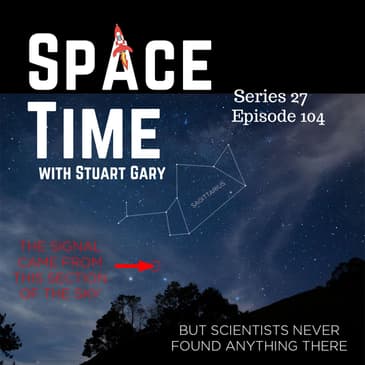



00:00:00 - This is SpaceTime series 27, episode 104, for broadcast on the 28 August 2024
00:00:45 - New study may have identified the source of the famous "Wow!" signal
00:12:30 - European Space Agency's Cluster mission to end with a controlled re-entry
00:23:45 - Earth hit by another powerful solar storm
00:32:15 - The science report: Higher levels of plant fats linked to lower risk of heart disease
00:45:00 - Neuralink's brain implant shows promising results in second trial patient
For more SpaceTime, visit our website at www.spacetimewithstuartgary.com
www.bitesz.com
Become a supporter of this podcast: https://www.spreaker.com/podcast/spacetime-with-stuart-gary--2458531/support
Sponsor Link:
NordPass
ProtonMail & Security
Malwarebytes
NordVPN
[00:00:00] [SPEAKER_01]: This is SpaceTime, Series 27, Episode 104, for broadcast on the 28th of August 2024.
[00:00:07] [SPEAKER_01]: Coming up on SpaceTime, the alien Big Wow signal finally solved.
[00:00:12] [SPEAKER_01]: Well, maybe.
[00:00:14] [SPEAKER_01]: The European Space Agency's Cluster mission set to come to a fiery end over the South Pacific.
[00:00:19] [SPEAKER_01]: And Planet Earth hit by another powerful solar storm.
[00:00:23] [SPEAKER_01]: All that and more coming up on SpaceTime.
[00:00:27] [SPEAKER_03]: Welcome to SpaceTime with Stuart Gary.
[00:00:47] [SPEAKER_01]: A new study may finally narrow down the likely source of the famous Big Wow signal.
[00:00:53] [SPEAKER_01]: The signal was detected by the Ohio State University's Big Ear radio telescope in 1977
[00:00:58] [SPEAKER_01]: as part of the university's search for extraterrestrial intelligence SETI program, which ran from 1973 to 1995.
[00:01:06] [SPEAKER_01]: It originated in the HD164595 system, which is in the direction of the constellation Sanctus Aureus.
[00:01:14] [SPEAKER_01]: It lasted for the full 72 second window that the Big Ear was able to observe it.
[00:01:20] [SPEAKER_01]: And it was so strong and unusual, astronomers had never seen anything like it before,
[00:01:24] [SPEAKER_01]: they circled a printout of the signal data, writing WOW with an exclamation mark next to it in the margins.
[00:01:30] [SPEAKER_01]: And the name stuck.
[00:01:32] [SPEAKER_01]: For years it was thought by many to be the most promising sign so far
[00:01:37] [SPEAKER_01]: of a possible extraterrestrial intelligence trying to contact us,
[00:01:41] [SPEAKER_01]: letting us know that we are not alone in the universe.
[00:01:45] [SPEAKER_01]: That's because it was in a unique part of the electromagnetic spectrum's narrowband radio frequencies,
[00:01:51] [SPEAKER_01]: right near the frequency for neutral hydrogen,
[00:01:53] [SPEAKER_01]: a region long thought by scientists to be the most likely location for a cry in the dark from an extraterrestrial intelligence.
[00:02:00] [SPEAKER_01]: But despite regular surveys of the signal's location, it's never been repeated.
[00:02:06] [SPEAKER_01]: Nor has anything like it been observed in any other part of the sky.
[00:02:10] [SPEAKER_01]: Over the years the WOW signals become law in the SETI world,
[00:02:14] [SPEAKER_01]: and over time it gradually faded into historic legend.
[00:02:19] [SPEAKER_01]: Now a report on the pre-pressed physics website archive.org
[00:02:23] [SPEAKER_01]: suggests the signal was most likely caused by the sudden brightening of hydrogen emissions
[00:02:27] [SPEAKER_01]: due to a strong transient radiation source such as a magnetar flare,
[00:02:32] [SPEAKER_01]: a soft gamma repeater,
[00:02:33] [SPEAKER_01]: or possibly the first recorded astronomical mazar flare event in the hydrogen line.
[00:02:39] [SPEAKER_01]: All of these could have caused hydrogen clouds to brighten considerably for seconds or even minutes.
[00:02:44] [SPEAKER_01]: The authors of the new study were even able to identify the hydrogen clouds responsible for the signal,
[00:02:49] [SPEAKER_01]: but not the source of the radiation itself.
[00:02:52] [SPEAKER_01]: That suggests it's far more distant than the clouds which produce the hydrogen signal.
[00:02:57] [SPEAKER_01]: The new findings are based on archival data collected by the now defunct Arecibo radio telescope in Puerto Rico.
[00:03:05] [SPEAKER_01]: The study's lead author Abel Mendez from the University of Puerto Rico
[00:03:08] [SPEAKER_01]: says the Arecibo observations made between February and May 2020
[00:03:12] [SPEAKER_01]: have revealed similar narrowband signals near the hydrogen line
[00:03:15] [SPEAKER_01]: coming from multiple directions, but less intense than the original WOW signal.
[00:03:20] [SPEAKER_01]: On the other hand, thanks to Arecibo's more advanced electronics
[00:03:24] [SPEAKER_01]: compared to those available for the big air,
[00:03:26] [SPEAKER_01]: the signals are more sensitive, have better temporal resolution,
[00:03:29] [SPEAKER_01]: and include polarization measurements.
[00:03:32] [SPEAKER_01]: The authors say that these hydrogen flare events are rare
[00:03:36] [SPEAKER_01]: and they rely on precise conditions and spatial alignments
[00:03:39] [SPEAKER_01]: between the source, the intervening hydrogen cloud, and of course the observer.
[00:03:44] [SPEAKER_01]: It means what the Ohio researchers saw back in 1977
[00:03:47] [SPEAKER_01]: was a transient brightening of one of several neutral hydrogen clouds
[00:03:51] [SPEAKER_01]: in the telescope's line of sight.
[00:03:54] [SPEAKER_01]: Of course, this isn't the first time a possible solution to the big WOW signal mystery
[00:03:59] [SPEAKER_01]: has been hypothesized.
[00:04:01] [SPEAKER_01]: For a long time it was speculated to originate with a pulsar.
[00:04:05] [SPEAKER_01]: Then in 2020 a report in Archive narrowed down the possible source for the signal
[00:04:09] [SPEAKER_01]: to a distant sun-like star cataloged as 2MASS 1928 1982-2640 123,
[00:04:18] [SPEAKER_01]: which was detected in detailed observations undertaken
[00:04:20] [SPEAKER_01]: by the European Space Agency's Gaia spacecraft.
[00:04:24] [SPEAKER_01]: That star has a similar surface temperature, a similar radius,
[00:04:27] [SPEAKER_01]: and also a similar luminosity to our Sun,
[00:04:30] [SPEAKER_01]: making it and any surrounding planetary system a tantalizing target.
[00:04:35] [SPEAKER_01]: The Gaia data provided far more detailed three-dimensional observations
[00:04:38] [SPEAKER_01]: than astronomers had available to them when they previously hunted
[00:04:41] [SPEAKER_01]: for a source for the signal.
[00:04:43] [SPEAKER_01]: But even in 2020 there were some 66 other stars in the same catalog
[00:04:48] [SPEAKER_01]: all identified as potential candidates.
[00:04:51] [SPEAKER_01]: But this particular star appeared to be the most likely back then
[00:04:54] [SPEAKER_01]: because it was by far the strongest candidate.
[00:04:58] [SPEAKER_01]: This is space-time.
[00:05:00] [SPEAKER_01]: Still to come, the European Space Agency's Cluster mission
[00:05:03] [SPEAKER_01]: set to come to a fiery end over the South Pacific Ocean.
[00:05:07] [SPEAKER_01]: And planet Earth hit by yet another powerful solar storm.
[00:05:11] [SPEAKER_01]: All that and more still to come on space-time.
[00:05:30] [SPEAKER_01]: Next month, on September 8, the first of four satellites
[00:05:33] [SPEAKER_01]: to make up the European Space Agency's Cluster mission
[00:05:36] [SPEAKER_01]: will reenter Earth's atmosphere and burn up over the South Pacific Ocean.
[00:05:41] [SPEAKER_01]: The spacecraft's fiery demise will mark the end of an historic mission
[00:05:44] [SPEAKER_01]: which lasted 24 years measuring space weather events
[00:05:48] [SPEAKER_01]: and how they impact Earth's magnetic environment.
[00:05:52] [SPEAKER_01]: This targeted reentry will be the first of its kind.
[00:05:55] [SPEAKER_01]: Launched back in the year 2000, the four cluster satellites
[00:05:59] [SPEAKER_01]: have been studying perhaps one of the things that make Earth
[00:06:02] [SPEAKER_01]: a unique habitable world where life can thrive.
[00:06:05] [SPEAKER_01]: Namely, its powerful magnetic shield, the magnetosphere.
[00:06:09] [SPEAKER_01]: Like an enormous umbrella, the magnetosphere protects life on Earth
[00:06:13] [SPEAKER_01]: from most of the driving rain of particles
[00:06:16] [SPEAKER_01]: that relentlessly stream out of the sun in the solar wind.
[00:06:20] [SPEAKER_01]: But occasionally, powerful events such as solar flares
[00:06:23] [SPEAKER_01]: and coronal mass ejections can push through this magnetic shield
[00:06:27] [SPEAKER_01]: sending bursts of energetic particles cascading down towards the Earth's surface.
[00:06:32] [SPEAKER_01]: The most common result of these geomagnetic storms
[00:06:35] [SPEAKER_01]: are the northern and southern lights, the aurora borealis and aurora astralis.
[00:06:39] [SPEAKER_01]: A kaleidoscopic spectacle that mesmerizes all who see them.
[00:06:43] [SPEAKER_01]: But this storm of charged particles from the sun can also damage satellites
[00:06:48] [SPEAKER_01]: frying their onboard electrical circuits.
[00:06:51] [SPEAKER_01]: It can disrupt radio communications and navigation systems,
[00:06:54] [SPEAKER_01]: overload power grids on the ground, blacking out vast areas,
[00:06:58] [SPEAKER_01]: increase the radiation dosage suffered by astronauts in space
[00:07:01] [SPEAKER_01]: and even people in high-altitude aircraft.
[00:07:04] [SPEAKER_01]: And it can shorten the life of satellites that do survive
[00:07:07] [SPEAKER_01]: the initial electrical shock by heating and expanding the Earth's atmosphere
[00:07:11] [SPEAKER_01]: causing additional atmospheric drag on those satellites
[00:07:14] [SPEAKER_01]: resulting in their need to use more fuel in order to avoid orbital decay.
[00:07:19] [SPEAKER_01]: Until Cluster came along, these space weather events
[00:07:22] [SPEAKER_01]: all remained something of a bit of a mystery.
[00:07:25] [SPEAKER_01]: We had a rough idea of what was going on, but no actual detailed numbers.
[00:07:30] [SPEAKER_01]: And that's where Cluster came in.
[00:07:32] [SPEAKER_01]: For more than two decades, Cluster showed how important the magnetosphere was
[00:07:36] [SPEAKER_01]: in shielding the Earth from the solar wind and what happened when it was overwhelmed.
[00:07:41] [SPEAKER_01]: Cluster watched the effects of solar storms
[00:07:43] [SPEAKER_01]: to help science better understand and forecast space weather events.
[00:07:48] [SPEAKER_01]: Cluster was initially launched on what was just meant to be a two-year mission
[00:07:51] [SPEAKER_01]: to study the sun-Earth interaction.
[00:07:53] [SPEAKER_01]: It was never designed to last this long.
[00:07:56] [SPEAKER_01]: Because it was carrying out such impressive and world-changing science,
[00:08:00] [SPEAKER_01]: ESA spacecraft operations decided to keep it going.
[00:08:03] [SPEAKER_01]: But as the four satellites now gradually sink lower in their orbits,
[00:08:07] [SPEAKER_01]: the end has finally come.
[00:08:09] [SPEAKER_01]: Without intervention, the four cluster satellites will re-enter the Earth's atmosphere naturally
[00:08:13] [SPEAKER_01]: in an unpredictable manner potentially over densely populated areas.
[00:08:18] [SPEAKER_01]: So by targeting the four satellites' re-entries, ESA will ensure that Cluster's demise
[00:08:23] [SPEAKER_01]: doesn't contribute to dangers on the ground
[00:08:26] [SPEAKER_01]: or the rocketing amount of space junk currently orbiting around the Earth.
[00:08:29] [SPEAKER_01]: The four cluster satellites are named Roomba for Cluster 1,
[00:08:33] [SPEAKER_01]: Salsa for Cluster 2, Samba for Cluster 3, and Tango for Cluster 4.
[00:08:39] [SPEAKER_01]: And it will be Salsa which is the first to take the plunge back into Earth's atmosphere.
[00:08:44] [SPEAKER_01]: As with all planned satellite re-entries, mission managers are targeting a specific region
[00:08:49] [SPEAKER_01]: over the southeastern Pacific Ocean known as Point Nemo,
[00:08:52] [SPEAKER_01]: the furthest possible point in the ocean away from land and populated areas.
[00:08:57] [SPEAKER_01]: Back in January, mission managers tweaked Salsa's orbit to make sure that on September 8
[00:09:03] [SPEAKER_01]: it experiences its final steep drop from an altitude of roughly 110 km down to around 80 km,
[00:09:09] [SPEAKER_01]: at which point it will start to experience the buffeting of Earth's atmosphere.
[00:09:14] [SPEAKER_01]: This flight plan provides the greatest possible degree of control
[00:09:17] [SPEAKER_01]: over where the spacecraft will be captured by the atmosphere and where it will begin to burn up.
[00:09:22] [SPEAKER_01]: In fact, a targeted re-entry like this allows for so much predictability
[00:09:26] [SPEAKER_01]: in the re-entry time and location that there's no need for any further maneuvers.
[00:09:31] [SPEAKER_01]: But despite being confident that no surviving fragments will fall anywhere near land,
[00:09:35] [SPEAKER_01]: scientists really still have no idea about how spacecraft really behave
[00:09:40] [SPEAKER_01]: as they pass through the lower layers of the atmosphere and burn up.
[00:09:43] [SPEAKER_01]: And so ESA is considering observing Salsa's atmospheric re-entry using a specially equipped aircraft.
[00:09:49] [SPEAKER_01]: Now, the four cluster satellites are all identical,
[00:09:52] [SPEAKER_01]: so by watching them each enter the Earth's atmosphere on slightly different trajectories
[00:09:56] [SPEAKER_01]: and under different weather conditions,
[00:09:58] [SPEAKER_01]: scientists will have a unique opportunity to conduct valuable re-entry experiments
[00:10:02] [SPEAKER_01]: studying the breakup of satellites.
[00:10:04] [SPEAKER_01]: By seeing how Salsa burns up, which parts survive, for how long and in what state,
[00:10:10] [SPEAKER_01]: scientists will learn how to build zero-debris satellites.
[00:10:13] [SPEAKER_01]: So far the best guess scientists have is what survives to reach the surface,
[00:10:18] [SPEAKER_01]: and that's almost always limited to stainless steel and titanium components.
[00:10:23] [SPEAKER_01]: Following Salsa's re-entry next month, the three remaining cluster satellites will enter caretaking mode.
[00:10:28] [SPEAKER_01]: They'll not be undertaking any scientific measurements,
[00:10:31] [SPEAKER_01]: but mission managers will be monitoring them to minimize the risk of collision with other satellites in Earth orbit.
[00:10:36] [SPEAKER_01]: They'll adjust the orbit of Roomba in preparation for a similar targeted re-entry in November.
[00:10:41] [SPEAKER_01]: They'll then maneuver Sambaran Tango in November 2025,
[00:10:45] [SPEAKER_01]: ready for Cluster's final orbital goodbye in August 2026.
[00:10:50] [SPEAKER_01]: Now the sort of science being carried out by the cluster mission won't end.
[00:10:54] [SPEAKER_01]: Late next year, ESA plans to launch its next mission to tackle Earth's magnetic environment,
[00:10:59] [SPEAKER_01]: to be known as the Solar Wind Magnetosphere Ionosphere Link Explorer, or SMILE.
[00:11:05] [SPEAKER_01]: It will be a joint venture between ESA and the Chinese Academy of Sciences.
[00:11:09] [SPEAKER_01]: SMILE will build upon Cluster's work,
[00:11:12] [SPEAKER_01]: revealing even more about the complex and intriguing magnetic environment surrounding planet Earth.
[00:11:18] [SPEAKER_01]: A case of literally standing on the shoulders of Cluster.
[00:11:22] [SPEAKER_01]: This report from ESA TV.
[00:11:24] [SPEAKER_02]: After a drawn out period of weak activity,
[00:11:27] [SPEAKER_02]: our Sun appears in recent months to have been jolted from its deep slumber,
[00:11:32] [SPEAKER_02]: blasting tons of plasma into interplanetary space.
[00:11:35] [SPEAKER_02]: The flares constantly monitored by ESA's SOHO mission and other international spacecraft
[00:11:42] [SPEAKER_02]: emanate from sunspots with enormous magnetic filaments rising from the Sun's surface.
[00:11:49] [SPEAKER_02]: Having travelled 150 million kilometres,
[00:11:52] [SPEAKER_02]: this mass of plasma buffets against our planet's magnetic field.
[00:11:56] [SPEAKER_02]: It is this interaction that Cluster, Europe's space fleet to the magnetosphere,
[00:12:02] [SPEAKER_02]: has been recording in 3D since 2000.
[00:12:06] [SPEAKER_02]: Flying in close formation around our planet,
[00:12:09] [SPEAKER_02]: the four identical spacecraft carry a suite of instruments to study the charged particles
[00:12:15] [SPEAKER_02]: and Earth's electromagnetic fields in this region extending to around 50,000 kilometres above the atmosphere.
[00:12:24] [SPEAKER_02]: Its observations have revealed a dramatic realm of invisible violence.
[00:12:29] [SPEAKER_02]: In certain circumstances, magnetic whirlpools larger than the entire Earth
[00:12:34] [SPEAKER_02]: bore into our magnetosphere, injecting venomous particles.
[00:12:40] [SPEAKER_02]: As the Sun's high energy particles collide with molecules in the upper atmosphere,
[00:12:46] [SPEAKER_02]: they lose energy, causing the molecules to glow and heat the atmosphere.
[00:12:51] [SPEAKER_02]: The effects are well known,
[00:12:53] [SPEAKER_02]: the shimmering curtains of red-green and blue light of the northern and southern auroras.
[00:12:59] [SPEAKER_02]: The Cluster Quartet has been able to directly measure the acceleration of charged particles above the auroras.
[00:13:06] [SPEAKER_02]: It has also observed black auroras, strange phenomena with dark empty regions,
[00:13:12] [SPEAKER_02]: anti-aurora where electrons are sucked from the Earth's ionosphere.
[00:13:18] [SPEAKER_02]: One of the major highlights of the mission has been the first look at the heart of a magnetic process called reconnection.
[00:13:25] [SPEAKER_02]: This occurs when magnetic fields collide, releasing energy and allowing previously separated plasmas of gas to mix.
[00:13:34] [SPEAKER_02]: It is the key mechanism that allows the solar wind to penetrate the Earth's magnetic shield.
[00:13:40] [SPEAKER_02]: Understanding the magnetic reconnection is a major quest in physics.
[00:13:45] [SPEAKER_02]: It is believed to be a fundamental process that drives powerful phenomena,
[00:13:49] [SPEAKER_02]: the jets of radiation from black holes or the powerful solar flares of our own solar system.
[00:13:57] [SPEAKER_02]: Understanding what sparks magnetic reconnection will also help scientists on Earth trying to harness fusion reactors to produce electricity,
[00:14:06] [SPEAKER_02]: but thwarted by uncontrollable reconnection events.
[00:14:10] [SPEAKER_02]: Better understanding the interactions in the magnetosphere has introduced a valuable new discipline of predicting space weather.
[00:14:20] [SPEAKER_02]: Storms generated by the solar outburst can seriously hamper even knockout electrical systems aboard satellites and damage power grids on Earth.
[00:14:30] [SPEAKER_02]: Cluster has provided a continuous solar weather watch that now allows contingency measures to be taken.
[00:14:38] [SPEAKER_02]: The satellite quartet's success is all the more resounding after the dramatic start of the mission.
[00:14:45] [SPEAKER_02]: Years of work ended in the mangroves of French Guiana on the 4th of June 1996,
[00:14:51] [SPEAKER_02]: when the first cluster spacecraft were lost in the catastrophic explosion of the first test launch of Ariane 5.
[00:14:59] [SPEAKER_02]: But within 10 months the decision to try again was taken and like a phoenix the satellites were rebuilt.
[00:15:06] [SPEAKER_02]: Four years later they were orbited in pairs by two Soyuz rockets, a tremendous achievement to relaunch the mission in such a short time.
[00:15:16] [SPEAKER_02]: Rumba, Samba, Salsa and Tango as they are affectionately called have been circling the Earth in formation ever since,
[00:15:25] [SPEAKER_02]: conducting their own style of a complex orbital dance.
[00:15:29] [SPEAKER_01]: This space-time, still to come, planet Earth hit by another powerful solar storm.
[00:15:34] [SPEAKER_01]: And later in the science report a new study has confirmed that eating higher levels of plant fats lowers your chances of developing heart disease and dying early.
[00:15:44] [SPEAKER_01]: All that and more still to come on space-time.
[00:16:03] [SPEAKER_01]: Well any of our listeners living at higher latitudes will know that the Earth's been pummeled by more violent solar storms erupting out of the Sun,
[00:16:11] [SPEAKER_01]: including several powerful X-class solar flares.
[00:16:14] [SPEAKER_01]: And again it's been spreading to lower latitudes.
[00:16:18] [SPEAKER_01]: In fact the US National Oceanographic and Atmospheric Administration, NOAA, says intense solar storms brought level 4 geomagnetic storm activity that's on a scale 5
[00:16:27] [SPEAKER_01]: and that's resulted in a rural activity seen as far south as Alabama and northern California.
[00:16:33] [SPEAKER_01]: These solar storms are being triggered by powerful blasts of energy and plasma exploding out from the Sun as solar flares and coronal mass ejections.
[00:16:42] [SPEAKER_01]: When these particles hit the Earth's protective magnetic field they cause the entire structure to vibrate.
[00:16:49] [SPEAKER_01]: And when they're powerful enough they can push through the magnetosphere shield,
[00:16:53] [SPEAKER_01]: travelling along magnetic field lines down towards the magnetic north and south poles.
[00:16:58] [SPEAKER_01]: And if you think the number of geomagnetic storms the Earth's facing are increasing, well you're right.
[00:17:03] [SPEAKER_01]: Back in May the planet went through the most powerful geomagnetic storms recorded in 20 years
[00:17:08] [SPEAKER_01]: and they caused the rural activity to light up the night skies in the United States, Europe and Australia at much lower latitudes than usual.
[00:17:16] [SPEAKER_01]: These events are expected to continue to increase both in strength and frequency as the Sun continues to move towards solar maximum,
[00:17:23] [SPEAKER_01]: the climax of its 11 year solar cycle, at which point the Sun's magnetic polarity will reverse.
[00:17:29] [SPEAKER_01]: Its magnetic north pole will become south and its south pole north.
[00:17:34] [SPEAKER_01]: And that's expected to happen sometime between now and the end of next year.
[00:17:38] [SPEAKER_01]: We'll keep you informed.
[00:17:40] [SPEAKER_01]: This is Space Time.
[00:17:58] [SPEAKER_01]: And time now to take another brief look at some of the other stories making news in science this week with a science report.
[00:18:04] [SPEAKER_01]: International researchers say people who have higher levels of plant fats in their diets also had lower chances of developing heart disease or dying early.
[00:18:13] [SPEAKER_01]: A report in the Journal of the American Medical Association looked at data from over 400,000 people spanning 24 years,
[00:18:21] [SPEAKER_01]: including nearly 190,000 deaths.
[00:18:24] [SPEAKER_01]: They say diets rich in plant fats, especially those from grains and vegetable oils,
[00:18:29] [SPEAKER_01]: were associated with a lower overall risk of heart problems and subsequently a lower risk of dying from heart related issues.
[00:18:37] [SPEAKER_01]: Inversely, the authors also found that those who had higher levels of animal based fats,
[00:18:41] [SPEAKER_01]: including those from dairy foods and eggs, had a higher risk of heart disease and a higher risk of dying from heart related issues.
[00:18:50] [SPEAKER_01]: A new study claims there may be a disproportionately higher risk of suicidal thoughts among people
[00:18:56] [SPEAKER_01]: using the diabetes and weight loss drugs containing semiglutide.
[00:19:00] [SPEAKER_01]: A report in the Journal of the American Medical Association analyzed the World Health Organization database
[00:19:06] [SPEAKER_01]: of suspected adverse drug reactions to compare the rate of suspected semiglutide related suicidal thoughts with those of other similar drugs.
[00:19:14] [SPEAKER_01]: The researchers say the reports of suicidal thoughts were slightly higher than expected for semiglutide,
[00:19:20] [SPEAKER_01]: even when compared with other diabetes drugs.
[00:19:23] [SPEAKER_01]: The researchers say they can't prove that using semiglutide causes this high risk of suicidal thoughts
[00:19:29] [SPEAKER_01]: and it's highly unlikely that the risk outweighs the benefits of the drug for most people.
[00:19:36] [SPEAKER_01]: A new study claims playing video games for less than three hours a day may actually have a positive effect on your mental well-being.
[00:19:43] [SPEAKER_01]: The findings reported in the journal Nature Human Behaviour looked at data from almost 100,000 people,
[00:19:50] [SPEAKER_01]: including more than 8,000 who were involved in a lottery to get one of two different gaming consoles.
[00:19:55] [SPEAKER_01]: The survey collected details on whether participants had consoles, what their gaming preferences were,
[00:20:01] [SPEAKER_01]: what their mental health was, what their degree of life satisfaction was, as well as their socio-demographic characteristics.
[00:20:07] [SPEAKER_01]: They found that people who had a gaming console and played games on them had improved mental health over their peers.
[00:20:15] [SPEAKER_01]: However, that was only for people who played for less than three hours.
[00:20:19] [SPEAKER_01]: Those people who played for over three hours a day did see diminishing benefits.
[00:20:24] [SPEAKER_01]: Interestingly, they also found that the simple act of owning a console was linked to improved life satisfaction,
[00:20:30] [SPEAKER_01]: helping to reduce their psychological distress.
[00:20:34] [SPEAKER_01]: Elon Musk's brain technology startup Neuralink says its implant,
[00:20:38] [SPEAKER_01]: designed to allow paralysed patients to use digital devices through thought alone,
[00:20:43] [SPEAKER_01]: is working well in a second-trial patient that was implanted with the device last month.
[00:20:48] [SPEAKER_01]: The company says the patient hasn't faced the same rejection issues suffered by the first patient back in January.
[00:20:54] [SPEAKER_01]: Patient 1's implanted wires eventually retracted post surgery,
[00:20:58] [SPEAKER_01]: resulting in a sharp reduction in the electrode's ability to measure brain signals.
[00:21:02] [SPEAKER_01]: With the details, we're joined by technology editor Alex Saharov-Royt from TechAdvice.life.
[00:21:08] [SPEAKER_00]: Okay, so Elon Musk has implanted, or his team has implanted a second Neuralink into a human being,
[00:21:14] [SPEAKER_00]: and he's now able to play Counter-Strike 2 with his mind.
[00:21:18] [SPEAKER_00]: He's also designing 3D objects as well.
[00:21:21] [SPEAKER_00]: So we really are getting into this whole idea of the force, in this case through technology,
[00:21:26] [SPEAKER_00]: and I guess building the Cyberman or Cyberwoman.
[00:21:29] [SPEAKER_00]: And this is a patient named Alex, now that's not me, but this is a procedure that went very smoothly.
[00:21:34] [SPEAKER_00]: And Elon said in a post to X that if this all goes well,
[00:21:38] [SPEAKER_00]: there will be hundreds of people with Neuralinks within a few years,
[00:21:41] [SPEAKER_00]: maybe tens of thousands within five years and millions within 10 years.
[00:21:46] [SPEAKER_00]: And the progress is obviously amazing for somebody with a spinal cord injury
[00:21:51] [SPEAKER_00]: and obviously can control the computer cursor with his mind,
[00:21:54] [SPEAKER_00]: and he was able to do that within minutes of connecting the linked device to his computer.
[00:21:59] [SPEAKER_00]: And obviously we're in a situation where the operations only just recently happened
[00:22:03] [SPEAKER_00]: and the first recipient did lose some access to the Neuralink.
[00:22:07] [SPEAKER_00]: There was just a bit of rejection.
[00:22:08] [SPEAKER_00]: The scientists were able to compensate for that and restore some of the connectivity,
[00:22:12] [SPEAKER_00]: but it's a learning process, but it certainly does highlight the technology's potential
[00:22:17] [SPEAKER_00]: for enhancing all manner of everyday activities.
[00:22:20] [SPEAKER_00]: I mean being able to control things with the power of your mind was once just science fiction,
[00:22:24] [SPEAKER_00]: but this patient can control computer-aided design software.
[00:22:27] [SPEAKER_00]: He had a mount for his Neuralink charger, a custom mount that was then 3D printed
[00:22:32] [SPEAKER_00]: and just incredible how even Elon Musk wants to create an optical product called Blindsight,
[00:22:38] [SPEAKER_00]: and this will enable people who've lost both eyes or have no sight to see.
[00:22:43] [SPEAKER_00]: And he also said that if somebody has lost their arms or legs,
[00:22:46] [SPEAKER_00]: they can actually attach an optimus arm or leg during the Neuralink implant
[00:22:50] [SPEAKER_00]: so that the commands from their brain would go to their robot arms or legs.
[00:22:54] [SPEAKER_00]: So this is heikening to Luke Skywalker losing his arm in a fight with Darth Vader.
[00:22:59] [SPEAKER_00]: I am your father.
[00:23:02] [SPEAKER_00]: These sorts of things are actually starting to be done for real, so it's a truly exciting time.
[00:23:07] [SPEAKER_00]: That's Alex Zaharov-Royd from TechAdvice.life.
[00:23:25] [SPEAKER_01]: And that's the show for now.
[00:23:28] [SPEAKER_01]: Spacetime is available every Monday, Wednesday and Friday through Apple Podcasts, iTunes, Stitcher, Google Podcasts, Pocket Casts, Spotify, Acast, Amazon Music, ByteStore.
[00:23:39] [SPEAKER_01]: Spacetime.com, Soundcloud, YouTube, your favorite podcast download provider and from Spacetime with StuartGarry.com.
[00:23:47] [SPEAKER_01]: Spacetimes also broadcast through the National Science Foundation on Science Zone Radio and on both iHeartRadio and TuneIn Radio.
[00:23:55] [SPEAKER_01]: And you can help to support our show by visiting the Spacetime store for a range of promotional merchandising goodies
[00:24:01] [SPEAKER_01]: or by becoming a Spacetime patron, which gives you access to triple episode commercial free versions of the show
[00:24:07] [SPEAKER_01]: as well as lots of Burness audio content which doesn't go to air, access to our exclusive Facebook group and other rewards.
[00:24:15] [SPEAKER_01]: Just go to SpacetimewithStuartGarry.com for full details.
[00:24:19] [SPEAKER_01]: You've been listening to Spacetime with StuartGarry.
[00:24:22] [SPEAKER_03]: This has been another quality podcast production from Bytes.com.