
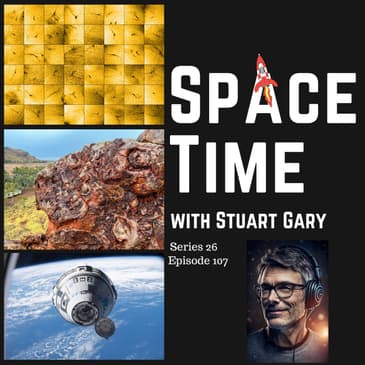



SpaceTime Series 26 Episode 107 *Solar Orbiter discovers tiny jets that could power the solar wind Astronomers have discovered tiny jets on the Sun that could be the source of the solar wind – the constant stream of charged particles flowing out from the S un and filling the solar system. *Looking for signs of the earliest life in outback Australia Astrobiologists and geologists with NASA have been scouring the Pilbara region of outback Western Australia looking for the earliest signs of life on Earth. *Getting busy aboard the International Space Station Four new astronauts have arrived aboard the International Space Station following a text book launch from the Kenedy Space Centre in Florida. *The Science Report Study shows claims paper straws contain potentially toxic chemicals. Scientists find that single use paper cups are just as toxic as plastic cups. The secret spices used in the ancient Egyptian mummification process. Alex on Tech: Listen to SpaceTime on your favorite podcast app with our universal listen link: https://spacetimewithstuartgary.com/listen and access show links via https://linktr.ee/biteszHQ Additionally, listeners can support the podcast and gain access to bonus content by becoming a SpaceTime crew member through www.bitesz.supercast.com or through premium versions on Spotify and Apple Podcasts. Details on our website at https://spacetimewithstuartgary.com For more SpaceTime and show links: https://linktr.ee/biteszHQ
Become a supporter of this podcast: https://www.spreaker.com/podcast/spacetime-with-stuart-gary--2458531/support.
00:00:00
This is Space Time series 26 episode, 100 and seven for
00:00:03
broadcast on the sixth of September 2023. Coming up on
00:00:07
Space Time have scientists just discovered the origins of the
00:00:12
solar wind, looking for signs of the earliest life on Earth in
00:00:16
Outback Australia and things are getting busy aboard the
00:00:20
International Space Station. All that and more coming up on Space
00:00:25
Time.
00:00:27
Welcome to Space Time with Stuart Garry, astronomers have
00:00:47
discovered tiny jets on the Sun that could be the source of the
00:00:51
solar wind, a constant stream of charged particles flowing out
00:00:55
from the Sun and filling the solar system. The joint eser
00:00:59
NASA's Solar Orbiter spacecraft observed a multitude of these
00:01:02
little jets of material escaping from the Sun's outer atmosphere.
00:01:07
A report in the journal science found that each jet lasts
00:01:10
between 2100 seconds and expels plasma at a rate of about 100
00:01:14
kilometers per second. So, could these jets be the long sought
00:01:19
after source of the solar wind? The solar wind is composed
00:01:23
mostly of protons, neutrons, alpha particles and large chunks
00:01:27
of magnetic field.
00:01:29
Collectively, these are called a plasma and the plasma propagates
00:01:33
outwards through interplanetary space colliding with anything in
00:01:37
its path. When large enough chunks of the solar wind collide
00:01:40
with the Earth's magnetic field, it produces spectacular aurora
00:01:44
lights, the aurora Strauss and aurora borealis. But these space
00:01:48
weather events can also produce geomagnetic storms.
00:01:52
These can be powerful enough to fry the circuits on satellites
00:01:55
and spacecraft cause elevated radiation doses for crew in
00:01:59
orbit, disrupt communications and navigation systems and even
00:02:04
black out power grids on the Earth's surface. Although the
00:02:07
solar wind is a fundamental feature of the Sun,
00:02:10
understanding how and where it's generated has proven to be
00:02:13
elusive and has been a key focus of study for decades now.
00:02:17
Thanks to its superior instrumentation. Solar Orbiter
00:02:20
has taken astronomers an important step closer. The data
00:02:24
comes from Solar Orbiter's extreme ultraviolet image or
00:02:27
instrument images of the Sun's south pole revealed a population
00:02:32
of very faint short lived features that were associated
00:02:35
with small jets of plasma being ejected from the Sun's
00:02:38
atmosphere.
00:02:39
The study's lead author Lakshmi Pradeep Chia from the Max Park
00:02:42
Institute says they could only detect these jets because of the
00:02:46
unprecedentedly high resolution and high cadence images being
00:02:50
produced by Solar Orbiter.
00:02:52
The images were taken in the extreme ultraviolet channel
00:02:55
which observes million degree solar plasma at a wavelength of
00:02:58
17.4 nanometers analysis shows these features are caused by the
00:03:04
expulsion of plasma from the solar atmosphere. Researchers
00:03:08
have known for decades that a significant fraction of the
00:03:10
solar winds associated with magnetic structures known as
00:03:14
coronal holes.
00:03:15
These are regions where the Sun 's magnetic field doesn't turn
00:03:19
back down towards the Sun. Instead, the magnetic field
00:03:23
lines simply stretch deep into the solar system. And plasma
00:03:27
from the Sun can flow along these open magnetic field lines
00:03:30
heading into the solar system and generating the solar wind.
00:03:34
But the big question was, how did the plasma get launched?
00:03:37
Now, the traditional assumption has always been that because the
00:03:40
corona is hot, it will naturally expand and a portion of it will
00:03:44
escape into space along the field lines. But these new
00:03:48
results look in the coronal holes situated near the Sun's
00:03:51
south pole and the individual jets that were revealed
00:03:54
challenge the assumption that the solar winds produced only in
00:03:57
a continuous steady flow.
00:03:59
It turns out this flow is not actually uniform. The ubiquity
00:04:03
of the jets suggests that the solar wind from coronal holes
00:04:07
might originate as a highly intermittent outflow. Now, the
00:04:11
energy associated with each individual jet is small. Let me
00:04:16
put it this way. At the top end of coronal phenomena, you have
00:04:19
your X class solar flares.
00:04:21
These are humongous and can blast at the Earth causing
00:04:25
magnificent geomagnetic storms. Major space weather events at
00:04:29
the lower end of the scale are so called nano flares. There's
00:04:33
millions of times more energy in an X class flare than what there
00:04:37
is in a nano flare.
00:04:39
And these tiny jets discovered by Solar Orbiter are even less
00:04:43
energetic than that manifesting around 1000 times less energy
00:04:47
than a nano flare and channeling most of that energy into the
00:04:50
expulsion of the plasma. But their ubiquity implied by the
00:04:54
new observations suggests they're expelling a substantial
00:04:57
fraction of the material which we see in the solar wind. So
00:05:00
they're really tiny, but there are lots of them at present.
00:05:04
Solar orbit is still circling the Sun close to the equator. So
00:05:08
these observations across the south pole are being seen at a
00:05:11
grazing angle. It's hard to measure some of the properties
00:05:15
of these tiny jets because we're seeing them virtually edge on.
00:05:19
But in a few years Time astronomers will get a very
00:05:21
different perspective.
00:05:23
That's because Solar Orbiter's trajectory will gradually
00:05:25
incline its orbit towards the polar regions. At the same Time,
00:05:30
the activity on the Sun will continue to progress through the
00:05:32
solar cycle and the coronal holes will be popping up in many
00:05:35
different locations thereby providing scientists with unique
00:05:39
new perspectives. This report from Eser.
00:05:43
Tv built by Airbus in the UK. Engineers had the challenging
00:05:48
task of designing a mission capable of observing the Sun as
00:05:52
close as 42 million kilometers away within the orbit of
00:05:56
mercury.
00:05:58
The spacecraft has a number of key new technologies that have
00:06:01
been developed just for the purpose of flying close to the
00:06:04
Sun. We have a specific heat shield designed just for Solar
00:06:08
Orbiter that will reach temperatures of over 500 °C on
00:06:12
the front side and will keep things as cool as just about 50
00:06:16
°C on the back side to protect the sensitive electronics.
00:06:19
The Sun generates a bubble of plasma enveloping the entire
00:06:23
solar system known as the heliosphere. Anything within it,
00:06:27
including Earth is subject to a stream of charged particles
00:06:31
called the solar wind.
00:06:33
Violent space weather from flares and coronal mass
00:06:37
ejections has the potential to damage satellites, disrupt
00:06:41
communications and knock out power grids on the ground.
00:06:45
Solar Orbiter will help answer fundamental questions about the
00:06:49
Sun's activity.
00:06:50
One of the key questions the scientists have is how the
00:06:54
heliosphere is actually generated and how it's
00:06:57
accelerated. So what is really driving the solar winds? And the
00:07:01
second key question, the mission is understanding what makes the
00:07:06
Sun change or vary over this 11 year cycle that we all know.
00:07:10
So understanding the the magnetic properties of the Sun
00:07:14
and how this change over this 11 year cycle is one of the key
00:07:17
scientific objectives of Solar Orbiter.
00:07:20
To measure the magnetic environment around the Sun.
00:07:23
Solar Orbiter is fitted with extremely sensitive instruments
00:07:27
and to capture the closest ever pictures of our star, the heat
00:07:31
shield has peep holes through it covered by protective doors.
00:07:36
We are going to places where no other solar telescopes have been
00:07:39
before we are going to be very close to the Sun to take very
00:07:42
high resolution images of the Sun unprecedented spatial
00:07:46
resolution. And we are also going to fly over the poles of
00:07:49
the Sun regions that are very much unknown because we don't
00:07:53
see them very well from Earth, but they are the source of the
00:07:55
wind and therefore are very important.
00:07:58
To reach this orbit. After launch Solar Orbiter will use
00:08:01
the gravity of Venus and Earth over the course of several
00:08:05
years.
00:08:06
Solar Orbiter is building on the rich legacy of Esa's previous
00:08:10
missions to the Sun including ulysses and SOHO in orbit around
00:08:15
our star for more than 20 years. Soho is still returning
00:08:19
spectacular images. This solar mission will complement NASA's
00:08:24
Parker solar probe. We will not get as close to the Sun but we
00:08:28
will have vastly bigger payload complements and more instruments
00:08:32
with more cameras looking at the Sun.
00:08:34
So we will do science that is complementary to solar probe and
00:08:38
the two will really have a great deal of synergy. Scientists and
00:08:41
engineers have been working on Esa's Solar Orbiter mission for
00:08:45
more than 20 years. They can now look forward to unraveling the
00:08:49
mysteries of the Sun.
00:08:50
This is Space Time still to come looking for signs of the
00:08:54
earliest life on Earth in Outback Australia and things are
00:08:58
getting busy aboard the International Space Station. All
00:09:02
that and more still to come on Space Time.
00:09:20
Ok. Let's take a break from our show for a word from our new
00:09:22
sponsor in Cockney, a new data protection service. From the
00:09:26
same folks who bring you Nord VPN. It's a startling fact that
00:09:30
everything you do online is being sold even published
00:09:34
without your knowledge.
00:09:35
How often do you think about your personal information that's
00:09:38
out there on the internet, what it's being used for and how it's
00:09:42
being collated? But there is a silver lining because you have
00:09:45
every right to protect your privacy and ask these data
00:09:48
brokers to erase your information.
00:09:51
Now, if you're thinking about doing this manually, brace
00:09:54
yourselves because it's going to take years just to go through
00:09:57
the whole rigor all once and guess what? You'll need to keep
00:10:00
this tedious process going every few months.
00:10:03
That's because big brothers out there are continually creating
00:10:06
new information and getting new records on all your data and
00:10:10
you'll be surprised to learn just how much data they have on
00:10:13
you and where they get it from. But now there's in Coney, it's a
00:10:17
game changer in cogn experts who will handle all this for you,
00:10:22
ensuring your data is removed from these databases, which in
00:10:25
turn will reduce spam and those Pesky scam attacks.
00:10:29
And the best part is all their subscriptions are already
00:10:32
incredibly affordable as a special treat for Space Time
00:10:35
listeners will give you an extra 60 per cent off now to find out
00:10:39
more, check out their website and take advantage of our
00:10:42
special 60 per cent off offer.
00:10:44
Head over to www in cog dot com forward slash Stuart Garry and
00:10:50
incognito. The way is spelled Inc Ogn, I that's IC Ogn I the
00:10:58
URL again is www dot in cog dot com forward slash Stuart Garry
00:11:04
or simply apply the discount code, Stuart Garry at the check
00:11:08
out.
00:11:08
So don't let your data be someone else's profit, take
00:11:12
control back and let incognito the hard work for you. And of
00:11:16
course, you'll find all the URL details in the show notes.
00:11:19
And on our website, this is Space Time with Stuart Garry,
00:11:30
geologists and astrobiologists with NASA have been scouring the
00:11:33
Pilbara Region of Outback Western Australia looking for
00:11:36
some of the earliest signs of life on Earth. The expedition
00:11:40
which includes scientists with the European Space Agency, the C
00:11:44
SI O and the Australian Space Agency are actually studying
00:11:48
what signs of ancient life look like.
00:11:50
So they have a better idea of what to look for as they
00:11:53
continue to explore the red planet. MARS Eric Einen, the
00:11:58
director of NASA's MARS Exploration Program says the
00:12:01
more scientists learn about Earth's evolution, the more they
00:12:03
can apply that knowledge to their characterization of the
00:12:06
red planet.
00:12:08
And the Outback Pilbara Region is one of very few places on
00:12:11
Earth that hold an intact geological record of the planet
00:12:15
's early history, including some of its earliest known geological
00:12:18
samples and some of the earliest samples of life.
00:12:21
Now, specifically, this team is searching for fossilized
00:12:24
stromatolites mats of micro organisms that have been in
00:12:28
existence for over 3.5 billion years and are thought to have
00:12:32
supplied Earth with its oxygen.
00:12:34
Living examples of these ancient bacterial structures can still
00:12:37
be found today, mostly in sheltered coastal bays and
00:12:40
inlets and fossils of their ancient relatives can be found
00:12:44
preserved in the rocks of the Pilbara Region due to the
00:12:48
geological and climatic processes which are continuously
00:12:52
reshaping the Earth's surface.
00:12:54
It's extremely difficult for stromatolites as well as other
00:12:56
fossils to be preserved on Earth for long periods of Time. So
00:13:00
really only a fraction of past life remains in the geological
00:13:04
record.
00:13:05
Luckily, in the Pilbara Region, the rock record's been able to
00:13:08
stay relatively intact for billions of years that's
00:13:12
resulting in outcrops of geology that match the same age as what
00:13:16
scientists are seeing on much of the Martian surface today. And
00:13:20
that makes this area of planet Earth a critical testing ground
00:13:24
for scientist and engineers to hone their skills for
00:13:27
identifying science of ancient life environments.
00:13:30
Lindsay Hayes, the deputy scientist for MARS sample return
00:13:34
and program scientist for Astrobiology at NASA says to be
00:13:37
able to prove that these features are biogenic.
00:13:40
Not only do you need to be able to prove that life could have
00:13:42
created them, but you also need to be able to prove that a
00:13:45
particular version of these features wasn't created by some
00:13:48
other geological or chemical process. So you need to
00:13:52
understand what else is going on in the geological record. Of
00:13:55
this rock to be able to understand what you're looking
00:13:58
at.
00:13:58
The central theme of the field workshop is the importance of
00:14:02
geological context when choosing sampling sites and eventually
00:14:06
confirming the integrity of a sample's biological origin. The
00:14:10
Pilbara is the perfect classroom for teams to study stromatolites
00:14:14
that have already withstood the test of Time and that of
00:14:16
scientific rigor and thereby to give scientists a better idea of
00:14:20
what to look for on MARS.
00:14:22
The group investigated how the environment in which the science
00:14:25
of ancient life were found could have been conducive or
00:14:28
unfavorable to biology taking shape.
00:14:31
NASA's MARS perseverance rover has been reversing Jero crater
00:14:35
which contains an ancient river delta ever since it landed there
00:14:39
on February the 18th 2021 it's been collecting samples of rock
00:14:43
and regolith that just maybe contain samples of ancient
00:14:47
microbial life from the Time these rocks were formed on MARS
00:14:50
between three and 3.5 billion years ago.
00:14:54
The exercises on the Pilbara expedition have been mimicking
00:14:57
what perseverance has been doing remotely millions of kilometers
00:15:00
away, identifying samples in the field and then studying the area
00:15:04
around them. This report from NASA TV.
00:15:21
Welcome everybody to the dope.
00:15:25
We're delighted to be able to take you into a site containing
00:15:29
the oldest, most convincing evidence for life on Earth in
00:15:34
rocks that are 3.5 billion years old.
00:15:39
It's a great opportunity to come and see what you might be
00:15:42
looking for on MARS.
00:15:46
We can see rippled sediment, beautiful ripples here
00:15:49
continuing along and it comes up to the edge and it pinches out
00:15:53
against the side of the stroma and then continues over here on
00:15:57
the other side.
00:15:58
So what we're looking at here in Western Australia are what are
00:16:01
known as stromatolites. These are rock features that were
00:16:05
precipitated or caused to precipitate by mats of micro
00:16:09
organisms that were living at the Time again, 3.5 billion
00:16:12
years ago.
00:16:13
So a stromata light is a physical feature. Usually it's
00:16:16
either a dome or a cone shaped feature. And these are formed
00:16:21
when single celled organisms living together in a colony,
00:16:25
either trap and bind sediment or precipitate sediment on them.
00:16:29
And then these photosynthetic organisms grow up.
00:16:31
And so you see these layers that repeat in that shape, sometimes
00:16:35
they branch, sometimes they grow, sometimes they shrink. But
00:16:39
what it is is evidence of a colony of life from the earliest
00:16:42
evolution of life, the earliest fossils that we have.
00:16:46
And these organisms then had their presence here on Earth
00:16:49
captured and preserved in the rock record for all of this
00:16:53
Time. And so what we're looking for are these particular
00:16:56
structures that these microorganisms made that are
00:16:59
distinct from what geology normally does.
00:17:04
So the greatest thing about Australia is that it has some of
00:17:07
the oldest rocks and some of the best preserved rocks for all
00:17:11
different Time periods in Earth history.
00:17:14
And it's important for us to come here because what we're
00:17:17
looking for here is the oldest convincing evidence of life on
00:17:21
Earth.
00:17:22
And in our search for evidence of life on other planets beyond
00:17:25
Earth, especially MARS, it's important to understand how
00:17:29
difficult it is to convince people of what we're seeing here
00:17:32
on Earth as being evidence of life from 3.5 billion years ago.
00:17:37
And if we're looking for something similar on MARS, it's
00:17:39
a much more challenging prospect.
00:17:42
So in order for us to find a biosignature, there are actually
00:17:45
five stages that have to happen and all of them have to happen.
00:17:47
And in this particular order, the first is life has to exist.
00:17:51
The second is life has to create some kind of a fossil that we
00:17:55
can recognize and we can see as unique enough to be indicative
00:17:59
that there was something going on there.
00:18:01
Third, that fossil has to be preserved immediately or very
00:18:05
soon after its form. The fourth step is that preservation has to
00:18:09
continue for a long period of Time. And then finally, we have
00:18:12
to find it.
00:18:13
So it either has to be eroded or it has to be somewhere where we
00:18:16
can look at a rock and recognize that there's a fossil that is an
00:18:21
extremely unique and difficult process to have happen. So there
00:18:25
's only a fraction of life that ever existed, ever becomes a
00:18:29
fossil. It's in fact an incredibly lucky process to go
00:18:32
from life living at some point to a fossil that you can find.
00:18:36
And so that's why building that story takes a lot of Time and
00:18:39
why it's difficult that any one particular feature may not be
00:18:43
biological. But when you combine all of these things together,
00:18:47
that is what convinces people that what we're actually looking
00:18:50
at is evidence of 3.5 billion year old life on this planet.
00:18:54
So trying to do this here on Earth is difficult enough and
00:18:57
then trying to do it from 100 million miles away with rovers
00:19:00
that have cameras and you have to send signals that take a
00:19:03
really long Time to go back and forth even more challenging
00:19:07
Earth.
00:19:07
And MARS may have had similar past and the more we learn about
00:19:11
Earth's past, the more we may be able to apply it to MARS now
00:19:15
that we're collecting samples at MARS, wouldn't it be
00:19:17
unbelievable if we were able to find something that indicated
00:19:21
similar things that we're finding here on Earth that
00:19:24
indicate hate there may have been life in the distant past on
00:19:27
MARS.
00:19:36
And in that report from NASA TV, we heard from Dr Martin Van
00:19:39
Kraen Dock from the University Of New South Wales. Dr Mit
00:19:43
Schult NASA scientist with the MARS Exploration Program, Dr
00:19:47
Lindsay Hayes NASA's deputy program scientist with the MARS
00:19:51
sample return mission and Eric Ien NASA's Director for the MARS
00:19:55
Exploration Program. This is Space Time still to come.
00:20:01
It's getting crowded on the International Space Station.
00:20:03
There are 11 astronauts up there right now and they've all got
00:20:06
lots of scientific experiments to carry out. And later in the
00:20:10
science report, have you ever wondered what an Ancient
00:20:13
Egyptian mummy smells like? Well, stay listening and we'll
00:20:16
tell you all that and more still to come on Space Time.
00:20:36
Four new astronauts have just arrived aboard the International
00:20:39
Space Station following a textbook launch from the Kennedy
00:20:42
Space Center in Florida. The flight aboard a SpaceX Fara Nine
00:20:46
rocket propelling the dragon capsule endurance had been
00:20:49
delayed by a day to give engineers more Time to review a
00:20:52
component in the capsule's environmental control and life
00:20:55
support system.
00:20:56
The spacecraft dock with the space station's harmony module,
00:20:59
Zenith port 29 hours after lifting off from Pad 39 A, the
00:21:04
mission was the seventh crew transfer flight to the orbiting
00:21:07
outpost using Elon Musk's SpaceX and the NASA's commercial crew
00:21:11
program.
00:21:12
Since 2020 Boeing's trouble plagued starliner spacecraft
00:21:16
should be sharing the load with SpaceX but ongoing technical
00:21:19
issues have repeatedly delayed their flights with the earliest
00:21:22
launch Time. Now, not likely before next year.
00:21:26
The only other manned spacecraft authorized the transport crew to
00:21:29
the space station is Russia's soyuz which unlike the dragon
00:21:33
and starliner is a single use spacecraft. The International
00:21:37
Space Station remains a rare area of cooperation between
00:21:40
Russia and the West in the wake of Moscow's invasion of Ukraine.
00:21:44
The crew seven mission was also the most multinational
00:21:48
representing crews from America, Denmark, Russia and Japan.
00:21:53
They'll join the seven expedition 69 70 crew currently
00:21:57
on station and eventually replace the four crew, six
00:22:00
members who will return to Earth in a couple of days aboard their
00:22:03
dragon capsule endeavor.
00:22:04
After spending six months on station during cruise, six's
00:22:08
Time on the is two Russian cosmonauts conducted a spacewalk
00:22:12
using the pois airlock, the seven hour E VA or extra vehicle
00:22:17
activity attached three debris shields to the rast module. They
00:22:21
also tested the sturdiness of a work platform which is affixed
00:22:24
at the end of the European robotic arm attached to the NACA
00:22:28
multipurpose laboratory module.
00:22:30
Crew seven will also conduct a spacewalk during their stay on
00:22:33
station. They'll be collecting samples to determine whether the
00:22:37
space station releases microorganisms through its life
00:22:40
support system vents and whether those microbes, if they're there
00:22:44
can survive and reproduce in space.
00:22:46
Another experiment will aim to assess the physiological
00:22:50
differences between sleeping on Earth and sleeping in space.
00:22:54
This is Space Time and Time had to take another look at some of
00:23:14
the other stories making news in science.
00:23:16
This week with the science report, a new study claims that
00:23:20
paper straws contain potentially toxic chemicals which could pose
00:23:24
a risk to people, wildlife and the environment. The findings
00:23:28
reported in the journal food additives and contaminants shows
00:23:31
that the majority of paper and bamboo straws tested contained
00:23:35
long lasting and potentially destructive poly and per fluro
00:23:38
alkali substances known as PFAS.
00:23:42
Pfas chemicals are often known as forever chemicals as they
00:23:46
don't fully break down naturally in the environment. They're
00:23:49
toxic to a range of animals and have been linked to a number of
00:23:52
human health problems including lower response to vaccines,
00:23:56
lower birth weight, thyroid disease, increased cholesterol
00:23:59
levels, liver damage, kidney cancer and testicular cancer.
00:24:04
The study analyzed 39 brands of straws made from paper, bamboo
00:24:08
glass, stainless steel and plastic, which were randomly
00:24:11
selected from a range of European stores and fast food
00:24:14
outlets.
00:24:15
They found that 18 of the 20 brands of paper straws contained
00:24:19
the P FA S chemicals P FA S was also frequently detected in
00:24:23
bamboo straws. In fact, only the stainless steel straws lacked
00:24:27
chemicals. Paper straws used to be the mainstay of milk bars and
00:24:32
fast food joints until the mid 19 sixties.
00:24:35
That's when they gradually began to be replaced by cheaper but
00:24:38
environmentally very unfriendly plastic straws. So eventually
00:24:43
the pendulum swung back to paper on environmentally friendly
00:24:46
grounds. These days, those same paper straws usually come
00:24:50
wrapped inside a sealed plastic sleeve which sort of defeats the
00:24:54
purpose, doesn't it?
00:24:56
Now, while we're on the subject, just when you thought your
00:24:59
morning cafe latte was safe and its corrugated paper cup comes a
00:25:03
new study finding that single use paper cups are just as toxic
00:25:07
as plastic cups. A report in the journal environmental pollution
00:25:11
found that the plastic film used to keep the cup water tight is
00:25:14
often made of poly lact or ple.
00:25:17
It's a type of bioplasma are produced from renewable
00:25:22
resources such as corn cassava or sugar cane rather than toxic
00:25:26
fossil fuels. As is the case for 99 per cent of plastics on the
00:25:30
market today.
00:25:31
So PS are often regarded as biodegradable, meaning they can
00:25:35
break down faster than oil based plastics. But the researchers
00:25:39
have now found that this can still be toxic. They found that
00:25:43
as the paper cups break down in nature, they released poly lact
00:25:47
pls which it turns out affected the growth of other animals.
00:25:53
Have you ever wondered what an Ancient Egyptian mummy smells
00:25:55
like? Well, archaeologists have now discovered some of the
00:25:59
secret spices used in the Ancient Egyptian mummification
00:26:02
process based on their smell. The team have been studying the
00:26:06
Egyptian herbal woman, Sene Nay, whose remains were uncovered in
00:26:09
the year 1900.
00:26:11
She lived in Egypt around 1450 BCE and was the wetness to
00:26:15
Pharaoh A and hotep. The second, the authors say she smelled like
00:26:19
pine and vanilla were just ahead of bitumen.
00:26:22
It suggested that she was mummified using bees, wax, plant
00:26:25
oils and animal fats naturally occurring bitumen resins from
00:26:29
coniferous trees such as pine and larches and a compound
00:26:33
called Kumaran which has a vanilla like scent
00:26:36
interestingly. The authors also found different balms in
00:26:39
different canopic jars which he used to store the mummy's
00:26:42
different organs.
00:26:44
When they examined these, they found that some canopic jars
00:26:47
contained substances which originated in India or South
00:26:50
East Asia, which highlights not just the existence but also the
00:26:54
importance of long distance international trade even 3.5
00:26:58
1000 years ago, new iphones on the way longer update windows
00:27:04
for pixel and a drop in global PC sales with all the details on
00:27:08
these stories and more.
00:27:10
We're joined by technology editor Alex Sahara Roy from Tech
00:27:13
Advice dot live.
00:27:14
Well, Apple has made the announcement that on September
00:27:16
the 12th at 10 a.m. pacific Time at Cupertino, they're going to
00:27:20
be launching the 15, the 15 and 15 plus and then the Iphone 15
00:27:26
Pro with the three cameras and the Pro Max, which is also
00:27:29
rumored to be called the Ultra. That is also rumored to have a
00:27:32
six times optical zoom periscope zoom one.
00:27:35
It's not as big as Samsung with 10 times, but look, it's all
00:27:38
still rumors. We'll have to wait to see what Apple actually
00:27:41
announces in the 15 and 15 plus. They should be in the colors of
00:27:44
black, green, blue, yellow and pink. They'll probably launch a
00:27:47
red model sometime next year, early next year to continue
00:27:51
sales.
00:27:51
And in the 15 Pro And Pro Max, we've the usual silver and space
00:27:56
black, but there's a new Titan gray and a new dark blue color
00:28:00
and these phones are supposed to have rounded edges as well. So
00:28:03
there's still going to be surprises, you know, faster
00:28:05
processes and smaller bezels and other things we've talked about
00:28:08
before. But really, it's just Time to wait for next week to
00:28:12
arrive.
00:28:12
It will be at 10 a.m. on the West coast. It will be 6 p.m. in
00:28:16
London and for us in Australia, it will be September 13th at 3
00:28:20
a.m. in the morning on the east coast of Australia. So I'll be,
00:28:24
I'll be awake and I'll be watching already. Greg Jos, one
00:28:27
of the Apple executives says that there are wonders ahead.
00:28:30
Now while we're on the subject of cell phones, Google are
00:28:33
upping the number of updates. What a report.
00:28:35
Says is that Google is going to offer five years of Android OS
00:28:39
updates starting with the pixel eight series. And so that
00:28:42
matches Apple's effectively five year update cycle. I think
00:28:45
Samsung also spoke about offering five years worth of.
00:28:48
And this is in stark contrast to most of the other Android device
00:28:51
makers who do get the updates from Google when Google makes
00:28:55
them available.
00:28:56
But if they take their Time to test them across the entire
00:28:59
product range and allow users to update, and that of course, is a
00:29:02
security risk. If there's a known vulnerability, Google has
00:29:04
patched it, that your phone hasn't yet got it, then your
00:29:06
phone is able to be hacked in theory.
00:29:08
So Apple users can update the moment that Apple makes an
00:29:12
update available and Google pixel users can do that as well.
00:29:15
But what is happening here is that Google is said to be
00:29:17
matching Apple's five years worth of updates. And in fact,
00:29:19
Apple actually still continues to give security updates for
00:29:22
even some of its older devices for at least a year if not
00:29:25
longer.
00:29:26
And there's been forecasts of a decline in PC shipments.
00:29:29
Yes, IDC, the analyst firm is forecasting that PC shipments
00:29:32
will decline 13.7 per cent this year. But they do expect global
00:29:36
PC shipments to return to growth, although not to the
00:29:40
height of the pre pandemic levels in 2019, we did actually
00:29:44
have explosive years of growth in 2020 21 but signs of growth
00:29:48
are actually returning.
00:29:49
I mean, people didn't buy a lot of pcs last year because, well,
00:29:52
they just upgraded throughout 2020 2021 as there was this huge
00:29:55
rush to work from home.
00:29:56
And of course, we have had inflationary pressures, but IDC
00:29:59
does suggest that this year won't be as high, but 2024 will
00:30:04
see 261.4 million shipments growth of 3.7 per cent year over
00:30:09
year. This shipment volume is higher than the 259.6 million
00:30:13
units in 2018, but it's still below 2019 levels.
00:30:16
And what else is on the website this week? Well, well, there's
00:30:18
some.
00:30:18
News about Berlin, the big tech show in Germany. It'll be on
00:30:22
over the next few days and we'll have details next Time we speak
00:30:25
about the big announcements that were there. Yeah, I've also got
00:30:28
some details on Samsung's Soul for Tomorrow Competition for
00:30:30
2023.
00:30:31
This is supposed to be elevating the next generation of
00:30:34
innovators, all the details at my site, as well as some
00:30:37
information on generative ai from tel site, an Australian
00:30:42
emerging technology research firm.
00:30:44
And they've also just released some stats as well about how the
00:30:46
streaming services are going in Australia. Whilst Netflix has
00:30:50
lost subscribers in Australia and it does still remain the top
00:30:53
dog. They actually haven't put subscribers on in the US. All
00:30:56
the details are at Tech Advice dot life. Please come and.
00:30:58
Check it out. That's Alex Sahara Roy from Tech Advice dot live
00:31:18
and that's the show for now. SpaceTime is available every
00:31:21
Monday, Wednesday and Friday through Apple Podcasts, itunes,
00:31:25
Stitcher, Google podcast, Pockets, Spotify, a Cast Amazon
00:31:30
music bites dot com. Soundcloud, YouTube, your favorite podcast
00:31:35
download provider and from Space Time with Stewart Gary dot com.
00:31:39
SpaceTime is also broadcast through the National Science
00:31:42
Foundation on Science Own Radio and on both iheart Radio and
00:31:46
Tune in radio and you can help to support our show by visiting
00:31:50
the SpaceTime store for a range of promotional merchandizing
00:31:53
goodies or by becoming a SpaceTime patron which gives you
00:31:57
access to triple episode commercial free versions of the
00:31:59
show as well as lots of bonus audio content which doesn't go
00:32:03
to air access to our exclusive Facebook Group and other
00:32:06
rewards.
00:32:07
Just go to Space Time with Stewart Gary dot com for full
00:32:10
details. And if you want more Space Time, please check out our
00:32:14
blog where you'll find all the stuff we couldn't fit in the
00:32:16
show as well as heaps of images, news stories, loads of videos
00:32:20
and things on the web.
00:32:21
I find interesting or amusing. Just go to Space Time with
00:32:24
Stuart Garry dot tumblr dot com.
00:32:27
That's all one word and that's Tumbler without the E you can
00:32:31
also follow us through at Stuart Garry on Twitter at Space Time
00:32:35
with Stuart Garry on Instagram through our Space Time YouTube
00:32:38
channel and on Facebook, just go to Facebook dot com forward
00:32:42
slash Space Time with Stewart Gary and SpaceTime is brought to
00:32:46
you in collaboration with Australian Sky and Telescope
00:32:49
Magazine.
00:32:49
Your window on the Universe. You've been listening to Space
00:32:53
Time with Stuart Garry. This has been another quality podcast
00:32:57
production from bites dot com.