
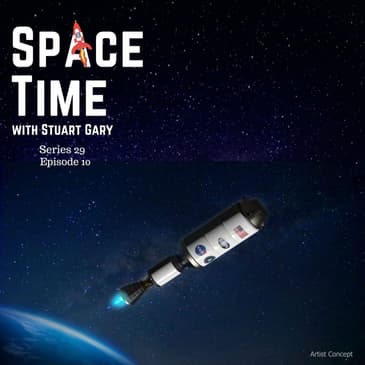



In this episode of SpaceTime, we explore groundbreaking developments in space exploration, including the imminent launch of the first nuclear-powered rocket, the merging of low mass dwarf galaxies, and the intriguing connection between Earth-like planets and gas giants.
The Dawn of Nuclear Rocket Technology
History is set to be made as NASA and DARPA prepare to test the world’s first fully operational nuclear-powered orbital rocket. This innovative vehicle utilizes a nuclear thermal propulsion system that heats liquid hydrogen propellant through nuclear fusion, achieving nearly double the efficiency of conventional rockets. The test aims to validate reactor operation in orbit, potentially revolutionizing space travel by reducing transit times to Mars and allowing for larger payloads.
Merging Dwarf Galaxies: A New Discovery
A recent study published in the Astrophysical Journal Letters confirms that low mass dwarf galaxies can merge with one another. Observations of the Ursa Minor dwarf spheroidal galaxy reveal previously hidden stellar structures, suggesting that even the smallest galaxies experience mergers. These findings challenge traditional views on galaxy formation and evolution, indicating that interactions between dwarf galaxies may be more common than previously believed.
The Connection Between Earth-Like and Gas Giant Planets
Astronomers have found that rocky planets similar to Earth are more likely to exist in star systems that also contain large gas giants like Jupiter. This research, reported in Astronomy and Astrophysics, shows that cold Jupiters, which orbit beyond the snow line, play a significant role in the formation of super Earths in the inner regions of their planetary systems. The study offers new insights into the complex dynamics of planetary formation and the conditions that lead to the development of terrestrial planets.
www.spacetimewithstuartgary.com
✍️ Episode References
Astrophysical Journal Letters
Astronomy and Astrophysics
Science Advances
Become a supporter of this podcast: https://www.spreaker.com/podcast/spacetime-your-guide-to-space-astronomy--2458531/support.
(00:00:00) NASA and DARPA prepare to test the first nuclear-powered orbital rocket
(00:10:15) New study confirms mergers among low mass dwarf galaxies
(00:20:45) Link discovered between Earth-like planets and gas giants
(00:30:00) China breaks through barriers in nuclear fusion reactor development
(00:35:20) The impact of ultra-processed foods on global health.
This is Spacetime Series twenty nine, Episode ten, for broadcast on the twenty third of January twenty twenty six. Coming up on space Time, the first nuclear rocket about to be launched into space, do low mass dwarf galaxies merge? And the link between Earth like planets and Jupiter like gas giants. All that and more coming up on space Time. Welcome to space Time with Stuart Gary. History is about to be made. With NASA and the Defense Advanced Research Projects Agency DARPER getting ready to test the world's first fully operational nuclear powered orbital rocket within the next few months. The new vehicle is based around a nuclear thermal propulsion system in which uranium undergoes nuclear fusion to heat a liquid hydrogen propellant, which is then expanded and exhausted through a nozzle to propel the rocket forward. The systems projected to develop thrust with a specific impulse of roughly around nine hundred seconds. That's nearly double the efficiency of conventional chemical rocket engines, which peak at about four hundred and fifty seconds. The test will validate reactor operation in orbit, with nuclear systems remaining inactive during the launch, which will use conventional chemical rocket engines. The project saw NASA's Space Technology Emission Directorate undertake the technical development of the nuclear thermal engine, which was then integrated into DAPESS Experimental spacecraft. DARPA also supplied the nuclear reactor for the project. The last nuclear thermal rocket engine tests were conducted by the United States more than fifty years ago under what was then NASA's Nuclear Engine for Rocket Vehicle Application and RODOT projects. The nuclear thermal propulsion system could reduce mass transit times by twenty five percent in the process an astronaut's exposure to radiation and enabling larger payloads to be carried. However, the project still needs to navigate stringent nuclear safety requirements, complex reactor engineering, and of course, the ever present political oversight. This is space time still to come. The low mass dwarf galaxies merge, and the link between planet Earth and planets like the gas giant Jupiter. All that and more still to come on space time. A new study is confirmed that lon mass dwarf galaxies can and do merge with each other. The findings reported in the Astrophysical Journal Letters, are based on new observations of the distant outer stars of our own galaxy, the Milky Way, Astronomers discovered a previously unknown structure surrounding a tiny satellite dwarf galaxy which orbits the Milky Way. The newly discovered structure is exhibiting features which resemble the remnants of past galaxy mergers. The findings are providing compelling evidence that even extremely low mass dwarf galaxies may still experience mergers with other similar sized galaxies. Numerous small satellite galaxies have long been gravitationally bound to the Milky Way, orbiting around it. These dwarf galaxies are often regarded as fossil galaxies formed in the early universe, with their structures providing valuable clues to understanding how galaxies form and evolve. Traditionally, dwarf galaxies have been thought to form through relatively simple processes such as gas inflow and outflow and internal star formation, meaning that galaxy galaxy interactions or mergers were considered rare in such low mass systems. However, recent observations by the European Space Agency's GUY emission have revealed that in some dwarf galaxies, stars are distribute beyond their expected outer boundary known as the tidal radius. Because Geyer observations are limited to relatively bright stars, primarily red giant branch stars. It's been difficult to investigate detailed distribution using numerous faint stars in the outer regions. As a result, it's remained unclear whether or not these extended structures are caused by tidal interactions with the Milky Way galaxy, or whether their intrinsic features form through past small galaxy mergers. To get a better idea of what's happening, astronomers use the Subaru telescope in Hawaii to study a small dwarf galaxy orbiting the Milky Way known as the URSA Minor dwarfs Feroidal Galaxy. This allowed them to investigate the faint stellar populations of the galaxy up to its outskirts beyond the nominal title radius. They detected many faint main sequence stars that were invisible to Gaya and successfully mapped their stellar distribution extending into the very outskirts of the dwarf galaxy with unprecedented precision. Aalysis revealed that the stellar distribution extends not only along the major axis of the galaxy, which was previously known, but also along the minor axis and the structure along the minor axis of this galaxy shows properties distinct from the elongation along the major axis, which is commonly attributed to tidal forces from the Milky Way. Now, this suggests that the minor axis structure may well have a different origin. The authors believe the minor axis structure discovered around the Ursa minor dwarf soroial galaxy may have been formed through a merger between it and another dwarf galaxy. The studies lead author, Kouski Sato from the National Astronomical Observatory of Japan, says that the finding suggests that galaxy interactions and mergers may play a role in the formation and evolution of even extremely low mass dwarf galaxies with masses as small as just one ten thousandth that of the Milky Way. Sato says the studies revealed a previously hidden stellar structure in the outskirts of URSA Minor, representing an important step forward in understanding the formation and evolution history of dwarf galaxies. However, to determine whether this structure was formed by tidal interactions with the Milky Way or whether it really does represent a remnant past merger more detailed studies using stellar kinematics and chemical abundances will need to be undertaken, and needless to say, we'll keep you informed. This is space time still to come discovery of a link between Earth like planets and Jupiter like gas giants, and later in the science report, China breaks through a decade long barrier which is limited nuclear fusion reacted development or that and more still to come on space time. Astronomers have shown that rocky terrestrial planets similar to the Earth tend to occur more often in star systems which also contain large Jupiter like planets in more distant orbits, just like our Solar system. The findings, reported in the journal Astronomy in Astrophysics, are based on detailed computer simulations. They show that these cir called cold Jupiters, tend to orbit beyond the snow line of their host star's planetary systems. The snow line is the distance from a star where water tends to condense out of the protoplanetary disc as ice. The stati's lead author, Martin Schlecker from the Maxiplank Institute for Astronomy in Heidelberg, says the simulated Earth like planets produced by the models end up being larger and more massive than the real Earth, but only have thin atmospheres and hardly any water or ice. He says, they tend to populate the inner cir called temperate zones of their planetary systems, again just like Earth, and Schlecker points out that the Earth, despite its enormous oceans and polar ice regions, only really contains about zero point one two percent water, so technically it too qualifies as a dry planet, in line with what the simulations have produced. Schlecker's findings are based on a statistical evaluation of new simulations of one thousand planetary systems that were evolving in a protoplanetary disk around a sun like star. During these simulations, the planetary embryo is collected material grew into planets, changed their orbits, collided with each other, or were rejected from their planetary systems. Planetary systems that survived the evolution eventually had planets of different sizes, masses, and compositions, all on different orbits around their central star. The advantage of using computer simulations for this kind of work is that it eliminates the problems of hunting for real coal jupiters, which will require years to identify due to their white orbits around their host stars. Remember, even in our Solar system, Jupiter takes eleven point eight six earth years to complete each orbit around the Sun. Also, in real life, the technological limits of telescopes means astronomers are far more likely to find high mass planets in close orbits around low mass stars. Still, real observations made in recent years have shown that planetary systems with a cold Jupiter are almost always likely to contain a super Earth as well. In fact, Schleckers says almost thirty percent of all planetary systems which contain a super Earth also appear to have a cold jupiter. It would be more plausible to expect massive planets are more likely to disrupt planetary systems during their formation in such a way that the formation of other planets would be hindered. However, Schlicker points out that these cold jupiters seem to be sufficiently far away so that their gravitational influence on the development of smaller super earthlike planets appears to be rather small. We study the relations between inner super Earth and outer Chine planets that live in the same system, and we were wondering is there a difference in the composition of a super Earth when there's a cold Jupiter in the system compared to when there is none. We found that indeed there is such a difference, and and the properties of the protoplanetary disk in which the planets have formed in a nutshell, if you have a moderately massive disc one hundred earth masses or so, we see that primarily icy cores formed just beyond the ice line. They migrate to detectable distances, and we end up with systems of volatile ridge superers of low bulk density. No giants are formed. If you have, on the other hand, a rather massive disc several hundreds of earth masters or more, you can form planetary cores further in and they migrate inwards to become dry superers. But the conditions are also right to form giant planets further out, and they prevent icy core from migrating inwards. In this case we get high density superers in the Inner System plus a distant giant planet. From this follows a testable prediction. If you find an inner superers with a high density, you're more likely to find the cold Jupiter in the same system as well. That's Martin Schlecker from the Maxpan Institute for Astronomy in Heidelberg and this Space Time and Time Out of Tech another brief look at some of the other stories making news in science this week With a science report, A new study shows that diets are being displaced around the world by cheaper, ultra process foods that are in turn increasing the rate of chronic diseases. The findings, reported in a series of papers in the Lancet Medical Journal, reviewed evidence and ultraprocessed foods and found a shift towards these ultra processed options was worsening diet quality, with obesity, diabetes, heart disease, and depression among the conditions which have now been linked to these foods. The authors argue that these foods are often mostly sold by major global corporations, and policy changes such as increased food labeling, better marketing restrictions, and increased taxes are urgently needed to tackle this takeover. Scientists with East the experimental Advanced superconducting TURKOMAC in China have broken at decades long barrier that's limited nuclear fusion reactor development. TURKOMAC fusion reactors rely on densely packeted, superheated plasma inside a doughnut shaped chamber, which is kept away from the chamber walls by powerful magnets. Instead of splitting atoms as conventional fission reactors do, which provides heat but also vast levels of radiation because of the uranium fuel they is, fusion reactors act like the cause of stars, fusing heavy isotopes of hydrogen atoms called deuterium and tritium together to generate heat with very little radiation. But one of the problems with fusion reactors until now has been the actual density of the plasm itself, a boundary known as the Greenwood limit, beyond which it becomes unstable. The new study, reports in the journal Science Advances, claim scientists have now been able to push beyond this limit to achieve densities of thirty to sixty percent higher than those normally reached while still keeping the plasma stable. Well. As any dog owner will tell you, man's best friend can be especially good at learning words simply by eavesdropping on human conversations. I mean, you only have to use the word vet or simply spell it a couple of times. And Fido quickly works out its meaning. Now. A report in the journal Science claims this cabineability is comparable to that of an eighteen to twenty three month old human child. The authors reach their conclusions by recruiting ten dogs that already proven themselves to be gifted at learning the names of objects, and then made them watch as their primary caregiver and another family member spoke in simple words about a new toy. As a group researcher said, the dogs were able to retrieve the correct toy when asked, at a rate well above simple chance. They say this requires complex social learning abilities that would normally take a human child at least eighteen months to develop. Australians are being targeted by new AI generated health experts dueling out medical advice and even treatments. Deceptive social media pages claiming to belong to qualified medical professionals are now plaguing the Internet. The Skeptics timendum says people need to study these sites carefully to make sure they're dealing with real doctors. He says some AI generated profile images show several telltale signs of artificial intelligence generation, things like distorted and readable text on medical coats. Two left arms and six digits on one hand, but lots of others are far more difficult to tell. Apart from the real thing. Bad think about artificial intelligence is that it offers a lot of benefits but also opens up a lot of averagues for all sorts of misinformation. And there's sort of increased number of doctors in quotes appearing on Facebook and offering either selling products or making particular claims about medical conditions. What it's showed to be is that a lot of these or some of those anywhere are fakes. They're actually AI generated, which is very sad. There's one Melbourne based doctor named doctor Garcia claiming to be part of the Australian Medical Association team, which doesn't make sense. One of the issues though, is that you go for a cliche that they say our generation, you say doctor i e. Whitecoat, stetoscope makes them a doctor makes them therefore trustworthy, doesn't it. So therefore you can have anybody in quote, whether they're artificially creative or what, say anything and it will look impressive. Some of them were sourced from Nigeria or Afghanistan, some of these things, and brooking medicines which they claim have been approved by regulators and if what they sell them, the common goal is exploited, whether financial or by spreading misinformation. People who do this for the fun of it are scary people. Obviously is very sad, and people who do it to make money are evil, So just watch out. Just because it's on Facebook, obviously it doesn't mean it's true. That's the skeptics tremendum, and this space Time, and that's the show for now. Spacetime is available every Monday, Wednesday and Friday through bytes dot com, SoundCloud, YouTube, your favorite podcast download provider, and from space Time with Stuart Gary dot com. Space Time's also broadcast through the National Science Foundation, on Science Own Radio and on both iHeartRadio and tune In Radio. And you can help to support our show by visiting the Spacetime Store for a range of promotional merchandising goodies, or by becoming a Spacetime Patron, which gives you access to triple episode commercial free versions of the show, as well as lots of bonnus audio content which doesn't go to weir, access to our exclusive Facebook group, and other rewards. Just go to space Time with Stuart Gary dot com for full details. You've been listening to Space Time with Stuart Gary. This has been another quality podcast production from nights dot com