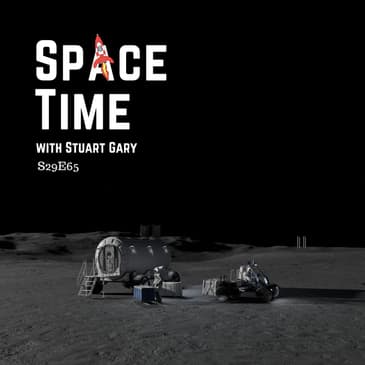


This Is Spacetime Series twenty nine, Episode sixty five will broadcast on the first of June twenty twenty six. Coming up on Spacetime, NASA confirms its Moon based plans and signs its first contracts, a surprising core reversal deep inside the Earth, and astronomers spot red dwarf stars eating their own planets. All that and more coming up on space Time. Welcome to Space Time with Stuart Gary. NASA has confirmed its plans to have humans living on the Moon by twenty thirty two. The agency has now released its latest draft for its lunar South Pole Base project, signing its first contracts as it prepares eliminary work towards the start of construction. The basic plan is similar to that proposed earlier this year. The announcement at NASA headquarters in Washington, DC included confirmation of the first contracts for lunar rovers as well as unmanned cargo landers to transport supplies to the lunar surface. NASER Administrator Jared Isaacman announced the first three based missions launched before the end of the year. On December eighteenth, President Trump signed a National Space Policy that reaffirmed America's commitment to leadership in space, to return to the Moon, establish an enduring presence, to build the Moon base, to invest in the next giant leaf, capabilities, to ignite an orbital economy, maybe even the foundations of a lunar economy, and launch extraordinary missions of science and discovery. On March twenty third, we shared with the world exactly how we intend to achieve the vision called for in the American Space Superiority Executive Order. Then on April first, we took an incredible step in the right direction when the clock hit zero and Artemis two got underway on an epic test mission of science, discovery, and integrity, bringing the amazing crew home safely to Earth. Just ten days later. We are working alongside our lunar lander providers preparing for Artemis three crew announcement and getting ready to begin stacking Artemis three this summer with a target launch in mid twenty twenty seven. We are leveraging the NASA playbook from the nineteen sixties, figuring out what works and what doesn't in this epic science of survival. Because the Moon base is as beautiful as it is hostile, in sunlight, the surface can heat to over two hundred and fifty degrees in darkness, it can drop well below minus two hundred In the permanently shaded crators areas of great interest that have been untouched by sunlight for millions, even billions of years, temperatures can fall well below minus four hundred degrees. There is no atmosphere to moderate these extremes, no protection from radiation and solar particle events, and the surface is exposed to meteorite impacts, including the kind of light flashes the Artemis two crew observe from orbit. Recognizing this reality, I'm often asked why we send our astronauts into such harsh and danger is an unforgiving environment of space or the lunar surface, and at such great cost, And we go for the technology we will pioneer to get there, the science and all that we will learn that will make life better here on Earth, to advance humankind on this great adventure, to inspire the next generation to do it better than we can, and to be very clear, to master the skills for where we will inevitably go next. So we are discussing three Moon based missions and a series of additional awards, with more missions to be announced in the. Months ahead now. Moon Base one will be the first privately funded lunar lander mission in history. The Blue Origin Mark one Endurance Lander will deliver multiple payloads to the Shackleton Connecting Ridge, a strategic area of the lunar South Pole, in addition to flying two NASA Science payloads scalps, a lunar retro reflector array. The mission objective is to demonstrate critical capabilities that reduce risk for the human landing system missions. On that note, every mission in support of the Lunar Base helps us learn in de risk crude missions, but this one is especially important because of the roll Blue Origin plays in the Artemis program. The target no earlier than launch date is the fall of twenty twenty six. Moonbase two will be the largest commercial payload delivered the lunar surface ever, though in this Moon Base endeavor we certainly hope to be breaking records on nearly every mission. The Astrobotic Griffin Lander will carry more than five hundred kilograms of cargo including Astrolabs flip rover through the lunar surface. This mission will help mature the capabilities necessary to support future lunar train vehicles, autonomous operations, logistics, and especially the LTV astronaut Mobility. Moonbase three will expand our scientific understanding of the lunar surface. This mission will deliver the first payloads selected through NASA's PRISM initiative, a program that brings together universities, researchers, and industry through open competition to solve scientific questions. The anchor scientific mission is Lunar Vertex, which will study lunar swirls, one of the Moon's most intriguing mysteries. Now, these unusual formations appear brighter than their surroundings as portions of the lunar surface or somehow shielded from the effects of the solar wind. Understanding why they exist could improve our understanding of how the lunar environment evolves, how surface materials change over time, and how future infrastructure may perform in these extreme conditions. The Moon Base three landings will also deliver payloads from ISSA and the Korean Space Agency, demonstrating that the future of lunar exploration is an international effort. Moonbase two and three are targeted to launch before the end of twenty twenty six. Now, these represent the first of more than a dozen missions we expect to announce you. The balance of this year as we return, build the base, and never give up the Moon again. That's the Associated Administrator, Laurie Glaze says. The pathway to a permit human prisons on the Moon is being paved by the Automis missions. In November twenty twenty two, Automis one tested the Giant SLS space launch System vehicle and the Orion spacecraft on an actual flight to the Moon and back. Then in April this year, Atomis two took the next step, sending a crew of four around the Moon and back, the first time humans have visited this alien world since the flight of Apollo's seven more than half a century ago. Artemists two is not only a historic journey, it was a comprehensive test of NASA's capabilities as we push farther from Earth. The space launch system delivered our crew to orbit with precision. The Orion's life support systems, navigation, communications, camera systems, and heat shield all performed well. Each of these successes validated the technologies and processes will rely on as missions become more ambitious and more complex. Where the systems didn't perform is expected. We gained important information to help us improve on future flights. Artemists two proved that NASA is ready for the next step, and that next step is coming fast. Artemist three will conduct critical integrated tests in Earth orbit, including rendezvous and docking with our commercial landers. Artemis three hardware, from the SLS core stage to Orion's modules to lander partner systems, is moving into final integration, flight readiness development, and Artemists four and five hardware is already flowing to the Kennedy Space Center from other centers and partner facilities around the US and the world. We're moving toward the cadence necessary for a sustained deep space program, steady, accelerated and continuously learning as we prepare to return to the lunar surface, and that then brings us to the future Moon Base. Moon Base will be home base for our Artemis crews and will encompass long duration stays, expanded robotic and human capabilities, and an enduring presence on the lunar surface. Everything we tested and learned on Artemis two, the systems, the teamwork, the operational tempo feeds directly into our ability to build a sustainable foothold on the Moon. With Moon Base, Artemis astronauts will stay longer, explore farther and conduct the kinds of science that advances exploration itself. Understanding how humans operate off world, how we build infrastructure, and how we prepare. For Mars mean well. NASA Moon Based Executive Kylos Gassia Gailan has announced the first contracts for the Moon based project with Blue Origin to provide the lunar landers, both astro lab and learn the outpost to build the first of the rovers. From now through twenty nine, we're going to work to make sure that get into the lunar surface is a high reliability endeavor, many assets we can deliver there. We're also going to test and experiments the science of survival. We're going to experiment on the things that we know are ahead of us that we're going to need to build a permanent infrastructure, which is happening on Phase two and then permanent habitation on Phase three. To do this, we're building and working on many different systems from transportation to mobility, and we've broadcast are pretty high kend submissions that will help us to get there. Phase one, for example, we'll have twenty five launches, twenty one landings, and we're planning to deliver about four metric tons of cargo to the surface of the Moon, and we want to graduate from that to sixty metric tons to one hundred and fifty by time we get to Phase three. We envision multiple assets. Those twenty one landings is to deploy many types of assets in different areas where we have objectives for science or we think it's a good place to develop the moon base. We're going to have landers small and medium class. We're going to have constellations of satellites that will enable communication, navigation, point in observation. We're going to have rovers and LTVs, and also we're going to have drones. Blue Origins Lunar Lander product line has two variants. Mark one, which is the ancrewed version, is what we're going to be using for the delivery of the LTVs, and Mark two, which is the crew lander mission. So using Mark ones will also reduce the risk for future croup missions there. Mark one is the same type of vehicle as Endurance, which is feature in moon Base one, the first mission to the lunar surface. Mark one type of spacecraft is also going to deliver the Viper Rover later in the fall of twenty twenty seven as the lunar roving vehicle during the Apollo program. The LTV will give astronauts the ability to further conduct scientific research around the Moon, but it's going to do a lot more than that, because in this case we needed to work all year around. We need them to be on. The surface doing things that basically prospect the surface, scope around to potential landing sights, or go to areas of deep scientific objectives. So the LTVs are both crude and autonomous rovers. They're a mix. Between the Apollo Lunar robin vehicle and a Mars style rover. The LTVs will have a mass of about one metric ton or a little bit less than that, and will have to be in a configuration that is kind of compressed to be able to fit on those landers. They're designed to traverse about two hundred kilometers from where they're dropped off, which is four times greater than any rover has ever traveled on the Moon or Mars. They can be telerobotically operated by people on the ground, they can work autonomously, and of course when we have human crude missions, they'll be driven by the humans. These things can. Go up to ten kilometers per hour and go up and down slopes of like twenty degrees. The first LTB Award winner, Astrolab, has adapted its flex rubber architecture to deploy the Crew. Lunar Vehicle number one. Well, this new vehicle is smaller, lighter, and can accommodate up to two crew CLV one has a maximum mass of nine hundred and fifty kilograms and can reach speeds up to ten kilometers per hour. Astrolapp is also building the flip rover, which has a lot of the features that will then be carried over to the Lunar Terrain vehicle. So imagine the first rover because we're going to have cameras, we're going to have payloads basically bringing us with them in real life, going to places we have never seen of the Moon, testing nows and giving us key ground truth. Data so we can build on that. The second LTV provider Lunar Outpost and Veil and nuclass of rover called Pegasus, which is what we're going to deliver to the surface of the Moon. Pegasus is a paradown version of Lunar Outpost EGO. Lunar Terrain Vehicle PEGUSU is a lighter weight, and we'll be ready to fly on earlier missions. As we've asked and demanded, they will do things like autonomous driving, terrain mapping, and identify future potential Moon based sites. Becazus can carry up. To two crew members and travel ten kilometers per hour on the lunar surface and like I said, go through steep slopes and terrains. These awards are incredibly important to the next steps of Phase one because we have to be able to move around the surface and start looking and gaining the knowledge we need to build up on the Moon base. Part of that also is Moonfall. Moonfall is the first lunar drome capability that we're going to have, and it's going to accomplish different objectives. The first is demonstrate the technology. It is going to be the first robotic mobile platform with the range to quickly explore sites interesting at the lunar south pole. The variances in lighting thermal gradients are gigantic on the lunar surface, and we basically have a range of like one meter dedicated information on the different areas we want to go to, So in that one meter, if we're wrong or if we're off a little bit those ranges of four or five hundred degrees in temperature can be a key aspect that we need to overcome. These drones will allow us to go cover a broader range of areas that we and prospect and get background truth. It can demonstrate the ability to take off and land in multiple locations with precision under South Pole lighting conditions and terrain features. Also, it will utilize available electronics so we can develop them quickly and deploy them where we need. One of the key things that we want to put on these drones is survive the night technology, So not only can they accomplish the mission they can help go to multiple locations, but they can also survive the long lunar nights, so when they get sun again, they can serve a permanent objective wherever they ended up at. It could be observation, it could be communications or something else. Another key objective is side characterization, so we'll be able to map the surface at centimeter scale resolution, allowing us to biff up our orbital databases and reduce the is for future landings. It will prospect for water and ice in the subsurface of the Moon. It can go look into the surface of the Moon about one meter in depth across tens of kilometers. It will also characterize the radiation environment before we send other assets or crews to the surface and provide a geodetic framework for navigation using rehetor reflectors. Whatever we put these drones. It will provide much more of a capability for precision lander for whatever landing is coming into that area, and then we'll have cameras of course on all of them and be able. To observe around the territory. The next objective is imaging so high resolution imagery across all mission phases, including the deployment, the landing, and nominal operations of staining city or hopping around. It will continue image collection you're an extended mission, and it will analyze different sites for unprecedential detail, basically allowing us to build our understanding of soil mechanics, the terrain, the lighting conditions in feature of wherever we want to go. It will help us build a digital terrain map of different landing sites on the Moon and prospect Moon based sites. This is space time still to come. A surprising core reversal deep inside the Earth and red dwarf stars detected eating their own planets all that and more still to come on space time. The European Space Agency has discovered a surprising flow reversal of Earth's liquid outer core, apparently changing direction in twenty ten. The molten core, which swirls around twenty two hundred kilometers below the Earth's surface, generates our planet geomagnetic field by measuring small changes in the magnetic field. Scientists of historically third the core flows mainly westwards, but then in twenty ten it unexpectedly changed direction deep beneath the Pacific Ocean and started moving strongly in an easterly flow. The reasons for this unexpected reversal in the flow of the molten material is still a mystery. The findings, reported in the Journal of Studies of Earth's Deep Interior, are based on a combination of readings using birth ground based observations and satellite data collected between nineteen ninety seven and twenty twenty five. The research found that in twenty ten, a broad region of iron rich fluid beneath the equatorial Pacific Ocean suddenly switched direction from flowing mainly weekly towards the west the flowing strongly eastwards. The article was previously thought to move in a comparatively stable manner, and so this dramatic change of flow shows that this is not always the case. The findings provide insights into the turbulent processes that generate as magnetic field. The studies author Frederick Dale Madison from the University of enbra says the light scale flow reversal beneath the Pacific raises new questions about the Earth's deep interior. Scientists now want to understand whether the reversal represents a short lived fluctuation part of a repeating oscillation, or a new stable equilibrium for core circulation. Continued monitoring will be essential in order to determine how the flow evolves in coming years. The model used in the research suggests that this specific eastwards flow has weakened since twenty twenty. Madison says the rise of the strong eastward flow in the Pacific is contemporary with a change in behavior in the planet's solid inner core. Based on geodosy and seismic data. The Earth's magnetic field is a geodynamo generated by motion of the liquid outer core, where electrically conducting molten iron circulates around the solid iron in a core. This geed dynamo is constantly evolving that many of its long term flow patterns always appear to be relatively consistent over decades of observation. This is space time still to come. Astronomers have discovered some of the strongest evidence yet that stars eat their own offspring, and later in the science report, a new species of giant moses or fossil discovered in Texas. All that and more still to come on space time. Astronomers have discovered some of the strongest evidence yet it stars eat their offspring, consumming their own orbiting planets. The findings are reported in the journal the Monthly Notices of the Royal Astronomical Society. Supports the long held belief that young stars are capable of destroying nearby worlds as planetary systems form. Astronomers studied thousands of stars and found evidence that's sick. Spectral type ed red dwarf stars, the smallest, coolest, the most common type of star in the universe, hav engulfed earthlike rocky planets orbiting around them. The studies lead author, Robin Jeffries from kill University, says the giveaway was the detection of the doom planets chemical signatures. Jeffries says some of the red dwarf stars contain lithium, a chemical element that shouldn't be there. Red dwarfs are smaller and cooler than our Sun, with surface temperatures of less than two thousand degrees, but inside they're still extremely hot, and this heat should be enough to destroy all of their fragile lithium in nuclear reactions shortly after they form, so finding the presence of lithium in their atmospheres could single the engulfment of a still lithium rich material that created from a surrounding planetary system. Jeffries and colleagues looked at observations of young star clusters collected by the European Space Agency's GAYA European Southern Observatory Spectroscopic Survey, a project which covered thousands of stars. Unlike isolated stars, those finning clusters have well understood ages and masses, and the presence of many similar siblings, which are all born from the same initial material, means that even small chemical abundance differences are easier to establish, and the authors identified six different red dwarf stars in three separate clusters which had much higher lithium content. Than the other stars of a similar spectral type. Their analysis suggest that these stars had consumed the surrounding earthlike planets well at least planets of between three and ten Earth masses, enough to provide a fresh burst of lithium to an otherwise lithium depleted atmosphere. These engulfment eventss have been called have long been theorized as a possible, even probable outcome during early planetary system formation, and may even have happened earlier in our own Solar system. Now, if this explanation does prove correct, a new window will have opened up in the early lives of planetary systems, allowing the quantity in timing of planetary in golvement to be further investigated. This is space time, and time that to take a brief look at some of the other stories making news and science this week With a science report. A new study claims a cocktail of tomato and sojuice is loaded with compounds which could help lower inflammatory proteins in healthy adults with obesity within just four weeks. The findings, reported in the General Molecular Nutrition and Food Research shows tomato soyjuice cocktail contained high levels of the plant based compound isopine as well as soy isoflavens, both of which are believed to have antioxidant and anti inflammatory properties. Now, this was a really small study. It involves just twelve healthy adults with obesity who consume too six ounces of tomato soy juice every day for four weeks, then after a watch out period, they consumed a low carotenoid controlled tomato juice for four weeks. The authors took blood samples testing for cytokines. These are pro inflammatory proteins produced by the immune system, and only the tomato sajuice combo resulted in a significant reduction in three key cytokines into lucan ile five into lucan twelve, P seventy, and granulocyte macroface colony simulating factor, as well as showing a downward trend in chiminecrosis factor ALPHA. Paleontologists have identified fossils of a new species of giant mersosaur, a marine reptile that roamed the oceans eighty million years ago during the age of the dinosaurs. A report in the Bulletin of the American Museum of Natural History claims the creature, named Tylosaurus rex, or King of the Tylosaurs, was more than thirteen meters long. The fossils were unearthed at a dig site in northern Texas. New research suggests that a sodium ion battery used in some foreign electric vehicles could become a genuine, low cost rival the Tesla's lithium ion technology. Studies authors independently tested one hundred and twenty battery cells using a range of physical and chemical techniques in order to compare performance against Tesla's technology under real world conditions. They found the batteries match Teslas in several key areas and performed better than expected, although it did struggle to charge efficiently in cold temperatures. The findings, published in the General Cell Reports Physical Science, suggest targeted improvements could make cerdium ion batteries a viable alternative for short range vehicles as well as large scale energy storage. A United States congressman claims he knows of an immovable giant flying sources so big authorities were forced to construct an entire building around it in order to try and hide the vehicle from the public. The skeptics timendum says, You're a conspiracy theorist claim this hidden flying saucer is located on the outskirts of Seoul in South Korea. This was raised a few years ago that these enormous UFOs insteaded up being one and nothing about thirteen of these things. They're so big that can't be moved, so they put a building up around it, and there's a particular one in Outh Korea. I think it is that it's around Naturally, if you're going to hide a UFO, you build a building that looks like a UFO around. It's a big round building. And these sort of things have been raised by the intelligensity of the world III and American Congressman who was saying that these things exist lovely quote saying that they're in plain sight in a secret who sees location, which doesn't really make sense, believed to be on the outskirts of Seoul in South Korea. This is the secret location where they know where it is and it's in plain site in a secret place. Logic is never a strong point with these sort of people, and they look at. That Representative Eric Berlinson and has been fully briefed on the existence of alien. Yes, I'm sure it has been. I think he's not saying that one in career is the one. But he's saying these things exist and we need to reveal them, and he's actually never seen one, and he doesn't actually have a lot of evidence. He didn't refer to where it is, but he says bureaucratic hurdles are making it difficult to ratify the theory, you know, which to make a lot of claims. And then if you're asking a few times he says, well, I don't really know. I don't have the evidence. I've never seen it. I've been told third hand, fourth and fifth hand that it exists and that therefore, but I know it's there, and it doesn't want to mention the country because I heard of it inside of a closed setting and I want to protect my classification level. The American congressman. It's one of the things that the Australian journalist Ross Cult has been pushing very heavily, and because he keeps saying that anything pushing. Your first story not such a level headed person. Yeah, you want everything, obviously. I think it says something about the winners of process he's been pushing, or how he's gone in the rabbit hole every year. He's saying it's going to happen. He says, I'm neverer one one that he's pushing this thing that any day now, next year is going to be the big revelation. It's all going to be revealed. It's all going to happen. And he's been saying this for years, as every UFI proponent has been saying since the ninety forty said, any day now this year is going to be revealed. The secret is going to be out. And seventy years later they haven't been, so after a while you start to think will they ever be? That's the skeptics timendum. And for the record, the structure in question in South Korea, it's nothing more than a common vortec used for aircraft navigation. It's threatened in sixty degree line of sight is key to providing on the directional distance measuring emitter system. So I guess mystery solved. But then again, that's what we do. This is space Time and that's the show for now. The Space Time is available every Monday, Wednesday and Friday through at bytes dot com, SoundCloud, YouTube, your favorite podcast download provider, and from space Time with Stuart Gary dot com. Space Time's also broadcast through the National Science Foundation, on Science Own Radio and on both iHeartRadio and tune in Radio. And you can help to support our show by visiting the Spacetime Store for a range of promotional merchandising goodies, or by becoming a Spacetime Patron, which gives you access to triple episode commercial free versions of the show, as well as lots of burnus audio content which doesn't go to wear, access to our exclusive Facebook group, and other rewards. Just go to space Time with Stuart Gary dot com for full details you've. Been listening to Spacetime with Stuart Gary. This has been another quality podcast production from bytes dot com.
🚀 We would love your feedback. How's SpaceTime travelling...love it or hate it, we need to hear it all. Take the 1-minute survey and let us know what you think: Click Here