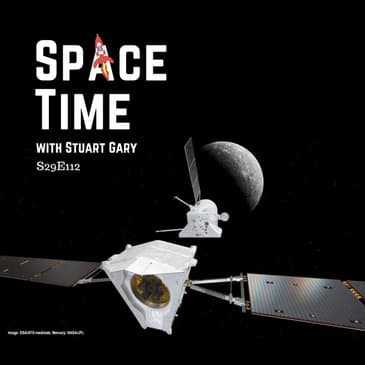


This is Space Time, Series 29, Episode 112, for broadcast on the 18th of September, 2026. Coming up on Space Time, BepiColombo on final approach to the planet Mercury. Speaking of Mercury, it seems the planet nearest the Sun's crust was formed by extreme volcanism, and the first orbital launch success from European soil. All that and more coming up on Space Time. Welcome to Space Time with Stuart Gary. The BepiColombo spacecraft Mercury transfer vehicle has now successfully separated from the main ship, marking a major milestone in its eight-year journey to the nearest planet to the Sun. Next, the joint European-Japanese spacecraft will divide into two separate probes. That'll happen on December the 9th. They'll then begin their independent Mercury orbital missions. This month-long arrival phase is described by the European Space Agency as its most operationally challenging planetary arrival sequence. BepiColumbus already needed to undertake a series of nine planetary gravitational-assist flybys involving the Earth, Venus and Mercury in order to speed up, slow down and correct its trajectory during its 10 billion kilometre journey in order for it to achieve Mercury orbit insertion on November the 21st. See, getting to Mercury isn't easy. The problem is Mercury's relatively small mass. The planet's only slightly larger than the Earth's moons. That means its gravitational pull is extremely weak compared to the huge mass of the nearby Sun. So everything needed to be worked out really precisely in order to make Mercury, and not the Sun, the ultimate target. And the spacecraft needed to check and execute its various maneuvers autonomously, including the separation, which involved detaching the four mechanical struts connecting the orbiters to the transfer module used for the cruise phase. A spring mechanism system then gently pushed them away at a rate of 40 cm per second. By April next year, ESA's Mercury planetary orbiter will begin studying the planet's surface from its 480 km high orbit, while Japan's Mercury magnetospheric orbiter will focus on the planet's space environment and magnetic field, following an elliptical orbit ranging out as far as 11,000 km from the planet's surface. Mercury is the least studied of the four inner rocky planets. NASA's Mariner 10 was the first probe to capture close-up images of Mercury that was way back in 1974. And that wasn't followed until the MESSENGER probe arrived in 2011. But there are many questions that remain about the planet, including its magnetic field, its iron core, and its deeply created surface. This report from ESA TV. It has highlands and lowlands like other planets, but unlike Earth, Mercury rotates on an axis of perpendicular to its orbit. Due to the fact that Mercury is not tilted, there are some craters on the poles where the sun never shines into it. And inside these craters, MESSENGER found water ice. It was detected even earlier in the 80s from ground that there were rather bright spots and there were some hints that it might be water ice. But now from MESSENGER, we are pretty sure that we have water ice in craters. And that's pretty much surprising. Think about if you have a planet on the surface, 450 degrees, and then you have water ice at the poles. It's kind of unbelievable. Fortunately, there's an instrument on board called MERTIS, which can measure the surface temperature directly to see if it's cold enough for water ice. Knowing the makeup of the planet's dark surface is also important. A team at DLR, the German space agency, have built a special chamber to heat up samples to examine how they behave at high temperatures. These can then be compared with what will be found on the planet. Planetary scientists are unsure how it formed. It could have originated beyond Mars, with an impact pushing it closer to the Sun. Or it could have formed at lower temperatures in its current position. If so, current theoretical models will need a rethink. One of the things why I like working on Mercury is we need to understand Mercury in order to understand how planets form. If we have a model that forms all planets but not Mercury, that model is basically useless because you need to get that one as well. NASA's Messenger mission did a great job. But BepiColombo consists of two orbiters, using complementary orbits with more combined instruments. Plus, unlike MESSENGER, it will obtain high-resolution images of the entire planet. The planet is also shrinking in size, possibly due to cooling. Plus, there may be active volcanoes, so there is much more to learn. Mercury is a very mysterious planet. Every time we went there, we found new surprising results. And that is the reason why we do BepiColombo. And we hope with BepiColombo, on one hand, we are able to answer many of these new questions. But I'm pretty sure we found a lot of new surprising results which raise new and other questions which we then need to follow up. And in that report from ECTV, we heard from BepiColombo project scientist Johannes Benkhoff and DLR planetary scientist Jorn Helbert. This is Space Time. Still to come, extreme volcanism, the most likely cause of Mercury's crust, and the first orbital launch success from European soil. All that and more still to come on Space Time. Now, while we're on the subject of the planet nearest the Sun, a new study has shown that Mercury's crust was formed by extreme volcanism. The findings, reported in the Planetary Research Journal, has provided important clues about Mercury's formation based purely on its surface composition. The key finding is the lack of abundance of silicon dioxide on Mercury's surface. It has a mass fraction of just 37%, which is up to 25% less abundant than previously thought. By comparison, here on Earth, silicon dioxide, which is a compound comprising one silicon and two oxygen atoms, is virtually ubiquitous across the planet. in its pure form of sand, and in large quantities in all volcanic rocks such as basalt, andesite, and granite, which contain up to 75% silicon dioxide. Now, that means these new findings are showing the evolutionary histories of the Earth and Mercury are fundamentally very different. It means Mercury likely ended volcanic activity as early as just a billion years after its formation as a solid, continuously rocky crust formed on the planet's surface. Earth's crust, on the other hand, is still in motion, with volcanism and plate tectonics constantly stirring the planet up. The study's lead author, Christian Rengelli from the Max Planck Institute, says the findings suggest that the volcanic rocks on Mercury formed from more deeply melted mantle material than previously thought. Silicon dioxide gradually accumulates in the molten mantle of a young planet, that is, in the layer just below the solidified crust. That's because as the mantle cools, the first rocks to form extract comparatively little silicon dioxide from the melt. The hot lava that soars up to the surface therefore becomes increasingly rich in silicon dioxide over time. And so if this compound's present in small amounts on the surface, it indicates high temperatures in the interior. It's also possible that Mercury once had more silicon dioxide in its crust, but gradually lost its oxygen. So where's all this coming from? Well, scientists can only infer Mercury's composition through remote sensing data using both telescopes on Earth and spacecraft in orbit. So instead for this study, the authors developed a new way to make infrared measurement data on Mercury usable. To do so, they first produced tiny glass beads only about half a millimetre in size. And these beads had precisely defined proportions of silicon dioxide in order to act as calibration scales for the infrared readings. Now, to ensure the calibration relationship between the silicon dioxide content and the infrared radiation was correct, they repeated the same process using the Moon and known readings from NASA's Lunar Reconnaissance Orbiter. LRO has been orbiting the Moon since 2009, and it's measured the infrared radiation emitting from the surface with high spatial resolution. From this data, the authors were able to create the first complete map of the silicon dioxide content of the lunar surface. And rock samples brought back to Earth from various regions of the lunar surface made it possible to verify the results. After confirming the moon readings, the authors turned their attention to the infrared data from Mercury using the Bock Telescope at Stewart Observatory in Arizona. And that's how they reached their findings. Now to confirm those findings, they'll now look for low silicon readings on Mercury's surface in the upcoming ESA JAXA BepiColombo mission. And needless to say, we'll keep you informed. This is Space Time. Still to come, the first orbital launch success from European soil. And later in the science report, a new study warns that people with lung cancer have been shown to have larger quantities of microplastics embedded in their lungs. All that and more still to come on Space Time. Time. For the first time in history, a space launch from continental Europe has successfully reached orbit. The mission, by Germany's ISAR Aerospace Spectrum rocket, was launched from Norway's Andonia spaceport north of the Arctic Circle, achieving a 500 km by 180 km high orbit. The launch follows months of delays caused by technical and safety issues, and it was only the second launch for the 28-metre-tall two-stage Spectrum rocket, and followed a failed first test flight back in March 2025. All previous European orbital launches have either been from the European Space Agency's Kouros spaceport in French Guiana, or from the Woomera rocket range in outback South Australia. Once operational, Spectrum will carry payloads of up to 1,000 kilograms into low-Earth orbit, with an expected cadence of around 30 launches a year. Now, for the record, the first European rocket to reach space was a Nazi V-2 rocket, which was launched from Penemunda back on June 20, 1944. This was the first successful German V-2 launch to exceed the Kármán line, the internationally recognized 100-kilometer boundary of where space begins. It reached an apogee of approximately 176 kilometers, making it the first man-made object to enter outer space and the first suborbital spaceflight. It was part of a series of vertical test launches that June to study the rocket's behavior in the near vacuum of space. Another launch also in June 1944 reached an even higher altitude of around 179 kilometers. The first successful V-2 flight overall was back on October 3, 1942, also from Penemunda. It reached somewhere between 85 and 90 kilometers in altitude, which the Nazis celebrated as reaching the edge of space, but in reality didn't cross the Kármán line. This latest European success comes in the wake of an equally successful launch by a private Indian company from the subcontinent. Skyroot Aerospace's Vikram-1 rocket was blasted into orbit from the Shatish Dhawan Space Center on the Bay of Bengal coast. It was the first successful orbit launch by any private Indian company. The 22-metre-tall four-stage Vikram-1 rocket is designed to eventually carry payloads up to 480 kilograms into low-Earth orbit. This is Space Time. And time now to take another brief look at some of the other stories making use in science this week with a science report. A new study has shown that people with lung cancer are more likely to have large quantities of microplastics embedded in their lungs. The findings, presented to the European Respiratory Society Congress, revealed that half of all patients being investigated for lung symptoms were later diagnosed with lung cancer. Of these, 70% had detectable microplastics, and patients with lung cancer were more likely to have detectable microplastics and a higher overall microplastic burden than those without cancer. However, while the authors found a link between lung cancer and microplastics, they say it doesn't prove microplastics cause lung cancer. That's still put down mostly to smoking. But it could mean that swollen, inflamed lungs are more likely to trap microplastics that have been breathed in. Doctors have reported that a genetically modified pig kidney was able to keep a 66-year-old male patient with kidney failure free of dialysis for a record nine months. It's the first time a pig kidney has been used as a temporary bridge to a human transplant. Surgeons at Massachusetts General Hospital in Boston transplanted the modified kidney back in January last year. It had been genetically engineered to be compatible with the human immune system. Following Xenotransplant, the kidney began working immediately but it had to be removed nine months later due to organ failure. The patient didn't show the usual signs of rejection, but the authors say the body may still have rejected the kidney by some other as yet unknown means. Good news is the patient was able to go on to dialysis and went on to receive a human kidney several months later. Paleontologists have uncovered the fossilized remains of what they're describing as a peculiar new species of Jurassic squid-like animal. The 160-million-year-old cephalopod, which has been named Wyattuthlus linstrum, appears to be a type of ancient belemite, which are cousins of modern-day squid and octopus. The authors say the unusually thick barrel-shaped skeleton makes this animal the chunkiest or fattest belemite ever discovered. Belemites are among the most common fossils found worldwide. This one was uncovered in Wyoming. They're easily recognized by their bullet-shaped remains, known as a rostrum or guard. Previous examples were around 5 to 10 centimetres long and around 1 to 2 centimetres wide. But this new specimen had an unusually broad barrel-shaped rostrum around 10 centimetres long, up to 6 centimetres wide, making it the thickest belemite ever recorded. Now while we're on the subject of paleontology, scientists have discovered the first Denevisian radius bones at a fossil dig site in southwestern China. The radius is one of the two long bones in the forearm. A report in the journal Nature claims the fossils helped paint a more complete picture of this ancient human ancestor. Denevisians roamed over much of Asia during the late Middle Pleistocene, between 167 and 134,000 years ago. However, due to the limited number of Denevisian fossil remains known, especially post-cranial bones, that is those below the skull, little is known about the physical traits that allowed these hominids to adapt to different environments. A Mississippi medium who claims to speak to the dead says the main message she gets from the dearly departed is the need to enjoy life while you can. The skeptic's timidness says while you may question her ability to really contact those in the afterlife, her underlying message about not taking things too seriously is fairly accurate. This is a story from a lady from Mississippi. She's a medium, means she's not well done, named Jill Jackson, who says that she, speaking with the dead, they often share their remorse of having followed strict interpretations of religious teachings and commandments while they were alive. This is a person who's a bit of an agnostic, obviously, or a bit of an anti-church. person who says that heaven is a place where there's no hell. Heaven is a place which is just all around you. It's vibrations, energies, et cetera. And really, if you go up there and you're disappointed in what you've done, you have these regrets forever, I presume. These spirits have sent her telepathic messages of regret for taking life too seriously before their death. That is when the common theme is that humans need to play more often. That is when they look back on their life review and notice that they were so serious and that they had so many opportunities to just have fun, laugh and play. I think this lady is a bit of an unreformed hippie. Everything is beautiful if you're just allowed to be. Yeah, of course. And if you don't take things too seriously, it's probably a decent message, actually. And don't follow a strict religion cultish thing that tells you day by day what you can and can't do. You're not going to be necessarily fitting in with that. But as for what she says, that the afterlife is actually operating at different energy levels. giving off vibrations or vibrational frequencies, which doesn't mean a lot. It's just terms that are used by mediums all the time. She noted the childlike wonder of youth who were closer to the frequency spirits attained in the afterlife. So there was jaundice, if you like. And when you get older, you start sort of having the worries of the world thrown upon your shoulders and you start getting a bit serious and a bit worried. And, you know, she warns that you're going to regret it and you probably will. As they say, no one says on their deathbed, I wish I'd spent more time in the office. I think her philosophy is right. It's just her understanding of the machinations is probably very right. Yeah, it's the underpinnings and what she thinks is happening. Yeah, I agree. Don't take things too seriously. Have some fun. Go out and do it. Run in the park. Do some stuff to make you feel good. And don't let someone else run every second of your life. You should actually take everything with a pinch of salt, which is actually a paranormal thing in itself, isn't it? That's the Skeptic's Timendum, and this is Space Time. And that's the show for now. Space Time is available every Monday, Wednesday and Friday through Bytes.com, SoundCloud, YouTube, your favorite podcast download provider and from spacetimewithstuartgarry.com. Space Time is also broadcast through the National Science Foundation on Science Zone Radio and on both iHeart Radio and TuneIn Radio. And you can help to support our show by visiting the Space Time store for a range of promotional merchandising goodies. or by becoming a Spacetime patron, which gives you access to triple-episode commercial-free versions of the show, as well as lots of bonus audio content which doesn't go to air, access to our exclusive Facebook group, and other rewards. Just go to spacetimewithstuartgary.com for full details. You've been listening to Spacetime with Stuart Gary. This has been another quality podcast production from Bytes.com.
🚀 We would love your feedback. How's SpaceTime travelling...love it or hate it, we need to hear it all. Take the 1-minute survey and let us know what you think: Click Here