



Become a supporter of this podcast: https://www.spreaker.com/podcast/spacetime-with-stuart-gary--2458531/support.
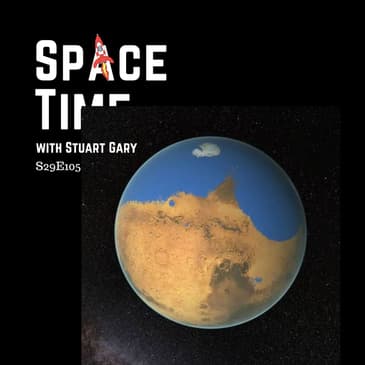
This is Space Time, Series 29, Episode 105, for broadcast on the 2nd of September, 2026. Coming up on Space Time. More evidence Mars once had liquid water. Are those mysterious little red dots at the edge of the universe hiding something big? And China's Chang'e 7 mission to the moon delayed until next year. All that and more coming up on Space Time. Welcome to Space Time with Stuart Garry. More than 20 years after NASA's Mars Spirit rover landed on the Red Planet, scientists have uncovered new evidence that suggests liquid water, essential for life as we know it, may once have covered large areas of the Martian surface. The findings, reported in the journal Interactions, are based on archival material observations that had remained buried in the six-wheeled golf cart-sized rover's data. The study's lead author, Paulo de Souza from Edith Cowan University, says that by re-examining observations collected by a spirit over more than 2,000 days on Mars, he's identified traces of hematite and altered magnetite in the Martian soil. Now these minerals are important because they can form when rocks interact with water. The findings provide fresh insights into the red planet's ancient environment and strengthen evidence that water once played a major role in shaping the Martian surface. D'Souza analysed the data collected from 32 undisturbed soil sites across Gusev Crater between 2004 and 2010. By combining hundreds of individual measurements, he created the most detailed iron mineral profile ever produced for typical Martian soils. D'Souza says one of the most important discoveries was finding crystalline hematite in ordinary Martian regolith. This mineral's widespread presence suggests not only that water was present, but that significant areas of Mars may once have been covered by it. Scientists had previously believed hematite was mostly absent from these soils. However, the new analysis suggests the mineral was there all along, but in amounts too small for individual rover measurements to detect. So you need to remember the original rover observations were limited by time, by power availability, and by the gradual aging of the very instruments used to collect the data. The SUSE says many measurements were not detailed enough on their own to identify the minerals present in extremely small quantities. But by bringing the data together and analysing it in a new way, the SUSE and colleagues were able to reveal information that had been hidden for years. The new research also supports the idea that much of Mars is covered by a similar layer of dust and soil. Scientists believe this layer formed over millions of years through wind erosion, extreme temperature changes and the movement of dust across the planet. D'Souza says the discovery also highlights the value of revisiting old data from past missions. He says the work shows that important discoveries aren't always made in collecting new data. Sometimes they can come from looking at existing data with a fresh set of eyes, as well as better analytical techniques. So what we found was the presence of hematite and magnetite, the two iron oxides that need water to be formed, particularly hematite. And we found them on the Martian dust. So if you look at the surface of the entire planet, it looks red. It's supposed to be reaching hematite, but we've never been able to find any trace of that in the dust. We found them rocks in some places on Mars. Not all the rocks are reaching that mineral, but for the first time we found in the dust. When we look at images of Mars, we see that the northern half of the planet is very smooth. It has signs of seashores and beaches around its rim. It seems to all be the floor of a once ancient, now dried up ocean. Yeah, it has that kind of features. And the difference between looking from orbiters, for example, and looking at the surface of Mars, yes, it gave us the indication that there were fluids floating through, probably an ocean bed. present in some lower ranges of Mars, you have all that remote sensing observation. And geologists will look at that and say, wow, oh my God, this looks like an ocean bed or a lake bed or a river that brought water to a large crater. And Gusev Crater, where we landed with The Spirit is exactly that kind of large crater with some features that resemble a river bringing that in. The difference is that you land on the surface, you analyze the data, and you have direct evidence. in situ of presence of minerals. And that is a completely different level of observation than just looking at images, for example. There are some spectroscopy data that can look at that distance, yet they don't have the same resolution as when you look at the surface. When you look at the data being collected now by Perseverance and Curiosity, that must give you further support for what Spirit and Opportunity found. When we landed back in 2004, in January 2004 with Spirit and then three weeks later with Opportunity, Mars for us was a very desolated place, full of volcanic rock. What we call primary minerals were present, which are minerals formed by lava, by volcanism. And evidences from previous missions like Pathfinder or with Viking landers just point to the same kind of boring rocks, the ones that you would see lava. solidified, forming what we call olivines and pyroxenes and minerals that you would usually find in lava. So water was not an element in those places. However, with opportunity, the first evidence came with the discovery of hematite and gyrosite on rocks. And that was the first direct evidence that Mars was once wet. Before that, we had no evidence. And that was the whole objective of the Mars exploration hover mission. However, the more we start continuing analyzing them, we start seeing different minerals or different type of sediments that we could not find before. For example, we found silica-rich deposits forming opaline silica, the same opal that we have in South Australia. We have on Mars, and that is a direct evidence that that place was a hot spring in the past. There was this heated water bubbling on the surface, and that place is a Wonderful candidate for life because you have energy, you have water, you have nutrients. Places like that on Earth, it doesn't matter where they are. It could be on the deep of the ocean. If hot water is present, you'll have colonies of bacteria growing. These are really the birds, like place for life. So the water, actually, it's in a very diverse environment. type of environment, gyracite needs water in a very low pH, such that part of the scientific community said, yeah, water, fine, great thing for life, but not at this pH. It's so acidic that it's going to destroy any organic matter there. But when you find in hot springs, a completely different thing. When you find gyracite in and other smectides and different types of minerals that you form in the mud with fresh water. It's a completely different scenario. So Mars was very complex in terms of water deposits. Some would be a wonderful place for life. Some would be an awful place for life. But life strives. If you have water, and that's the whole strategy, you follow water, you will find life. Where would you like to take this research next? I am very interested in comparing the results from Spirit with another hover that is at the other side of the planet with Opportunity. So they have the same, they are twins, they have the same instruments and we are now deep in the analysis of the data from Opportunity to compare with Spirit. If we find the same concentration of minerals and the same type of minerals all over the thousands of samples that we analyze, it means that the whole dust around the planet, it's homogeneous. Therefore, we're talking about a wonderful way to sample the planet is to look at the surface dust. Now, there are other interesting places with some bright soils that we are looking at. It's some kind of subsurface analysis that we use to trench with the wills that may have evidences of For a while now, the United States and Europe have been looking at developing a joint sample return mission to Mars. That appears to be on hold. At least in the near future, due to discussions regarding funding. The Chinese, however, are moving ahead with their sample return mission to Mars. They're going to be launching in two years, and they'll hopefully bring samples back in 2031. That must be exciting. Absolutely. The reason why it's exciting to bring samples from China Mars, as we did with some comets and some asteroids. The whole idea is that we can characterize, we can analyze those samples with instruments that could not be miniaturized and put into a hover. That is the main advantage. I cannot have a transmission electron microscope, a scanning electron microscope, or even a particle accelerator to review all the new uses and all the details on those minerals. What I can do on Earth, just I need to bring the samples here. When we do that, also, there is a lot of care that we should take. The samples could contain forms of life, and we don't know if that life could be dangerous to us. So we need to take extraordinary care on how we're going to handle that sample. If life is present, then you cannot analyze with things that could kill it. So you need to be very careful, and there is a lot of ethical consideration on when we bring the samples back. That's Professor Paulo de Souza from Edith Cowan University, and this is Space Time. Still to come, are those mysterious little red dots from the beginning of time hiding something? And China's Chang'e 7 mission to the moon delayed until next year. All that and more still to come on Space Time. A new study claims those mysterious little red dots seen near the dawn of the universe are likely to reside inside small, dense, compact star-forming galaxies. The findings, reported in the journal Nature Astronomy, represent the latest hypothesis trying to understand and explain these strange objects, which were only discovered once NASA's Webb Space Telescope began operations, allowing scientists to peer back almost to the beginning of spacetime. The observations are offering new clues about how these mysterious objects developed within the first billion years of the universe's existence. The findings are based on web images of 217 little red dots, revealing faint optical emissions extending beyond the central objects. Now, these couldn't be clearly detected in individual images, but by modelling the data suggests the emissions likely come from star-forming galaxies, with total masses equivalent to around a billion times that of our Sun. and the little red dots appear to be residing at the centers of these galaxies, most likely as supermassive black holes. The galaxies have average radii of around 685 light years. That makes them around two and a half times more compact than other star-forming galaxies of similar mass seen at comparable periods in cosmic history. Previous research detected sides of material around some of these objects at ultraviolet wavelengths, possibly indicating the presence of galaxies. However, there has been little evidence of this material at optical wavelengths, which provides a clearer view of stellar mass. This is Space Time. Still to come, Beijing scrubs its Chang'e 7 mission until at least next year, and later in the science report, a promising new way to tackle one of the most aggressive forms of breast cancer. All that and more still to come on Space Time. Beijing has scrubbed for now its Chang'e 7 mission to the moon, citing a failure to meet strict launch conditions. The flight aboard a Long March 7 rocket from the Wenchang Satellite Launch Center on China's southern Henan Island will search for water ice in the permanently shadowed areas of Shackleton Crater near the lunar south pole. Beijing refused to go into details about why the delay is taking place, so we're left with speculation, and most of that's focusing on the high winds and bad weather in the wake of Typhoon Nara pushing the launch beyond the window needed to achieve the correct alignment in order to meet the narrow lighting and shadowing constraints of the landing site. Of course, there's also the possibility of technical issues with the spacecraft, something Beijing wouldn't want to admit for fear of losing face. The postponement is expected to delay the mission until next year. By the way, the name Changi, well, that's a Chinese moon goddess. This, the seventh Changi mission, follows the highly successful Changi 6 sample return mission in 2024. Changi 6 brought back almost 2 kilograms of regolith from the lunar South Pole Aitken Basin, the largest and oldest impact crater on the moon. These were the first samples ever collected from the lunar far side. China's made studying the moon a major effort. It plans to send Tarkinodes to the lunar surface before 2030, and plans a will advance on a joint manned Sino-Russian base on the lunar surface by 2031. NASA's Artemis 4 mission is expected to return humans to the lunar surface in 2028, and establish a permanent lunar colony there by 2036. This is Space Time. And time now to take another brief look at some of the other stories making news in science this week with a science report. Australian researchers have discovered a promising new way to tackle one of the most aggressive forms of breast cancer. The findings reported in the journal EMBO Molecular Medicine are raising hopes of more effective treatments to stop the disease from spreading. The authors identified a molecular switch which drives the spread of triple negative breast cancer, the subtype responsible for some of the poorest outcomes, because it lacks the hormone receptors that make many other breast cancers treatable with the existing therapies that target these receptors. A new study has shown that alumni relationships between judges and lawyers are affecting court rulings. The findings, reported in the Journal Economic Inquiry, provided clear evidence of in-group bias operating within the judiciary, a setting where impartiality is, or at least should be, expected. Assuming, of course, they're not activist judges appointed by corrupt politicians. Using Florida medical malpractice cases with randomly assigned judges, investigators at Rice University found a sharing of a law school with presiding judges boosted a plaintiff's attorney's probability of recovering damages by approximately two percentage points. The authors found no comparable effect when judges and lawyers attended different law schools, were of similar rank, or shared the same gender or minority status, suggesting the result isn't driven by school quality or any of these other observable similarities. There's growing hope there may soon be an inexpensive and safer alternative to dangerous lithium-ion batteries. A report in the journal Ungewandte Chemie claims researchers from Flinders University have developed an aqueous zinc iodine battery that can be charged and discharged over 60,000 cycles. The development could put an end to the countless fires caused by damaged lithium-ion batteries, which are hard to extinguish and result in many deaths and millions of dollars in damage annually. A new study has shown that an artificial intelligence smartphone app called Mobilo may help visually blind or impaired people navigate outdoors. Mobilo uses the phone's camera, as well as motion sensors, GPS and light detection-arranging LiDAR, together with headphones and a white cane. A report in the journal Nature Biomedical Engineering found it reduced navigation time and required fewer verbal corrections compared with using Google Maps and a white cane. And in an obstacle course test, it reduced the number of collisions, but it did mean completing the course took a bit longer. With further refinement, the team behind the app hope it will be a relatively cheap and accessible travel aid for blind and visually impaired people. Of course, the big news over the past week has been Meta, which owns Facebook and Instagram, agreed to pay 18 billion US dollars to settle lawsuits over children's social media addictions. The settlement ends a federal trial of allegations Meta's products harm children and the companies deliberately misled the public about their safety. Meta's also agreed to implement age verification for kids so they can restrict Facebook and Instagram access with a school mode, time limits to two hours a day, and blocking all social media usage from midnight to 6am. There'll now also be default safety restrictions including parental supervision features, disabling likes and filters, and protecting against privacy risks. Of course, for Meta, $ 18 billion is nothing more than a slap on the wrist. It was a calculated move by the $ 1. 47 trillion company because it ends the original lawsuits, which were seeking over $ 200 billion in damages. It comes as Google and YouTube continue to try and force users to adopt digital IDs, removing your right to privacy, and giving Big Brother and government another rung on the ladder towards a Chinese government-style social credit scheme, which determines where you can live, where you can work, where you can travel, and even to what schools your children can attend and the standard of medical care you're entitled to, based in part on your internet history. With the details, we're joined by technology editor Alex Saharov-Royd from TechAdvice.life. One of the US states accused Meta of being a public nuisance. And we have the situation where algorithms push all sorts of things onto users, take them down rabbit holes, shape what it is that they are. looking at online, all in the attempt to shape attention and to advertise things to you and to get you to spend as much time on their system as possible. And that addicts young children and just people in general to online services that plenty of previous generations throughout all recorded history never had access to, never needed, and were never encumbered by. And we've seen children go down the rabbit holes of anorexia or other sorts of depression or cyberbullying because of the things that they're watching online. So Meta has had to put in the US, major restrictions on when children can use Facebook, how long they can use it for, whether they can use it at nighttime. And you can now actually look at a chronological list of posts from the people you follow and your followers rather than being fed an algorithmic bunch of slop that paddles the mind. And look, Facebook, I don't think it has been a net benefit to the world. The power of these social networks. is, you know, it's just absolutely appalling. And of course, there's spoken many times on this program about how Mark Zuckerberg had to go on like a two decade plus apology tour for all kinds of infractions that normally would see a business shut down and potentially the people running it investigated and potentially jailed. And yet, because Mark Zuckerberg is a billionaire. He seems to have a get out of jail free card. I mean, an 18 billion with a B dollar fine is an incredible indictment. And yet he's going to get off scot-free once again, and the bad behavior will creep back in. I mean, it always has, it always will. The leopard doesn't change its spots and neither does Mark Zuckerberg. That says something about where the world is heading in terms of being able to remain anonymous while you're online. Sure, yeah. Well, I mean, you know, governments and companies want to know who you are. I mean, if they're providing you a service where you're not actually paying for it, like watching YouTube videos for free, they want to know as much about you as they can because they play ads on YouTube and they want to target those ads to you. No point showing you an ad for the Wiggles if you're an adult with no children. No point showing you, you know, adults. diaper as if you're a teenager. I mean, there's lots of different things and reasons as to why they want to know who you are. But also, governments always are finding ways to want to be able to control what you're doing online and getting you to divulge your age or pay for something in terms of YouTube premiums, which does identify you because you've had to pay with. Your credit card. It's just the way that the world is going. The whole business about trying to identify you as an internet user is, of course, fueling the rise in people getting VPNs, And you can use different accounts. It also stifles speech. And the one thing we want to do with free speech is not stifle it because letting people speak lets you know what that person really thinks. And then you as an individual can decide whether you wish to associate with that person or let them into your community or not. Again, it just comes down to the opposing forces of people who want to be free, to live unencumbered by too many government restrictions. And those in government who believe that those voted in or those simply put into the deep state type of scenario where they never voted in, they're just part of the mechanism of government, are believing that they are more superior to everybody else and lauded over everybody else. And we've seen examples, plenty of examples, where those in power who shouldn't necessarily be there cause all sorts of problems. And those who are trying to resist are then crushed, as we've seen in Iran and other places. That's Alex Saharov-Reut from techadvice.life. And this is Space Time. And that's the show for now. Space Time is available every Monday, Wednesday, and Friday through bytes.com. soundcloud youtube your favorite podcast download provider and from spacetime with stuart gary.com spacetime's also broadcast through the national science foundation on science zone radio and on both iheart radio and tune in radio and you can help to support our show by visiting the spacetime store for a range of promotional merchandising goodies or by becoming a Spacetime patron, which gives you access to triple-episode commercial-free versions of the show, as well as lots of bonus audio content which doesn't go to air, access to our exclusive Facebook group, and other rewards. Just go to spacetimewithstuartgary.com for full details. You've been listening to Spacetime with Stuart Gary. This has been another quality podcast production from Bytes.com.