
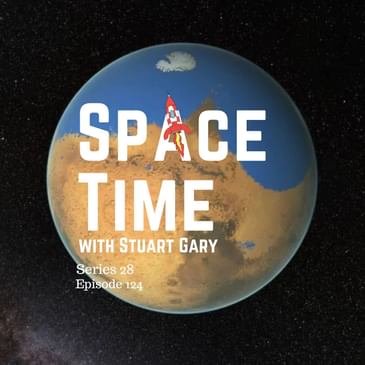



Ancient Oceans on Mars: Geological Evidence Revealed
A new study published in the journal Geophysical Research Letters presents compelling geological evidence that Mars' Northern Hemisphere was once home to a vast ocean. Lead author Chris from the University of Arkansas discusses how comparisons between river rocks on Earth and Martian sediment reveal ancient river deltas and backwater zones, suggesting that liquid water flowed on the Red Planet, increasing the possibility of past life. This episode delves into the processes of sedimentation and erosion that shaped Mars' landscape, providing insights into its watery past.
The Moon's South Pole-Aitken Basin: Unveiling Impact Mysteries
A fresh analysis of the Moon's largest impact crater, the South Pole-Aitken Basin, sheds light on its formation and the Moon's geological history. Researchers have discovered that this massive crater's shape indicates an impact from the north, challenging previous assumptions. As the Artemis missions prepare to land near this basin, they will have the opportunity to study material excavated from the lunar interior, potentially unlocking secrets about the Moon's evolution and the asymmetries in its crust.
Nancy Chris Roman Space Telescope: Mapping the Milky Way
NASA's upcoming Nancy Chris Roman Space Telescope is set to revolutionise our understanding of the Milky Way's interstellar medium. This mission will map around 20 billion stars, using infrared light to penetrate the dust clouds obscuring our view. Chief investigator Catherine Zucker explains how this data will refine our models of star formation and the galaxy's structure, while also addressing the ongoing mysteries of galactic spiral patterns and their role in star birth.
www.spacetimewithstuartgary.com
✍️ Episode References
Geophysical Research Letters
https://agupubs.onlinelibrary.wiley.com/journal/19448007
Nature
https://www.nature.com/nature
NASA Nancy Chris Roman Space Telescope
https://roman.gsfc.nasa.gov/
Become a supporter of this podcast: https://www.spreaker.com/podcast/spacetime-your-guide-to-space-astronomy--2458531/support.
Ancient Oceans on Mars: Geological Evidence Revealed
The Moon's South Pole-Aitken Basin: Unveiling Impact Mysteries
Nancy Chris Roman Space Telescope: Mapping the Milky Way
(00:00) Evidence of ancient oceans on Mars
(10:15) New insights into the Moon's largest impact crater
(19:30) The upcoming Nancy Chris Roman Space Telescope mission
(27:00) Science Robert: Heatwaves and their impact on global mortality
This is Spacetime Series twenty eight, Episode one hundred and twenty four, for broadcast on the fifteenth of October twenty twenty five. Coming up on space Time, high seas on the Red planet Mars, a new analysis of the largest impact crater on the Moon, and a new mission by NASA to study the Milky Way Galaxy's interstellar medium. All that and more coming up on space Time. Welcome to space Time with Stuart Gary. A new study has provided fresh geological evidence that the Martian northern hemisphere was once home to a vast ocean. Billions of years ago water flowed across the Martian surface. There's plenty of evidence a bouth observation and geological that the Red planet once had rivers feeding into lakes and larger bodies of water, But did those rivers ever flow into an actual ocean From aorbit, There's clear evidence of what appeared to be seashores, beaches, and river deltas flowing to what once was a huge northern hemisphere ocean. And now a new study reported in the journal Geophysical Research Letters, has found more strong evidence in Martian geology that an ocean once existed in the planet's northern Hemisphere. The stadi's lead author, Corey Hughes from the University of Arkansas, says, there are no known life forms that can survive without liquid water, so finding evidence that liquid water once existed on the Red planet increases the possibility that life might also once have existed there. To better understand the geology of ancient rivers, using colleagues compared river rocks on Earth to rocks on Mars, including sandstone created by a river that once flowed across northwestern Arkansas some three hundred million years ago. Hugh says, you need to imagine a river with no human built levees or dams to constrain its course. That river would shift constantly like a ribbon snaking across the landscape. You see. Rivers carry sediments like silk, clay, and rocks. These sediments eat away at one side, causing the river to curve in that direction, while at the same time depositing sand and fine dirt on the opposite side. The region that defines how far a river shifts from side to side over time is called a channel belt. Also, a river slows down as it approaches an ocean, which is a massive, comparatively still body of water. As a river's flow velocity decreases, it carries less sediment, so the solid matter starts to fall out a suspension, creating a river delta and with less sediment to erode its banks. A river's movement from side to site also decreases. In other words, the channel belt narrows as the river approaches an ocean. This section where the river belt narrows and the river bed d below sea level is called the backwater zone. The backwater zone of a river flowing into an ocean is long. In the case of the Mighty Mississippi River, for example, the backwater zone begins to Ea Baton Rouge that's some three hundred and seventy kilometers from the Gulf coast. Looking at Mass from orbit, Hughes found geological evidence of ancient river backwater zones on the Red planet. Is described that as a large scale process, which is why he was able to see it so clearly from space. The presence of river deltas with long backwater zones provide strong evidence that large rivers once float on Mars, and they emptied it into an ocean before the surface of the Red planet dried up. Bedans of years ago. Hugh says these were very mature deltas a strong point in favor of an ancient ocean or at least a very large sea. Now, as rivers flow, gravity pulls the coarsest grains to the bottom of the river bed. If the river eventually dries up that course, sediment's buried, and over time, due to heat and pressure, that sediment of eventually becomes sandstone. On Earth, shifting tectonic plots will push that rock to the surface, and then wind and rain will erode everything but the coarse channel bed itself, leaving behind a sort of ridge where the channel used to be. This process is known as topographic inversion. When a ridgetop is composed of sandstone that used to be at the bottom of a river, it's called an inverted channel belt or an inverted ridge. Now, Mars doesn't have tectonic plates like the Earth, so its inverted ridges were likely formed when finer deposits around the sandstone were eroded, and it's those inverted ridges on Mars which provide strong evidence of long vanished rivers. It's part of their research using colleagues studded the Weddington Sandstone, a rock formation found across much of northwestern Arkansas. They realize that stone cliffs are all part of a branching network of inverted ridges formed by a three hundred million year old river that once ran from modern day Indiana through to the sea that central Arkansas. Scientists have learn about the process of topographic inversion for thirty to forty years now, but in northwestern Arkansas, the authors discovered the only known example of an inverted river delta on planet Earth, and that discovery has helped them identify oceans on Mars. This is space time Still to come, a new analysis of the largest impact crater on the Moon, and a new mission to study the Milky Way galaxies interstellar medium. All that and more still to come on space time. A new analysis of the largest impact crater on the Moon may help astronomers solve some of the biggest long standing mysteries of how Earth's only natural satellite came to be. The findings mean that when the Artamus cruise land at the Moon's south pole in two years time, they're likely find themselves with a treasure trove of clues that could help scientists better understand how Earth's only natural satellite evolved. The Earth's Moon was created some four and a half billion years ago when a Mars sized planet slammed into the early proto Earth, melting both bodies into a mag morosi, which eventually differentiated and solidified to form the Earth as we know it today. Meanwhile, malton ejected debris from that impact was thrown high into orbit, gradually accreting to form the Moon now. A report in the journal Nature is providing a snapshot of the Moon's tumultuous past, one which could help explain long standing puzzles, such as why the Moon's crater riddle far side is so dramatically different from its smooth knee side, which provided the backdrop for the Apollo moon landings in the nineteen sixties and seventies. Roughly four point three billion years ago, when the Solar System was still in its infancy, a giant asteroid so It's slammed into the fart side of the Moon, blasting at an enormous crater known today as the South Pole at con Basin. This massive impact feature is the largest crater on the Moon, spanning almost two thousand kilometres north to south, over sixteen hundred kilometa is east to west. It's thought the oblong shape of the basin is the result of a glancing blow rather than a head on impact. By comparing the shape of the South Pole Acin Basin to other giant impact basins across the Solar System, the authors found that these features tend to get narrow and the downrange direction forming a shape resembling a tear drop. Up Ending conventional wisdom that the South Pole Acin basin was formed by an asteroid coming in from a southerly direction, the new analysis reveals that it shape narrows towards the south, indicating an impact coming in from the north. The stadi's lead author, Jeffrey Andrews Hannah from the University of Arizona, says the downrange and of the basin should be covered by a thick layer of material excavated from the lunar interior by the impact, while the up range end should not. He says it means that the Artemis missions will be landing on the downrange rim of the basin, the best place to study the largest and oldest impact basin on the Moon, where most of the ejector material from deep within the lunar interior should be piled up. It means the location will provide new clues about the interior structure of the Moon and its evolution through time. It had long been thought that the early Moon was melted by an energy released through its formation, creating a magma ocean covering the entire body. As the magmaotion, crystallized, heavy minerals sun to make the lunar mantle, while lighter materials floated up to make its crust. However, some elements were excluded from the solid mantel and crust and instead became concentrated in the final liquids of the magma ocean. Andrews Hannah says these leftover materials included potassium, rare earth elements, and phosphorus, collectively referred to its creep, the achronism's first letter being K, referreding potassium symbol in the periodic table of elements. These elements are especially abundant on the lunary side. Andrews Hannah says, if you've ever left the cannis soda in the freezer, you may even noticed that the water becomes solid first. The high fructose corncipt resists freezing until the very end and instead becomes concentrated in the last bits of liquid. He says something similar must have happened on the Moon with creep As it cooled over many millions of years, the magma osian gradually solidified into the crust and mantle, and eventually you get to a point where you just have a tiny bit of liquid left sandwiched between the matal and the crust, which is the creep rich material or the creep rich material and heat producing elements somehow became concentrated on the lunarar side, causing it to heat up and leading to the intense volcanism that formed the dark volcanic planes that make up that familiar sight of the so called face of the Man on the Moon. However, the reason why the creep rich material ended up only on the knee side and how that material evolved over time has long been a mystery. Also a mystery is why the Moon's crust is so much thicker on its far side than its near side facing the Earth. It's an asymmetry known as lunar dichotomy, which is still posing a puzzle for scientists today, and this dichotomy affected all aspects of the Moon's evolution, including the later stages of the magma ocean. ANDREWS. Hannering colleagues think that as the crust thickened on the lunar far side, the magma ocean below it was squeezed out on the sides, sort of like toothpaste being squeezed out of a tube, until most of it ended up on the knee side. The new study revealed a striking unexpected asymmetry around the basin, which supports this hypothesis. Interestingly, the ejective blanket on the western side is rich in radioactive thorium, but not on its eastern flank, and this suggests that the gash left by the impact created a window through the Moon's skin right at the boundary separating the crust under lane by the last remnants of the creep enriched magma ocean from the regular crast. So the last dregs of the lunar magma ocean ended up on the knees side, where one sees the highest concentrations of radioactive elements. But at some earlier time a thin patulayer of magma ocean would have existed blow parts of the farst side of the Moon, explaining the radioactive ejector on only one side of the South Pole a can impact basin this space time Still to come a new mission to study the Milky Way Galaxies interstellar medium, and later in the Science report, a new study claims the unprecdered heat waves of twenty twenty three contributed to over one hundred and seventy eight thousand excess deaths. All that and more still to come on space time. NASA says its new Nancy Grace Roman Space Telescope we at astronomers better understand the Milky Way Galaxies interstellar medium, that is, the dust and gas between stars, known as the Galactic Plane's Survey. The project will peeer through our galaxy to its most distant edge, mapping roughly twenty billion stars, about four times more than have currently been mapped. Astronomers will use data from these stars to study and map the dust their light travels through, contributing to the most complete picture yet of the Milky Way structure, star formation, and the origins of our solar system. One of the mission's chief investigators, Katine Zuka, from the Harvard and Smithsonian Center for Astrophysics, says that with Roman, astronomers will be able to turn existing artist's conceptions of the Milky Way into more data driven models using new constraints the three dimensional distribution of interstellar dust. Scientists know what our galaxy looks like by comparing observations of the Milky Way with that of other spiral galaxies. The problem is clouds of dust and gas make it hard to work out details on the opposite side of our galaxy. It's a bit like trying to map your neighborhood while looking through the windows of a house surrounded by dense fog. Roman will see through the fog of dust and gas using a specialized camera that filled us observed infrared light. Light with longer wavelengths than what our eyes can detect. Infra red lights more likely to pass through dust clouds without scattering. You see light with shorter wavelengths, including blue light produced by stars, is more easily scattered. That means that stars shining through dust appear dimmer and redder than what they actually are. By comparing the observations with information on the sauce stars characteristics, astronomers can disentangle a star's distance from how much its colours have been reddened, and stating these effects also reveals clues about the dust's properties. Scientists will also learn about the dust composition and probe clouds to investigate the physical processes behind changing dust properties. Clues in dust influenced starlight hint at the amount of dust between us and a star, and piecing together results from many stars will allow astronomers to construct a detailed three dimensional dust map. This would enable scientists like Zuka to create a model of the Milky Way, which will show us how it looks from the outside. Then scientists can better compare the Milky Way with other galaxies that we only observe from the outside, slotting it into a cosmological perspective of galaxy evolution. Zucker says Roman will add a whole new dimension to our understanding of galaxies because we'll see billions and billions more stars. The thing is, the interstellar medium does more than just mill around the Milky Way. It fuels star and planet formation. Dense blobs of the interstellar medium form the molecular gas and dust clouds, which can then gravitational collapse, triggering new star formation. At the same time, young stars hot winds that can cause surrounding dust to clump together, forming planetary building blocks. The Roman Space Telescope will identify young clusters of stars in new distance star forming regions, as well as contribute data on stellar nurseries previously identified by missions like NASA's now retired Spits of Space Telescope. Zuker says, if you want to understand star formation in different environments, you need to have understood the interstellar medium that seeds it. Roman will allow astronomers to link the three dimensional structure of the interstellar medium with the three dimensional distribution of young stars right across the galaxy's disc. The dust maps will refine sciences understanding of the Milky Way spiral structure. The pin will, like patent with stars, gas and dust tend to bunch up like galactic traffic jams. By combining velocity data to dust maps, scientists will compare observations with predictions from models to help identify the causes of the spiral structure is currently unclear. In fact, the very role that spiral patterns play in star formation also remains uncertain. Some theories suggest that galactic congestion triggers star formation, while others contend that these traffic jams gather material but don't stimulate starbirth. The Roman Space Telescope will help solve mysteries like these by providing more data on dusty regions right across the Milky Way galaxy. That'll enable scientists to compare numerous galactic environments and steady starbirth in specific locations like the galaxies winding spiral arms or at central Stellar bar. ROMAN is stated to launch no later than May twenty twenty seven, with a team working towards the potential earlier launch date, possibly as soon as the middle of next year. Needless to say, we'll keep you informed this report from Nasser TV. Astronomers around the world are working together to plan observations for NASA's upcoming Nancy Griefs Roman space Telescope. The Galactic Play, roman's first general astrophysics program proposed by the community, promises to reveal the Milky Way in unprecedented detail. The Milky Way is our home in the universe, and there's still so much to explore. Roman pairs the high resolution capabilities of the Hubble Space Telescope with the field of view two hundred times larger, and it is able to efficiently survey the sky a thousand times faster. The survey will capture our Milky Way galaxy across the span of its plane and also go deeper to map the far side of the galaxy, which is largely unknown territory. ROMAN will help astronomers fill in missing puzzle pieces in our picture of the Milky Way, and its huge archive of data will be immediately available for any researcher to access, allowing for transformative new research for decades to come. With ROMAN, astronomers will get a much better census of stars for reconstructing the history of our galaxy how did we get here? Future ROMAN surveys that will be developed by the astronomy community will explore additional ways to push roman's unique capabilities to explore our biggest questions, including those we haven't yet thought to ask. This is space, time and time that would take another brief look at some of the other stories making us in science this week with a science report, A new study claims the unprecedented heat waves that hit the world in twenty twenty three contributed to some one hundred and seventy eight thousand, four hundred and eighty six excess deaths, more than half of which can be directly attributed to man made climate change. The study reported in the journal Innovation Use climate mortality data from around the world to estimate how many people globally been historically dying each year as a result of heat waves and how many deaths in twenty twenty three were heatwave related. They found that fifty four point two nine percent of all twenty twenty three heat related deaths were attributable to man made climate change, with southern, Eastern and Western Europe seeing the highest mortality rates that year. Predatory fish that evolved in the first terrestrial animals on Earth are still now revealing insights into the origins of mammals, including new research into the eating habits of lobe finfish, which inhabited an ancient reef in what is now northern Australia. The new research, reported in the journal Eye Science, provides fresh insights into the lives of three hundred and eighty million year old lungfish. The research by Flinders University involved a high tech examination of remarkably well preserved jaw bones which were found in the remote Gogo fossil field of northern western Australia. Scientists have developed a new laser based dating technique for measuring the age of dinosaur eggs. The findings reported in the journal Frontiers in Earth use carbonate uranium lead dating to find that eggs from Central China were laid in the Late Cretaceous period around eighty five million years ago. Until now, dating dinosaur eggs has always been difficult. Available methods are limited, prone to errors because of measurement proxies such as volcanic rocks or crystals, which may have changed between egg laying and dating attempts. The authors say using the new method, which involves firing lasers at eggshells, could all researchers learn more about dinosaur populations and the climate millions of years ago. In case you haven't noticed it yet, the EESIM is the latest technological innovation. Aesims are digital built in sim cards that eliminate the need for a physical plastic card, allowing you to activate a sulfur or tablet plant simply by downloading it onto a small chipm better in your device YEA he stands for embedded any. Sims offer flexibility in security, enabling you to easily switch between carriers, add modible phone numbers to a single device, and activate plants remotely simply by scanning a QR code with the details which you want by Technology to Alex Haharovrot from take advice, do lie. And this is where you can get a SIM that's electronic, it's not physical, and you can now buy these. You can buy them with twenty gig of data, you can buy them with five or ten. You can buy them with seven days, two weeks a month, ninety days, three hundred and sixty five days of validity. They work depending on how much data you have and how much have used. And if you get them with phone calls and you get them for a year's access for example, well you'll pay a lot for that. But you can have a SIM that just sits in your phone without interfering with your physical SIM slot. And I've been using an e sym that gave me global access. I got it for a year with twenty gigabytes to cost me about eighty seven dollars Australian and I've used about fourteen to fifteen gigabytes and i still have plenty for the trip. But this has become a very easy way of being connected and not having to worry about getting somewhere using the physical SIM, handing over your passport and filling with little SIM card dejector tools it's eSIM is the in thing, and I'm using an iPhone Air as you speak right now. It doesn't even have a physical SIM slot, so I have to use an eesim. I've got one from my provider at home, but I've gotten one for global travels and it's fantastic. You'll probably use one on your next overseas trip. That's Alex aharav Rout from Tech Advice to out Live and that's the show for now. Space Time is available every Monday, Wednesday and Friday through Apple Podcasts, iTunes, Stitcher, Google podcast, pocker Casts, Spotify a cast, Amazon Music, bytes dot com, SoundCloud YouTube, your favorite pot cast download provider, and from space Time with Stuart Gary dot com. Space Time's also broadcast through the National Science Foundation, on Science Own Radio and on both iHeartRadio and tune in Radio. And you can help to support our show by visiting the Spacetime Store for a range of promotional merchandising goodies, or by becoming a Spacetime Patron, which gives you access to triple episode commercial free versions of the show, as well as lots of Bonnus audio content which doesn't go to weir, access to our exclusive Facebook group and other rewards. Just go to space Time with Stewart Gary dot com for full details. You've been listening to space Time with Stuart Gary. This has been another quality podcast production from bytes dot com