
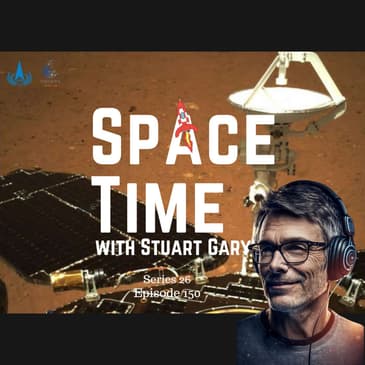


- Scientists discover strange, irregular wedge-shaped objects buried beneath the Martian surface.
- Polygons range from centimeters to 10 meters in size and may have formed during ancient freeze-thaw cycles billions of years ago.
- Possible formation mechanisms include mud cracks from wet sediments and contraction from cooling volcanic lava flows.
- Zhurong rover detected at least 16 polygons, suggesting a wide distribution.
- Iran successfully launches a small spacecraft, raising concerns about its ballistic missile program.
- Officials claim the launch was for peaceful purposes, but it violates the Vienna Accords.
- Iran's enriched uranium stockpile is now 18 times above the limit set by the Accords.
- International community urges Iran to stop its nuclear weapons development.
- Progress MS-25 successfully docked with the International Space Station, delivering over 2.5 tons of supplies.
- The cargo included food, personal items for the crew, spare parts, and fuel, oxygen, and water.
- This resupply mission ensures the crew has the resources they need to continue their research aboard the ISS.
- New Australian Skyguide released, providing stargazers with information about upcoming celestial events. www.maas.musem/store
- Study shows eating a healthy vegan diet lowers cholesterol, weight, and insulin levels.
- Increasing walking speed to 4 km/h may reduce the risk of developing type 2 diabetes.
#SpaceTimePodcast #SciencePodcast #SpaceNews #Astronomy #HealthScience #Environment #Technology #CurrentEvents
Become a supporter of this podcast: https://www.spreaker.com/podcast/spacetime-with-stuart-gary--2458531/support.
[00:00:00] vs. SpaceTime Series 26 Episode 150, full broadcast on the 15th of December 2023 Coming up on SpaceTime… Mysterious polygons discovered beneath the Martian surface Iran's nuclear missile program continues to advance And a Russian Progress cargo ship docks successfully with the International Space Station All that and more coming up on SpaceTime
[00:00:27] Welcome to SpaceTime with Stuart Gary Scientists peering through data from China's Zhurong Mars rover have discovered strange irregular polygonal wedges deep beneath the Martian surface The tiny rover's ground-penetrating radar system detected the object at depths of about 35 metres
[00:01:02] all along the rover's exploration track at the Utopia Planitia landing site The findings reported in the journal Nature Astronomy suggest the objects range from just a few centimetres in size to tens of metres across The study's authors hypothesise that these buried polygons
[00:01:19] were formed during repeated freeze-thaw cycles between 3.7 and 2.9 billion years ago during the late Hesperian and early Amazonian epochs on Mars possibly marking the cessation of an ancient wet environment billions of years ago They were then subsequently buried by later geological processes
[00:01:38] The authors say the most likely formation mechanisms involved soil contraction from wet sediments that tried producing mud cracks The presence of water and ice required for the freeze-thaw process in the polygonal wedges may have come from cryogenic suction-induced moisture mitigation from an underground aquifer, snowfall from the air
[00:01:58] or even vapour diffusion for pore ice deposition However, contraction from cooling volcanic lava flows could also have produced thermal contraction cracking The authors detected at least 16 polygonal wedges within about 1.2 kilometres of the rover's track suggesting a fairly wide distribution
[00:02:16] While polygon terrain has been seen across several areas of Mars before this is the first time they've been detected underground Chirong landed on Mars back on May 15th 2021 It lasted more than a full Earth year on the red planet's surface travelling some 1,921 metres
[00:02:35] However, it's failed to wake up after being placed into a planned hibernation phase by mission managers in order to see through the harsh Martian winter And despite recent efforts to reawaken the little rover, there's been no response Still to come Iran's nuclear missile program continues to advance
[00:02:57] and a Russian Progress cargo ship docks successfully with the International Space Station All that and more still to come on Space Time Iran has successfully placed a small spacecraft into orbit as part of its ongoing campaign to develop a delivery system for its secret nuclear weapons program
[00:03:32] The Islamic State, which is the world's largest sponsor of terrorism released images of what it describes as a Salman rocket apparently blasting up from the Imam Khomeini Missile Test Centre in northern Semnan province The Salman is actually a solid-fuelled rocket motor
[00:03:46] designed and built by the Islamic Revolutionary Guard for use as the second stage on the Kursat and Qaem-100 missiles Kursat is a three-stage rocket equipped with a Gadair medium-range ballistic missile liquid-fuelled first stage a solid-fuelled Salman second stage and a newly developed solid-fuelled third stage
[00:04:05] The Qaem-100 is a three-stage solid-fuelled rocket designed to place an 80kg payload into low-Earth orbit The official IRNA news agency claims the rocket was fitted with a 500kg capsule capable of carrying live animals into space The agency claims the mission achieved a 130km high orbit
[00:04:25] Iran claims it plans to send astronauts into space by 2029 although it would need a launch vehicle at least 14 times bigger than the Salman to do so But then again, Iran often talks about a manned space program Remember the images it showed of their astronauts wearing spacesuits?
[00:04:41] They turned out to be children's toy suits But Iran's latest launch is another direct violation of the Vienna Accords which prevent Iran from developing nuclear weapon delivery systems such as ballistic missiles Israeli intelligence says Iran now has enough weapons-grade uranium to produce at least four atomic bombs
[00:05:01] The only thing stopping them is to be able to miniaturise the bombs enough to fit into the warheads of their existing missiles In October, Iran banned United Nations weapons inspectors from accessing the Islamic Republic's suspected nuclear weapon sites
[00:05:15] The International Atomic Energy Agency slammed the unprecedented move as profoundly regrettable warning that it would harm the agency's capacity to monitor the Islamic Republic's nuclear program Then in September, the UN nuclear watchdog said Iran had made no progress on several outstanding nuclear issues
[00:05:34] including reactivating surveillance devices that Tehran had disconnected last year The IAEA says Iran's total stockpile of enriched uranium is now more than 18 times above the limit set in the 2015 Vienna Accords between Tehran and world powers
[00:05:50] and it was estimated to be around 3,796 kilograms as of August 19th this year That's well above the 202 kilograms agreed to under the Vienna Accords The United Nations nuclear watchdog says the Islamic Republic began using advanced centrifuges to enrich uranium back in September 2019
[00:06:11] In February 2021, UN weapons inspectors found Iran had started producing uranium metal Now that's a material which only has one use, nuclear weapons Then in April 2021, both German and Swedish intelligence agencies issued warnings of growing efforts by Tehran to obtain nuclear weapons technology
[00:06:32] Then a report in May 2022 by the International Atomic Energy Agency found traces of enriched uranium at three secret atomic weapons research facilities Iran insists its nuclear program is for peaceful power generation only This is Space Time
[00:06:51] Still to come, a Progress cargo ship docks with the International Space Station and later in the Science Report, a new identical twin study shows that eating a healthy vegan diet not only lowers your cholesterol it also lowers your weight and your insulin levels
[00:07:07] All that and more still to come on Space Time A Russian Progress cargo ship carrying over 2.5 tons of fresh supplies has successfully docked to the International Space Station The Progress MS-25 had launched two days earlier aboard a Soyuz-2.1a rocket from the Baikonur Cosmodrome
[00:07:40] in the Central Asian Republic of Kazakhstan The Progress manifest included 1.5 tons of dry cargo including food, personal items for the seven Expedition 70 crew members spare parts and other equipment and supplies as well as 515 kilograms of fuel, 40 kilograms of oxygen and 420 kilograms of water
[00:08:01] A previous Russian supply ship, the Progress MS-23 undocked from the orbiting outpost last week and re-entered the Earth's atmosphere loaded with trash where it burnt up Teaching your kids about astronomy or taking them into the backyard or park at night to gaze up into the night skies
[00:08:18] pointing out key stars, constellations and planets is one of the best ways to spark their interest in science and open up an exciting new world before them And listeners in the Southern Hemisphere are especially blessed because they have some of the planet's very best views of the cosmos
[00:08:34] including our nearest star systems the best views of the galactic centre of the Milky Way as well as stunning views of some of our nearest satellite galaxies The Powerhouse Sydney Observatory has now launched the 34th and latest edition of its popular Australian Sky Guide
[00:08:50] providing stargazers and the general public with an easy-to-follow tour of the majestic southern night skies And it's a great companion for our own monthly Skywatch Guide The guide, which has been published annually since 1991 contains the latest star maps and information on all the key astronomical events
[00:09:08] expected over the coming year The guide also examines the fascinating sky science of First Nations astronomy and the role it plays in traditional Aboriginal life and dreamtime stories The 2024 guide was written by Dr Nick Glom consultant curator of astronomy at the Powerhouse Museum's Sydney Observatory
[00:09:26] and honorary professor at the University of Southern Queensland This year's book, it's been completely redesigned It's much easier to read, looks much more modern but the real big difference is the monthly sky map Previously they would have covered the whole sky in one circular map
[00:09:45] Now the two maps have been split into two so you can look towards the north and actually see what's up in the northern sky and then you can turn the book over and look in the south and see what's in the southern sky
[00:09:58] It makes it much easier to use and to get familiar with the night sky Now Nick, the cover is usually one of the most spectacular features of the guide What about this year's? The cover is very spectacular
[00:10:11] As usual it's from a photograph which is a winner in the David Malian Award which is run by the Central Astronomical Society each year and it's called the Running Chicken which is a rather wonderful name for the nebulosity
[00:10:26] It's got various colours, gases and in the centre there is a bright patch which for people with a good imagination looks like a running chicken It's taken by a photographer called Steve Bode and he took it from suburban Melbourne
[00:10:42] It's quite amazing that you can take deep sky photographs from a brightly lit suburban area and he spent some like 20 hours taking the image The book also has an essay as we do every year on First Nations astronomy This year it's by Uncle Pilar Michael Anderson
[00:11:03] and it talks about the Astronomical Ulali people These are people who live in parts of New South Wales and Queensland and like other Aboriginal people, First Nations people they embed their astronomical knowledge in stories So there are some very interesting stories associated with the sky
[00:11:24] and yet at the same time showing that they do understand a lot of what's happening in the sky and how the events in the sky what you see in the sky repeat over time What about some of the highlights for 2024?
[00:11:37] There are lots of exciting events during the year There's two main meteor showers, the Ita Aquarids which are a meteor shower associated with Halley's Comet or dust particles of Halley's Comet over the centuries and thousands of years it's been circling the Sun
[00:11:56] and we run into those dust particles in early May This year is particularly favourable as there will only be a thin crescent moon in the sky so the sky will not be brightened and there will be good chances to see them
[00:12:08] Obviously like with any other meteor shower, it's best to find the darkest spot as possible And late in the year, the Atogemini, they occur in mid-December They can be some very bright objects as part of the Atogemini
[00:12:22] They're associated with an asteroid which is very strange and very unusual because most meteor showers are associated with comets This one is a rocky asteroid but somehow bits of particles have been driften off it over the years Over the many long years it's been circling around the Sun
[00:12:41] and when we run into those particles they can give rise to some very bright streaks in the sky This year however, at least in 2024 there will only be a short window between the incident and dawn
[00:12:54] There's a bright gigas moon so we will have to wait for that set and then there'll be a short window of half an hour or so between that time and dawn but there will still be a chance to see it
[00:13:06] There'll be close approaches by planets to each other during the year For example, on the evening of 22nd March, Venus will be close to Saturn and that's always a spectacular event when there are two planets close to each other
[00:13:20] So shining brightly Venus especially is the brightest planet in the night sky Then a few months later in August, mid-August there is the approach of Mars and Jupiter and that takes place in the early morning So Mars being the red planet, Jupiter being the giant planet
[00:13:37] and it's fairly bright, not quite as bright as Venus but fairly bright Again, that should be a great sight Then in June we have an occultation and that's really one of the highlights of the year, possibly the highlight of the year
[00:13:52] So it happens in June but fairly late in the evening around 11pm and the moon starts covering the red planet Saturn and it disappears around 11pm, it disappears around the bright edge of the moon
[00:14:06] so it makes it a little bit difficult to see, at least certainly difficult to follow until during the last few seconds as the moon approaches Saturn but it will reappear about 40 minutes later and it will appear at the dark edge so that will be much easier to see
[00:14:23] and there are always people taking some very spectacular photographs of Saturn being occulted by the moon I should say that's visible only in the eastern part of Australia Sydney, Brisbane, Canberra, Melbourne is sort of the region where you can see the moon occultation
[00:14:43] We also have a couple of supermoons in September and October These are supermoons when the moon is a little bit closer or appears a little bit larger to Earth than usual
[00:14:56] and this is because it is closer and the time that it's closest to the Earth corresponds to or matches when the moon is at full moon so that's always nice to see, it's best to observe it just as the moon rises
[00:15:11] because then the effect is improved by what's called the moon illusion that makes the moon appear larger when it's either rising or when it's up in the sky It's not a real effect, it's only in our brains but it is very, very noticeable
[00:15:27] We have the final highlight for the year and that may or may not happen If it does happen, it could be a really exciting event and that's a possible bright comet It has a rather mouthful of a name, the 2023 A3 Juche-Shenzhen Atlas
[00:15:45] Now this comet was discovered in January of this year from the Perfel Mountain Observatory in China and because it was discovered from so far away, people think when it does approach the sun and the Earth it could be bright
[00:15:59] But comets are fickle, we do not know if it will happen It might just completely fizzle out, we don't know but it could be very bright so it's certainly worthwhile looking at it It will be closest to Earth in mid-October
[00:16:12] It will be 71 million kilometres away which is half the distance from Earth to the sun So it's not that close but it's still close enough if it's a bright comet, large bright comet that it could appear bright
[00:16:25] At the time of closest approach to Earth, there is unfortunately never a bright moon in the sky but that moves out of the way in a few weeks later on Saturday 19th of October
[00:16:37] and that in the evening will give us the best chance to look for the comet that evening 19th of October and next few evenings and hopefully if it's clear and the cometaries remain bright then it will be a good chance to see it
[00:16:52] So there is a lot in the Sky Guide, I haven't mentioned all but these are details that people need to become familiar with the sky The 2024 Australasian Guide is available at all good bookstores and online from the Powers Museum Sydney Observatory at mwas.museum.com
[00:17:11] This is Space Time And time now to take another brief look at some of the other stories making use in science this week with the Science Report
[00:17:35] A new study of identical twins has shown that a healthy vegan diet can assist in lowering cholesterol, weight and even insulin levels The findings reported in the Journal of the American Medical Association followed 22 pairs of identical twins which saw one of each pair eating a healthy vegan diet
[00:17:53] and the other a healthy omnivore diet for two months At the end of the two months, researchers say cholesterol levels and insulin levels were better for the vegan group compared to their siblings and the vegan group also lost more weight
[00:18:06] They say the research shows that a vegan diet can be a good option for reducing the risk of some health problems with identical twins providing an opportunity to compare health outcomes between two people with essentially similar genetic and lifestyle factors Well it's time to dust off your sneakers
[00:18:24] It seems increasing your walking speed to at least 4 km per hour could decrease your risk of developing type 2 diabetes The findings reported in the British Medical Journal also show that every additional km per hour increased in your speed was associated with a further 9% reduction in that risk
[00:18:43] The authors reviewed research including over 500,000 people in 10 studies and say that moving 3 to 5 km per hour was associated with a 15% lower risk of developing the condition irrespective of the time spent walking At 6 km per hour, the reduction was 39% equal to 2.24 fewer cases of type 2 diabetes in every 100 people
[00:19:05] Now while this type of study can't prove that walking directly caused the reduction in type 2 diabetes the researchers suggest that it's probably in your best interest to lace up those shoes and get moving Scientists have developed an ingestible device about the size of a pill
[00:19:21] that, once swallowed, can monitor a patient's vital signs while sitting in the digestive tract The tiny device, named the VM-Pill, monitors the small vibrations in the body associated with breathing and heartbeat
[00:19:34] A report in the journal Device found that the electronic pill was able to show researchers when breathing problems developed allowing them to intervene and save a subject's life The researchers also tested the pill on people with sleep apnea and found it could monitor when a person's breathing stops
[00:19:50] and monitor respiration and heart rate with an accuracy of 92.7% and 96% respectively Well, it seems the once great Washington Post newspaper has now fallen for acupuncture pseudoscience Once seen as one of the world's great bastions of journalistic integrity bringing truth to power
[00:20:10] the Post these days is little more than a political apologist pushing a deliberate agenda to a willingly spoon-fed readership and never letting the truth get in the way of a good story You probably know when a news organisation has reached the bottom of the tabloid barrel
[00:20:24] when it starts pushing stories that are blatantly pseudoscience And as Tim Mendham from Australian Skeptics points out, that's where the acupuncture comes in Washington Post, as you say, a recognised newspaper A once great newspaper A once great newspaper Unfortunately, you're only as good as your journalists
[00:20:43] although your editors should be aware of what you're letting through and perhaps in these days of straightened finances for newspapers and mainstream media that they will look for things that get a greater interest They're looking for clickbait, let's face it
[00:20:56] Yeah, some of these are clickbait of quite a length actually Not the usual little clickbait, that's a big headline small story But there's a story that came out fairly recently in the Washington Post talking about acupuncture and basically saying that
[00:21:08] meta-analysis, which means you're looking at a whole range of research projects and trying to get a feeling for what the consensus is So meta-analysis, 20,000 patients, 39 high quality randomised controlled trials found that acupuncture was superior to both sham, like pretend
[00:21:24] and no acupuncture for back or neck pain, osteoarthritis, headaches and shoulder pain and they said that these outcomes persisted over time even after 12 months of receiving treatment The problem is, that's what they said The reality is that's not quite the case
[00:21:36] Meta-analysis is a great thing because you basically try to even out the score and they do it all the time with political polls What's the sum of the political polls to try and find the average between them? Trying to find the average is a funny area
[00:21:48] The average Australian has less than two legs Now, not many Australians have less than two legs but the average Australian has less than two legs because no one has more than two legs and there are a few with less
[00:21:57] The thing is then that if you're looking at meta-analysis which is generally regarded as a good thing you have to look at the quality of the individual research that's making up your overall analysis and if you have a lot of bad quality research projects
[00:22:11] and a few good research projects the average out will tend towards those bad or believing or sort of less well done, less rigorous studies So your average then is a skewed average So it's not just the number, it's the quality which is the important thing
[00:22:29] One commentator on this and has been commenting for a long time is Steve Novella, a skeptic who has a blog called Science Based Medicine which is very much worth looking up and he says, as you improve the control and rigor of the study
[00:22:41] in other words, make it a better study the effect of acupuncture diminishes to zero But if you do a meta-analysis across the spectrum of study quality up to some arbitrary cut off, you can see statistical significance If you therefore include everything, even the bad ones
[00:22:54] your result of a meta-analysis is not going to be very good and obviously with acupuncture, it's a bit hard to do a blind test double blind test even harder The patient doesn't know what they're getting The practitioner doesn't know what they're getting
[00:23:05] and someone else makes the assessment to see if it works Trying to get a patient to see if their needles or toothpicks or not having at all or if they're going in the wrong place not that the meridians etc. or the acupoints as they're called
[00:23:18] Well they can't even agree on the meridians, remember that Or the acupoints The trouble is, there's interesting things in most pro-acupuncture documentation they talk about acupoints as being which is the points you stick across your body for different things, 365 of them Now the number 365 might be significant
[00:23:36] because it's the same number of days in a year and the traditional belief of acupuncture is that each point relates to a particular day of the year which is obviously strange I was going to say garbage, it's strange Every acupoint, there's probably 365 of these things
[00:23:52] across your body, there's hardly a spot of your body which isn't an acupoint Even though we can stick it everywhere and even if we're trying to find a relationship between a particular acupoint and a particular symptom or disease it's impossible, it doesn't work
[00:24:06] and even the authorities, the researchers say they can't find it Not to stop the World Health Organization recognizing 361 for some reason standardized acupoints on the human body Now whether they're believing those acupoints work or whether they're just saying this is the belief of acupuncture, I'm not quite sure
[00:24:21] Knowing what the World Health Organization's doing lately I wouldn't be at all surprised if they say these things work I mean, it always comes down to the quality of the trials the ability to do proper double-blind testing trying to have some sort of theory behind it proper practice
[00:24:36] and then your meta-analysis might work But then again in this case you've got the added problem of the writer of the article, Tricia Pasarica She's an MD apparently Nevertheless, she appears not to understand the different qualities of scientific research which you were discussing earlier
[00:24:50] You can always find a doctor somewhere to support any particular modality regardless of whether these regardless how silly it is or how contentious it is And this particular person who's written an article in the Washington Post is saying, is making all these claims about acupuncture
[00:25:02] which are not supported actually by the papers that she's quoting and certainly not supported by the general evidence So that doesn't stop the Washington Post from publishing and these days we're seeing more and more once prestigious newspapers, etc wandering off into the pseudoscience areas and claiming they're justified
[00:25:18] And because they have this imprimatur of being a decent paper people believe them Have it been in the Upper Conductor West Gazette you might not be so impressed by it but because it's in the Washington Post or the New York Times which has had its own issues lately
[00:25:29] you tend to believe it Tim, journalism today isn't anywhere near as good as what it was when you and I were taught the craft I agree with you, yes I think there's a lot of pressures on journalism to soften their journalism
[00:25:40] These days the game for a specific demographic based on subscriptions that means they're catering to a specific audience rather than providing the truth There's two aspects to the decline of journalism One is the pressure on journalists Journalists are the exact fewer journalists same amount of work to do
[00:25:54] so they don't have as much time to go in depth and the other aspect is to try and get bums on seats, as we say people to read your stories and therefore you have to make them more exciting and certainly in this particular case
[00:26:04] more positive towards a particular thing rather than saying, no, don't work That's Tim Mendham from Australian Skeptics And that's the show for now Space Time is available every Monday, Wednesday and Friday through Apple Podcasts iTunes Stitcher, Google Podcasts Toker Casts, Spotify Acast, Amazon Music Bytes.com, Soundcloud
[00:26:41] YouTube, your favourite podcast download provider and from Spacetime with Stuart Garry.com Space Time is also broadcast through the National Science Foundation on Science Zone Radio and on both iHeart Radio and TuneIn Radio And you can help to support our show by visiting the Spacetime store
[00:26:59] for a range of promotional merchandising goodies or by becoming a Spacetime patron which gives you access to triple episode commercial free versions of the show as well as lots of bonus audio content which doesn't go to air access to our exclusive Facebook group and other rewards
[00:27:15] Just go to Spacetimewithstuartgarry.com for full details And if you want more Space Time please check out our blog where you'll find all the stuff we couldn't fit in the show as well as heaps of images news stories, loads of videos
[00:27:28] and things on the web I find interesting or amusing Just go to Spacetimewithstuartgarry.tumblr.com That's all one word and that's Tumblr without the E You can also follow us through at Stuart Garry on Twitter at Spacetimewithstuartgarry on Instagram through our Spacetime YouTube channel And on Facebook
[00:27:48] just go to Facebook.com forward slash Spacetimewithstuartgarry You've been listening to Spacetime with Stuart Garry This has been another quality podcast production from Bytes.com