



Martian Ice: A Potential Reservoir for Life
A recent study suggests that Martian ice may be the most promising location to search for signs of ancient microbial life. Researchers found that biomolecules from dormant microbes degrade significantly slower in pure water ice compared to Martian soil mixtures. This discovery, published in the journal Astrobiology, raises hopes that future missions to Mars could uncover preserved organic materials in its icy regions, potentially revealing the planet's biological history.
A Mysterious Dark Object in the Universe
Astronomers have identified the lowest mass dark object ever detected, with a mass about a million times that of our Sun. This enigmatic object, reported in Nature Astronomy, may offer insights into the nature of dark matter, which constitutes a significant portion of the universe's mass. The object was detected through gravitational lensing, and its small size challenges existing theories about dark matter's composition and distribution.
NASA's Call for Lunar Mission Bids
NASA is seeking new bids for its Artemis Moon program, aiming to foster competition among American companies to return humans to the lunar surface. With ongoing delays from SpaceX, NASA Administrator Sean Duffy emphasizes the urgency of the mission as the U.S. races against China to achieve lunar exploration milestones. The upcoming Artemis missions promise to be pivotal in establishing a sustainable human presence on the Moon.
November Skywatch with Jonathan Nally
www.spacetimewithstuartgary.com
✍️ Episode References
Astrobiology Journal
https://www.liebertpub.com/journals/astrobiology/1
Nature Astronomy
https://www.nature.com/natureastronomy/
Become a supporter of this podcast: https://www.spreaker.com/podcast/spacetime-your-guide-to-space-astronomy--2458531/support.
Martian Ice: A Potential Reservoir for Life
A Mysterious Dark Object in the Universe
NASA's Call for Lunar Mission Bids
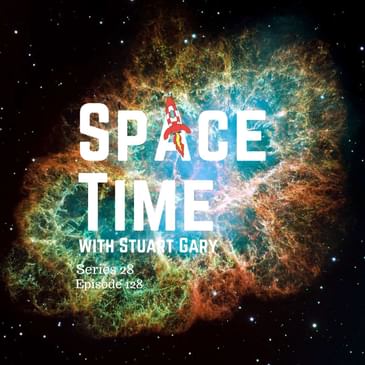
This is Spacetime Series twenty eight, episode one hundred and twenty eight for broadcasts on the thirty first of October twenty twenty five. Coming up on space Time, are they microbes in the Martian Ice? Discovery of a mysterious dark object in the distant Universe, and NASA looking for near bids for its lunar missions. All that and more coming up on Spacetime. Welcome to space Time with Stuart Gary. A new study has shown that Martian Ice might be the best place to look for evidence of biomolecules on the red planet. The findings reported in the journal Astrobiology, based on research showing that intent biomolecules from dormant microbes the far slower in pure water ice than inmixed or samples. Scientists recreated Mars like conditions in the lab and then suspended and sealed fragments of proteins of the colobacteria in test tubes containing either pure water ice or a mixture of water ice and ingredients found in Martian sediment, such as silicon based rocks and clays. The samples were frozen and transferred to a gamma radiation chamber, which was cooled to minus fifty one degree celsius, the temperature of icy. Regions on Mars. The samples were then blasted with radiation equivalent to twenty million years of cosmic ray exposure on the Martian surface. They then modeled an additional thirty million years of radiation to provide a total fifty million year time span. The authors found that in pure water ice, more than ten percent of the amino acids that molecular building blocks of proteins from the Acholi samples survived the simulated fifty millionaire time span, while the samples containing Mars like sedimentary material degraded ten times fast and did not survive. Fifty million years is far greater than the expected age with some current surface ice deposits on Mars, which are often less than two million years old, meaning any organic life present within the ice would be preserved. That means that if there were bacterian in the Martian surface, future missions should be able to find it. The studies lead author, Alexander Pavlov from NASA's Godard Space Flight Centering, Green Belt, Maryland, says ancient microbes or their remains could be found in time in Martian ice deposits by future missions. To the Red planet, Pavlov says the results show that bio molecules, if present in the Martian permafrost and ice caps, could remain intact for over fifty million years, despite the harsh and continuous exposure to cosmic radiation and early at twenty twenty two study also by Pavlov and colleagues found that amino acids reserved in a ten percent water ice in ninety percent Martian soil mixture were destroyed more rapidly than sample was containing only sex ediment. Now, based on those findings, the authors had speculated that organic material in ice or water alone would be destroyed even more rapidly than the ten percent water mixture, but instead they were surprised to find that the organic materials placed in water ice alone were destroyed at a much slower rate than the samples containing water and soil. That degradation could be due to a slippery film which forms in areas where ice touches minerals, allowing radiation to reach and destroy amino acids. On the other hand, in solid ice, harmful particles created by radiation get frozen in place and may simply not be able to reach organic compounds. Pavlov says future missions searching for life on Mars should therefore target locations with pure ice or ice dominated permafrost for exploration, as opposed to stating rocks, clays. Or soils. Back in twenty oh eight, NASA's Mars Phoenix mission landed at the Marsian equivalent of the Arctic Circle. They undertook a shallow depth excavation at the site, finding permafrost ice just below the surface. In addition to testing for conditions on Mars, the authors also tested organic materials in temperatures similar to those on the Joviet ice moon, Europa, and Satin's frozen moon Andciladus. They found that these even colder temperatures further reduced the rate of deterioration. Pavlov says those results are encouraging for NASA's Europa Clipper mission that'll explore the icy crust and subsurface ocean of Europa, the fourth largest of Jupiter's ninety five moons. Europa Clipper was launched in twenty twenty four, and he's traveling almost three billion kilometers to reach Jupiter. In twenty thirty, it will conduct forty nine close flybys of Europa assessing whether or not the replaces below the surface that could support life. Needless to say, we'll keep you informed. This is space time still to come, the discovery of a mysterious dark object in the distant universe and NASA looking for new bids for its lunar missions. All that and more still to come on space time. Astronomers have detected the lowest mass dark object ever found in the universe. The discovery reported the Journal's Nature Astronomy in the Monthly Notices of the Royal Astronomical Society, as a mass about a million times that of our Sun. Its nature is unknown. It could be a clump of dark matter hundred times smaller than any previously detected, or it might be a very compact inactive to off galaxy. Finding more such mysterious objects and understanding their nature could rule out some theories about the nature of dark matter, a mystery substance which makes up almost eighty percent of the total mass of the universe. Scientists have no idea what they know it exists because they can see its impact on normal baryonic matter around it, keeping galaxies together as they rotate and magnifying more distant background objects through gravitational lensing, the way gravity distorts light passing through or near it from a more distant background object. Now, because this mysterious object doesn't emit any light or other radiation, it too was detected through gravitational lensing. Based on the distortion, astronomers can infer the amount of matter in the unseen object. But this new object was so small it was only detected by inducing a small pinch in the distorted image caused by the much larger object, sort of like a flaw in a funhouse mirror. One of the studies authors, Chris Fassnach from the University of California, Davis, says it was an impressive achievement to detect such a low mass object at such a large distance. Finding low mass objects such as this one is crucial for learning about the nature of dark matter. Although imperceptible except for its gravitational effects, dark matter is thought to shape the distribution of galaxies, stars, and other visible bodies across the cosmos. A key question for astronomers is whether dark matter can exist in small clumps without any stars. This could confirm or refute some theories about the very nature of dark matter. To reach their findings. The authors used a network of radio telescopes in the United States, Europe, Asia, South Africa, and Puerto Rico, using a technique called radio interferometry to create an Earth sized super telescope by linking all these telescopes together and capturing the subtle signals of gravitational lensing by this mysterious dark object. Because it's by one hundredfold the lowest mass object yet found by this technique, astronomers believed the method could also be used to find other similar objects. The studi's lead author, Devin Powell from the Max Plank Institute in Germany, says that given the sensitivity of the data, this discovery is consistent with the so called cold dark matter theory of cosmology, on which much of science's understanding are how galaxies form is based. Having found one, the question now is whether they can find more and whether the numbers will still agree with the models this space time still to come. NASA has called new bids for its Artamis Moon program and the giant spiral galaxy M thirty one Andromeda. The crab Nebula M one and three meteor showers are among the harlots of the November night skies on SkyWatch. NASA is called for new bids for its Artamis Moon program to compete against SpaceX. NASA Administrator Sean Duffy says he wants a space race in regard to American companies competing to see who can actually get the United States back to the Moon first. Duffy expects to see companies like Blue Origin put in bids for the contract. He says that while he loves SpaceX and what they're doing right now, there behind the projected timeline for the multi billion dollar Artemis program, Duffy says they've pushed their timelines out and America is in a race against China to get people to the lunar surface first. The upcoming Artemis two mission will send a full person crew around the Moon a boord In Oriot spacecraft in April next year, although that could be accelerated to a soon as February. And Atomis three is currently stated to land on the lunar surface South Pole in mid twenty twenty seven. The problem is ongoing delays keeps pushing that date back. China's currently aiming to land its first Tiger notes on the lunar surface in twenty thirty and then set up a joint lunar base with the Russians soon after that. US President Donald Trump, who announced the Artemis program during his first term in office, wants to see the US return of the Moon as soon as possible, and he also wants to send the first humans to Mars. Duffy says both he and Purtis want to get to the Moon during the President's current term in the White House, so he's going to open up the contract. This is space time, and time that out. To turn our eyes to the skies and check out the celestial sphere for November. On SkyWatch high in the northern skies of November, you'll find the constellation Pegasus, the Mesopotamian and etruscan mythical winged horse who was born from the blood of Medusa the Gorgon after she was slain by Perseus. The brightest star in Pegasus is the orange super giant Epsilon Pegassy, located some six hundred and ninety light years away. It's estimated to have about one hundred and eighty five times the Sun's radius and twelve times its mass. Epslon Pegassy, together with the star's markub alganeb Shaheit and alpha andromedy forms. The asterism or pattern of stars known as the Great Square of Pegasus, a bunch of bright, naked eye stars shaped like a square. One of the stars in this constellation is fifty one Pegasi. Fifty one pe Gassy is a Sun like star located fifty one light years away. On October sixth, nineteen ninety five, astronomers announced the discovery of an exoplanet orbiting the star. It was the first ever confirmed detection of a planet orbiting another star. The planet has around half the mass of Jupiter, and he's thought to be a gas giant, but it wasn't what scientists were expecting. The planet orbits the star in just four earth days. That's much closer to the Mercury's eighty eight day orbit around the Sun. Because it orbits so close to the star, fifty one Pegasy B, as it's called, experiences temperatures estimated to be around twelve hundred degrees celsius now at the time of its discovery. This close distance was not compatible with theories of planetary formation and resulted in a lot of discussion among scientists about the idea of planetary migration. However, since it's discovery, numerous other cir called hot jupiters have been detected, pretty much confirming planetary migration to be real. By the way, a light year, well, that's the distance a photon can travel in a year at the speed of light, which is some three hundred thousand kilometres per second in a vacuum and the ultimate speed limit of the universe. Also visible in Pegasus is the M fifteen or n GC seven oh seven eight globular cluster, which is located around thirty three thousand, six hundred light years away. Globular clusters are type balls containing thousands of stars which are all originally formed at the same time out of the same molecular gas and dust cloud. M fifteen is estimated to be around twelve billion years old, making it one of the oldest known globular clusters, and it contains around one hundred thousand stars, making it one of the most densely packed globular clusters in the entire Milky Way galaxy. Its cause under go on a contraction known as core collapse, and it has a central density cusp with an enormous number of stars orbiting very rapidly around what appears to be a central black hole. Fifteen also contains at least one hundred and twelve variable stars, eight pulsars, including one double neutron star system, and the first ever planetary nebula found. In a globular cluster. Now, if you're in or near the Northern Hemisphere and away from city lights, you'll notice a fuzzy patch of light right next to Pegasus. This is the giant spiral galaxy M thirty one. Andromeda. Andromeda is the biggest galaxy in our local galactic group. Located some two point five million light years away, Andromeda consists of more than a trillion stars, around twice the number fan in the Milky Way, and it's huge, some two hundred and twenty thousand light years of cross Based on current estimates, Andromeda appears to have more older stars than the Milky Way. It also has far less new star production going on than our galaxy, and the rate of supernovae in the Milky Way is also about double that in Andromeda. Andromeda is surrounded by a large massive halo of hot gas and plasma, estimated to contain at least half the mass of the stars in the galaxy. This nearly invisible halo stretches about a million light years from its host galaxy. That's almost halfway towards the Milky Way. Using a good pair of binoculars or a backyard telescope, you'll see dark dust lanes and andromeda spiral arms, and you'll see its bright central galactic core. Now, over time, Andromeda will become a lot clearer. That's because it's getting closer. You see. The Milky Way and Andromeda are expected to collide in about three point seven to four point five billion years from now, the two spirals eventually merging to form a new giant elliptical galaxy. What that means for the future of the Earth the Sun in our Solar system is a matter of great on going owing debate. The gravitational tidal perturbations from the encounter could rip our Solar System apart, or even fling us out into intergalactic space. At this stage, only time will tell. Now, looking to the east and slightly south of Pegasus, you will see the ancient constellation of Cetus, the Great Whales sea monster. The brightest star in the constellation is Beta Seti or Denibkatos, an orange giant located ninety six light years away. The name Denebkatos means the whale's tail. Another one of the stars in Thetus is Mirror, the first variable star ever discovered. Located some four hundred and twenty light years away. Mirror pulsets in brightness over a period of three hundred and thirty two days, changing in diameter from around four hundred to five hundred times the diameter of our Sun. Also visible is Alpha Seti, traditionally called Menca the Nose. It's a red, huge giant star some two hundred and twenty light years away, actually a double star with a secondary ninety three Seti being a blue white star some four hundred and forty light years away. Also in Cetus, located some eleven point nine light years away, is the yellow dwarf star Taos Seti, the nearest sun like star to the Earth other than the Sun. Astronomers describe stars in terms of spectral types. It's a classification system based on temperature and other characteristics. The hottest, most massive, and most luminous stars are known as spectrotype O blue stars. That's followed by spectrotype B blue white stars, then spectro type A white stars. Spetual type F whitish yellow stars. Then comes spectro type G yellow stars. That's where our Sun fits in. Slightly cooler are spectual type K orange stars, and then the coolest and least massive stars known are spectral type M red stars. Each spectral classification can then further be subdivided using a numeric digit to represent temperature, with zero being the hottest, nine the coolest, and then you add a Roman numeral to represent luminosity. So at the end of all that, our Sun is classified as a G two V or if you prefer G two five yellow dwarf star. Also included in the stellar classification system are spectral types LT and Y, which are assigned to failed stars known as brown dwarves, some of which were actually born as spectro type M red stars but then became brown dwarves after losing some of their mass. Brown dwarves fit in a unique category between the largest planets, which are about thirteen times the mass of Jupiter, and the small spectrotype M red stars, which can be seventy five to eighty times the mass of Jupiter or zero points zero eight solar masses. South of CTUs, you'll find the brilliant star Akinar, which means the River's end, and it marks the end of the river Riddanus. Akinar is a binary system comprising Alpha Ridny, which is the brightest star of point of light in and lying at the southern tip at the constellation of Riddiness. The two components of Alpha Ridney and designated Alpha Orridney A and Alpha Ridney B, and they're located about one hundred and thirty nine light years away. Of the ten apparent brightest stars in our night sky, Alpha Ridney is the hottest and bluest in color. That's due to Akina being a spectrotype B main sequence star. Akina also has an unusually rapid rotational velocity, causing it to be quite oplat in shape. The second star in the system is the smaller spectrol type A white star and orbits the primary star at a distance of around twelve astronomical units. An astronomical unit is the average distance between the Earth and the Sun, which is roughly one hundred and fifty million kilometers or just over eight point three light minutes. Follow Eridanus towards the east and you'll see the magnificent constellation of Rhine. The Hunter. A familiar signpost for southern summer skies. To the west of Iran is the constellation Taurus. The ball and located in taurists is M one the crab Nebula. It's the remnt of a star which Chinese astronomers saw explode as a supernova on July the fourth in the year ten fifty four. They recorded the sudden appearance of a new star on their sky charts at the exact position of the crab nebula. The supernova appeared brighter than the planet Venus for weeks on end, before finally fading completely from view after almost two years. The crab Nebula is located some seven thousand light years away. It's expanding at a rate of over five million kilometis per hour. At the heart of the nebula is a rapidly spinning neutron star or pulsar, rotating some thirty times every second. Its emitting radiation in all wavelength from gamma rays and X rays, through ultraviolet, optical and infrared, and uninto radio waves. Observations indicate the pulse's spin rate is slowing down and it will fall to just half its current rotational rate in the next thousand years. November is also a great time they check out the Plates or Seven Sisters, one of the nearest and most spectacular open star clusters to Earth. Also known as M forty five, The platees are located in the constellation Taurus Now depending on whose measurements you prefer, the Plates are located somewhere between one hundred and eighteen and one hundred and thirty seven parsex away, a pasek being three point twenty six light years. The Plates are composed of mostly hot blue white stars. Amazingly different cultures in vastly different parts of the world all describe the Plates as seven sisters or seven women, possibly some sort of ancient throwback to very early human civilization. Just like October, November also sees three meteor showers. There's the November Orionids, as well as the Taurids and the Leonids. Although peaking in la at October, the Orionids continue to sprinkle down during the start in November and are usually at their best in the wee small house before dawn. They are generated by the debris trail left behind by the comet halley and appear to radiate out from the direction of the constellation arind the Hunter, hence their name. The Turreds are generated by the comet Anki, and as their name suggests, they appear to radiate out from the constellation Taurists. The ball now Enki and the Taurids are believed to be the remnants of a much larger comet which disintegrated sometime in the past twenty thousand to thirty thousand years, breaking into several pieces and releasing material by normal cometary activity and maybe occasionally through close encounters with the gravitational tidal force of the Earth and other planets. In fact, the cometary stream of material from the Taurreds is the largest in the Inner Solar System, and being so spread out the Earth. Takes several weeks to pass through it. All that means as an extended period of meta activity compared to the much smaller periods of activity for other meteor showers. Interactions with the giant gas planet Jupiter have also caused the Torreds to be segmented into separate northern and southern streams. The southern Tourreds usually last from around September twenty fifth to around November twenty fifth, while the northern Tourreds go from October twelfth to around December two. The Toureads are usually quite diffuse, only producing about seven meteors per hour. However, they're composed of far more massive material think of pebbles instead of dust grains, and so they tend to produce a hypercentage of very bright meteors known as fireballs, produced by the larger meteoroids burning through the atmosphere. The Southern Tourreds should be putting on their best show just after midnight around now. The third meteor shower in November are the Leonids, which peak around November the eighteenth. They usually produce around fifteen meteors an hour, but have been known to occasionally produce some spectacular meteor storms, with showers in nineteen ninety nine, two thousand and one, and two thousand and two producing around three thousand lionid meteors per hour. But one of the best had all been Thelenid's meteor shower of nineteen sixty six, which generated literally thousands of meteors per minute, falling like illuminated rain. The Leonids are usually picked up after midnight, with peaks occurring just before dawn, produced by debris from the comet temple Tuttel. The leonids radiate out from the constellation Leo the Lion, and they're a fast moving stream encountering the path of the Earth at seventy two kilometers per second. Largely inids, which are about ten millimeters across, can have a mass of half a gram and are known to generate really bright meteors. It's been calculated that the annual Lyoids meteor shower can deposit twelve to thirteen tons of particles across the planet. Jonathan Nalley from Sky and Telescope magazine joins us now for the rest of our tour of the November night skies. Gonna Stuart. Yes, it's definitely November, which means we're coming up the summer in the southern hemisphere here winter of course in the northern hemisphere. Good observing weather for where I lives. So it's a great comming yet stargate. So let's start with what we can see in the early evening sky. When you go out after dark, the sun's gone down, the sky is sufficiently darkness see the milky Way, which is our galaxy scene from the inside, and it's sort of hugging the western horizon from the north round to the south to the north, far above the western horizon, and you're able to see the tail and the stinger of the constellations Scorpius, the Scorpius picking sort of straight up from the western horizon. Scorpius is one of the few constellations it actually looks like the thing it's supposed to represent, a scorpion. It really does look like a scorpion if she trails out the stars to join the dots. Thing right next door to Scorpius. Forgot the constellation Sagitarius, which doesn't look like anything and nestled in between Scorpius and sent to Carrious. But another little constellation that most people have never heard of, called Corona Australas, or the Southern Crown. It's a nice little sort of half circle of stars if you join the dots, and it is therefore another one of these accurate constellations. A crown is a sort of a ground sort of semicircle shape, and this constellation is a semicircle shape. There is actually also a Corona borealis as a northern crown as well, in the northern part of Star directly where yes, and just above the horizon for an hour or so during November is a big bass constellation called oph Yugus. Most people haven't heard of this. Opi Yugas has the distinction actually of being the thirteenth sign of the so called zodiac, which is defined as being all the constellation is traversed by the Sun's path across the sky. Now, astrologers have conveniently overlooked the fact that there's a thirteenth sign of a zodiac called Ophugus all this time, because of course that this doesn't get in with their sort of ridiculous superstitions. But then astrology in accuracy has never really gone together, have they? Quod non sense? That is, anyway, down in the south, we've got the Southern Cross, but it's hard to find at the moment. It's very low down on the horizon for most people, or even out of sight below the horizon for many others. The best time to see the Southern Cross, if you're really keep on seeing it, is from about March through the September, when it's up nice and high in the southeast. Down towards the horizon, we've got a very bright star called Canopus in the constellation Carina. Canopus is the seven brightest star of the night sky. It's a little over three hundred light years away, which is not too far in space terms, and it's a pretty amazing star. It's more than seventy times as big as our sun, and it's more than ten thousand times as luminous, So imagine that ten thousand times as bright as our sun basically, So it's three hundred light years away. Imagine if it was closer, I mean, if it was thirty light years away, we'd have a second moon in the star. It'd be so bright, it'd just be amazingly bright. Now, higher up in the southeast is another star called another bright star is called Akronar akronar ach e Nar. It marks the far southern end of a consperation called Erganus, which means the river, and Akinar is the ninth brightest star in the whole sky. It's about one hundred and forty light years away from Earth, so only about half the distance to Canopus. And unlike Canopus, which is a solo star, Akinar is a binary system, which is very common throughout its the galaxy. The main star of this system, the second star, is pretty small and insignificant. But the main star is about six times as big as the Sun and several thousand times as luminous, So it's not as big and not as bright as Canopus, but it's roughly half the distance away. You have to factor in these things. Even though a star might be intrinsically bright, how far away it is determines how bright it seems to us at this distance. Now, in the northern half of the sky at the moment, as seems in the southern hemisphere at least, is pretty bare at this time of year. Steel as it is. That a bunch of big constellations that don't have very many bright stars. Got Pegasus, the wind horse, You've got Pieces the Fish. There's one called Cetus, which is the whale. There's Areas the ram, and there's that Erdaneous river constellation I was talking about a moment ago. But over in the eastern sky you've got the constellation of the Orion starting to poke its head above the horizon. This is the sign stargaze is that summer is approaching in the southern hemisphere or winter in the northern half of the planet. Now, as the night goes on, as theuth rotates, by the early morning hours, the sky will have changed quite a lot, so constellations will have dipped down below the horizon in the west and other ones come up interview in the east, so Orion by early morning hours, Orion is now high in the sky. You've got another constellation called Ca this major with its bright star Serious, which is the number one brightest star in the whole sky. That's really high overhead from where I live. And you've got Gemini and Leo and Cancer visible in the north. Fabulous constellations to explore. The telescore boy even mister Fair of binoculars. So the end of the year is a really great time for stargazing. Fantastic constellations and things up. For our friends in the northern hemisphere, of course you've got the cold weather they have to rug up, but you know, as long as you've got some clear skies, it's very rewarding to see all these stars and constellations. For us in the South, we're lucky that it's summertime. The temperatures are nice and everything, although it does mean, of course in the summer the hours of daylight are longer and the hours of nighttime are shorter, so we do actually have a shorter number of hours each night to go out. And the list of stargates now moving on to the planets, and there's only one of them visible in the evening hours this month, and that's Saturn. You'll find it about halfway up from the northeastern horizon. It's pretty easy to identify because there aren't any other bright stars around nearby arrival it, so it really stands out on its own. For the rest you're going to have to be up at about three am. Just got the next two planets to become visible, which is Mars and Jupiter. They both rise above the eastern horizon at about the same time about three am. Jupiter is quite big and bright. Mars is dimmer and has a sort of a really orange ready sort of color. So that's fairly easy to identify if you're up in the early hours of the fifteenth or anywhere really from about the thirteenth through to the seventeen. Take a look at Mars and Jupiter because they come quite close together. They're only going to be about a degree apart or two moon woods a path on the fifteenth and the morning hours of the fifteenth, so that should looked pretty good as well. And finally around four thirty am, so you're going to be an earlier riser or a real night how we've got Venus coming up over the eastern horizon. Now it's much bigger and brighter than Jupiter, so you really can't miss that. Venus is the third brightest thing in the day after the Sun and the moon. So we get a lot of get a lot of people saying, oh, what's that really bright star out there in the morning, and so Venus and sometimes Venus is visible in the morning star, and sometimes visible it's visible in the evening style, and it's what's become known as the evening style of the morning star. Even though but it's normally really big and bright and you can't stake it for anything else. So go out and you see the brightest thing in the sky, it's the Moon's not up. Then that's Venus, and that's good. Is the sty for November. That's Jonathan Nelly from Sky and Telescope magazine, and this is space Time. And that's the show for now. Space Time is available every Monday, Wednesday and Friday through Apple Podcasts, iTunes, Stitcher, Google podcast pocker casts, Spotify, a cast Amazon Music, Fites dot com, SoundCloud, YouTube, your favorite podcast download provider, and from space Time with Stuart Gary dot com. Space Time's also broadcast through the National Science Foundation, on Science Own Radio and on both iHeartRadio and tune In Radio. And you can help to support our show by visiting the Spacetime Store for a range of promotional merchandising goodies, or by becoming a Spacetime Patron, which gives you access to triple episode commercial free versions of the show, as well as lots of burnus audio content which doesn't go to wear, access to our exclusive Facebook group, and other rewards. Just go to space Time with Stuart Gary dot com for full details. You've been listening to space Time with Stuart Gary. This has been another quality podcast production from bytes dot com.