
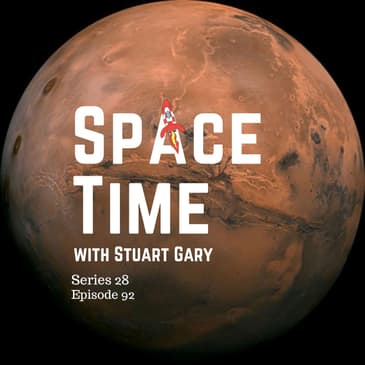



Searching for Life on Mars
A new study reveals that thick layers of clay on Mars could indicate stable environments conducive to life billions of years ago. Researchers have identified that these clay deposits likely formed in standing bodies of water, providing the right conditions for chemical weathering and potentially supporting ancient life. The findings suggest that the balance between water and carbon cycles on Mars may explain the planet's geological history and the absence of carbonate rocks. Lead author Rhianna Moore discusses how these stable terrains could have fostered habitable conditions for extended periods, offering insights into the Red Planet's wet past.
Discovery of 2020 VN40: A Distant Cosmic Companion
Astronomers have discovered a rare celestial body, 2020 VN40, located far beyond Neptune, moving in perfect synchronicity with the ice giant. This trans-Neptunian object orbits the sun once for every ten orbits Neptune completes, providing new insights into the dynamics of the outer solar system. The discovery, reported in the Planetary Science journal, enhances our understanding of how distant objects interact with Neptune's gravity and offers clues about the solar system's evolution.
Mapping Sulfur in the Milky Way
A groundbreaking study has mapped the distribution of sulfur across the Milky Way, an essential element for life. Utilizing the CRISM X-Ray Imaging and Spectroscopy mission, scientists have directly measured sulfur in both its gaseous and solid forms within the interstellar medium. The findings shed light on sulfur's role in the cosmos and its potential implications for understanding life's distribution throughout the galaxy. This research marks a significant step in answering fundamental questions about the building blocks of life in the universe.
www.spacetimewithstuartgary.com
✍️ Episode References
Nature Astronomy
https://www.nature.com/natureastronomy/
Planetary Science Journal
https://iopscience.iop.org/journal/2632-3338
CRISM Mission
https://www.nasa.gov/mission_pages/asteroids/overview/crism.html
Become a supporter of this podcast: https://www.spreaker.com/podcast/spacetime-space-astronomy--2458531/support.
00:00:00
This is Space Time, Series 28, Episode 92, for broadcast on the
00:00:04
1st of August 2025.
00:00:07
Coming up on Space Time, searching for life's home on
00:00:10
Mars.
00:00:11
A rare distant object in the outskirts of the solar system
00:00:15
found in perfect synchronicity with the ice giant Neptune, and
00:00:19
mapping sulfur, essential for life as we know it, throughout
00:00:22
the Milky Way galaxy.
00:00:24
All that and more coming up on Space Time.
00:00:28
Welcome. To Space Time with Stuart Gary.
00:00:47
A new study has been looking at thick layers of clay on the
00:00:50
surface of the Red Planet Mars, which would have been a stable
00:00:52
place for life on this ancient world had it ever existed there.
00:00:57
Mars is home to thick layers of clay that can span hundreds of
00:01:00
meters.
00:01:01
Since they need water to form, these outcrops have long been of
00:01:05
interest to scientists looking for signs of past life on the
00:01:08
Red Planet.
00:01:09
Now, a report in the journal Nature Astronomy has taken a
00:01:11
closer look at some of these clay terrains, and they've found
00:01:15
that most form these standing bodies of surface water which
00:01:18
were common on Mars billions of years ago.
00:01:21
This environment would have fostered the chemical weathering
00:01:24
needed to create thick mineral-rich layers of clay, and
00:01:27
could have provided the right mixture of water, minerals and a
00:01:29
calm environment for life to develop.
00:01:32
The study's lead author, Rhianna Moore from the University Of
00:01:35
Texas, says these areas had a lot of water but not a lot of
00:01:39
topographic uplift, so they were very stable. And if you have a
00:01:42
stable terrain, you're not messing up your potentially
00:01:45
habitable environment.
00:01:47
Favorable conditions might be more able to be sustained for
00:01:50
longer periods of time.
00:01:52
Moore and colleagues also found that these thick clay layers may
00:01:55
also have been a sign of an imbalanced water and carbon
00:01:58
cycle on ancient Mars.
00:02:00
And that would explain why the Red Planet appears to be missing
00:02:03
carbonate rocks in environments where they would normally be
00:02:06
expected to be found on Earth.
00:02:08
Billions of years ago, Mars was a warm, wet world, with lakes
00:02:12
and rivers and even an ocean.
00:02:15
These created geological formations that are carved onto
00:02:17
the surface of the planet today, and the thick clay layers formed
00:02:22
during this wet period.
00:02:24
However, before this study, little was known about the
00:02:26
environments in which they formed, and how the surrounding
00:02:29
terrain would have influenced their evolution.
00:02:31
Moore and colleagues analyzed images and data from 150 clay
00:02:35
deposits that had previously been analyzed using a global
00:02:38
survey conducted by NASA's Mars Reconnaissance Orbiter.
00:02:41
The authors identified trends in the topographical
00:02:44
characteristics and how close they were to other geological
00:02:47
features, such as former bodies of water.
00:02:50
They found the clays were mostly located at low elevations, elect
00:02:54
deposits. But away from valley networks where water was thought
00:02:57
to have been flowing more vigorously across the terrain.
00:03:00
This balance between chemical and physical weathering led to
00:03:03
their preservation through time.
00:03:05
The Martian clay environment is similar to tropical places with
00:03:09
thick clay layers found here on Earth.
00:03:11
On Earth, the places where we tend to see the thickest clay
00:03:14
mineral sequences are in humid environments, and those with
00:03:18
minimal physical erosion that can strip away newly created
00:03:21
weathering products.
00:03:23
The results suggest that the latter element is also true on
00:03:25
Mars, while there are hints of the former as well.
00:03:28
However, the clays also reflect an ancient Martian world that
00:03:32
was very different from the Earth of today.
00:03:35
On Earth, shifting tectonic plates are consistently exposing
00:03:38
fresh rock that can steadily react with water and carbon
00:03:41
dioxide in the atmosphere, which helps regulate the climate.
00:03:45
However, Mars lacks tectonic activity.
00:03:47
When Martian volcanoes released carbon dioxide into the
00:03:50
atmosphere, the lack of a source for new reactive rock would have
00:03:53
led the greenhouse gases to linger, causing the planet to
00:03:55
become warmer and wetter.
00:03:57
The authors suggest that these conditions may have contributed
00:04:00
to the formation of the clays, and the lack of new rock on the
00:04:03
surface may well have impeded the chemical reactions needed to
00:04:07
form new carbonate rocks that would normally form from
00:04:09
volcanic rock that underlies most Martian geology given
00:04:12
carbon dioxide, water and time.
00:04:15
Ongoing clay formation on Mars may well have contributed to the
00:04:19
dearth of carbonates there by sucking up water and
00:04:22
sequestering chemical byproducts in the clay, rather than having
00:04:26
them leach out into the wider environment where they could
00:04:28
react with the surrounding geology.
00:04:31
This is space-time.
00:04:33
Still to come, a rare distant body in the outer solar system
00:04:37
found in perfect synchronicity with the planet Neptune, and a
00:04:40
new study mapping the Milky Way 's sulfur distribution.
00:04:44
Sofa. Being one of the essential elements for life.
00:04:47
All that and more still to come on Space Time.
00:05:05
Astronomers have discovered a rare celestial body in the far
00:05:09
outer reaches of our solar system, well beyond the orbit of
00:05:11
Neptune, which appears to be moving in synchronicity with the
00:05:15
ice giant.
00:05:16
The object, catalogued as 2020 VN40, belongs to a class of
00:05:20
celestial bodies known as trans-Neptunian objects.
00:05:24
And it's the first confirmed body that orbits the Sun once
00:05:27
for every 10 orbits Neptune completes.
00:05:30
The discovery, reported in the Planetary Science Journal, will
00:05:32
help astronomers better understand how objects in the
00:05:35
outer solar system behave and how they got there.
00:05:38
It supports the idea that many distant objects are temporarily
00:05:42
caught in Neptune's gravity as they drift through space.
00:05:45
The study's lead author, Rosemary Pike, says this
00:05:48
discovery is a huge step forward in understanding the outer solar
00:05:51
system.
00:05:52
It shows that even very distant regions influenced by Neptune
00:05:55
can contain objects and provides new clues about how the solar
00:05:59
system evolved.
00:06:01
The discovery was made by the LIDO, Large Inclination Distant
00:06:04
Object Survey, which looks for unusual objects in the outer
00:06:07
solar system using the Canada-France-Hawaii Telescope.
00:06:11
The survey was designed to search for bodies with orbits
00:06:13
that extend far above and below the ecliptic. That's the plane
00:06:16
where Earth and most other planets orbit around the Sun.
00:06:19
The LIDO survey has already found more than 140 distant
00:06:22
objects.
00:06:24
It's all part of the outer solar system that hasn't yet been well
00:06:27
studied.
00:06:28
2020 VN40's average distance is about 140 times further out from
00:06:32
the Sun than the Earth, and it follows a very tilted orbit
00:06:36
around the solar system.
00:06:37
What makes the object even more interesting is how it moves
00:06:40
compared to Neptune.
00:06:42
Most objects with a simple ratio of the duration of their orbit
00:06:45
compared to the duration of Neptune's orbit, what's known as
00:06:48
a resonance, always come closest to the Sun when Neptune's
00:06:51
furthest away.
00:06:53
In contrast, 2020 VN40 comes closest to the Sun where Neptune
00:06:57
's also very close by. That's if you look at their positions from
00:07:00
above the solar system.
00:07:02
See, the tilt of 2020 VN40's orbit means that the objects
00:07:05
aren't actually that close because 2020 VN40's actually far
00:07:09
below the solar system's plane.
00:07:11
They only appear that close when you flatten out the map.
00:07:14
All other known resonant trans-Neptunian objects orbit in
00:07:17
such a way as to avoid this alignment at the closest
00:07:20
approach to the Sun, even in the flattened view.
00:07:23
The findings suggest that these highly tilted orbits can lead to
00:07:26
new and unexpected types of motion.
00:07:29
And that could mean new discoveries.
00:07:32
Maybe even a Planet 9.
00:07:34
This is Space Time.
00:07:36
Still to come, mapping the Milky Way's sulfur distribution, the
00:07:40
red supergiant Antares, the second nearest star system to
00:07:44
the Sun Barnard star, and the annual Perseids meteor shower
00:07:47
are among the highlights of the August night skies on Skywatch.
00:08:06
A new study has provided astronomers with an
00:08:08
unprecedented tally of elemental sulfur spread between stars in
00:08:12
the Milky Way galaxy.
00:08:14
Sulfur is important for how cells function in living
00:08:17
creatures here on Earth. So, understanding its distribution
00:08:20
on an interstellar scale is important for understanding how
00:08:23
widespread life could be.
00:08:26
One of the study's authors, Leo Corrales from the University Of
00:08:28
Michigan in Ann Arbor, says science still has a lot of
00:08:31
questions about where sulfur is found in the universe.
00:08:34
Sulfur can easily change from a gas to a solid and back again.
00:08:39
To try and answer this puzzle, scientists have turned to the
00:08:41
joint NASA and JAXA, that's Japanese Aerospace Exploration
00:08:45
Agency, CRISM X-Ray Imaging and Spectroscopy Mission spacecraft.
00:08:49
It provides the resolution and sensitivity needed to find
00:08:52
sulfur in both its solid and gaseous forms, and to learn more
00:08:56
about where it might be hiding.
00:08:58
Astronomers used X-Rays from two binary star systems to detect
00:09:02
sulfur in the interstellar medium. That's the gas and dust
00:09:05
found in the space between stars.
00:09:08
It's the first direct measurement of both sulfur's gas
00:09:10
and solid phases, a unique capability of X-ray
00:09:13
spectroscopy, which is CRISM's primary method of studying the
00:09:16
cosmos.
00:09:18
The findings, reported in the publications of the Astronomical
00:09:20
Society Of Japan, used ultraviolet light to find
00:09:23
gaseous sulfur in the space between stars.
00:09:27
In the denser parts of the interstellar medium, such as
00:09:29
molecular gas and dust clouds where stars and planets are
00:09:32
born, this form of sulphur quickly disappears.
00:09:35
Scientists have always assumed that sulphur condenses into a
00:09:38
solid either by combining with ices or mixing with other
00:09:41
elements.
00:09:42
When a doctor performs an X-ray here on Earth, they place the
00:09:45
patient between the X-ray source and the detector.
00:09:48
Burns and tissue absorb different amounts of X-ray light
00:09:51
as it travels through the patient's body, creating a
00:09:54
contrast in the detector.
00:09:56
To study sulfur, Corellius and colleagues did something
00:09:59
similar.
00:09:59
They picked a portion of the interstellar medium with the
00:10:01
right density, not too thin so that all the X-Rays would pass
00:10:04
right through unchanged, but also not so dense that they'd
00:10:07
all be absorbed.
00:10:09
They then selected a bright X-ray source behind that section
00:10:11
of the medium, a binary star system called GX340 plus zero.
00:10:16
It's located some 35 light-years away in the southern
00:10:19
constellation Scorpius.
00:10:21
Using the RESOLVE instrument on CRISM, the authors were able to
00:10:24
measure the energy of the star system's X-Rays and determined
00:10:27
that sulfur was present not only as a gas, but also as a solid,
00:10:30
possibly mixed with iron.
00:10:32
Chemistry and environments like the interstellar medium are very
00:10:36
different from anything seen on Earth. But Karelis and
00:10:38
colleagues modeled sulfur combined with iron and it seemed
00:10:41
to match what they actually saw with CRISM.
00:10:44
Ion-sulfur compounds are often found in meteorites, so
00:10:47
scientists have long thought they might be one way sulfur
00:10:50
solidifies out of molecular gas and dust clouds that travel
00:10:53
through the universe.
00:10:54
The authors were also able to use measurements from a second
00:10:57
X-ray binary catalogued as 4U1630-472 to help confirm their
00:11:03
findings.
00:11:04
NASA's Chandra X-Ray Observatory had previously studied sulfur,
00:11:07
but CRISPR's measurements are far more detailed.
00:11:11
Since GX340 plus zero is on the other side of the galaxy from
00:11:14
Earth, CRISM's X-ray observations have provided a
00:11:17
unique probe of sulfur across a large section of the Milky Way.
00:11:21
This report from NASA TV.
00:11:24
Sulfur.
00:11:25
It's the fifth most common element on Earth.
00:11:28
It also helped make our early world habitable and allows life
00:11:32
to function now.
00:11:34
But scientists have a lot of questions about where it hides
00:11:37
in interstellar space.
00:11:39
Using the CRISM satellite, astronomers have now x-rayed our
00:11:43
galaxy's sulfur in unprecedented detail.
00:11:47
Out in the vastness of space is the interstellar medium, the gas
00:11:51
and dust between the stars.
00:11:54
Scientists see lots of sulfur as gas in molecular clouds, cold,
00:11:59
dense patches of the medium where stars and planets are
00:12:01
born.
00:12:02
But this type of sulfur tends to disappear quickly.
00:12:05
Where does it go?
00:12:07
To find out, scientists picked a region of gas and dust that
00:12:11
wasn't too thin or too thick.
00:12:14
Then they picked a bright X-ray source behind the patch so that
00:12:18
the light would pass through it on its way to CRISM. This is
00:12:21
like getting an X-ray here on Earth, but instead of the light
00:12:23
being absorbed by tissue and bone, it's absorbed by different
00:12:27
elements, like sulfur.
00:12:29
CRISM showed scientists that sulfur in the interstellar
00:12:31
medium can be found as both a gas and as a solid, and possibly
00:12:35
mixed with iron.
00:12:36
This aligns with studies of meteorites and may help explain
00:12:40
how sulfur moves through the cosmos.
00:12:42
It's also the first direct measurement of sulfur in both
00:12:45
solid and gas phases. Thanks to CRISM, we're a step closer to
00:12:49
understanding how life on our planet came to be.
00:12:52
This is Space Time.
00:13:11
And time now to turn our eyes to the skies and check out the
00:13:14
celestial sphere for August on Skywatch.
00:13:17
August is the 8th month of the year in the Julian and Gregorian
00:13:20
calendars.
00:13:21
It was originally named Sextilis in Latin because it was the 6th
00:13:25
month of the original 10-month Roman calendar under Romulus in
00:13:28
753 BCE when the year started in March.
00:13:32
It only became the 8th month when January and February were
00:13:35
added to the start of the year.
00:13:37
In the year 8 BCE, it was renamed in honour of the Roman
00:13:40
statesman and military leader Augustus, who had achieved
00:13:43
several military victories, including the conquest of Egypt
00:13:46
during the month.
00:13:48
Okay, turning to the heavens, and the constellation Scorpius
00:13:51
the Scorpion is high overhead this time of year, covering
00:13:54
almost a third of the August night skies.
00:13:57
At the heart of Scorpius, located some 470 light years
00:14:01
away, is the red supergiant Antares.
00:14:05
A light year is a distance of about 10 trillion kilometers.
00:14:08
The distance a photon can travel in a year at 300 kilometers
00:14:12
per second, the speed of light in a vacuum, and the ultimate
00:14:15
speed limit of the universe.
00:14:17
Red supergiants have the largest diameters of any known star.
00:14:21
They evolve out of main sequence stars with more than eight times
00:14:25
the mass of the Sun.
00:14:26
A main sequence star is a star fusing hydrogen into helium in
00:14:30
its core.
00:14:31
When stars stop fusing hydrogen into helium in their core, the
00:14:35
balancing act between gravity pushing a star's mass down
00:14:38
towards the center and energy from nuclear fusion in the core
00:14:42
pushing outward ceases and gravity wins, causing the star
00:14:46
to begin to collapse inwards, crushing the stellar core until
00:14:49
the increase in pressures and temperatures trigger helium
00:14:52
fusion.
00:14:53
At the same time, a shell of hydrogen around the core begins
00:14:56
to fuse, causing the star's outer gases envelope to expand
00:14:59
out into a bloated giant.
00:15:02
And now, being further away from the core, the stellar surface
00:15:05
starts to cool down, becoming redder in colour.
00:15:08
While Sun-Like stars will become red giants, those that are far
00:15:12
bigger, 8 times or more the mass of the Sun, become red
00:15:15
supergiants.
00:15:17
Supergiants will fuse all their core helium into carbon and
00:15:19
oxygen within just a few million years.
00:15:22
They'll then begin fusing this core carbon and oxygen into
00:15:25
progressively heavier and heavier elements until they
00:15:28
eventually begin to produce iron in their core.
00:15:31
Now, no star, no matter how massive it is, is big enough to
00:15:34
fuse iron into heavier elements.
00:15:36
And so then the star will collapse catastrophically in
00:15:39
what's known as a core collapse supernova, an explosion bright
00:15:43
enough to outshine an entire galaxy.
00:15:46
The end result of this core collapse supernova will be the
00:15:49
creation of either a neutron star or a black hole, depending
00:15:53
on the progenitor star's mass.
00:15:55
The name Antares means rival of Mars, and indeed when they're
00:15:59
close together in the sky, they do look very similar.
00:16:03
Antares, or Alpha Scorpius it's sometimes called, has some 12.4
00:16:07
times the mass and an incredible 450 times the diameter of our
00:16:11
Sun, and is one of the largest known stars in the universe.
00:16:15
Antares is so big that were it placed where the Sun is at the
00:16:18
centre of our solar system, it would engulf all the inner
00:16:21
planets, Mercury, Venus, Earth and Mars.
00:16:24
Its outer surface would reach almost as far as the orbit of
00:16:28
Jupiter.
00:16:29
Antares is a binary system.
00:16:31
There's a companion star orbiting with it called Antares
00:16:34
b, a massive spectrotype b blue-white star at least 7.2
00:16:38
times the mass and 5.2 times the radius of the Sun.
00:16:42
It's located about 224 astronomical units beyond the
00:16:46
primary star.
00:16:47
An astronomical unit is the average distance between the Sun
00:16:50
and the Earth, about 150 million kilometres or 8.3 light minutes.
00:16:56
Astronomers describe stars in terms of spectral types, a
00:17:00
classification system based on temperature and characteristics.
00:17:04
The hottest, most massive and most luminous stars are known as
00:17:07
Spectral Type O blue stars.
00:17:10
They're closely followed by Spectral Type B blue-white
00:17:13
stars, then Spectral Type A white stars, Spectra type F,
00:17:17
whitish yellow stars.
00:17:18
Spectra type G, yellow stars, that's where our Sun fits in.
00:17:22
Spectra type K, orange stars. And the coolest and least
00:17:25
massive of all stars are Spectra type M, red stars, commonly
00:17:30
referred to as red dwarfs.
00:17:32
Now each Spectra classification is further subdivided using a
00:17:35
numeric digit to represent temperature, with zero being the
00:17:39
hottest and nine the coolest. And a Roman numeral to represent
00:17:42
luminosity.
00:17:44
Now put all that together... And our Sun is a spectral type G2V
00:17:48
or G2V yellow dwarf star.
00:17:52
Also included in the stellar classification system are
00:17:55
spectral types LT and Y, which are assigned to failed stars
00:17:59
known as brown dwarfs, some of which were actually born as
00:18:02
spectral type M red dwarf stars, but became brown dwarfs after
00:18:06
losing some of their mass.
00:18:08
Brown dwarfs fit into a category between the largest planets,
00:18:11
which are about 13 times the mass of Jupiter, and the
00:18:14
smallest spectral type M red dwarf stars, which are about 75
00:18:18
to 80 times the mass of Jupiter, or 0.08 solar masses.
00:18:23
Located near Antares is the spectacular globular cluster
00:18:27
Messier 4, or M4 for short.
00:18:30
Named after the 18th century French astronomer and comet
00:18:33
hunter Charles Messier, it's one of a catalogue of 103 fuzzy
00:18:37
objects which weren't comets, and so were of no interest to
00:18:40
Messier, and so he made a list of them. So he didn't waste his
00:18:44
time looking at them.
00:18:45
Other astronomers have since added further celestial objects
00:18:48
to the catalogue, bringing the total to around 110.
00:18:52
Located some 7 light-years away, Messier 4 can be seen
00:18:55
through a pair of binoculars, making it one of the closest
00:18:58
globular clusters to Earth.
00:19:00
Globular clusters are densely packed spheres containing
00:19:03
thousands to millions of gravitationally bound stars,
00:19:06
which it's thought were either originally all born at the same
00:19:09
time in the same stellar nursery, or are the surviving
00:19:12
cores of galaxies that have been cannibalized by larger galaxies.
00:19:17
They're almost always found orbiting the halo of galaxies.
00:19:20
The Milky Way has about 150 of them, and they're all usually
00:19:24
very ancient, some dating back to around 12 billion years.
00:19:28
Located just below the Sting of Scorpius are two open star
00:19:32
clusters, M6 and M7.
00:19:35
M7's the nearer of the two, located about 800 light years
00:19:38
away. While M6 is a more distant 2000 light years.
00:19:42
Open clusters are less densely packed than their globular
00:19:45
cluster counterparts, with the stars inside them less
00:19:48
gravitationally bound and more prone to drifting away over
00:19:51
time.
00:19:52
Another open star cluster in Scorpius is NGC 6231, located
00:19:57
about 6 light-years away, just near the star Zeta Scorpii.
00:20:01
NGC 6231 is a bright open star cluster containing around 120
00:20:07
stars, including a significant population of highly luminous
00:20:11
supergiants, numerous white-yellow stars, and at least
00:20:15
two Wolf-Rayet stars.
00:20:17
Wolf-Rayets are extremely luminous evolved stars reaching
00:20:20
the ends of their lives.
00:20:22
Having run out of hydrogen for core fusion, they're no longer
00:20:26
on the main sequence and are instead fusing progressively
00:20:29
heavier and heavier elements in their cores.
00:20:32
This causes them to have surface temperatures of up to 200
00:20:35
degrees Celsius, and such extreme temperatures generate
00:20:38
powerful stellar winds.
00:20:41
Just behind Scorpius is the constellation Sagittarius, the
00:20:45
half-man, half-horse of Greek mythology.
00:20:48
And as we mentioned in last month's Skywatch, The centre of
00:20:50
the Milky Way galaxy is found in Sagittarius, roughly 27
00:20:55
light-years away.
00:20:56
The name Sagittarius can be traced back beyond the Greeks to
00:20:59
the ancient Mesopotamian archer god Nurgle.
00:21:02
Sagittarius is known for its many nebulae and clusters, more
00:21:05
than any other constellation.
00:21:07
One of the largest and brightest is the globular cluster M22, big
00:21:12
enough to be visible to the unaided eye.
00:21:14
Located about 10 light-years away near the galactic bulge,
00:21:19
M22 is more elliptical than most globular clusters.
00:21:22
It's located just south of the ecliptic, the plane in the sky
00:21:26
upon which all the planets orbit the Sun.
00:21:28
And it contains over 70 stars, covering an area of
00:21:33
around 100 light-years.
00:21:35
It also contains at least two black holes, and is one of only
00:21:38
a handful of globular clusters known to contain planetary
00:21:41
nebulae, the puffed-off outer gases envelopes of dead Sun-Like
00:21:45
stars.
00:21:47
Located in the sky next to Scorpius in the west and
00:21:50
Sagittarius in the east is the constellation Ophiuchus, the
00:21:53
healer or serpent bearer, often portrayed as a snake coiled
00:21:57
around a man.
00:21:58
In Greek mythology, Ophiuchus raises Orion from the dead after
00:22:02
he was bitten by Scorpius.
00:22:04
Ophiuchus contains several star clusters and other interesting
00:22:07
features, including Barnard's Star.
00:22:10
Barnard's Star is the second nearest star system to the Sun,
00:22:14
beaten only by the Alpha Centauri Triple Star system.
00:22:17
Located some 5.9 light-years away, Barnard's Star is a
00:22:21
spectral type M red dwarf, about 0 times the mass of the Sun.
00:22:27
Our Sun is around 4.6 billion years old.
00:22:30
At between 7 and 12 billion years of age, Barnard's Star is
00:22:34
considerably older than the Sun and may be among the oldest
00:22:37
stars in the Milky Way galaxy.
00:22:40
It's lost a great deal of rotational energy and it's...
00:22:43
Periodic slight changes in brightness indicate that it's
00:22:46
rotating about once every 130 days.
00:22:49
By comparison, our Sun rotates roughly once every 29 days.
00:22:54
Given its age, Barnard's Star was long assumed to be quiescent
00:22:57
in terms of stellar activity.
00:23:00
But in 1998, astronomers observed an intense stellar
00:23:03
flare, indicating that Barnard's Star is indeed a flare star.
00:23:07
Flare stars are variable stars. They can undergo unpredictable
00:23:11
dramatic increases in brightness lasting a few minutes.
00:23:15
It's believed that the flares of flare stars are analogous to
00:23:18
solar flares in the Sun, in that they're generated by stellar
00:23:21
magnetic energy stored in the star's atmosphere.
00:23:25
Lying just to the west of the Scorpion is the constellation
00:23:28
Libra the Scales.
00:23:30
In Greek mythology, Libra represents the claws of Scorpius
00:23:33
the Scorpion.
00:23:34
However, the Romans considered Libra a distinct separate
00:23:37
constellation from Scorpius. And thought them to be the scales
00:23:41
symbolizing the equinoxes, the times of the year in March and
00:23:44
September when the Earth gets equal lengths of day and night.
00:23:48
That's because 2000 years ago when all this was made up, the
00:23:51
Sun moved into Libra at the time of the September equinox.
00:23:54
But due to precession as the Earth's spin axis wobbles in
00:23:57
direction, this point in time has now moved into the adjoining
00:24:00
constellation of Virgo.
00:24:03
If you look to the south on the Southern Cross, that's the
00:24:05
constellation Centaurus. Another half-man, half-horse mythical
00:24:09
beast.
00:24:10
Centaurus was the teacher of many of the Greek gods and
00:24:13
heroes.
00:24:15
He was placed among the stars in the heavens after accidentally
00:24:18
being killed by a poisoned arrow fired by Hercules.
00:24:22
Close to the pointer star nearest the Southern Cross, Beta
00:24:25
Centauri, lies NGC 5139 Omega Centauri, the largest and
00:24:30
brightest globular cluster in the visible sky.
00:24:34
Because of its brightness, The ancient Greek mathematician and
00:24:37
astronomer Claudius Ptolemy originally thought Omega
00:24:40
Centauri was a star.
00:24:42
It has a diameter of more than 150 light-years and contains an
00:24:46
estimated 10 million stars, giving it some 4 million times
00:24:50
the mass of our Sun.
00:24:52
Located some 15 light years away, Omega Centauri is another
00:24:57
very ancient globular cluster, around 12 billion years old.
00:25:01
And it contains many so-called Population II stars.
00:25:05
These are the second generation of stars to have formed, and
00:25:08
were created directly out of the remains of the very first stars
00:25:12
in the universe.
00:25:13
Stars in the core of Omega Centauri are so crowded, they're
00:25:16
estimated to average only 0.1 light years away from each
00:25:20
other.
00:25:20
And that can compares to the nearest star to our Sun, Proxima
00:25:23
Centauri, which is some 4.2 light years distant.
00:25:27
Located close to Omega Centauri in the sky is the giant
00:25:31
lenticular galaxy NGC 5128 Centaurus A, which we see
00:25:37
looking like it's split in half by a thick band of dust.
00:25:40
The galaxy was discovered in 1826 by astronomer James Dunlop
00:25:45
from his home in what is now the Sydney suburb of Parramatta. A
00:25:48
time long before the bright lights of a modern city would
00:25:51
make such a discovery impossible.
00:25:54
Located some 13 million light-years away, Centaurus A is
00:25:57
one of the strongest radio sources in the sky and is
00:26:01
thought to be the result of a merger between an elliptical and
00:26:04
a spiral galaxy.
00:26:06
It can be easily seen using a pair of binoculars, but you'll
00:26:09
need a telescope to make out its spectacular dust lanes.
00:26:13
August is also the time of the peak of the annual Perseids
00:26:16
meteor shower.
00:26:18
The meteors are the debris trail ejected by the comet
00:26:21
Swift-Tuttle as it travels along its 133-year orbit through the
00:26:25
solar system.
00:26:27
As its name suggests, the Perseids Radiant, that is the
00:26:30
point in the sky from which the meteors appear to originate,
00:26:33
lies in the constellation of Perseus.
00:26:35
The Perseids are one of the oldest known meteor showers,
00:26:38
with early Chinese historical records of its activity going
00:26:41
back almost 2 years.
00:26:44
They're active between July 17 and August 24. With a peak on
00:26:48
August 12th with around 60 meteors an hour being visible.
00:26:52
The Perseids are very bright and fast-moving meteors, travelling
00:26:56
at speeds of 59 kilometres per second.
00:26:59
They're best seen between midnight and just before dawn,
00:27:02
producing long, bright trails and some fireballs.
00:27:06
Most Perseids burn up in the atmosphere at altitudes of over
00:27:09
80 kilometres.
00:27:11
They're best seen from the northern hemisphere, so for
00:27:13
southern hemisphere skywatchers, look to the north with a
00:27:16
radiant... Below the northern horizon.
00:27:19
Turning to the planets now, and six planets, Mercury, Jupiter,
00:27:22
Venus, Uranus, Neptune and Saturn will all align in the
00:27:26
morning sky on August 9th, with Mercury, Jupiter, Venus and
00:27:30
Saturn visible with the unaided eye.
00:27:32
Meanwhile, Venus will be close to Jupiter and visible in the
00:27:35
constellation Gemini on August 12th, while Saturn will appear
00:27:39
to be close to the Moon on the same night.
00:27:41
By August 19th, Mercury will appear at its furthest apparent
00:27:44
distance west of the Sun, which is known as greatest elongation,
00:27:48
and Jupiter will have replaced Saturn as appearing nearest to
00:27:50
the Moon.
00:27:51
The following night, Venus will appear nearest the Moon, while
00:27:54
Mercury will appear nearest the Moon on the 21st, and the new
00:27:58
Moon will occur on August the 23rd.
00:28:01
Finally, on August the 26th, the Moon will appear close to Mars,
00:28:05
in the direction of the constellation Virgo.
00:28:08
This is Space Time.
00:28:25
And that's the show for now.
00:28:27
Space Time is available every Monday, Wednesday and Friday
00:28:30
through Apple Podcasts, ITunes, Stitcher, Google Podcasts,
00:28:34
Pocket Casts, Spotify, Acast, Amazon Music, Bytes.Com,
00:28:39
SoundCloud, YouTube, your favorite podcast download
00:28:42
provider and from SpaceTime with StuartGarry.Com.
00:28:47
Space Time is also broadcast through the National Science
00:28:49
Foundation on Science Zone Radio and on both IHeart Radio and
00:28:53
TuneIn Radio.
00:28:55
And you can help to support our show by visiting the Space Time
00:28:58
store for a range of promotional merchandising goodies, or by
00:29:01
becoming a Space Time patron, which gives you access to triple
00:29:05
episode commercial free versions of the show, as well as lots of
00:29:08
bonus audio content which doesn't go to air, access to our
00:29:11
exclusive Facebook group and other rewards.
00:29:15
Just go to spacetimewithstuartgary.com for
00:29:17
full details.
00:29:19
You've been listening to Space Time with Stuart Gary.
00:29:22
This has been another... Quality podcast production from
00:29:25
Bytes.Com.