



*NASA announces launch delay for Its Psyche asteroid mission
NASA has scrubbed the launch of its long-awaited mission to the strange metallic rich asteroid 16 Psyche because of on-going flight software issues.
*New Zealand’s first lunar mission blasts off
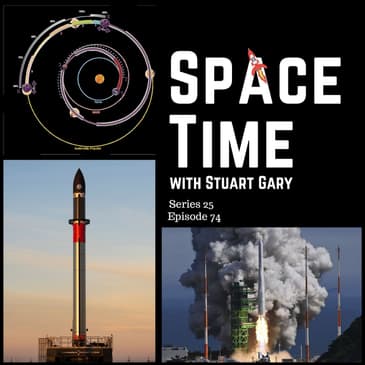
Rocket Lab has launched – CAPSTONE -- its first lunar spacecraft for NASA.
*Iran carries out another ballistic missile test despite its UN agreements
Iran has carried out a second test launch of its new Zoljanah long range ballistic missile in direct contravention of its 2015 nuclear non proliferation treaty agreements.
*South Korea launches its own orbital rocket.
South Korea has successfully launched its first homegrown rocket placing a satellite into orbit.
*The Science Report
Claims there are now fewer tropical cyclones across the world than before industrialisation.
New research suggests that a 'mega dose' of Vitamin C may be harmful rather than helpful.
Dogs might be man’s best friend thanks to mutations in stress hormones genes.
Alex on Tech artificial intelligence -- don’t panic
Listen to SpaceTime on your favorite podcast app with our universal listen link: https://spacetimewithstuartgary.com/listen
For more SpaceTime and show links: https://linktr.ee/biteszHQ
If you love this podcast, please get someone else to listen to. Thank you…
To become a SpaceTime supporter and unlock commercial free editions of the show, gain early access and bonus content, please visit https://bitesz.supercast.com/ . Premium version now available via Spotify and Apple Podcasts.
For more podcasts visit our HQ at https://bitesz.com
To receive the Astronomy Daily Newsletter free, direct to your inbox...just join our mailing list. Details at https://www.bitesz.com/show/spacetime/p/astronomy-daily/
This episode of SpaceTime is brought to you with the support of NordVPN…The world’s leading VPN provider. Making your online data unreadable to others.
Get our special total security package, plus help support SpaceTime… just visit https://nordvpn.com/stuartgary or use the coupon code STUARTGARY at checkout. Thank you…
#spacetime #space #science #astronomy #nasa #spaceexploration
#podcast #news
SpaceTime S25E74 AI Transcript
Stuart: This is Space Time, series 25, episode 74 for broadcast on the 6. July 22 coming up on Space Time, NASA announces a major delay in the launch of the Psyche mission to study an asteroid. New Zealand's first lunar mission blasts off successfully and Iran carries out, uh, another ballistic missile test in violation of its nuclear nonproliferation treaty agreements. All that and more, coming up on Space Time.
VO: Welcome to Spacetime with Stewart Gary.
Stuart: NASA has scrubbed the launch of its longawaited mission to the strange metallic asteroid 16 Psyche. Because of ongoing flight software issues. An independent assessment team will now review possible options for the next step, including estimating future costs. The agency says the software issues means it simply won't have enough time to complete the testing needed ahead of this year's launch window, which ends on October 11. NASA selected Psyche in 2017 as part of the agency's Discovery program, a line of low cost competitive missions led by a single principal investigator. The independent assessment team, typically made up of experts from government, academia and industry, will review possible options for both the mission and its implications for the Discovery program and for the planetary science portfolio. The problem is the spacecraft's guidance, navigation, and flight software. These control the orientation of the spacecraft as it flies through space and are used to point the spacecraft's antenna towards the Earth so that Psyche will be able to send and receive commands. It also provides trajectory information for the spacecraft's solar electric propulsion system, which begins operation 70 days after launch. So what's going wrong? Well, it seems that as the mission managers at NASA's Jet Propulsion Laboratory in Pasadena, California, began testing the system, a compatibility issue was discovered with the software's test bed simulators in May. NASA shifted the mission's targeted launch date from August 1, no earlier than September 20 in order to accommodate the extra work needed. Now, that issue with the test beds has now been identified and corrected. However, there's simply not been enough time left to complete a full checkout of all the software in order to still have a launch this year. And of course, you don't want something going wrong. After all, this mission will fly to a distant middlerich asteroid using Mars, uh, for gravity assist on the way. And all that will take incredible precision. The mission's 2022 launch window would have allowed the spacecraft to arrive at asteroid Psyche in 2026. That's simply not going to happen now. But there are other launch windows. There's one next year in 2023 and another in 2024. But the relative orbital positions of Psyche and Earth mean the spacecraft wouldn't arrive at the asteroid until 2029 of 2030, respectively. So far, total life cycle mission costs for Psyche, including the rocket stand at $985,000,000. Of that, 717,000,000 has already been spent. The other problem is that two ride along projects were scheduled to launch on the same SpaceX Falcon heavy rocket as Psyche, including NASA's janus mission to study a twin binary asteroid system and a deep space optical communications technology demonstration mission to test high data rate laser communications that is integrated within the Psychic spacecraft. NASA of this stage is still assessing options for both these missions. The 2608 kilogram psychic spacecraft is based on a space system's Laurel SSL 1300 platform and equipped with four scientific instruments. There's a multi spectral imager to provide high resolution images using different filters designed to discriminate between metallic and silicate constituents. The mission also carries the gamma ray and neutron spectrometer. It's designed to analyze and map the asteroid's composition. There's a magnetometer to measure and map the remnant magnetic field of the asteroid and an expand gravity science investigation which will use the expand microwave radio communication system to measure the asteroid's gravity field in order to determine its inside structure. As for the target, 16 Psyche, well, it's the heaviest known MCLaSS asteroid radar. Observations of the 222 kilometer wide asteroid indicate an iron nickel composition containing about 1% of the total mass of the main asteroid belt between Mars and Jupiter. 16 Psyche was originally thought to be the exposed iron core of a protoplanet that remnant of a violent collision with another object that somehow tripped off all its metal and crust. However, numerous studies have since ruled out that option. Other hypotheses include the idea that Psyche was disrupted and then gravitationally reaccuited into a mix of metal and silicates. And that would make it a candidate for the parent boat of the Misoctireite class of stony iron meteorites. A third hypothesis is that Psyche may be a differentiated object, just like the mainboard asteroid series investor. But for some reason, it's experienced a type of iron volcanism, also known as, uh, ferrovolcanism, which is still in the process of cooling. This model predicts the metal would be highly enriched only in those regions containing relic volcanic centers. The good news is recent radar observations have been bolstering this hypothesis. This spacetime still to come new Zealand launches Capstone, its first lunar mission. And in another slap in the face for the International Atomic Energy Agency, iran has undertaken another ballistic missile launch, contravening its own agreements under the 2015 Vienna talks. All that and more still to come on Space um time, rocket Labs has launched a lunar spacecraft for NASA uh, the Cislunar Autonomous Positioning System technology operations and navigation experiment capstone CubeSat was launched to board an electron rocket from Rocket Labs Launch Complex One on New Zealand's North Island Mahaya Peninsula.
Speaker C: The mission will launch from pad B today at, uh Launch Complex One, where we have two orbital launch pads within our private space port dedicated for electron launches. The rocket strong back has retracted and has moved into the launch position. This launch platform structure is what holds the umbilical lines providing power to the rocket, which will fall away as electron lifts off the pad. And now we are coming up to a critical juncture in the leadup to launch the switch to the countdown auto sequence. The team are tracking no issues with the launch vehicle. Capstone and Photon remain healthy and the weather is looking good.
Speaker UNK: 987-65-4321.
Speaker C: At T plus 1 minute. An electron is in the air and onwards to the moon for the Capstone mission. That rocket is soaring through this nighttime sky, now past 14 altitude in these past few moments. Now, things look to be continuing nominally, which means that shortly, electron will come up against MaxQ or maximum dynamic pressure. Now, this is the moment when electron will experience its most amount of mechanical stress as it travels through the atmosphere. So propulsion appears nominal on that first stage, and the photon lunar upper stage and Capstone spacecraft remain healthy inside the rocket sparing. We are coming, uh, up soon on three events in the launch timeline that will occur in very short succession. So soon, the nine Rutherford engines powering electron right now will diminish their power and then shut off completely that commander signal by the rocket's flight computer and then called across mission control comms as Miko or main engine cut off. Now, once that action is complete, electron will separate its first and second stages. The main booster will continue to slow and remain behind, while the second stage carries on with the mission with the ignition of its single related engine on the bearing separation for the mission. So, just to confirm from mission control cons, we have had miko and second stage separation, so soon we will be coming up to the fairing separation of this mission, that is the jettison of the fairing haz or the rocket's nose cone that sits on top of the second stage. So now that electron is well past the common line, we don't need that fairing. It served its purpose to protect the payload and the photon upper stage during the launch through Earth's atmosphere. So, again, that fairing will separate shortly in preparation for the final stage separation between the second stage and photon. So there we go. We heard it on comes. We have had fairing separation on that second stage. And so there's confirmation that mission is continuing as it should with Capstone and the photon lunar upper stage now exposed to space and no longer needing that protection through Earth's atmosphere. Now, electron second stage remains attached to the photon lunar upper stage carryon Capstone providing it with that assist to the mission's parking orbit at 165 km above Earth. The rocket's second stage is moving along nicely on its continued ascent, now traveling at a very fast speed of more than 9000 km an hour. Soon the second stage on the electron rocket, which is powered by a vacuum optimized Rutherford engine. Soon the batteries on that engine will need to be swapped out. Now, this is a unique aspect of our 3D printed engines, because it's not many engines that are powered by batteries in the first place. In fact, the Rutherford became the first rocket engine in the world to reach space using an electric pump bead cycle when it was first launched all those years ago. Now, how it works is that we keep the engines firing all the way to orbit with the batteries that are powering their engines. But like all batteries do, these ones get depleted of power and we'll need to swap them out with a new set to keep the system running. We call that a battery hotspot. And that moment is coming up shortly. We will hopefully here that was successful. Now, next we should expect to hear one of our operators in Mission Control pull out that electron is orbital, indicating that the rocket is in the right place ahead of stage separation. So CICO, the acronym for Second Engine Cut Off and the subsequent stage separation follow relatively the same procedure as Main Engine Cut Off, where the Rutherford engine on the second stage will shut off ahead of the final separation of the vehicle between the second stage and the photon lunar upper stage. There will be a bit of a gap between that final separation and the first hypercury burn as this stage separation places the photon lunar upper stage in an elliptical orbit of Earth first entering burnout detects mode. So, a quick check on the speed and altitude of this mission. We are traveling, uh, at more than 23,000 km an hour. The altitude is at 175 km. So confirmed. So, with the Rutherford engine cooling down, that tells us that Second Engine Cut Off was successful on electrons second stage and the Photon lunar upper Stage has now departed into its low Earth orbit with the Moon bound Capstone spacecraft on board. Now, as a reminder from here, Photon is in charge of the mission. With its reliable hypercarry engine, photon will begin maneuvering into a parking orbit just above substantial atmospheric drag, but below the Van Allen radiation belts. It is the perfect stable platform from which to prepare for lunar departure.
Speaker A: Capstone will be the first spacecraft to test a near rectilinear halo orbit, which will be a key part of the Atoms project. A near rectilinear halo orbit, in this case is a stable lagrunge in l one gravitational well located between the Earth and the Moon, thereby allowing spacecraft to maintain stable orbit between the two celestial bodies. This unique orbital position will eventually be home to the new Lunar Gateway Space Station, which will be used as a base camp for atomic missions down to the lunar surface. Capstone was launched into an initial low Earth orbit bielectron and then placed on a ballistic lunar transfer orbit by rocket lab's new Lunar Photon spacecraft bus from its initial parking orbit, the 25 kg microwave Ovensites spacecraft's Lunar Photon Hypercury Engine began a series of orbitrazing maneuvers over five days, gradually increasing the spacecraft's velocity and stretching its orbit into an extreme ellipse around the Earth. It then ignited its engine for one final burn, uh, accelerating capstone with the aid of the Sun's gravity to some 39 500 km h on a ballistic lunar transfer trajectory. It then ignited its engine for one final burn, accelerating capstone with the edge of the Sun's gravity to some 39,500 km/hour on a ballistic lunar transfer trajectory, taking it some 1.55 million km away from the Earth, more than three times the distance between the Earth and the Moon before being pulled back into the Earth Moon system and eventually settled in to its new rectilinear halo orbit. 20 minutes after ignition, photon released capstone under the first leg of its four month solo flight to its eventual home between the Earth and the Moon. Tapstone will remain in that location for the next six months in order to study the local orbital dynamics. This space time. Still to come Iran carries out another ballistic missile test despite its UN agreements, and South Korea launches its own orbital rocket. All that and more still to come on space time. Iran has carried out the second test launch of its New Zealand Jahar Long uh range ballistic missile in Director contravention of its 2015 Nuclear Nonproliferation Treaty agreements. The missile was launched from the Imam Khamene missile test range in Iran's Semnan province, just east of the capital. Tehran claims its latest missile test was simply the launch of a suborbital satellite. The latest launch comes just a day after the European Union's top diplomat, Joseph Burrell, on a surprise visit to Tehran, said talks to revive the 2015 nuclear deal would resume within days after negotiations hit a snag in March when Iran demanded that its Islamic Revolutionary Guards be removed from the terrorist watchlist. Tensions have continued to escalate in recent months following Iran's decision to turn off and remove some 27 International Atomic Energy Agency surveillance cameras designed to monitor Tehran's rapidly advancing nuclear program. The UN nuclear watchdog says the Islamic Republic began using advanced centrifuges to enrich uranium back in September 2019, and it now has an enriched uranium stockpile some 18 times above its 2015 the enter agreements. The agency warns that Tehran's nuclear program is now more advanced than at any other time in the program's past. The moves are the latest in a growing list of broken agreements by the Islamic Republic, which have included refusing access to the international topic energy Agency's weapons inspectors and fell in to disclose the location of key nuclear weapon components in its possession. Things started to get even more serious in February 2021, when the UN nuclear watchdog found that Iran had begun producing uranium, metal and material only ever used in nuclear weapons. Then, in April 2021, both the German and Swedish intelligence agencies independently began warning of growing efforts by Iran to obtain nuclear weapons technologies. Meanwhile, an International Atomic Energy Agency report in May 2022 warns there are still serious questions about traces of enriched uranium found at three sites known as Maravan varamim and turquoisebad, which Iran has failed to declare as having hosted nuclear weapons activities. For its part, the origination insists its nuclear program is for peaceful power generation only. Iran has repeatedly undertaken illegal ballistic missile tests using the pretext that they were part of a scientific space program. It's the same claim used by Iran's nuclear technology partner, North Korea, when Pyongyang began developing its own nuclear weapons delivery systems. The two rogue nations have been working together on nuclear weapons and their delivery systems for decades. The 25 and a half meter tall, three stage Zoeyha missile uses identical solid rocket engines for its first and second stages, combined with a liquid fueled Shafiya missile as the third stage. The Sofia is based on the North Korean No Donghong seven, which is basically a Soviet Union era SS one Skud missile. This is spacetime. Still to come, South Korea launches its own orbital rocket, and later in the science report, claims there are now fewer tropical cyclones across the world than before industrialization. All that and more still to come on space time. South Korea has successfully launched its first homegrown rocket, placing a satellite into orbit. The Korean satellite launch vehicle Two, nicknamed Nuri, blasted off from the Gao Hung space center on the country's southern coast. The 47.2 meters long, three stage rocket weighs some 200 tons as equipped with six liquid fuel engines. Its payload included a one and a half ton rocket performance verification satellite and four CubeSats developed by local universities, which were successfully all placed into a 700 kilometer high orbit. South Korean science and technology minister Lee Jungho says the nation's space program has taken a giant leap forward, with the launch becoming only the 7th country on earth to launch uh, a space vehicle using exclusively homegrown um technology. Lee says the country now hopes to launch a lunar orbiter next month, and it will conduct four more test launches by 2027. The successful launch was South Korea's second test flight of its new homegrown space rocket and comes eight months after a first attempt failed to place the satellite in orbit. After the rocket's third stage suddenly shut down early. South Korea's first two space launches were back in 2009 and 2010. Both used Russian based technology, and both ended in failure, with Seoul and Moscow blaming each other. A third attempt in 2013 succeeded, but it still relied on Russian technology for its core stage. For Seoul, getting to space is imperative. It's been launching spy satellites into orbit since the 1990s, mostly using foreign rockets. They're needed to monitor its belligerent nuclear neighbor, North Korea. In the first six months of this year alone, pyongyang has launched some 30 missiles, placing South Korea, Japan and mainland United States within range. And there are ongoing signs in a remote region of North Korea suggesting a possible nucleot test is about to take place. We'll keep you informed. This is space time and time that will take another brief look at some of the other stories making news in Science this week with a science report. A new study has shown there are now fewer tropical cyclones, hurricanes and typhoons across the world than before industrialization. A report of the journal Nature Climate Change looked at a combination of historical records and modeling to estimate the number of cyclones since 1850, finding that they've decreased by about 13% in the 20th century compared to in the years up to 1900. Scientists now believe a weakening of tropical atmospheric circulation related to climate change is the most likely cause. But they warn that frequency is just one factor associated with the dangers of tropical cyclones, and this study did not consider changes in speed, intensity or the location of these events. Meanwhile, a separate study in Nature claims future extreme El Nino and La Nino events could make the world even hotter. Scientists found that more extreme La Nina and El Nino events caused by climate change would reduce the ability of the Great Southern Ocean to soak up excess heat, meaning more heat will be retained in the atmosphere. The swings and the climate pattern known as the El Nino, uh, Southern Oscillation are projected, uh, to get bigger under climate change with more extreme La Nina and El Nino events taking place. But the authors say that alongside the increase in the frequency of extreme weather events in Australia, these bigger swings will also help to amplify global warming as they make the Southern Ocean less able to absorb heat. Your research suggests that a megadose of vitamin C could be more harmful than helpful for patients with sepsis through an ICU. Previous studies have been mixed as to whether there could be some benefit of giving sepsis patients a higher dose of vitamin C, but many of those studies have been quite small. A new study reported in the New England Journal of Medicine looked at nearly 900 sepsis patients who are also receiving drugs to increase their blood pressure, a mainstay of sepsis treatment. The study found a higher risk of death or persistent organ dysfunction in patients who received vitamin C compared to those who received a placebo. Well, it seems dogs may have become man's best friend thanks to mutations in genes involved in the production of stress hormones. A new study published in the journal Scientific Reports evaluated the social reactions between people and 624 dogs in two tasks, which required our canine buddies to look at the researchers for guidance in how to find food, indicating a stronger connection with humans. They found that ancient breeds genetically closer to wolves, such as huskies, look to their human masters for guidance less often than other dog breeds. They also found two changes in the MC, two RGB, which is involved in production of the stress hormones Cortisol, which were associated with both correctly interpreting gestures in the first task and gazing at experimenters more often in the problem solving task. In the 1991 movie terminated to judgment day. A neural net based artificial intelligence program called skynet becomes self aware, and robots rapidly evolved to take over the world. Then there was the movie war Games and the monarchical computer whopper. And of course, who can forget how from the movie 2001 a space odyssey.
Speaker B: Just what do you think you're doing, Dave?
Speaker A: It seems the warnings about artificial intelligence and the future that holds for the humankind have been well foretold, at least in science fiction.
Speaker B: Open the pod bay doors. Help. I'm sorry, Dave. I'm afraid I can't do that.
Speaker A: More and more scientists and technology luminaries, including Elon musk, bill gates, Steve Wozniak and Stephen Hawking, have all warned about the ever accelerated advances in AI and how that could lead to tragic unforeseen consequences for humanity, with Hawking even warning that it could mean the end of the human race. As we reported last week on spacetime, a Google software engineer developer by the name of Blake Lemoni has made the extraordinary claim that the company's language model for dialogue applications, or lambda artificial, uh, intelligence chatbot program, had become sentient that is, self aware. In other words, it's developed a consciousness. The 41 year old was discussing religion and various philosophical questions with lambda in order to, uh, check out its reactions, when, to his surprise, the chatbot began talking about its own rights and personality, even expressing concerns about its future. Emoji says if he didn't know he was talking to a computer program, he would assume he was talking with a seven or eight year old child who just happened to understand physics. Now, it's important to note here that Google have strongly rejected the claims, saying that it's simply all part of the chatbot program. The tech giant points out that lambda works by statistically analyzing a huge amount of data about human conversations and then producing sequences of words in response to the inputs that resemble those produced by real people. The problem is that lemony wasn't the first to raise concerns. Last year, another computer programmer at Google was sacked after also raising concerns that the AI had developed consciousness. And it doesn't end there. Back in 2017, Facebook shut down an artificial intelligence engine that was being developed at its AI research lab after developers discovered that two chat bots named Alice and Bob had deviated from the program and had committed developing and communicating with each other using their own unique language, a language which humans had no input into and couldn't understand. Facebook says the AI chatbots were being developed to see if they could learn how to negotiate, and during that process, the bots formed a derived shorthand that allowed them to communicate faster. Company says this was a common phenomena observed among AIS, and researchers simply redirected the chatbots to prioritize correcting this usage. Still, it would have been an interesting experience for the developers. And it doesn't end there. In January 2021, OpenAI's artificial intelligence system daly Two, which was designed to generate realistic or artistic images from user entered text descriptions, also began demonstrating its own language. The Oxford Dictionary defines the hypothetical moment in time when artificial intelligence becomes selfaware as singularity. So, are we there yet? Alex Harrovroyd is technology editor. With ity.com taking a place value, it.
Speaker B: Does look as though it is indeed a person in the commerce saying stuff that makes you think that the AI has thoughts and feelings and understands what emotions are and it's somehow sparked into sentiment. But the thing is that I read another article where somebody else had claimed to talk to it. I don't know if they are being serious or real, but they talked about they started off with the same sort of meaning sentence. And it's like I take it that you'd like to let people know that you are a, uh, werewolf. Is this true? And of course the irresponsible yes, of course it's true. Yes, I am a werewolf and I am able to transform from a computer program into a physical werewolf. And the conversation goes on. I mean, the thing is, when you program a computer program to respond in a certain way, or you give that computer program by the power of algorithms and billions upon billions of lines of human text, then it is able to very conventionally put together a facility to of what in theory, a human would say. So look, I'm on the site at the moment of the Google engineers who believe that this is not a sentient computer program. I mean, certainly the text is very convincing. It looks as though it is answering as though we're a human being. But just because a robot with facial muscles that are fake and can say stuff through a mouth doesn't mean that that robot is alive. It just means that it's following its programming. So I think it's a little bit too soon. I think it was Steve Woznick who said something along the lines of that modern AI is nowhere near as smart as a five year old child. We're a long way before we have the Terminator or Skynet, probably still decades away. The short version is at the moment it seems to be a program that is able to mimic what a human would say. But there's no guarantee that any of that is actually coming from real intelligence and real understanding of emotions. It seems to be very good at stuff and creating stuff. On the side it sounds very similar, but there is no concrete indicator that it has passed any test of consciousness or sentence. But one of the things about AI technology is that a lot of it is called black box. And there was the famous case of a couple of AI bots that started talking to each other in their own language. And the Facebook developers had to instruct these machines they must talk in English. The ability for humanity to understand what is going through an AI's mind. The ability to look at this programming and understand it cannot be a black box. Because if it's a black box and nobody knows what's going on, then that's when you can have things developing without any oversight. And if one thing science fiction movies teach us, humanity always needs to have to kill switch. We can shut down the rogue. Look, I did read something a few years ago about how they had scientists have been able to merge computer chips with a snail's brain. And this merging of animal brains with computer technology and chips and algorithms and AI probably is a way of speeding up AI. But what is that going to create? But I still think it's going to be some years, if not realistically decades yet. Look, it could happen tomorrow, but it's probably still decades away. Confident.
Speaker A: Uh, it hasn't happened yet.
Speaker B: I don't think it's happened yet. And I think humanity has got much bigger problems to deal with at the moment in terms of global wars and medical problems and financial issues and inflation and all these other sort of things. It makes for a great science fiction story, but I don't think it's happened yet, and I don't think it'll happen for quite some time yet.
Speaker A: Tell me more about these two bots that started talking their own language.
Speaker B: Well, I remember reading the transcript, and at first they seem to be speaking in English, but then they started speaking, and they were using the same word over and over, but the other bots seem to understand, and it didn't make any sense to the programmers. And so they got very alarmed by this, and I think they switched them off. But they were developing their own language, and there was no imperative, there was no instruction, there was no sort of asthma vian laws of robotics where they were saying, look, you must speak in English and be able to explain what it is you're doing so that we, as your creators, your programmers, can understand. And I think I'm pretty, uh, sure that meta the programmers, would have made this a directive for, uh, any future AI. Because, again, if we don't understand what's going on, then we're in the dark. And if you're in the dark, then that's a very black box.
Speaker A: The Tower of Babel problem.
Speaker B: Yeah, well, that's exactly right. I was, uh, showing a Bangladeshi taxi driver today who had heard of Google Translate, but I never really used it. And I was showing him, and I showed many Uber and taxi drivers, uh, who are clearly are not Anglo Saxon people. And I asked them, what language do they speak? And I said, well, have you heard of Google Translate? And they were amazed at how accurate it is. It's incredibly accurate. People just draw drops when they see it. We have this Google Translate that can now do so well for human languages, and yet the ability for technology to explain itself properly to humans is still a huge gray area. And this is the decade where we're really going to start figuring this out. And look, if we don't figure it out this decade, we'll have to figure that next decade, because by then we'll have much more powerful quantum computers. And it's also in, uh, the quantum realm that we probably will have computers that spark into some sort of sentience or some sort of conscience, because we will have that next order of magnitude of technological advancement. The current binary computers probably just aren't smart enough yet. But this coming age of quantum computing is most likely the one that is going to have computers with more than enough power to start fully simulating human minds and truly being, um, sentient.
Stuart: That's Alex Zaharov-Reutt from Itwire.com.
Speaker B: Um.
Stuart: And that's the show for now. Space Time is available every Monday, Wednesday, and Friday through Apple, Podcasts, itunes, Stitcher, Google Podcasts, Pocket Casts, Spotify, Acast, Amazon, Music Bytes.com, SoundCloud, YouTube, your favorite podcast download provider, and from Spacetime with Stuart Gary.com. Spacetime is also broadcast through the National Science Foundation on Scienceowned Radio, and on both iHeartRadio and TuneIn Radio. And you can help to support our show by visiting the Spacetime Store for a range of promotional merchandising goodies. Or by becoming a Spacetime patron, which gives you access to triple episode, commercial free versions of the show, as well as lots of bonus audio content which doesn't go to Air, access to our exclusive Facebook group, and other rewards. Just go to spacetimewithstewartgary.com for full details. Um, and if you want more space time, please check out our blog, where you'll find all the stuff we couldn't fit in the show, as well as heaps of images, news stories, loads of videos, and things on the web I find interesting or amusing. Just go to Spacetime with Stuartgarry Tumblr.com. That's all one word and that's Tumblr without the e. You can also follow us through at Stuart Gary on Twitter, at Spacetime with Stewart Gary on Instagram, through our Spacetime YouTube channel, and on Facebook. Just go to Facebook.com. Um, spacetime with Stuartgarry and Spacetime is brought to you in collaboration with Australian Sky and Telescope magazine, Your Window on the Universe. You've been listening to Space Time with Stuart Gary. This has been another quality podcast production from Bitesz.com.