



🌏 Get Our Exclusive NordVPN deal here ➼ www.bitesz.com/nordvpn . The discounts and bonuses are incredible! And it’s risk-free with Nord’s 30-day money-back guarantee! ✌ If you’d like to support the podcast and gain access to bonus content by becoming a SpaceTime crew member, you can do just that through premium versions on Patreon, Spotify and Apple Podcasts. Details on the Support page on our website https://www.bitesz.com/show/spacetime/support/ For more SpaceTime and show links: https://linktr.ee/biteszHQ If you love this podcast, please get someone else to listen to. Thank you…
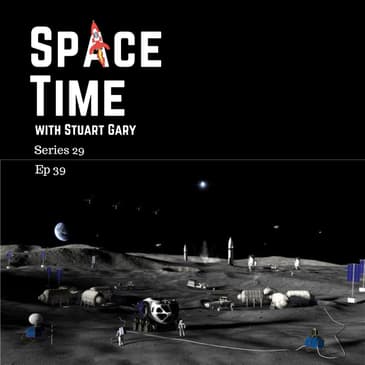
This is Spacetime Series twenty nine, Episode thirty nine, for broadcast on the first of April twenty twenty six. Coming up on Spacetime, we continue our special report on NASA's new Moon based program, extending the life of the International Space Station, and confirmation that a nuclear powered spacecraft will fly to Mars in twenty twenty eight. All that and more coming up on space Time. Welcome to space Time with Stuart Gary. And we begin tonight at show with the second part of our special report looking at NASA's decision to pause construction of the Lunar Gateway space station project in favor of accelerating plans to build a permanent base at the Luna South Pole. As we report earlier, forget what you've heard until now. NASA's wiped the board and they're study from scratch. The agency's bypassing, at least for now, plans to build its Lunar Gateway space station in near rectilinear halo orbit around the Moon, instead opting to fly directly to the lunar surface, or at least to low lunar orbit for rendezvous with transfer vehicles, which will then shuttle crew and supplies down to the surface. A new plan named Ignition was authorized by United States President Donald Trump's One Big, Beautiful Bill Act and is designed to achieve the White House's National Space Policy with the aim of establishing a permanent human presence on the Moon. The seven year, twenty plus billion dollar project will see Willover's sixty spacecraft sent to the Moon, deploying rovers, equipment, habitat modules, and of course people. Phase one of the Ignition plan will see regular commercial lunar payload services or CLIP deliveries to the Moon. A Lunar Terrain vehicle or LTV program will see regular supplies of ROW instruments and technology demonstrators sent to the Moon. They'll test mobility power generation, including both isotope heaters and thermoelectric generators, as well as communications and navigation systems, and the commencement of science surface operations. That'll be followed by phase two of the program, which will see construction of permanent, habitable infrastructure on the lunar surface with regular visits by crew. Included in this part of the project will be a pressurized lunar rover built by the Japanese Aerospace Expiration Agency. Phase three will see the arrival of SpaceX's cargo capable HLS Starship, which will deliver heavier infrastructure needed for continuous human habitation on the Moon, making the transition from periodic expeditions to a permanent lunar base. This will also include the Italian Space Agency's multipurpose habitats and the Canadian Space Agency's Lunar Utility Vehicle. Carlos Garcia Garleen is the Project executive in charge of NASA's Moonbase project. National space policy prioritizing sending astronauts back to the lunar surface and also building. An outpost on the Moon. When we evaluated the current Gayway architecture, which is focused on building an orbiting outpost, while that is still relevant for future exploration goals, is not required to accomplish our primary objectives. As a result, we're. Announcing today that NASA is pivoting the Gayway architecture to focus. On building the Moon base. There were other considerations that we assessed when making this decision, for example, the HLS providers and the performance penalties that were incurring in trying to get to the orbit that we had selected for Gayway, and some other challenges that are still ahead of us with developing the modules and putting them in orbit. For example, right now we are projecting to achieve the first initial capability in twenty thirties. Many facilities that we were using are already We're already designed for an evolving architecture with the orbiting outpost, so those will be easy to transition. For example, our laboratories that we were going to use for integration test verifications, we're going to be transitioning those. Also, we have significant amount of hardware in a band state, like the power and propulsion element. We're going to transition that to meet one of our near term objectives. In addition the habitation and logistic outpost module, which has also been built here in the United States, there's many subsystems and components that potentially we could use in other habitation modules for the Moon based. President Trump's vision for space exploration requires that we establish the initial elements of a lunar outpost by twenty thirty. We're going to have to deploy systems in very high catens that will survive extremes in temperature, illumination, and very complex and rugged terrain with very steep slopes. Phase one is all about getting too the Moon. Reliably learning how to get there in high kins, deploying assets in different areas of the Moon where we think we may want to build this moon base. We're going to experiment with new tech knowlogies that we know we're going to need for future infrastructure development to support that permanent habitation, and we're going to actually start the infrastructure in this phase that goes from now to twenty twenty eight. That infrastructure is going to start with constellations of communication satellites that can also do observation. Transition into Phase two, which we estimate will start around twenty twenty nine, we're going to think about establishing the infrastructure. So we've tested some new technologies, we're transitioning to actually establishing and laying out what we think are permanent elements of that infrastructure. It includes power, surface communications, surface preparation. And mobility. And then once that's said, we're going to transition into achieving semi permanent and permanent crew presence on the Moon base. So that is going to include habitation modules and everything we need to keep the crews alive and enable them to do groundbreaking signs and exploration on the surface of the Moon. Phase one. These are the top down objectives to establish the type so things we're going to need in the missions that are going to talk about. We want to achieve high rate reliable surface access talked about that establish the ground truth for the Moon based landing sites. We have a ton of data from satellites, a little bit of data from rovers and other pros and landers we've sent, but there's nothing like going there and experiencing that environment that I was talking about. I'm prospecting and looking around, So we need to do that in phase one with a high rate of assets. We also need to test and experiments on the technologies that we think we're going to need. They're not a nice to have, they're a mass have. We got to make sure that we understand how those. Are going to work in that environment. And we're going to host the first screwed mission to the South Pole in this phase. We're investing significantly and projecting about twenty five lunches twenty one landings in that period of time. We're going to. Put about four thousand kilograms of payloads on the surface, so the payload capacity is going to drastically change. We're going to also deploy two lunar orbital com satellite constantly to have reliable come and observation. And then we're going to do technology demonstrations like radio isotope heating units, We're going to have drones on the Moon. Well, of course, we'll have the human landing system. We're going to use the CLIPS program that we have today, drastically expanding that to do that high Kings of Landers, and then we're going to do a series of different demonstrations. And some of these key missions are going to talk about in more detail in a minute, but certainly the radioisotope heating units to survive the night, Lunar terrain vehicles rovers of different kinds, all of those are in our plants, So lunar terrain vehicles. These vehicles are about the size of a golf cart. There's two versions of them. One is going to be crude and one is going to be uncrewed. The crew version, of course, is going to allow the astronauts on an EVA suit to move around farther distances from their landing side, potentially going from the landing side to the areas where we're going to start setting up some of the elements of the moon base and the uncrewed version. Equally important is what we're going to be able to do exploration. I'm prospecting we're going to put payloads on them, maybe some of the technology them. Ust imagine perhaps a lunar terrain vehicle with an RHU attached to it, or maybe carrying something related to surface preparation to see what things work and what things don't. Can this thing push a rock on the Moon? Can we level those type of things? We're going to explore key characteristics. Five hundred kilograms, it can go up pretty stiff slopes. Twenty degrees doesn't seem like a lot, but it's pretty impressive, surviving one hundred and fifty hours in the shadow and about a speed of our ten kilometers per hour. Let's talk about the next one, lunar drones. We're calling this Moonfall. This is built on the legacy of the ingenuity helicopters on Mars. Obviously we can have helicopters. On the Moon, but we're going to take everything we learn from Genesy Systems and the avon X all of that to build. This is going to be used for side surveillance and the rain survey. We want to send this to places that are hard to reach, which is points where maybe are the ridges where we see more sunlight, or where we are places where eventually women want to put a lunar cell calm tower. So we're going to send them to do the prospect in and potentially they could host a variety of payloads as well, like in RHU for example, too farther survived the night. The drones themselves are going to be independent from each other. Their independent spacecraft will bring them in and basically deploy them as the space travis coming in, and each drone is going to be capable of several propulsive hops that can go about fifty kilometers each in total, and then it's about one hundred and fifty seconds from launch to landing on each hope. And then eventually we'll place them in a place when we run out of field where maybe they can if they have something that allows them to survive the night and stay longer period of time, we can leave them there and have a function like maybe communications or something like that. Communications is key. We can put all the assets we want, but if we cannot get their data back or even look at prospecting from the top to see what things are doing bring you along for the ride. We're going to get much lower value of that. So building a constellation of satellites. We're very used to this on Earth, as you know GPS communications anywhere in the world. We got to establish that on the Moon as well. So we want to increase the throughput to about more than five hundred megabits per second. We want to increase and establish a good amount of surface links to orbit links and basically being able to communicate with our assets anytime we want. We're also going to start establishing protocols, so I mean we're going to all this stuff we're going to put on the Moon. We want to make sure that is standard and even though the initial set may not have those requirements, we want to test some stuff in phase one, so maybe by phase two or three we can deploy those protocols and have a unified comm system on the Moon as we develop other capabilities. Another one I'm excited about the Viper Rover. Viper is also another golf cart size rover is built, is tested, is ready for a ride, and now we're going to give it one. It's going to go in the Blue Origin Lander serial number two, which is scheduled to go to the lunar South Pole by twenty twenty seven. What is used for is going to map the water and volatiles from lunar resource prospecting, and these are critical for some of. The reasons why we want to go to the Moon. Some of these areas that have permanent or semi permanent shadows, have things that are billions volatiles are billions of years old, and we're going to go after those things and to try to understand our universe where we come from, our neighborhood to say in a different way. So, yeah, this rover is going to get deployed, is going to help us do a lot of the prospecting and trying to find out where are the cool places to go do signs on the Moon. The lighting conditions on the South Pole very challenging, so lighting of course is related to also the thermal environment that these assets are going to see on the Moon. As a matter of fact that at the beginning in phase one, some of the things we put there are not going to last very long because of this very recent so anything we can do to not rely necessarily on solar power and allow the assets to get heating and maybe some power is going to be golden for our ability to take that forward. Basically, we want to put things that will help the lander survive more than one hundred and twenty hours of continuous operations in darkness and be able to send signals back to Earth. We're committing about a ten billion dollar investment in these years through twenty twenty eight. In twenty twenty six, we already have two missions planned to the South Pole using our CLIPS program that we're falling into the Moon base. Twenty twenty seven, we're drastically increasing that mission cadence with ten lunches to put nine landers. In twenty twenty eight, we want to maintain that canes and potentially do twelve lunches to put ten landers on the surface, including the HLS provided landers for demos and of course to bring the crew for the first time. Okay, let's talk about phase two. So we're building the moon base, so we're laying out infrastructure to be able to support the habitation modules. Later, we're going to drastically increase the CLIPS lander payload mask capacity to about five metric tons. We're gonna use some of also the heavy cargo landers, so there's a lot more than that coming. But from clips perspective, we're wanting to increase the size of the landers and. Their ability to take cargo. We're gonna do technology the most to enable lunar permanence, and we're gonna at this point we would like to increase our crew visits to the moon base, doing it semi annually, so two missions per year. Additional rovers with increased capability, lunar terrain vehicles that have been hard at work, maybe preparing the surface for a potential habitation module or multiple modules. We're gonna connect the infrastructure like solar tower masts and so forth, twenty seven lunches, twenty four landings, seven rovers, and drastically increasing the payload capacity. That we want to put on the lunar surface. By this time, we would like to also have a pressurized rover that we're doing with our partners at Jaxa is our power stations. Definitely we're building up on this nuclear capability, maybe graduated from our age US to RTGs, maybe something else. Start seeing some of the infrastructural surface communications, our cell towers, which also give us the ability to do navigation pressurized rovers of course, excavator rovers, so we need to you know, connecting things on the surface of the Moon is going to be almost harder than on orbit because you've got to deal with the terrain. So we're going to work on the technology for that. But also having an even surface, even if it's just clearing up rocks, is going to be key. Side preparation logistics rovers. You know, logistics. If you want to have a vibrant Moon base, you have to have a logistics train from launches to in space, transportation to landers and then getting that cargo from the landing side to where it needs to go. So using perhaps LTVs or an extension of other rovers, we're going to have to experiment and start setting that up from one crewis are coming there. Let's talk about the assets that we're going to have there. Of course, one of the great ones is the pressurized rover and we're doing with our partners in Japan. It's a mobile habitat that is going to extend the human expert range. They'll be able to work in a short sleeve environment, so it's kind of a habitation on wheels that will allow them to travel significant amount of distance. Of course, they will have power systems and so forth. We're designing this to have a ten year design life and it's about fifteen metric tons, So of course to deliver that pressurize rover, we're going to have a heavy cargo lander already in the books, contraverse quite a few degrees of slope and then survive up two hundred and fifty hours in the shade. The wopping speed is three point five kilometers per hour, but trust me, if you're in that, you probably don't want to go any faster. So when we deploy some of those permanent assets, we're looking at about ten kilowat plus dealing illumination and then when we're in the shade three hundred and sixty kilo What hours for the assets that we want to serve. You're thinking, okay, we have habitation modules is for that, but we also have a bunch of rovers, So maybe having stations where the rovers come in hook up to it either with cables and connectors or wirelessly and charge up some of the things we're going to have to do. So we want to establish and expand the network to enable more throughput, more connections, constant communication. With our surface assets. We want to. Deploy dedicated surface to orbital communications stations and deploy the system for direct communication across the surface with creators all over the place, which is where we want to be. It is going to be hard to achieve. There's a lot of multipath in, there's hard to line, hard to find line of sight, places to communicate directly, so all of that, even though we all know communications, doing it on the surface of the Moon in the South Pole is not going to be easy. We're looking at perhaps ten kilometer range of direct. Line of site. That's what we want to achieve. One of my favorites the site preparation and logistics rovers. So these are rovers are deployed to start working on surface pread. We want them to last long so they can be working for us while the crews are preparing to launch to come to the lunar base. We're thinking this is a key capability for the lunar terrain vehicles, the upscale version two that we want to be deployed during phase two. And also we may want to be doing some excavation and compaction. I know this is very challenging in one six gravity. We know that, so we talked about experimenting a lot. Maybe the beginning in Phase one is really just to heat yourself while you're. In the long lunar night. But now we're going to want to be working on. These things to supply power to multiple assets too, so they can survive the night and eventually also provide power for operations. So we're talking about hundreds of what's demonstrate technology, process and operations at the larger scale connected together. All right, So if you rack and stack Phase two, which goes from twenty nine through thirty two. Twenty nine, we're. Planning six lunches, five landings, two rovers, two surface infrastructure elements, thirty seven lunches, six landings, two rovers, four moon based drones with upgraded capabilities, thirty one seven lunches, seven landings, two rovers, three surface infrastructure elements, and in thirty two seven lunches, six landings on rover and more drones. This may not be exact, but these are the numbers we're working for, all right. Phase three so top level objectives long duration and long distance human exploration. We want to increase the clips lander payload mask capacity to eight metric tons. We want to do a bunch of regulative manipulation and site preparation capable rovers we want to start the routine logistic flights to deliver to Earth and then we'll do initial uncrewede mission cargo returns maybe up to five hundred kilograms, so we start having a serious both ways train of logistics. Definitely see a bunch of infrastructure for power, both potentially nuclear which is maybe shielded to a bunch of solar arrate hours that are either directly connected to the habitation modules or perhaps on the side at different locations, providing power to some of the assets that are moving around pressurized rovers, advand sell TVs, and then different line and in sights for human landings, cargo landings, and potentially launching cargo vehicles back to Earth with a bunch of Moon regulately. At this point, we're talking about one hundred and fifty thousand kilograms of payload on the surface. When you account for all these things that we're talking about in C two manufacturing or resource utilization, we're going to start seeing some sites on the Moon that are kind of like the industrial neighborhood where we're trying some of that technology and also using it to actually keep the Moon based growing and bible. We'll have different locations for habitats and then widespread power distribution, and then we'll see an increase on communications as well. Surface and potentially we have additional constellations at this point, so we want to enable continuous human presence there. We potentially are looking at multiple locations we would like to expand into different modules that are connected together, but will evaluate if that's the best play. We definitely going to expand our capabilities in echless surface mating and of course airlocks. We're going to be experimenting with this, and of course the pressurized rubber and the things we have already done with ISS all touched on these things, but it's going to be the next layer of complexity when we try to go to the Moon missions in Phase three, another about ten billion dollar investment. In this phase, we're currently planning for a capability to include three new habitats, including the multipurpose app that we're already planning, three more rovers, two more surface comm nodes. By twenty thirty three, for example, we expect them to add two rovers and our first habitat and supporting logistics capabilities six landers over seven lunches. Twenty thirty four, we'll add our next habitat and supporting logistics, more community surface communications, twenty thirty five, one more rob perhaps another habitat, supporting logistics, and a bunch of lunches and landings, and then in twenty thirty six potentially more habitation volume and all the things that come with that. That's Carlos Garcia Galin, program Executive in charge of NASA's Moon based project. This is space time still to come, extending the life of the International Space Station, and confirmation that a nuclear powered spacecraft will fly to Mars in twenty twenty eight. All that and more still to come on space time. There's more to the Ignition project than just the Moon. NASA's refocus also keeps the International Space Station in orbit for another two years until twenty thirty two by adding an additional core module to the orbiting our post. This will allow commercial space station modules to be attached to the ISS for testing and validation before they're detached and moved to their own orbits. The new module will be attached to one of the forward ports of the space station. It will feature four radial docking ports, expanding access for additional commercial private astronaut missions. It'll be able to host two commercial modules at a time. These commercial modules will be owned and operated by commercial providers. In future, when the market allows, the station can transform from a partner based agreement to a services provider based one. Eventually, those companies will detach their modules from the space station and fly them independently. The new admission plan will also see the launch of an atomic powered rocket to Mars. In December twenty twenty eight, NASA will launch the space Reactor one Freedom, the first nuclear powered into planetary spacecraft, which will journey to Mars demonstrating advanced nuclear electric propulsion in deep space. The vehicle will feature a nuclear fission reactor to generate electricity. This electricity will then power ion thrusters for propulsion. The mission will also repurpose the now redundant Lunar Gateway space Station's power and prop hortion element, which will carry a payload of Ingenuity class helicopters to Mars Court Skyfall. Once at Mars, the Skyfall rotocopters will be deployed to explore the red planet. Of course, Ingenuity were sent to Mars as part of the Perseverance Rover mission to Jesro Crater back in twenty twenty one. It was originally only meant to undertake five short test flights. However, it proved so successful that it remained operational for seventy two missions, starting up terrain ahead of the rover and exploring new areas. SR one Freedom will establish flight heritage nuclear hardware, set regulatory and launch precedents, and activate the industrial base needed for future fission power systems across propulsion, surface and long duration missions. NASA and the United States Department of Energy are working together on the project, which could eventually see nuclear fission powered spacecraft traveling on deep space missions across the Solar System. This year, we'll also see NASA launch its Nancy Grace Room space telescope based on the platform of a surplus CIA Keyhole Spice satellite. ROMAN will study the mysterious force learn as dark energy, which has been forcing the expansion of the universe to accelerate. However, more recent. Observations but other telescopes have suggested that the outward accelerated expansion of the universe might have actually started to slow down. ROMAN will help resolve this. Issue, an important point as the ultimate feed of the universe depends on those observations. In twenty twenty eight, NASA will launch the Dragonfly mission for this attorneyan Moon Titan. The nuclear powered octaicopter will arrive at Titan in twenty thirty four to explore the Moon's complex, organic rich environment. Also in twenty twenty eight, NASA will launch the European Space Agency's Roslind Franklin rover to Mars. It's designed to undertect the most extensive search shed for signs of life both on and beneath the surface of the red planet. And there's a new Earth mission that NASA will be launching next year which will for the first time, measure the evolution of dynamics within convective storms, thereby helping to improve science's ability to predict extreme weather events up to six hours before storms occur. This is space time still to. Come yet another meteor sighting, this time in Texas, and later in the Science report, a new study shows that TikTok users have difficulty with their concentration and emotions. All that and more still to come. On spacetime, There's been yet another large meteor sighting, this time in Texas. The bright fireball exploded in the afternoon skies above Houston, with fragments running down across busy urban areas in the city's northwest. The airburs was picked up as an infrared flash by the National Oceanographic and Atmospheric Administry GOES East Geostationary satellite using its lightning mapper. Large meteorite fragments were collected from near the Houston Bush Intercontinental Airport, as well as from around Corville and Kline. Doppler weather radar also showed meteorites were produced between Willobrook and Northgate Crossing. The meteor was estimated to have been around a meter wide and weighing around a ton. It first became visible at an altitude of around eighty kilometers or tortun fifty nine thousand feet above the town of Stagecoach, located northwest of Houston, traveling southeast at around fifty seven thousand kilometers an hour before breaking apart some forty seven kilometers or one hundred and fifty three thousand feet above Brammel, just to the west of Cyprus Station. NASA's Meteoroid Environment Office says the airburst, which produced a sonic boom, reached about as much energy as twenty six tons of TNT, creating a pressure wave that propagated to the ground, causing the booms heard across the region. The Bremham, Texas Fire Department was dispatched to reports of a possible explosion in near Highway fifty, but when the units arrived at the scene, they failed to find any evidence of an explosion. This was the third major media event in the past month. Last week a large media air burst over Ohio, and the week before another exploded in the skies above northern Europe, with fragments raining down across much of northern Germany. This space time and Time that out. Take another brief look at some of the other stories making use in science this week. With the Science Report. Twenty twenty five saw Australia's environment experience above average conditions for the fifth year in a row. The findings published in the latest Australian Environment Report found that climate change continues to inflict serious and accelerating damage on marine ecosystems, driving more species towards extinction. The research by the Australian National University also found that the number of species listed has threatened under federal law has now grown to some twenty one hundred and seventy five of fifty four percent increase since the year two thousand, with thirty nine new listings in twenty twenty five alone. Prostate cancer affects one in five Australian men, making it the most common cancer in the country. Now, scientists with the Garvan Institute of Medical Research have reduced towards most detailed cellular atlas of early stage prostate cancer, revealing the earliest changes that lead to the disease. The study, reported in the General Cancer Research, describes a never before identified cell type and shows that many cells appearing healthy under the microscope have already begun their journey towards malignancy. A new study warns that young people who have difficulty with their concentration and emotions are also more likely to have developed an addiction to TikTok or other short video apps. The findings, reported in the journal Frontiers in Psychology, surveyed some three hundred and forty two students aged eighteen to twenty two about this short video consumption. The authors measured their concentration skills, their ability to identify and describe emersions, and their level of attachment anxiety, which can mean self esteem issues and an intense fear of rejection and abandonment. The authors say attachment anxiety was linked to higher levels of short video addiction, and this link appeed to be shaped by both problems with concentration and with emotions. But the authors say these skills can be worked on, and while their cohort was small seventy two percent mail, it's worth investigating if working on attention span and emotional awareness can help young people regulate their TikTok use. Open ais text to video generating tools Sora has just been mixt. The company hasn't offered a reason for the shutdown. With the details. Were joined by technology editor Alex Harrolroyd from Techadvice dot Life. The Saurer app team, which is part of open ai, the makers of Chat to the t They announced that the text to video generation till Saurer had died and this app launched with a great fanfare. You know, in the first week, the copyright filters were off, so people were doing all kinds of copyright breaking videos with all sorts of famous people. But what happened was even though the app had quickly sort of gone up the charts and then disappeared from the top one hundred apps charts and it had made a million or two dollars. What chat to BTA, What Open Hour realized was that this was chewing up huge amounts of GPU bandwidth. It was basically chewing up a lot of cycles, and it was very expensive app to run. And the Chinese with their seed dance and byte Edance and then the fleeing and you know the ones from China that were doing the videos with Brad Pitt fighting Tom Cruise, I mean, they were doing a better job and they were able to get more excitement than the saw app from Open Ay, So unbeknownst to anybody, they decided to kill it. I mean, the deal with Disney was announced at billion dollars of an event into Open Eye licens or the characters to them, and then the deal wasn't even sort of you know, the glories were still taking the time to go through it all. But the girl's been killed. So now open Ai is focusing on other things. No more side quests, they say. And they're feeling the heat from the likes of Anthropic, which has clawed the feeling from Gemini, and they're feeling the heat from the Chinese, and the danger for open Ai is that they become like MySpace. They were the first. They launched with great fanfare, but Facebook took over and nobody remembers MySpace anymore, even though I think Justin Timberlake invested in it with some other people. I mean, nobody uses MySpace now. Look, there's no chance that open A is going to die anytime soon, but one of their big flagship text video programs, which was quite popular for a time, has been unceremoniously killed, and there's going to be a timeline shared for people to be able to save the videos they've created. But it comes as a bit of a shock. Where do you think Disney will go next? Well, it's unlucky that Disney wants to license its characters to the Chinese companies. I mean, those guys are already ripping Disney's ip off, so they're probably not going to want to pay so they The biggest alternative is most likely to be Google with its video creation tour. I mean, they spend a lot of money creating videos as well from text, and you can make a whole movie with Gemini's tours them in the little cost in the feast to use it, and Disney has said they're going to work with other providers, but the most obvious natural company to work with is Gemini, Google, maybe Microsoft with Copulot which comes from Openea anyway, but probably we're going to see a deal with Google Gemini. And you know, the kids are not watching the two hour movies anyway, they're watching the short form content on TikTok and creating it. So it'll be interesting to see what Disney does there and if Google and Gemini end up being the home for Disney's characters. That's Alexe harrov Roy. It's from Take Advice, Start Life, and this is space Time, and that's the. Show for now. Space Time is available every Monday, Wednesday and Friday through at bytes dot com, SoundCloud, YouTube, your favorite podcast download provider, and from space Time with Stuart Gary dot com. Space Time's also broadcast through the National Science Foundation, on Science Own Radio and on both iHeartRadio and tune In Radio. And you can help to support our show by visiting the Spacetime Store for a range of promotional merchandising goodies, or by becoming a Spacetime Patron, which gives you access to triple episode commercial free versions of the show, as well as lots of burnus audio content which doesn't go to weir, access to our exclusive Facebook group, and other rewards. Just go to space Time with Stuart Gary dot com for full details. You've been listening to Spacetime with Stuart Gary. This has been another quality podcast production from bytes dot com