



This episode of SpaceTime is brought to you by Inconi. Take back your privacy and data online with Incogni. Check out our special offer: www.incogni.com/stuartgary
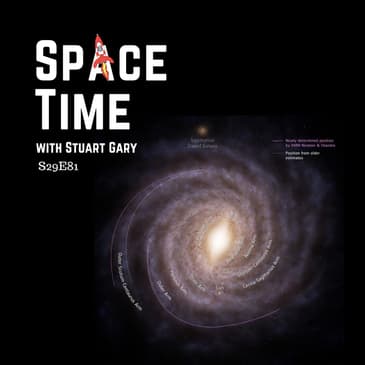
SpaceTime Series 29 Episode 81How a passing star redirected comets to the inner solar systemA fascinating new study reveals how a passing star, HD 7977, may have altered the trajectory of comets from the Oort Cloud, sending them cascading into the inner solar system. This event, which occurred approximately 2.47 billion years ago, could still be influencing comet activity today. Researchers used data from the European Space Agency's Gaia mission to refine the distances involved and suggest that the gravitational perturbations from HD 7977 temporarily dominated the generation of new comets.Changing our map of the Milky Way GalaxyAstronomers have redrawn the map of our Milky Way galaxy, moving its outer arms up to 10% further away than previously estimated. This revised picture is based on observations of gamma-ray bursts and the subsequent echoes of X-rays that helped to measure distances within the galaxy. New techniques have allowed for a clearer understanding of the Milky Way's structure, confirming the existence of its four spiral arms.Evidence of vast hidden magma systems inside MarsNew findings suggest that Mars once hosted extensive magmatic systems beneath its surface, despite the absence of plate tectonics. Data from NASA's InSight mission has revealed a previously unidentified boundary layer deep within the Martian crust, indicating complex geological processes that may have allowed the Red Planet to develop a habitable environment. This challenges long-held assumptions about the geological capabilities of rocky planets without tectonic activity.The Science RobertA new study indicates that the mental health of high school peers can significantly affect individual mental health outcomes. Additionally, research finds no link between paracetamol use during pregnancy and the risk of autism or ADHD. A detailed analysis of a fossilised pterosaur wing reveals insights into its diet, while scientists discover new methods to control quantum light sources, bringing us closer to practical quantum technologies.1. How a passing star redirected comets to the inner solar system 2. Changing our map of the Milky Way Galaxy 3. Evidence of vast hidden magma systems inside Mars 4. The Science RobertIf you’d like to support the podcast and gain access to bonus content by becoming a SpaceTime crew member, you can do just that through The Big Bang editions on Patreon, Spotify, and Apple Podcasts. Details on the Support page on our website https://www.bitesz.com/show/spacetime/support/
00:00:00 --> 00:00:02 Stuart Gary: This is space Time Series 29, episode
00:00:02 --> 00:00:05 81, for broadcast on the 8th of July,
00:00:05 --> 00:00:08 2026. Coming up on Space,
00:00:08 --> 00:00:11 how a passing star redirected comets to the
00:00:11 --> 00:00:14 inner solar system, a, uh, change in our map
00:00:14 --> 00:00:16 of the Milky Way galaxy, and evidence of
00:00:16 --> 00:00:19 vast hidden magma systems inside Mars.
00:00:20 --> 00:00:22 All that and more coming up on, uh, uh, Space
00:00:22 --> 00:00:25 Time. Welcome to Space
00:00:26 --> 00:00:27 Time with Stuart G.
00:00:43 --> 00:00:46 A new study has shown how a passing star
00:00:46 --> 00:00:48 redirected a stream of comets from the
00:00:48 --> 00:00:50 distant Oort Cloud to the inner solar system.
00:00:50 --> 00:00:53 Consequently, closer to Earth. And the
00:00:53 --> 00:00:55 cascade may not be over yet. The
00:00:55 --> 00:00:58 Oort Cloud is a collection of comets, frozen
00:00:58 --> 00:01:01 worlds and icy debris orbiting in the dark
00:01:01 --> 00:01:03 outer reaches of our solar system and
00:01:03 --> 00:01:05 extending more than a light year deep into
00:01:05 --> 00:01:08 interstellar space. The clouds, thought to
00:01:08 --> 00:01:10 include leftover objects from the formation
00:01:10 --> 00:01:12 of Our solar system 4.6 billion years ago, as
00:01:12 --> 00:01:15 well as interstellar objects that are tagging
00:01:15 --> 00:01:17 along after being captured by the Sun's
00:01:17 --> 00:01:19 gravitational field. About
00:01:19 --> 00:01:22 2.47 billion years ago, a spectral
00:01:22 --> 00:01:25 type G yellow dwarf star similar to and about
00:01:25 --> 00:01:28 1.07 times the mass of our sun, which is
00:01:28 --> 00:01:30 catalogued as HD7977,
00:01:30 --> 00:01:33 passed close to our solar system. But
00:01:33 --> 00:01:35 exactly how close is still a bit of a
00:01:35 --> 00:01:37 mystery. Today, HD
00:01:37 --> 00:01:40 7977 is located in the constellation
00:01:40 --> 00:01:43 Cassiopeia, about 246.9
00:01:43 --> 00:01:46 light years away. But during its close
00:01:46 --> 00:01:48 encounter with our solar system, calculations
00:01:48 --> 00:01:51 based on observations by the Gaia spacecraft
00:01:51 --> 00:01:53 suggest that it may have passed within the
00:01:53 --> 00:01:54 Oort Cloud, coming to within
00:01:54 --> 00:01:56 0 and
00:01:56 --> 00:01:59 0.4 light years from the Sun.
00:01:59 --> 00:02:02 Now, by comparison, the nearest star to us
00:02:02 --> 00:02:04 today is Proxima Centauri, which is 4.25
00:02:04 --> 00:02:06 light years away, which makes it eight or
00:02:06 --> 00:02:08 more times further than this closest
00:02:08 --> 00:02:11 approach. Now, uh, this new study by Nathan
00:02:11 --> 00:02:13 Cabe from the Planetary Science Institute and
00:02:13 --> 00:02:15 Sean Raymond from the University of Bordeaux,
00:02:15 --> 00:02:17 have further refined those distances,
00:02:17 --> 00:02:20 suggesting that HD7977's close
00:02:20 --> 00:02:22 encounter with our solar system could have
00:02:22 --> 00:02:25 been as near as 0 to
00:02:25 --> 00:02:27 0 light years from the Sun.
00:02:28 --> 00:02:30 Ah, at its nearest, that means it was just
00:02:30 --> 00:02:32 6 times further away from the sun than
00:02:32 --> 00:02:35 what the Earth is. Their research, which has
00:02:35 --> 00:02:37 been presented at the American Astronomical
00:02:37 --> 00:02:39 Society Division of Dynamical Astronomy,
00:02:39 --> 00:02:41 suggests that the gravitational perturbations
00:02:41 --> 00:02:43 triggered by such an encounter would have
00:02:43 --> 00:02:46 altered the orbits of some of the Oort Cloud
00:02:46 --> 00:02:48 objects, sending them cascading into the
00:02:48 --> 00:02:50 inner solar system. In other words, where the
00:02:50 --> 00:02:52 Earth is and they believe that we may still
00:02:52 --> 00:02:54 be feeling the effects of that passage today.
00:02:56 --> 00:02:58 The European Space Agency's Gaia mission was
00:02:58 --> 00:03:00 a, UH, telescope that precisely measured the
00:03:00 --> 00:03:02 changing positions and brightnesses of
00:03:02 --> 00:03:04 thousands of stars and other objects in our
00:03:04 --> 00:03:07 galaxy relative to background quasars and
00:03:07 --> 00:03:09 galaxies. Its combination of a
00:03:09 --> 00:03:12 spectrograph to measure motions towards and
00:03:12 --> 00:03:14 away from us and its high resolution cameras
00:03:14 --> 00:03:17 to measure proper motion across the sky has
00:03:17 --> 00:03:19 allowed three dimensional motions to be
00:03:19 --> 00:03:21 calculated for roughly 1% of the objects in
00:03:21 --> 00:03:24 ah, our galaxy, including the star HD
00:03:24 --> 00:03:26 7977. It allowed
00:03:26 --> 00:03:29 astronomers to understand the history of our
00:03:29 --> 00:03:30 solar system in new ways.
00:03:31 --> 00:03:33 Normally, the gravity of the galaxy's outer
00:03:33 --> 00:03:36 disc is the primary force causing icy objects
00:03:36 --> 00:03:39 in our solar system to change their orbits.
00:03:39 --> 00:03:42 This pull spreads out what was once a
00:03:42 --> 00:03:44 disc of material into what researchers
00:03:44 --> 00:03:46 calculate is currently a spherical shell of
00:03:46 --> 00:03:49 objects. This shell, the Oort Cloud, is
00:03:49 --> 00:03:52 named after its discoverer Jan Oort. And this
00:03:52 --> 00:03:55 same galactic tug should also dominate the
00:03:55 --> 00:03:57 orbits of new comets entering our solar
00:03:57 --> 00:04:00 system for the first time. And once it enters
00:04:00 --> 00:04:02 the solar system, the effects of the planets
00:04:02 --> 00:04:04 and its passage near the sun can radically
00:04:04 --> 00:04:06 change a comet's orbit. And these forces
00:04:07 --> 00:04:08 should leave a distinct signature in the
00:04:08 --> 00:04:11 direction that a comet orbits relative to our
00:04:11 --> 00:04:13 Milky Way's midplane. Now, uh, if
00:04:13 --> 00:04:16 HD7977 passed as near as Kabe
00:04:16 --> 00:04:18 and Rayman propose, its gravitational
00:04:18 --> 00:04:20 influence would temporarily dwarf that of the
00:04:20 --> 00:04:23 galaxy and the galactic signature should be
00:04:23 --> 00:04:26 absent from current comet orbits. And
00:04:26 --> 00:04:28 that's exactly what Cape and Raymond found
00:04:28 --> 00:04:30 when they analysed the orbits of several new
00:04:30 --> 00:04:33 comets. Cabe says the distribution of comet
00:04:33 --> 00:04:35 orbits suggests that we're living through an
00:04:35 --> 00:04:38 unusual time where HD7977
00:04:38 --> 00:04:40 has dominated the generation of new comets
00:04:40 --> 00:04:43 and not the larger gravitational field of the
00:04:43 --> 00:04:45 Milky Way as it usually would. This would
00:04:45 --> 00:04:47 also mean that we're living through the late
00:04:47 --> 00:04:50 stages of a pretty rare, powerful cometary
00:04:50 --> 00:04:53 shower. To test this
00:04:53 --> 00:04:55 idea, Cabe and Raymond ran a series of
00:04:55 --> 00:04:57 computer simulations to understand what
00:04:57 --> 00:04:59 comets would look like as a result of
00:04:59 --> 00:05:02 HD7977 passing at different distances.
00:05:02 --> 00:05:04 The computer models were then compared to the
00:05:04 --> 00:05:07 passage of 112 long period comets that have
00:05:07 --> 00:05:10 been observed since 1989, when professional
00:05:10 --> 00:05:12 surveys first made it possible to detect new
00:05:12 --> 00:05:15 comets in both hemispheres. By the way, long
00:05:15 --> 00:05:17 period comets are identified because they
00:05:17 --> 00:05:19 have highly elliptical orbits that typically
00:05:19 --> 00:05:21 take thousands to millions of years to
00:05:21 --> 00:05:23 complete. Brand new comets on their first
00:05:23 --> 00:05:25 passage to the inner solar system have
00:05:25 --> 00:05:27 orbital periods measured in millions of
00:05:27 --> 00:05:30 years, while older comets on Subsequent
00:05:30 --> 00:05:32 visits have much shorter periods due to their
00:05:32 --> 00:05:34 prior interactions with the planets and the
00:05:34 --> 00:05:37 Sun. The authors found the observed
00:05:37 --> 00:05:39 orbits of comets on their first passage into
00:05:39 --> 00:05:41 our solar systems. Inner regions matched
00:05:41 --> 00:05:44 HD7977, triggering a wave of long
00:05:44 --> 00:05:47 period comets to enter our solar system. All
00:05:47 --> 00:05:49 the comets on repeated passages are
00:05:49 --> 00:05:51 consistent with the galactic disc, pulling
00:05:51 --> 00:05:53 and clustering, creating their orbits. The
00:05:53 --> 00:05:55 authors say their predictions will be tested
00:05:55 --> 00:05:57 in the next six to 12 months. That's when the
00:05:57 --> 00:06:00 next data drop from Gaia is released.
00:06:01 --> 00:06:03 This is space time still to come.
00:06:04 --> 00:06:07 Changing our map of the Milky Way Galaxy and
00:06:07 --> 00:06:09 evidence of vast hidden magma systems deep
00:06:09 --> 00:06:12 below the surface of the Red Planet Mars.
00:06:12 --> 00:06:15 All that and more still to come on
00:06:15 --> 00:06:15 spacetime.
00:06:31 --> 00:06:34 Astronomers have redrawn our map of the Milky
00:06:34 --> 00:06:36 Way galaxy, moving its outer arms up to 10%
00:06:37 --> 00:06:39 further away than previous estimates. The
00:06:39 --> 00:06:42 revised picture is based on new data, uh,
00:06:42 --> 00:06:44 from both NASA's Chandra and the European
00:06:44 --> 00:06:46 Space Agency's XMM Newton X ray space
00:06:46 --> 00:06:49 telescopes. They were observing the aftermath
00:06:49 --> 00:06:52 of three bright explosions thrown out by
00:06:52 --> 00:06:54 three separate gamma ray bursts echoing
00:06:54 --> 00:06:56 through the outer spiral of the Milky Way
00:06:56 --> 00:06:59 galaxy. By measuring the distance to these
00:06:59 --> 00:07:01 echoes, astronomers were able to refine the
00:07:01 --> 00:07:04 distance to the outer arms. The thing
00:07:04 --> 00:07:06 is, we really don't know much about the
00:07:06 --> 00:07:08 structure of our galaxy's outer regions.
00:07:09 --> 00:07:10 That's because it's like looking at the
00:07:10 --> 00:07:12 forest through the trees. It's difficult to
00:07:12 --> 00:07:15 observe our galaxy from the inside. The
00:07:15 --> 00:07:17 solar system is well embedded inside its
00:07:17 --> 00:07:20 disc, preventing a bird's eye view. And as
00:07:20 --> 00:07:22 well as that, many regions are obscured by
00:07:22 --> 00:07:25 thick clouds of cosmic dust. But by
00:07:25 --> 00:07:27 using data from ESA's Gaia space telescope,
00:07:27 --> 00:07:29 it's allowed astronomers to gain a better
00:07:29 --> 00:07:31 perspective for mapping the Milky Way and
00:07:31 --> 00:07:34 doing so in more detail than ever before by
00:07:34 --> 00:07:36 measuring more precise distances to its
00:07:36 --> 00:07:39 stars. Before Gaia, astronomers weren't even
00:07:39 --> 00:07:41 sure if our galaxy had two or four spiral
00:07:41 --> 00:07:43 arms. We now know there are four.
00:07:44 --> 00:07:46 Beatriz Vallia from Italy's National
00:07:46 --> 00:07:49 Institute of Astrophysics says now another of
00:07:49 --> 00:07:51 ESA's missions has found a new way to map the
00:07:51 --> 00:07:54 extremities of our galaxy. Faias, uh, says
00:07:54 --> 00:07:56 astronomers usually model the Milky Way's
00:07:56 --> 00:07:58 outer arms indirectly based on what we know
00:07:58 --> 00:08:01 about how our galaxy rotates. But doing
00:08:01 --> 00:08:04 this leaves room for error. So instead,
00:08:04 --> 00:08:07 she looked at the aftermath of three cosmic
00:08:07 --> 00:08:09 explosions that took place far away in more
00:08:09 --> 00:08:12 distant galaxies. These explosions
00:08:12 --> 00:08:14 flung out X rays that echoed through several
00:08:14 --> 00:08:17 of the Milky Way's outer arms. And she
00:08:17 --> 00:08:19 measured the distances to these echoes
00:08:19 --> 00:08:22 directly. The X rays bounced around and
00:08:22 --> 00:08:23 were scattered by dust grains within the
00:08:23 --> 00:08:26 Milky Way spiral arms, forming bright rings
00:08:26 --> 00:08:28 that were then picked up by the xmm, Newton
00:08:28 --> 00:08:31 and Chandra space telescopes. By studying
00:08:31 --> 00:08:34 how these ring shaped echoes slowly expanded
00:08:34 --> 00:08:36 over time, Vaire and colleagues were able to
00:08:36 --> 00:08:38 pinpoint the distance to the scattering dust
00:08:38 --> 00:08:41 grains. As these grains lie within
00:08:41 --> 00:08:43 clouds within the arms of the galaxy, the
00:08:43 --> 00:08:45 authors were able to directly measure the
00:08:45 --> 00:08:47 distance to those arms. Besides
00:08:47 --> 00:08:49 confirming the known distance of the Perseus
00:08:49 --> 00:08:51 Arm, the authors also found that two of the
00:08:51 --> 00:08:54 Milky Way Galaxy's arms, the Artus Scutum
00:08:54 --> 00:08:56 Centaurus Arm and the Outer arm, are located
00:08:56 --> 00:08:59 up to 10% further away than
00:08:59 --> 00:09:02 previously thought. This is
00:09:02 --> 00:09:05 space time. Still to come. Evidence
00:09:05 --> 00:09:07 of vast hidden magma systems inside the Red
00:09:07 --> 00:09:10 planet Mars. And later in the Science
00:09:10 --> 00:09:13 report, a new study finds that your
00:09:13 --> 00:09:15 mental health might m well be impacted by the
00:09:15 --> 00:09:17 mental health of the people you went to
00:09:17 --> 00:09:19 school with. All that and more still to come
00:09:19 --> 00:09:21 on, uh, space time.
00:09:36 --> 00:09:39 A new study has uncovered that the Red planet
00:09:39 --> 00:09:41 Mars once hosted enormous Earth like
00:09:41 --> 00:09:44 magmatic systems deep beneath its surface.
00:09:44 --> 00:09:46 That's despite the planet lacking any plate
00:09:46 --> 00:09:48 tectonics, which was long thought necessary
00:09:48 --> 00:09:51 for this kind of geological complexity. The
00:09:51 --> 00:09:53 findings, reported in the journal Nature
00:09:53 --> 00:09:55 Astronomy, reveal fascinating new
00:09:55 --> 00:09:57 possibilities for how rocky planets could
00:09:57 --> 00:10:00 become habitable. Mars is often
00:10:00 --> 00:10:02 described as a stagnant lid planet.
00:10:03 --> 00:10:05 Unlike the Earth, its surface is not broken
00:10:05 --> 00:10:08 up into moving tectonic plates. Because
00:10:08 --> 00:10:11 plate tectonics drives volcanism, recycling
00:10:11 --> 00:10:12 and continent building on Earth, many
00:10:12 --> 00:10:14 scientists assumed Mars m lacked the
00:10:14 --> 00:10:16 conditions needed to produce similarly
00:10:16 --> 00:10:19 complex crust. However, this new study
00:10:19 --> 00:10:21 challenges that view, suggesting that Mars
00:10:21 --> 00:10:23 could have produced highly evolved crust
00:10:23 --> 00:10:25 through intense internal recycling. The
00:10:25 --> 00:10:28 findings are based on Data recorded by NASA's
00:10:28 --> 00:10:31 2018 InSight Lander Mission to the surface of
00:10:31 --> 00:10:33 the Red Planet. Insight investigated
00:10:33 --> 00:10:35 seismic waves from meteorite impacts and
00:10:35 --> 00:10:37 massquakes, the Martian equivalent of
00:10:37 --> 00:10:40 earthquakes. The authors used that data to
00:10:40 --> 00:10:42 investigate a mysterious boundary layer about
00:10:42 --> 00:10:45 24 kilometres beneath the Martian surface.
00:10:46 --> 00:10:48 Uh, now previous studies had identified this
00:10:48 --> 00:10:50 boundary, but no one knew what it really
00:10:50 --> 00:10:53 represented. To test the idea that
00:10:53 --> 00:10:55 this boundary may have marked a transition
00:10:55 --> 00:10:57 between two different rock types, the authors
00:10:57 --> 00:10:58 compared hundreds of possible rock
00:10:58 --> 00:11:00 compositions with the seismic data. Using
00:11:00 --> 00:11:02 thermodynamic modelling and statistical
00:11:02 --> 00:11:05 techniques, they found that while rocks above
00:11:05 --> 00:11:08 the 24 kilometre boundary appear to be MAFIC,
00:11:08 --> 00:11:10 that is they contained high proportions of
00:11:10 --> 00:11:13 silica. Rocks below the boundary seemed to be
00:11:13 --> 00:11:15 ultramafic, which means they're rich in iron
00:11:15 --> 00:11:18 and magma, but low in silica. The authors
00:11:18 --> 00:11:20 suggest this buried layer would have formed
00:11:20 --> 00:11:22 where molten rock pulled deep underground.
00:11:22 --> 00:11:24 And gradually separated into two distinct
00:11:24 --> 00:11:27 materials. This would leave behind a thick
00:11:27 --> 00:11:29 residue of dense crystals at the base of the
00:11:29 --> 00:11:31 crust, while lighter, uh, more evolved melts
00:11:31 --> 00:11:34 rose upwards. On Earth, similar
00:11:34 --> 00:11:37 processes occur beneath volcanic arcs and are
00:11:37 --> 00:11:39 linked to the formation of the continents.
00:11:40 --> 00:11:42 The study's lead author, Tobermori Mackie
00:11:42 --> 00:11:44 Champion from Oxford University says
00:11:44 --> 00:11:46 scientists have traditionally assumed that
00:11:46 --> 00:11:48 volcanism on Mars was relatively simple
00:11:48 --> 00:11:51 compared to that on the Earth. But this new
00:11:51 --> 00:11:53 discovery suggests Mars could sustain large
00:11:53 --> 00:11:56 long lived systems where molten rock evolved
00:11:56 --> 00:11:59 and reprocessed itself throughout the entire
00:11:59 --> 00:12:01 crust. The studies suggest that this layer,
00:12:01 --> 00:12:04 uh, may extend sideways for hundreds, even
00:12:04 --> 00:12:06 thousands of kilometres around the northern
00:12:06 --> 00:12:08 Martian hemisphere, indicating that the Red
00:12:08 --> 00:12:10 Planet once hosted enormous interconnected
00:12:10 --> 00:12:13 magmatic systems rather than simple isolated
00:12:13 --> 00:12:16 volcanoes. This phenomenon, known as
00:12:16 --> 00:12:18 transcrustal magmatism, was previously
00:12:18 --> 00:12:20 thought to be unique to Earth. These
00:12:20 --> 00:12:23 geological processes are closely linked to
00:12:23 --> 00:12:25 how planets develop atmospheres, oceans and
00:12:25 --> 00:12:28 potentially habitable environments. For
00:12:28 --> 00:12:30 instance, here on Earth, geological recycling
00:12:30 --> 00:12:33 helps regulate climate and supports long term
00:12:33 --> 00:12:35 cycling of water and other volatile elements.
00:12:36 --> 00:12:39 Scientists have often assumed um, plate
00:12:39 --> 00:12:41 tectonics were essential for creating these
00:12:41 --> 00:12:43 conditions. But the new findings suggest
00:12:43 --> 00:12:45 planets may not need Earth, uh, style
00:12:45 --> 00:12:48 tectonics to build complex crusts or sustain
00:12:48 --> 00:12:49 the conditions that support life.
00:12:50 --> 00:12:53 One of the big questions in science has
00:12:53 --> 00:12:55 always been whether planet Earth is unique.
00:12:55 --> 00:12:57 If Mars could develop this kind of complex
00:12:57 --> 00:13:00 crust without plate tectonics, then maybe the
00:13:00 --> 00:13:02 conditions needed for habitability could have
00:13:02 --> 00:13:04 emerged on more planets than just Earth, uh,
00:13:04 --> 00:13:07 including those previously dismissed based on
00:13:07 --> 00:13:10 their size or their apparent lack of tectonic
00:13:10 --> 00:13:12 activity. It's all just another part of the
00:13:12 --> 00:13:14 amazing treasure trove of Data coming from
00:13:14 --> 00:13:16 NASA's InSight mission on the Elysium
00:13:16 --> 00:13:19 Planitia region of the Red Planet.
00:13:19 --> 00:13:22 This report on INSIGHT from NASA tv
00:13:23 --> 00:13:26 Touchdown confirmed. INSIGHT is on. The
00:13:26 --> 00:13:26 surface of
00:13:28 --> 00:13:31 Bruce Bannert: INSIGHT has been fantastically successful.
00:13:31 --> 00:13:34 We've gotten more science than we had ever
00:13:34 --> 00:13:36 dreamed that we would get. During the course
00:13:36 --> 00:13:39 of the this mission. InSight's primary goal
00:13:39 --> 00:13:41 was to better understand how the
00:13:41 --> 00:13:44 terrestrial planets, the rocky planets, uh,
00:13:44 --> 00:13:45 formed and evolved.
00:13:46 --> 00:13:48 Mark Panning: First we landed an incredibly sensitive
00:13:48 --> 00:13:51 seismometer on the surface of Mars. And with
00:13:51 --> 00:13:53 that we were able to record over 1300
00:13:53 --> 00:13:54 marsquakes.
00:13:54 --> 00:13:56 Bruce Bannert: And these range all the way from tiny little
00:13:56 --> 00:13:59 templars that just barely go over the noise
00:13:59 --> 00:14:02 background to a handful of quakes that
00:14:02 --> 00:14:03 were larger than magnitude
00:14:04 --> 00:14:06 Kathy Ezamora Garcia: and feeling those vibrations. The scientists
00:14:06 --> 00:14:08 can actually take that information and use
00:14:08 --> 00:14:11 that to reconstruct all the material
00:14:11 --> 00:14:13 that those Mars quakes travelled through and
00:14:13 --> 00:14:15 thereby see the interior of the planet.
00:14:16 --> 00:14:19 Mark Panning: We looked at its core which is Big and
00:14:19 --> 00:14:21 not very dense. We looked at its mantle,
00:14:21 --> 00:14:24 which is not so hot, and we looked at its
00:14:24 --> 00:14:26 crust, which is not too
00:14:26 --> 00:14:29 thick and not too dense compared to some of
00:14:29 --> 00:14:29 our preferences.
00:14:31 --> 00:14:34 Bruce Bannert: By measuring the detailed
00:14:34 --> 00:14:37 structure of the inside of Mars, it gives us
00:14:37 --> 00:14:39 a snapshot of what the planet looked like
00:14:40 --> 00:14:43 four and a half billion years ago. The other
00:14:43 --> 00:14:45 thing that we've been able to do is make a
00:14:45 --> 00:14:48 very detailed record of the weather at
00:14:48 --> 00:14:50 Mars. We have a really good weather
00:14:50 --> 00:14:53 station which has allowed meteorologists to
00:14:53 --> 00:14:56 study the weather at the Insight landing site
00:14:56 --> 00:14:59 and relate that to the climate changes on
00:14:59 --> 00:14:59 Mars.
00:15:00 --> 00:15:02 Mark Panning: What we didn't do, unfortunately, was make
00:15:02 --> 00:15:04 the heat flow measurement we wanted to make.
00:15:04 --> 00:15:06 Our heat flow probe was supposed to get three
00:15:06 --> 00:15:08 to five metres down and we were
00:15:09 --> 00:15:10 unable to reach that depth.
00:15:10 --> 00:15:12 Kathy Ezamora Garcia: But we were able to get some of those
00:15:12 --> 00:15:14 measurements, such as the heat transfer
00:15:14 --> 00:15:15 amongst the soil.
00:15:16 --> 00:15:18 Mark Panning: Uh, it's left a permanent mark on me. I
00:15:18 --> 00:15:21 literally tattooed Insight onto my arm. I'll
00:15:21 --> 00:15:22 never let it go.
00:15:23 --> 00:15:26 Bruce Bannert: We've really rewritten sort of the
00:15:26 --> 00:15:29 chapter of the encyclopaedia on the interior
00:15:29 --> 00:15:31 of Mars. That was our last big
00:15:31 --> 00:15:34 hole in our understanding of the planet.
00:15:34 --> 00:15:36 Mark Panning: There's a lot of data that people are going
00:15:36 --> 00:15:37 to be looking at for decades to come.
00:15:37 --> 00:15:40 Kathy Ezamora Garcia: We accomplished so many of our science goals
00:15:40 --> 00:15:42 and we're going to have something to look
00:15:42 --> 00:15:43 back on and be proud.
00:15:43 --> 00:15:45 Stuart Gary: And, uh, in that report from NASA tv, we
00:15:45 --> 00:15:46 heard from INSIGHT Principal Investigator
00:15:46 --> 00:15:49 Bruce Bannert, Insight Project Scientist Mark
00:15:49 --> 00:15:51 Panning and INSIGHT Deputy Project Manager
00:15:51 --> 00:15:53 Kathy Ezamora Garcia.
00:15:53 --> 00:15:55 Uh, this is space, time.
00:16:11 --> 00:16:13 And time out of tech. Another brief look at
00:16:13 --> 00:16:15 some of the other storeys making news in
00:16:15 --> 00:16:18 Science this week with the Science Report. A
00:16:18 --> 00:16:20 new study in Finland has shown that the
00:16:20 --> 00:16:22 mental health of your high school mates may
00:16:22 --> 00:16:24 impact your own mental health. Uh, the
00:16:24 --> 00:16:26 findings reported in the Journal of the
00:16:26 --> 00:16:28 American Medical association indicate that
00:16:28 --> 00:16:30 people who had high school peers with a
00:16:30 --> 00:16:32 genetic predisposition for mental health
00:16:32 --> 00:16:34 disorders or a diagnosis of a mental health
00:16:34 --> 00:16:36 disorder were also at an increased risk of
00:16:36 --> 00:16:38 being diagnosed with a mental health disorder
00:16:38 --> 00:16:41 themselves. The authors say having peers with
00:16:41 --> 00:16:43 diagnosed depression or anxiety may make
00:16:43 --> 00:16:46 teens more aware of symptoms, reduce stigma
00:16:46 --> 00:16:48 and encourage them to seek treatment.
00:16:50 --> 00:16:53 A large new study of over 120
00:16:53 --> 00:16:55 kids has found no link between
00:16:55 --> 00:16:57 paracetamol use during pregnancy and the risk
00:16:57 --> 00:17:00 of autism or adhd. The, uh, study
00:17:01 --> 00:17:02 published in the Journal of the American
00:17:02 --> 00:17:04 Medical association, compared pairs of
00:17:04 --> 00:17:06 siblings to try and remove genetics and
00:17:06 --> 00:17:09 family environment from the equation. Because
00:17:09 --> 00:17:11 both HDAD and autism have a strong
00:17:11 --> 00:17:14 inherited component, the authors found no
00:17:14 --> 00:17:17 link between paracetamol use in pregnancy and
00:17:17 --> 00:17:19 increased risk of either autism or ADHD
00:17:19 --> 00:17:22 related Regardless of the timing pattern or
00:17:22 --> 00:17:24 dose of paracetamol use,
00:17:25 --> 00:17:28 a detailed study of a fossilised 113
00:17:28 --> 00:17:30 million year old pterosaur wing has found it
00:17:30 --> 00:17:32 was so well preserved in three dimensions
00:17:32 --> 00:17:35 that it even retained chemical traces hinting
00:17:35 --> 00:17:38 at its diet. The findings reported in the
00:17:38 --> 00:17:40 journal Eye Science, suggest the ancient
00:17:40 --> 00:17:42 flying reptile, which lived during the age of
00:17:42 --> 00:17:45 dinosaurs, had a diet rich in fish and squid.
00:17:45 --> 00:17:47 The authors were able to make that
00:17:47 --> 00:17:49 determination thanks to traces of steroids
00:17:49 --> 00:17:52 preserved in the remains, an unusual mix of
00:17:52 --> 00:17:54 special bacteria and a unique ancient marine
00:17:54 --> 00:17:56 environment, preserving not just the
00:17:56 --> 00:17:59 structure but even the subtle chemical traces
00:17:59 --> 00:18:02 of the animal's biology. The discovery
00:18:02 --> 00:18:03 highlights the growing potential for
00:18:03 --> 00:18:06 molecular palaeontology to unlock secrets
00:18:06 --> 00:18:07 from deep time.
00:18:08 --> 00:18:10 Scientists have found a new way to control
00:18:10 --> 00:18:13 quantum light sources, which is one of the
00:18:13 --> 00:18:14 key elements needed before quantum
00:18:14 --> 00:18:17 technologies can be used reliably in the real
00:18:17 --> 00:18:19 world world. The research reported in the
00:18:19 --> 00:18:21 journal Science Advances brings scientists a
00:18:21 --> 00:18:24 step closer to being used in practical
00:18:24 --> 00:18:27 quantum computing, secure communications and
00:18:27 --> 00:18:30 ultra high resolution sensing. The authors
00:18:30 --> 00:18:32 from the University of Technology Sydney say
00:18:32 --> 00:18:34 they were able to significantly shift the
00:18:34 --> 00:18:36 colour and wavelength of the light emitted.
00:18:36 --> 00:18:38 Unlike, um, many experiments where a device
00:18:38 --> 00:18:40 is made at one twist angle and left alone,
00:18:40 --> 00:18:42 the authors were able to pick up twist and
00:18:42 --> 00:18:45 restack hexagonal boron nitrate repeatedly
00:18:45 --> 00:18:47 and use that twist to modify the emitters,
00:18:47 --> 00:18:50 which you can't do with traditional materials
00:18:50 --> 00:18:52 like diamond or silicon carbide. These
00:18:52 --> 00:18:54 materials could eventually be used for
00:18:54 --> 00:18:56 applications such as healthcare cyber
00:18:56 --> 00:18:59 security and improved GPS and give more
00:18:59 --> 00:19:01 control over the building blocks needed to
00:19:01 --> 00:19:01 get there.
00:19:02 --> 00:19:04 Beta testers are uh, continuing to play
00:19:04 --> 00:19:07 around with Apple's new Siri AI ahead of this
00:19:07 --> 00:19:10 month's public beta launch. Among those
00:19:10 --> 00:19:11 testing the new Google Gemini based
00:19:11 --> 00:19:14 artificial intelligence is technology editor
00:19:14 --> 00:19:16 Alex Zaharov Vroith From Tech Advice Start
00:19:16 --> 00:19:17 Life
00:19:17 --> 00:19:19 Jonathan Nally: at the worldwide Developer conference, Apple
00:19:19 --> 00:19:22 announced its long awaited upgrade to Siri.
00:19:22 --> 00:19:25 So it's now called Siri AI and although it's
00:19:25 --> 00:19:27 using the Gemini brains from Google,
00:19:27 --> 00:19:30 it's not just a uh, plugin. Apple's been
00:19:30 --> 00:19:32 training its own models with Google's models
00:19:32 --> 00:19:35 and they have a lot of where they can on
00:19:35 --> 00:19:37 device work and the private cloud compute
00:19:37 --> 00:19:39 work to make sure that your queries and as
00:19:39 --> 00:19:42 much of your activity remains as private as
00:19:42 --> 00:19:45 possible. And this has given Apple
00:19:45 --> 00:19:47 the AI the ability to have natural
00:19:47 --> 00:19:49 conversations, the same sort of things we see
00:19:49 --> 00:19:51 with Gemini and ChatGPT. You can now edit
00:19:51 --> 00:19:54 photos in a much more performant way, it can
00:19:54 --> 00:19:56 rewrite things more effectively, it has real
00:19:56 --> 00:19:59 world knowledge. And look, at the moment it's
00:19:59 --> 00:20:01 only available to beta testers and we just
00:20:01 --> 00:20:03 have the first and second developer betas.
00:20:03 --> 00:20:05 There will be a, uh, public beta sometime in
00:20:05 --> 00:20:07 July and the whole thing will be ready for
00:20:07 --> 00:20:10 the public in September when the new iPhones
00:20:10 --> 00:20:12 also launch. So unless you are a real tech
00:20:12 --> 00:20:14 head and you've got spare iPhones, I wouldn't
00:20:14 --> 00:20:17 be updating your primary device to these beta
00:20:17 --> 00:20:19 versions. Even when the public beta comes
00:20:19 --> 00:20:21 out, it's always a bit of a gamble as to
00:20:21 --> 00:20:24 whether you should because the um, beta
00:20:24 --> 00:20:26 version can have bugs. Now people have said
00:20:26 --> 00:20:28 these latest betas are very smooth, but you
00:20:28 --> 00:20:31 go to Reddit and you read the iOS beta forum
00:20:31 --> 00:20:34 and you know the litany of beta problems
00:20:34 --> 00:20:36 that people have every year when this happens
00:20:36 --> 00:20:38 are there for all to see. So not recommended
00:20:38 --> 00:20:40 for the general public. But, uh, all the, uh,
00:20:40 --> 00:20:42 app developers and you know, people with
00:20:42 --> 00:20:44 spare iPhones that love tinkering, they're
00:20:44 --> 00:20:45 well into it.
00:20:45 --> 00:20:47 Stuart Gary: That's Alex Zaharov Vroit from TechAdvice
00:20:47 --> 00:20:49 Start Life. And this is Space Time.
00:21:05 --> 00:21:08 And that's the show for now. Space Time
00:21:08 --> 00:21:10 is available every Monday, Wednesday and
00:21:10 --> 00:21:13 Friday through bytes.com, soundcloud,
00:21:13 --> 00:21:15 YouTube, your favourite podcast download
00:21:15 --> 00:21:16 provider, and from
00:21:16 --> 00:21:19 spacetimewithstuartgarry.com
00:21:19 --> 00:21:21 Space Time's also broadcast through the
00:21:21 --> 00:21:23 National Science foundation on Science Zone
00:21:23 --> 00:21:26 Radio and on both iHeartradio and TuneIn
00:21:26 --> 00:21:29 radio. And you can help to support our show
00:21:29 --> 00:21:32 by visiting the Space Store for a range of
00:21:32 --> 00:21:34 promotional merchandising goodies, or by
00:21:34 --> 00:21:37 becoming a Space patron, which gives you
00:21:37 --> 00:21:39 access to triple episode commercial free
00:21:39 --> 00:21:41 versions of the show, as well as lots of
00:21:41 --> 00:21:43 bonus audio content which doesn't go to air,
00:21:43 --> 00:21:46 access to our exclusive Facebook group and
00:21:46 --> 00:21:48 other rewards. Just go to
00:21:48 --> 00:21:50 spacetimewithstuartgarry.com for full
00:21:50 --> 00:21:53 details. You've been listening to Space Time
00:21:53 --> 00:21:56 with Stuart Gary. This has been another
00:21:56 --> 00:21:59 quality podcast production from bytes.com.