


This episode of SpaceTime is brought to you with the support of Squarespace. When it's time to get a presence online, go with the folks who support us...and build the best websites easily. No hassles. You can check out their special offer for SpaceTime listeners by visiting our special URL....Click Here
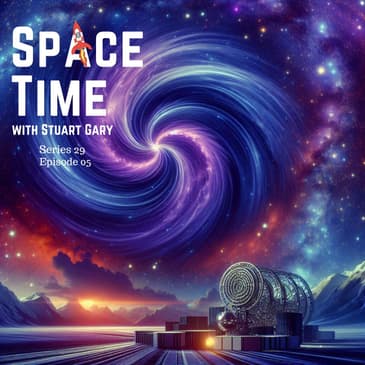
In this episode of SpaceTime, we uncover new evidence suggesting that dark matter may interact with neutrinos, a revelation that could reshape our understanding of the universe. We also discuss a serious medical issue that has forced one of the crews aboard the International Space Station to return home early, and learn about the remarkable discovery that galaxies spin like clockwork.
Dark Matter and Neutrinos: A Possible Interaction
Scientists are challenging the long-standing standard model of particle physics with new findings indicating that dark matter and neutrinos may interact. This groundbreaking research, reported in Nature Astronomy, provides a rare glimpse into the universe's hidden components. By analyzing data from both the early and late universe, researchers suggest that these elusive cosmic entities could influence the formation of galaxies and other structures, potentially addressing discrepancies observed in cosmological measurements.
Medical Emergency Forces ISS Crew to Return Early
NASA's SpaceX Crew 11 is returning to Earth ahead of schedule due to a medical concern involving one of the astronauts. While the situation is stable and not classified as an emergency, the decision was made to ensure the crew member receives comprehensive medical evaluation on the ground. This marks a historic moment, as it is the first time in 26 years of ISS operations that a medical issue has necessitated an early return.
Galaxies Spin Like Clockwork
Recent studies have confirmed that galaxies rotate approximately once every billion years, regardless of their size. This research, published in the Monthly Notices of the Royal Astronomical Society, reveals a consistent rotational pattern across different types of galaxies, enhancing our understanding of their mechanics and structure. The findings indicate that older stars exist even at the edges of galaxies, providing valuable insights into galactic formation and evolution.
www.spacetimewithstuartgary.com
✍️ Episode References
Nature Astronomy
Monthly Notices of the Royal Astronomical Society
British Medical Journal
Become a supporter of this podcast: https://www.spreaker.com/podcast/spacetime-your-guide-to-space-astronomy--2458531/support.
This is Spacetime Series twenty nine, episode five, for broadcast on the turf of January twenty twenty six. Coming up on space Time, evidence that that mysterious substance known as dark matter might be able to interact with neutrinos. A serious medical issue forces one of the crews aboard the International Space Station to return home early. And did you know that studies have confirmed that galaxies spin like clockwork. All that and more coming up on space Time. Welcome to space Time with Stuart Gary. Scientists may be a step closer to solving one of the universe's great mysteries with new evidence that dark matter and neutrinos might be capable of interacting, discovery that, if proven correct, will offer a rare window into the darkest recesses of the cosmos. The new findings, reported in the journal Nature Astronomy, are challenging sciences understanding of the standard model of particle physics, the foundation stone of our understanding of the universe. Dark matter and neutrinos are two of the least understood components that make up our universe. Dark matter is a mysterious, invisible substance that makes up around eighty five percent of all the matter in the universe, but it doesn't interact with normal matter except through gravity, so scientists really have no idea what it is. They only know it exists because they can see its gravitational influence on regular matter, holding galaxies together as they rotate and bending light from distant background objects through a process called gravitational lensing. Neutrinos are the most common substances in the universe. They're tiny supotomic particles reduced in places like the cause of stars, in sta supernova explosions, and in nuclear reactors, but they're extremely weakly interacting with all other matter. In fact, right now, there are beans of them passing through you, and you have no idea that it's happening. There are three known types or flavors of neutrinos, electron neutrinos, muon neutrinos, and tawn neutrinos, each with different masses. What makes them even more unusual is that they oscillate between these three flavors, So an electron neutrino generated in the core of say the Sun, might end up as a muon or town neutrino by the time it reaches the detector here on Earth. The standard model of cosmology known as Lambda col. Dark matter, with its origins in Albert Einstein's General theory of relativity, proposes that dark matter and neutrinos exist independently and did not interact with each other. And that's where this new study comes in. It's questioning that hypothesis, challenging the long standard cosmological model. The authors think that they've detected signs that these elusive cosmic components may interact, offering a rare glimpse into those parts of the universe we can't see or easily detect. By combining data from different errors, scientists have found what they believe is evidence of interactions between dark matter and neutrinos. It could have affected the way cosmic structures such as galaxies are formed over time. The data spans the history of the universe. It includes observations of the early universe using the highly sensitive ground based Attacama Cosmology Telescope and the European Space Agencies Planck spacecraft. Both instruments are specifically designed to study the faint afterglow of the Big Bang thirteen point eight billion years ago. Then there's the late universe data. It comes from a massive catalog of astronomical observations taken by the Dark Energy camera on the Victor en Blancot Telescope in Chile, along with galaxy maps from the Sloan Digital All Sky Survey. One of the studies authors, Leonora D. Valentino, from the University of Sheffield, says, the better science understands dark matter, the more insight it can gain into how the universe evolves and how different components are connected. These new results address a long standing puzzling cosmology. See Measurements of the early universe predict that cosmic structures should have grown more strongly over time than what we actually observe today. However, observations of the modern universe indicate that matter is slightly less clumped than expected, and that's pointing to a mild mismatch between early and late time measurements. Now, this tension doesn't mean the standard cosmological models wrong, but it may suggest that it's incomplete. The study shows that interactions between dark matter and neutrinos could help explained this difference, offering new insights into how structure formed in the universe. The findings set a clear path for future testing of the theory using more precise data from future telescopes, cosmic microwave background radiation experiments, and we glensing surveys, which use the subtle distortion of light from distant galaxies to map the distribution of mass throughout the universe. If this interaction between dark matter and neutrinos is confirmed, it would be a fundamental breakthrough. It would not only shed new light on a persistent mismatch between different cosmology probes, but also provide particle physicists with a concrete direction indicating which properties to look for in laboratory experiments in order to help finally unmask the true nature of dark matter. This is space time still to come, a serious medical issue forcing space station crew to return home early. And did you know that studies have confirmed that galaxies spend light clockwork. All that and more still to come on space time, SpaceX CREWE eleven aboard the International Space Station are returning to Earth early due to medical concerns for one of the astronauts aboard the orbiting outposts. Last week, NASA abruptly canceled an extra vehicular activity or EVA that's NASA speak for spacewalk, due to what the agency described as a sudden medical concern. They have given few details, citing patient confidentiality, but they did confirm the medical issue wasn't related to space operations and it wasn't an injury. NASA Administrator Jared Isiacman says, the medical issue isn't an emergency that requires immediate return to Earth, but it does require a more comprehensive examination than what can be accomplished in orbit. Therefore, the difficult decision was made to send CREWE eleven back home early, and it's quite an historic decision. It's the first time in twenty six years of Space station operations that medical issues have been serious enough to force a crew to return early. For over sixty years, NASA's set the standard for safe, the insecurity, and crewed space flight in these endeavors, including the twenty five years of continuous human presence on board the International Space Station. The health and the well being of our astronauts is always and will be our highest priority. Yesterday, January seventh, a single crew member on board the station experienced a medical situation and is now stable. After discussions with Chief Health and Medical Officer, Doctor J. D. Poke, and leadership across the agency, I have come to the decision that it's in the best interest of our astronauts to return Crew eleven ahead of their planned departure within the coming days. The Dragon Endeavor spacecraft will depart the International Space Station with Commander Xena Cartman, pilot Mike Fink, Kimya Yui from JACKSA and Olig platonoff of Rose Cosmos and safely return them to Earth. We expect to provide a further update within the next forty eight hours as to the expected anticipated undocked and re entry timeline. Over the last five months, Crew eleven contributed to the ongoing operations of the space station, conducted extensive scientific research, completed the majority of their mission objectives, and upheld the standards of professionalism for which astronauts are known. Crew twelve is currently scheduled to launch as soon as mid February. Alongside our international and commercial partners, NASA is evaluating their timeline to include earlier launch opportunities. We will provide more information when it's available in the meantime. NASA astronaut Chris Williams, having launched to the station on November twenty seventh on soyu's MS twenty eight, maintains our American presence in space and will support the Space station's operations and scientific efforts. NAS astronauts and our teams in mission control and professional are professionals who trained for every possible scenario at every step of the mission, including moments just like this. I'm proud of the swift effort across the agency thus far to ensure the safety of our astronauts, and I know NASA and or commercial partners will successfully bring Crew eleven safely home. And with that, I'll turn it over to Associate Administrator on it shitt. Three you good evening, Thank you, sir. I'll be brief. We'll get to doctor Polk as soon as we can, but I'll just add a few few comments and every discussion over the last twenty four hours as we've assessed the situation cruse safety has always remained our highest priority, and as it always is across the agency, we never take shortcuts, we never compromise when it comes to protecting our astronauts. The work accomplished during this period reflects the precision and professionalism of the flight control teams in the ground and the astronauts of board ISS. Our crews are extensively trained as the administrator mentioned to manage unexpected medical situations and other offnominal events, including on board training, which we conduct regularly for these situations. Yesterday was a textbook example of that training and action. Once the situation on the station stabilized, careful deliberations led us to the decision to return crew eleven. As the Administrator mentioned, while ensuring minimal operational impact to ongoing work aboard ISS, operating ISS is a complicated task and has been for the past twenty five years with crews on board. The safe operation of the station and the protection of the crew, who are the stewards of station operations, is the hallmark of flight operations and what we are reminded of every day of the unforgiving nature of human spaceflight. With that, I'd like to hand over to doctor. Poul Thanksalment first probably goes without saying, but I'll still reiterate as a physician that I'm not going to speak about any particular astronaut or any particular specific diagnosis. I'd asked that we still respect the privacy of the astronaut. As Administrator mentioned earlier, the astronaut is absolutely stable, so I have to reiterate that again. But anytime we have a medical incident, we embark on looking at diagnoses and what we would call a work up to get a differential diagnosis on what's happening with that patient or astronaut on board. And as many of you know, we have a very robust suite of medical heart we're on board the International Space Station, that we don't have the complete amount of hardware that I would have in the emergency department, for example, to complete a workup of a patient, and in this particular incident, that the medical incident was sufficient enough that we were concerned about the astronaut that we would like to complete that workup, and the best way to complete that workup is on the ground with where we have the full suite of medical testing hardware. Now, again, because the astronaut is absolutely stable, this is not an emergent evacuation, we're not immediately disembarking and getting the astronaut down, but it leaves that lingering risk and lingering question as to what that diagnosis is, and that means there's some lingering risk for that astronaut on board. And so always we air on the side of the astronaut's health and welfare and in this particular case, we are doing the same and I should reiterate in our twenty five year history tree of the International Space Station, we've had many models in Monte Carlo analysis. Models should have said we should have had a medical evacuation approximately every three years in that twenty five year history, and we've not had one to date. And even in this case, we're airing on the side of caution. Again, it's not an emergent evacuation, but we are airing on the side of caution for the crew member and in their best interest and in their best medical welfare. And there we heard from NASER Administrator Jared Isaacman, Associated Administrator i'm at Raa, and NASA Chief Health and Medical Officer doctor J. D. Poulk. Past medical problems on station have ranged from space sickness and skin rashes through the stomach upsets and most things in between, but none were serious enough to force a medical evacuation. Of course, the space station does maintain a large range of first DAID equipment, including a backboard and the specialized methods for performing CPR A micro gravity. There's also a range of over the countermedicines kept in STARK, including things like Aspirin. Crew eleven, launched to the space station, bought a Dragon SpaceX capsule on a Falcon nine rocket from the Cape Canaveral Space Force space in Florida last August for what was slated to be a six month mission. They were scheduled to return to Worth next month after being replaced by Crew twelve. The existing three man so's MS twenty eight crew will remain on station in the meantime. This is space time still to come. Did you know that studies have confirmed that galaxies rotate about once every billion years, no matter how big they are? And later in the Science report, a new study has shown how food preservatives are linked to a higher risk of cancer. All that and more still to come on space time. Did you know that it's been shown that galaxies all rotate about once every billion years, no matter how big they are. The findings reported in the Monthly Notices the Royal Astronomical Society, based on observations of galaxy density, the amount of mass galaxies contained for a given area. Planet Earth spinning around on its axis gives us the length of the day, and a complete orbit of Earth around the Sun takes one Earth year. Our solar system takes two hundred and thirty million Earth years to complete one orbit around the center of the Milky Way galaxy that makes our Solar system somewhere between sixteen and twenty galactic years old. The studies lead author Gerhard Murra from the University of Western Australia, note of the International Center for Radio Astronomy Research, says, it's not Swiss watch precision, but regardless of whether a galaxy is very big or very small, if you could sit on the extreme edge of its galactic disc as it spins, it would take you around a billion years to go go all the way round. Mirroring colleagues are able to calculate that all galaxies of the same size have the same average density. He says discovering such regularity in galaxies provides astronomers with a better understanding of the mechanics that make them tick. While a dense galaxy will rotate at a set speed, another with the same size but lower density will revolve more slowly. The authors also found evidence of older stars existing out to the very edges of galaxies. Mirror says that, based on existing models, expected to find a population of young stars at the very edge of the galactic discs he studied, but instead of finding just gas and newlyformed stars at the outer edges of their discs, mirroring colleagues also found a significant population of older stars along with a thin smattering of younger stars and interstellar gas. He says it's an important result because knowing where a galaxy ends means astronomers can limit their observations and not waste time, effort or computer processing power on study data beyond that point. So because of this work, scientists could determine that galaxies rotate once every billion years, with a sharp edge that's populated with a mixture of interstellar gas and both young and old stars this space time and time now to take a brief look at some of the other stories making us in science this week with a science report. A new study has shown how food preservatives are linked to a higher risk of cancer. The findings, reported in the British Medical Journal, looked at the diets of over one hundred and five thousand patients. The author's calculated participants intake of different preservatives using detailed twenty four hour dietary records filled out regularly over several years. They then tracked the participant's health, looking specifically for a diagnosis of cancer over a period of fourteen years from the start of the survey in two thousand and nine. Of the seventeen preservatives they analyzed, higher intakes of six showed some link with cancers, and while the study doesn't prove that eating more of these additives causes a higher cancer risk, the authors say these preservatives do appear to affect your immune and inflammatory systems. Scientists say that some one point eight million people every year are dying of heart related problems because of heat or cold. The findings, reported in the Journal of the American College of Cardiology, used data on heart deaths as well as temperature data from thirty two countries estimate how many heart related deaths are linked to cold and hot weather. Looking at the years two thousand through to twenty nineteen, the authors found that cord related deaths accounted for eight point two percent of all heart deaths, while heat related deaths were less common, accounting for about zero point sixty six percent of all heart deaths. Found an overall decline in temperature related to heart deaths due to a reduction in cold related deaths. However, heat related deaths increased over that time. Meanwhile, at separate study in the same journal has shown that man made pollutants and climate change contribute to millions of deaths from cardiovascular disease every year. The authors found that pollution in all its forms is a greater heart health threat than war, terrorism, malaria, HIV, the berculosis, drug use, and alcohol consumption all combined. The report focused on global warming as well as air pollution and exposure to wildfire smoke, and highlights the lesser nern drivers of heart disease, including soil noise and air pollution and exposure to toxic chemicals. A new study has shown that some of the very earliest animals to have lived, such as jellyfish and sean enemies, appear to have similar sleeping habits humans. The findings, reported in the journal Nature Communications, examine the sleeping paws of Nematode Stellar vectensis cean enemies in the lab and Cassiopeia andromeda jellyfish in both the lab and in the natural habitat. The authors found that both appeared to sleep for about a third of the day, just like humans do. Looking into how sleep works in these two creatures, the authors found that it appears to be driven by an internal sleep drive, as well as a light in the case of the jellyfish, and an internal body clock for the anenemy. For birth, sleep appeared to play a role in reducing DNA damage, supporting the theory that sleep originally evolved in animals to protect against DNA damage in a wide range of species. Climate change denials have been accused of cherry picking after reports on social media claim that Arctic CIS coverage has been increasing in recent years. Satellite data from the European Space Agency's Copernicus program, which runs the Sentinel satellites, shows the Arctic CI sheet is losing mass of raw and yete. Fluctuations cannot be seen as a so iron of rebound or reversal of this long term trend. Although the total mass of ice in Antarctica has fluctuated since twenty twenty, this followed almost twenty years of continuous decline in which the continent lost some two point five trillion tons of ice. The total mass has significantly decreased since nineteen seventy nine, the biggest losses occurring in the late nineteen eighties. A temporary growth in ice mass reported in the journal Climate and atmospheric science showed Antarctica gain two hundred and five billion tons of ice in twenty twenty two due to increased snowfall, corresponding to record lows in this CI extent, but the skeptics timendum points out that this gain was reversed the following year. The story here is that choosing your moment to look at the measurements and the mass of ice on Antarctica, it does fluctuate. It fluctuates with various weather things. A few years ago there was supposed to be anomalous snowfalls thanks to a El Nino or l Nina effect which was sort of an unusually long one. So that increased the amount of ice or snow turning a de ice in especially east aint article and I keep trying to figure out which is east any measure East is opposed to the west. Anyway, East is a big bit and west is the bit where there's sort of less size. And in those places where there's less ice and it's not a stick and there are various sort of water temperature issues, they lost ice dramatically to the east bit increases. They went ice over apeat of about twenty twenty two twenty twenty three, that sort of thing. But in the few years before they lost so many millions of tons of ice, and then in that short period it actually had a bit of an increase, and then since them it's also gone down again. So it's just being selective looking at the fluctuations. So the cherry pick much, yeah, cherry picking exactly, and it goes up and down, but the overall effect was going down. There might be sort of moments where it goes up, but overall is going down. Between April twenty three and January twenty four, it lost about six hundred billion tons. Shortly after that it had an increase, and then it's lost it again. So the increase has been wiped out. Any increase has been wiped out by the continual melting of the ice, especially in the western Antarctic. That's getting very bad and that's going to increase, and the Eastern because of the thicker level of spices, are slower the milk and therefore we can see any sort of report you see of Antarctic ice increasing, look at it over a decent period of type, and over a long period of time. I think they're talking about in the last twenty three years, one hundred and thirty five billion tons a year is being lost. So when you talk about a few hundred million tons of increased in a year or two, just as heavy snowfall, that's totally wiped out. Every year, I goes up a little bit and then down a lot and u a little bit. Yes, it's Any figures you see to show that the Antarctic ice is increasing is cherry picking. That's the skeptics timendum, and this space Time, and that's the show for now. Space Time is available every Monday, Wednesday and Friday bytes dot com, SoundCloud, YouTube, your favorite podcast download provider, and from space Time with Stuart Gary dot com. Space Time's also broadcast through the National Science Foundation, on Science Own Radio and on both iHeartRadio and tune In Radio. And you can help to support our show by visiting the Spacetime Store for a range of promotional merchandising goodies, or by becoming a Spacetime Patron, which gives you access to triple episode commercial free versions of the show, as well as lots of bonnus audio content which doesn't go to weir, access to our exclusive Facebook group, and other rewards. Just go to space Time with Stuart Gary dot com For full details. You've been listening to Space Time with Stuart Gary. This has been another quality podcast production from bytes dot com