



Become a supporter of this podcast: https://www.spreaker.com/podcast/spacetime-with-stuart-gary--2458531/support.
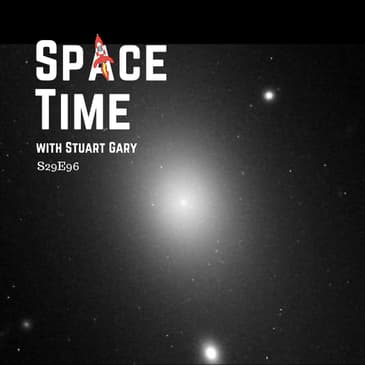
This is Spacetime Series twenty nine, Episode ninety six, for broadcasts on the twelfth of August twenty twenty six. Coming up on Space Time, the largest known galaxy in the universe, evidence of streams flowing across the surface of distant Pluto, and NASA's Mars Curiosity rover celebrates its fourteenth birthday on the surface of the red planet. All that and more coming up on space Time. Welcome to space Time with Stuart Gary. Astronomers have taken their deepest images yet of what, for now at least, is the largest known galaxy in the universe, a behemoth called I SEE eleven oh one, located in the heart of the galaxy cluster Able twenty twenty nine. The new observations, reported on the pre press physics website archive dot org, allowed the authors to identify the galaxy's outer edge for the first time, thereby confirming that it spans some one point seven million light years and contains an estimated three point four trillion solar masses in stars. Now by comparison, our own galaxy, the Milky Way, somewhere between one hundred thousand, one hundred and twenty thousand light years across and it contains roughly eight hundred billion to one point five trillion solar masses. All galaxies grow through mergers in galactic cannibalism, and for giants like IC eleven oh one, their faint stellar halos over billions of years blends smoothly in the intragalactic cluster that a fuse medium of gas, dust, and stars filling the space between galaxies in a cluster. All this splending makes them hard to measure. Their tidled tails and stellar halos overlap surrounding intracluster light, making it hard to turn where one galaxy ends and the next begins. So our studies, authors from the Institute of Astrophysics and the Canary Islands used ultra deep observations from the Isaac Newton Telescope to detect very faint starlight and then separate that light from the unwanted scattered light from foreground stars. This allowed them to build a detailed model of the telescope's points spread function using dozens of calibration stars of differing brightness. They could then use that data to subtract that scattered light one by one from over two hundred and fifty stars in their final image. In the process, revealing the faint structures and the radial profiles that is how the starlight changes with distance from the galactic center, revealed the galaxy's actual edge. Astronomers also found that this monster galaxy is still growing. The authors detected eight extensive, faint asymmetrical stellar structures, two lining up with known X ray disturbances, and the surrounding hot cluster gas, clear evidence this monster still cannibalizing other nearby galaxies getting bigger. This is space time still to calm. Evidence of streams flowing on the distant world of Pluto and NASAs Mars curiosity rover celebrates its fourteenth birthday on the red planet. All that and more still to come on space time. Astronomers have found the first ever evidence of liquids flowing across the surface of the distant, frozen world of Pluto. The findings, reported in the Planetary Science Journal, suggests that liquid nitrogen is rising to Pluto's surface through cracks along the northern edge of the spartanic Planetia, part of the massive heart shaped glacier that dominates much of the dwarf planet's surface. The findings are based on data from NASA's new Horizon spacecraft. The studies lead author Your Horizons, principal investigator On Stern from the Southwest Research Institute in San Antonio, Texas, says Pluto never stops surprising sciences. He says, in addition to suggesting that liquids have recently expressed themselves onto Pluto's surface, it also suggests a new kind of time variable feature on Pluto. Spartanic Planatia is a vast frozen nitrogen glacier larger than the states of Texas and Oklahoma combined. In twenty fifteen and twenty sixteen, the Horizons image the northernmost portions of this region, revealing city size geologic convection cells on Spartanic Planetia separated by a thin, dark, linear, and more diffuse dark features. New analysis now indicates that these dark, linear and diffuse features appear to have been occasionally and temporarily wetted, perhaps from time to time by liquid, the most likely liquid there being nitrogen. Now, Pluto's atmospheric and thermal conditions make liquid nitrogen rain physically impossible. Nevertheless, the surface patterns on northern Spotanic Planetia have been darkened in ways that do resemble glacial fractures on Earth that have been wetted by rain water or the subsurface emergent of liquids onto the surface. Scientists compared the New Horizon's images the NASA Lansat nine imagery of locations on Earth, including the Greenland Ice Sheet. Their dark, narrow surface features have been identified in areas where liquid water occurs on the ice and snow, and the Spartanic Planetia images from New Horizon appear very similar, suggesting that subsurface liquids, specifically nitrogen, is rising and wetting Pluto's nitrogen ice. Now adding to this is the simple fact Spartanic Planetia is quite young, probably less than a million years old based on muddling using surface overturn, so these features must have formed in the time period since then. Of course, Pluto has many unique terrains seen nowhere else in the Solar System, and this area of Spartanic Planetia is one of them. Its surface provides a different set of conditions compared to what scientists are used to seeing here on Earth, so exploring this area allows them to better understand how materials behave in environments that are very difficult to reaprot juice here on Earth, Earlier research did suggest ancient liquid flows on Pluto, but the new work suggests there is currently or at least recent liquid nitrogen beneath the surface of the glacier. Computer models show that nitrogen ice at the base of Pluto's kilometres deep Sputney glacier can melt, forming liquid nitrogen. These models reveal that this liquid can then be transported upwards to the surface through small condurits similar to lava or glacier tubes, driven by buoyancy or simply by pressure from below. The authors found that once reaching the surface, the melt and nitrogen can remain liquid long enough to flow downwards on the slopes on the spotanex nitrogen glacier, wetting the ice surface and producing the dark features being observed. While though other regions of Pluto showing the evidence of base or flow, over half of Pluto still remains unmapped in high resolution now this melting process and the liquid's up movement on Pluto could also potentially explain other events seen across the Solar System, such as the geysers observed by NATS Voyager two mission on Nettune's moon Triton, which, like Pluto, is thought to be a kipebot object. This is space time still to come as is Mars Curiosity rover celebrates its fourteenth birthday on the red planet and later in the science report for researchers genetically engineered tobacco and lettuce to produce meat proteins. All that and more still to calm on space time. NASA is Mars Curiosity rover has just celebrated its fourteenth birthday on the surface of the red planet. It was back on August sixth, twenty twelve, at the eight hundred ninety nine kilogram vehicle touched down on the floor of Gaal Crater. Its mission that determined if Mars was ever capable of hosting the sort of habitable conditions that would have been necessary to supported life as we know it, and within months scientists were provided with their answer are resounding yes. But that wasn't the end of its mission. Curiosity has continued to explore gal Cratus floor and is now moving up Mount Sharp, the crater's central peak. Curiosity has now reached a location that appears to be an erosional supersurface. That's a break in the rock record where layers of sediment have been stripped away by wind or water before newer layers were deposited on top of them. The five and a half kilometter high Mount Sharp is layered like a geology textbook, with each sedimentary rock strata representing a new chapter in the geologic history of the Red Planet. Mission managers say their six World car Sides robotic laboratory has now reached a layer where the science team have spotted a possible erosional supersurface. They reached this conclusion after analyzing orbital data alongside images of the layers and the buttes above the rover. After eyeing off this unusual section of Mount Sharp from a distance over the last few months, sit to say it's exciting to finally be so close to this feature over the coming days. Curiosity science instruments provide a geologist's eye view of the region, helping researchers understand this feature, including its composition and it's centime to scale geometry. The rovers imaging the feature at several different locations for the moment they've backed away from the feature to get a good rover's eye view, which sets up things nicely to collect two massive mass cam mosaics across the entire layer. Meanwhile, kemcam provided additional support by collecting some long distance images of the most interesting areas of the super surface. Mission managers have also measured the composition of the rocks at the bottom of the surface and to drive right up to the very base of the layer. They've also been using their time to grab some new images of the rovers wheels that determine just how badly they've become worn over the past fourteen years of travel, and the images show holds right through the treads. The science team have been able to use their new observation of the rock strata that determine where the most scientifically interesting places are and where to plan a new route in order to get there safely. You see, there are some pretty sandy and steeply sloping terrain around the site. After all, the last that you want is to get bogged in sand you can't get out of. Right now, NASA has two operational rovers on the surface of Mars, Curiosity and its younger sister, Perseverance, which are exploring two entirely different regions of the red planet and looking at different areas of the planet's past, Separated by some three thousand and seven kilometers. The two rovers are uncovering clues from very different moments in Martian history. Or Curiosity is climbing Mount Sharp in Sidegale Crater, where rock layers are revealing how the Martian climates changed as water dried up from its surface. Perseverance is on the rim of Jeso Crater, where it's studying some of the oldest Martian terrain ever explored, in the process searching for signs of ancient microbial life. Together, these two missions are helping scientists reconstruct how Mass four boomed and how it changed from a wool world where life could exist to the freeze dried desert it's become today. This report from Massa TV. NASA has two rovers on Mars and they're currently exploring completely different chapters of Martian history. They're two thousan three hundred miles apart, or roughly the distance from Los Angeles to Washington, d C. But the real divide between them isn't miles, it's millions, even billions of years. In and around Jeziro Crater. The Perseverance rover is looking back toward Mars's earliest years, searching for signs of ancient microbial life. After exploring an area of the crater that was once an ancient river Delta, Perseverance climbed to the crater rim to reach terrain that's nearly four billion years old. These rocks were here long before water filled the crater. Scientists even believe some rocks in this area formed when Mars was still shaping its crest and atmosphere and massive asteroids were pummeling the planet's surface. This terrain is a time capsule from the earliest period of the Solar System. Meanwhile, over two thousand miles to the east, the Curiosity rover is looking for evidence that ancient Mars had the right conditions to support life. Inside Gale Crater, Curiosity is climbing Mount Sharp, a mountain built from layers of sediment deposited over millions of years. Each layer is younger than the one below it, creating a geological timeline that records how Mars changed. So, while Perseverance looks back towards Mars' formative years, asking how the planet came of age, Curiosity is moving forward in time, reading a later story of water, climate, and habitability. Together, they're helping scientists reconstruct how Mars formed, how it changed and how it went from wet to dry. This is space time and time that another brief look at some of the other stories making news in science this week with the Science Report. Scientists have developed a you app they could help fast track the diagnosis of autism. It currently takes an average of three point one five years to confirm an autism finding, an even longer period of three point four nine years to confirm ADHD attention deficit hyperactivity disorder, and some four point two years to diagnose people with both. And that's where blink Lab comes in. It's a smartphone based diagnostic tool which is now being tested in Australia through Monash University, and it could cut down the time it takes to get a diagnosis in just three hours. Yepp works by playing videos with unexpe sounds while recording reactions on the phone's front camera. This is used to analyze facial reflexes and blinker responses to help diagnose autism and ADHD. Platforms already undergone successful trials in the United States, so now it's Australia's turn. Scientists have genetically engineered tobacco and lettuce plants, producing the meat protein miclobin, while at the same time also being environmentally friendly. The research, reported in the journal Frontiers of Plant Science, involved adding animal genes into the plant's DNA I enrich myoglobin gives me its gunami flavor and its red color. The authors say that myclobin could then be extracted from plants and used to improve the taste of vegan meat substitutes, or the letters could simply be een on its own as a source of iron. The authors found that per hector of farmland amount of myoglobin protein these plants can produce with more than rival that of animal agriculture, while at the same time also being far more environment friendly. A new study is shown that the famous, long extinct Dodo bird may actually have been nocturnal. The dodo, a global symbol of human caused extinction, was one of the world's largest pigeons. These flightless birds were native to Mauritius, an island east of Madagascar in the Indian Ocean. They were between sixty two and seventy five centimeters tall weigh up to twenty one kilograms. Dodos had grayish or brownish plumage, with lighter primary feathers and a tuft of curly light feathers high on its rear. Dodo's heads were gray and naked, with a green, black and yellow beak, and stout, yellowish legs with black claws. Sadly, the animals were hunted to extinction for their meat, with the last known death occurring in sixteen sixty two. The new study, reported in the Zoological Journal of the Line in Society, is shown that the dodo's' brains was proportionally appropriate for the bird's size, putting an end to the common belief that they were especially dumb at He claims that the rise of a teenager's problematic social media use from year to year may be a linked to an increase in attention deficit hyperactivity disorder symptoms. The research are reported in the Journal of the American Medical Association, found that year one year rises in problematic social media use in an individual were linked to a small subsequent increase in parent reported attention deficit hyperactivity disorder symptoms at ages fourteen through to sixteen, especially among boys. The authors say the new findings suggest that assessment of social media use among us with ADHD should focus on problematic patterns and consider sex specific risks. Amazon's next generation AI powered virtual assistant, Alexa plus has finally arrived in Australia. Based on Anthropic and Amazon's own AI programs, the large language model needed to be updated to understand the unique peculiarities of the Australian vernacular. With the details were joined by technology editor Alex Harovrout from Tech Advice Start Live. People might remember that Alexa is from these smart speakers and the ones with screens the Echo show. So originally you could talk to the smart speaker, ask it various questions, it would give you answers, and this was sort of like an aborted attempt in one sense to deliver an AI system, a bit like Siri and Google a system as well. But anyone who tried to speak to them from longer than a few senators quickly realized that, you know, the illusion of it being able to have these long phone conversations the way that we take for granted now with Chat, GBT and Claude just wasn't possible. Back then. It was a much more sort of primitive system. And although Amazon had hoped that people would use Alexa to order things from around their home, they even have little buttons where you could order more detergent for washing dishes or washing clothes. I mean, ultimately people were using Alexa Moore as a home automation system, and you know they were asking at various questions. You could ask it to give you a news bullets and TV news. There are a bunch of different skills. I mean, you were able to ask it to tell you funny jokes or you know, there was things you could do that made it kind of like a pretty cool all system, but not of the same caliber as chatbut or Claude as an example. And Alexa Plus, which is powered by Amazon's own AI systems, has been available in the US for the last year. And this is a conversational capable personal assistant, but unfortunately we didn't have it in Australia. But on August the fifth, it was launched into Australia and it is coming to early access people first, and it's designed to be conversational, deeply personal and complete real world tasks from start to finish. Now it'll be free during early access, then you'll need a prime membership. If you're not a Prime customer, it'll cost twenty nine dollars and ninety nine cents per month. One of the things that Amazon told me in December last year when I was in Vegas for their Reinvent conference, was it just wasn't ready for Australia yet, And I said, you know, well, it seems to be ready. There's a bunch of nuances for Australia. So now Alexa plus is tuned into Australian culture, local expressions. I was a sports, homegrown music. Amazon already put a lot of work into make sure that Alexa and Nenu you about Woolamloo, for example, and other Australian things. But when you're talking to an AI that really does feel effectively human, you really want to make sure that that's just sprinkled on top and it's baked in. The Other thing that you want your large language model to do is not just answer questions, but do things you want action. So you want it to be aclexa plus to book a table at your favorite restaurant, or tell you about potential calendar clashes you have with something you scheduled, with something that you're really doing, save cherished family recipes, or recommend to give for your mother and then buy it for you. And of course do things like home animation where you turn the eckon on, but do this proactively when it senses the temperature has risen in the room you're in. If you have those sorts of senses, I mean, these are the sort of things I'm talking about before. But now you've got this more intelligent AI behind it, it's going to feel a lot more natural, a lot more anticipatory. Actually, it'll feel like you're smart home is actually a smart home, not just smart because you can get a turn lights on or off, but it can talk to you if you set it up for Alexa Puss and that. Ways, that's Alex Oharov rout from Take Advice, Start Life, and this is Spacetime and that's the show for now. Spacetime is available every Monday, Wednesday and Friday through at bites dot com, SoundCloud, YouTube, your favorite podcast download provider, and from space Time with Stuart Gary dot com. Space Time's also broadcast through the National Science Foundation, on Science Own Radio and on both iHeartRadio and tune In Radio. And you can help to support our show by visiting the space Time Store for a range of promotional merchandising goodies, or by becoming a Spacetime patron, which gives you access to triple episode commercial free versions of the show, as well as lots of bonnus audio content which doesn't go away, access to our exclusive Facebook group, and other rewards. Just go to space Time with Stewart Gary dot com for full details. You've been listening to space Time with Stuart Garry. This has been another quality podcast production from bytes dot com.