
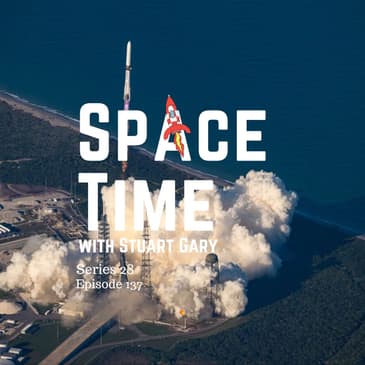



(00:00:43) NASA's ESCAPADE mission to Mars blasts off
(00:10:00) The Pleiades prove to be far bigger than thought
(00:14:05) Ending the debate over interstellar comet 3I-Atlas
(00:17:05) The Science Report
(00:19:39) Skeptics guide to talking to plants.
In this episode of SpaceTime, we explore the latest advancements in space exploration and cosmic discoveries that deepen our understanding of the universe.
NASA's Escapade Mission Launches to Mars
NASA has successfully launched its first dual satellite mission to Mars, the Escapade spacecraft, aboard Blue Origin's New Glenn rocket. This innovative mission aims to map the Martian magnetic field and atmosphere in three dimensions, providing crucial insights into how Mars lost its atmosphere and the conditions necessary for future human colonization. The twin probes, named Blue and Gold, will utilize a unique trajectory that allows for flexible launch windows, crucial for future resupply missions to Mars.
The Pleiades Star Cluster: A Greater Cosmic Structure
New research has revealed that the Pleiades star cluster is significantly larger than previously thought, forming the core of an expansive stellar complex that spans nearly 2,000 light years. This groundbreaking study combines data from multiple space missions, providing a clearer picture of the Pleiades' origins and its connection to other stellar groups, reshaping our understanding of star formation and migration across the galaxy.
Debate Over Interstellar Comet 3I Atlas Continues
The ongoing debate regarding the origins of interstellar comet 3I Atlas is addressed, as evidence increasingly supports its classification as a comet rather than an alien spacecraft. This segment explores the comet's characteristics, trajectory, and the scientific explanations behind its unusual features, reaffirming its status as a natural celestial object.
www.spacetimewithstuartgary.com
✍️ Episode References
Astrophysical Journal
NASA Reports
University of California Research
Become a supporter of this podcast: https://www.spreaker.com/podcast/spacetime-your-guide-to-space-astronomy--2458531/support.
This is Spacetime Series twenty eight, Episode one hundred and thirty seven, for broadcast on the twenty first of November twenty twenty five. Coming up on space Time, NASA's Escapade mission blasts off bound from Mars. Played E star cluster proved to be far bigger than originally thought, an ending debate over interstellar Comet three I Outlas. All that and more Coming up on space Time. Welcome to space Time with Stuart Gary. NASA's first dual satellite mission to another planet has successfully launched a boor Blue Origins New Glen heavy lift rocket bound for Mars. The Escape and Plasma Acceleration Dynamics Explorers or Escapade spacecraft blasted off from Pad third but He's six of the Cape Canavil Space Force space in Florida and what was only the second flight for the ninety eight meter tall New Glen rocket, which is named in honor of John Glenn, first American to orbit the Earth. The flight had been delayed several times due to bad weather and geomagnetic storms. Three minutes after liftoff, the rocket's first stage separated as planned and began its return journey to Earth, successfully landing on Blue Origin's recovery ship, Jacqueline, which had been prepositioned six hundred and four kilometers downrange in the North Atlantic Ocean. The successful landing means Blue Origin is now only the second company in history, after SpaceX, to recover a rocket during an operational orbital flight. Meanwhile, New Glen's second stage continued lifting the twin Escapade spacecraft into orbit. Thirty three minutes after launch, two Escapade probes were released into space to commence their long journey to Mars. The twin spacecraft, named Blue and Gold, will arrive at Mars in twenty twenty seven. Once in Mars orbit, the probes will fly in formation mapping the Martian magnetic field's upper atmosphere and our honosphere in three dimensions, in the process, providing the first stereo view of the red planet's unique near space environment. ESCAPADESS Principal investigator Robert Lillar's from the University of California, Berkeley. This is the mission will help scientists understand how and when Mars lost its atmosphere and provide key information about conditions on the planet that will help humans survive on this alien world once they get there. Sometime in the next decade. Lilli says, understanding how the honosphere varies will help develop better communications and navigation systems for life on Mars. Mapping the planet's magnetic fields and the response to space whether is important because Mars is neither a global magnetic field like the Earth nor a thick atmosphere like Earth. The shield its surface from damaging solar storms, so anyone living on the surface of Mars will have to protect themselves from the high energy particle radiation, which damages DNA and increases the risk of care answer. Lilis says, a background radiation level from the Milky Way galaxy is always present on Mars, but last year NASA's Curiosity rover documented an intense solar storm that delivered in one day the equivalent of one hundred days of normal background radiation. So this mission will be making space where the measurements to understand the system well enough to forecast solar storms whose radiation could harm astronauts on the surface of Mars or in orbit. Escapade will also pioneer a new trajectory to the red planet. Currently, typical missions to Mars are launched within a tight window just a few weeks long, roughly every twenty six months that gives spacecraft the most fuel efficient route. It's an elliptical path that allows vehicles to leave Earth orbit and insert themselves into Mars orbit at just the right time to catch the red planet as it reaches its closest orbital position to the Earth. All Mars missions up to now have used this method, known as a home and transfer, which restricts launchers to this once every two year alignment between the Earth and Mars. But instead Escapade will first head to a Lagrangian point that's where the gravitational pull of the Sun and Earth are equal, and it will remain stationed there for a year in a broad kidney being shaped orbit that will eventually bring it back towards the Earth early in November twenty twenty six at its closest approach. Escapade will then fire its engines to slingshot around the Earth and head out to meet Mars during its biannual alignment with the Earth. Lilis says if humans plan to settle on Mars in the future, hundreds of both manned and unmanned missions will need to be launched to resupply the colony during every alignment. Now since the Earth has a limited number of launch pads, whether and technical delays are also common escapades. Flexible trajectory could allow all these spacecraft to launch over many months, queueing up in the Lagrangian position before flying after Mars. During the planetary alignment escapades, too, probes will fly in different orbits around Mars, providing a three dimensional view of how the margin atmosphere responds to changes in the soul all wind, the constant stream of charged particles flowing out from the Sun. While Mars lacks a global magnetic field like the Earth's, it does have localized magnetic fields caused by strongly magnetized crust. These so called crustal fields are the remnants of a long gone global magnetic field that magnetized rocks as they cooled or were altered by water. While far weaker than the Earth's magnetic field, they are locally strong enough to push the solar wind up to fifteen hundred kilometers away from the Martian surface, and the goal here is to better understand how the solar wind energizes the particles and helps them escape into space. You see the escape of water and other atmospheric gases over the past four billion years has led to a very thin, wispy atmosphere on Mars with less than one percent the density of Earth's atmosphere. To understand how the solar wind drives different kinds of atmospheric escape is a key piece of the puzzle to understanding the climate evolution of Mars. Escapade stereo perspective will allow two different vantage points simultaneously, which could help determine what exactly happened to the water that once filled the lakes and rivers on Mars up to two billion years ago, and whether it's still available underground to be tapped by future Martian colonists. We already know that the geological evidence shows that Mars once had lots of water, but in order to keep that water, you need a thick atmosphere, one which hasn't been eroded and degassed into space. Once the satellites arrive at Mars, they'll take about seven months to settle into lower orbits that are synchronized. Instruments aboard the probes include two electrostatic analyzers. They'll measure the flux and energies of particles, both ionized atoms and electrons that are escaping from Mars. Litt it says that'll provide details on the direction the particles are going and what energies they have. Escapade is a twin spacecraft interplanetary mission to orbit Mars to understand Mars's unique magnetosphere. This is the first ever twin satellite mission sent to Mars. Berkeley has been involved with Mars mission since the early nineteen nineties with the Mars Leble Surveyor mission and the Maven mission in twenty thirteen, and then Escapade is sort of the next logical step the two spacecraft named Blue and Gold. We know that Mars once had a warm and wet atmosphere. It was definitely thick enough that liquid water could exist on the surface. But we know also today that Mars has a very thin atmosphere that would never be able to support liquid water. So Escapade's going to help us understand how Mars lost its atmosphere. Escapae will provide us with direct measurements of the escaping particles that are leaving the planet today to be lost to. Space, because the interaction of the solar wind with the man unisphere and the upper atmosphere of Mars is so complex. If you only have one spacecraft, you can either be measuring the effect of the interaction of the solar wind, or you can measure the solar wind, but you can't measure both at the same time. Escapade allows us to be in two places at once and to simultaneously sure the cause and the effect. Escapade has two instruments measuring electrons and ions that are built right here at you see. Berkeley on Escapade. The electrostatic analyzer exploits kind of a cool feature of electrons in space. Electrons of a particular energy tend to flow along magnetic field lines, and the way they're flowing along magnetic field lines can actually tell you what that magnetic field is connected to. You can tell something about the state of the plasma, the state of the atmosphere, the state of the sun from far away by measuring something really close. The Escapade mission will be our first mission that is truly interplanetary, because it's going to be the first time we operate spacecraft that far away from Earth. It's going to be unique for the first time for us to know that we can't have real time information into what's happening in the spacecraft we are simulating and training by putting in light travel time delays into our mission simulation. We need to understand the system well enough to send astronauts safely to Mars. A very important thing to understand is how radio signals propagate within and through Mars's atmosphere. That's important for communication and navigation signals. And in that report from the University of California, Berkeley, we heard from Escapade Principal Investigator Robert Lillis, Escapade Science team member Gwen Hanley, Escapade Sola and Heliospheric Associate Director Phyllis Whittlesey, and Escapade Mission Operations Director Abi Sheik Tripathy. This is space time still to come. The play at these proved to be far bigger than originally thought, and we end debate over the origins of interstellar Comet three I Atlas. All that and more still to come on space time. A new study has shown that the famous Plats open star cluster is far bigger than previously thought, and is actually part of an enormous stellar complex spreading across nearly two thousand light years. Open star clusters groups of stars that are all born in the same stellar nursery. The Plats or Seven Sisters, have been studied by humanity since antiquity. Amazingly different cultures on different far flung continents all refer to the same cluster as being seven sisters or seven daughters, possibly a throwback to the dreamtime stories that originated before humans first left Africa. The new researcher, reported in the Astrophysical Journal, employs a new approach to tracing stellar origins. Stars are formed in dense molecular clouds of gas and dust. As pockets of this material clumps together and gains mass, it collapses under its own gravity, eventually creating what becomes a hot stellar core, around which the star then forms. Star formation often happens in bursts, with many stars forming in close proximity and succession. These open star clusters remain gravitationally bound to each other for many millennia, eventually tens to hundreds of million years after their formation, The start forming material from which they emerge is ejected from the vicinity by cosmic winds, radiation, and other astrophysical phenomena. When this occurs, individual stars migrate across the other areas of their hearst galaxies, and it's then extremely challenging to identify their siblings and trace the chronology of their origin story, especially after one hundred million or more years have passed. This new work combines data from NASA's test mission is as Gay as Spacecraft and the Sloan Digital or Sky Survey to show that the Plates cluster actually constitutes the core of a much larger structure of related stars that are distributed over more than one nine hundred and fifty years. The studies lead author Andrew Boyle from the University of North Carolina Chapel Hill, says by combining data from Guya Tests and Sloane, the authors were able to confidently identify new members of the Plates On its own, The data from each mission was insufficient to reveal the full extent of the structure, but once integrated linking stellar motions from Geyer, rotations from tests, and chemistry from Sloane, a far more coherent picture emerged. Boyle says it was like assembling a jigsaw puzzle. Each data set provided a different piece for the larger puzzle. Now the authors are calling the new discovery the Greater Plats Complex. It contains at least three previously named groups of stars, likely too more. Bill and colleagues are able to determine that most of the members of this structure originated in the same giant stellar nursery. One of the keys of their approach is the fact that the speed of a star's rotation usually slows as it ages. Their work leveraged a combination of stellaration observations from tests which were designed to identify exo planets in transit in front of the heat stars, and observations of stellar motion from Geia, which was desired to map the Milky Way galaxy. Using this information, they developed a new rotational based way to single out and identify stars that share a common origin story. Beyond having complex ages, the authors also demonstrated that the stars integrated play these complex have similar chemical compositions, and that these stars all used to be much closer together combined. The evidence is overwhelming. This is space time still to come the ongoing debate over the origins and nature of the interstellar object three I Atlas, and later in the science report, the searchers find a new way to discourage seagulls from trying to steal your food at the beach. All that and more still to come on space time. Well, I know we've spoken about this before, but the ongoing debate over the origins and nature of the interstellar object three ey Atlas is continuing to pervade some sections of the media. The thing is, the evidence continues to point in just one direction. Three iye Atlas is a comet, not an alien spacecraft. Just like a comet, three eye Atlases swooped behind the Sun and emerged on the other side, And just as predicted, the comet's on the trajectory that will bring it to within two hundred and sixty eight million kilometers of the Earth on December the nineteenth, passing safely by. There has been no strange maneuvering towards the Earth, no slowing down, and no abrupt turns. It displays classic cometary features, including a tail, a coma around its nucleus, the outgassing of volatile materials, and an evolution in its brightness as it approached the head of the Sun. The so called anomalies which conspiracy theorists have been pointing to are all perfectly plausible characteristics for an interstellar comet. That's because these objects were a very different compositions, would have been subjected to very different radiation histories, and would be traveling at far higher velocities towards the Sun than those seen from your typical cloud or Kaiper Belt comet, so none of this should come as a surprise. What makes through our outless remarkable is where its outgassing begins, with hydruxyls surrogate for water being detected much further out from the Sun than typical Solar System comets, which at those sort of distances are still quiet. The comet's high gas plum nickel content and usually low water fraction, rapid brightening, and non gravitational acceleration suggesting a higher than normal rate of mass loss are all consistent with a body whose origin is in a star system with a very different elemental composition to our own Solar system, and that's exactly what one would expect from an interstellar object. Those supporting the alien spacecraft hypothesis claim that three Outlas was on a retrograde trajectory almost the line with the ecliptic, the plane around the Sun on which all the planets orbit, and they say its point of origin was close to the coordinates of the famous Wow signal, an unexplained signal picked up by a radio telescope in the nineteen seventies, which is now thought to have emanated from a pulsar. But none of this means that three I Atlas is a spacecraft, or more accurately, those pushing the conspiracy theories can't prove how this does mean it's a spacecraft. Other claims by conspiracy theorists peter rely on flawed statistics, and misinterpretations are uncertainly so large as to make the anomalies unconvincing. To quote the great astronomer Carl Sagan, extraordinary claims require extraordinary evidence, and so far it's just not there. This it's space time, and time that to take another brief look at some of the other stories making news in science this week with a science report, A new study claims drinking coffee can protect against atual fibrillation, a common heart rhythm disorder that causes rapid, irregular heartbeats and can lead to stroke, heart failure, and ultimately death. The findings, reported in the Journal of the American Medical Association, contradict earlier recommendations that people with heart issues like aphib should avoid caffeine out of fear that it will trigger symptoms. However, the new research by the University of Adelaide followed two hundred participants, concluding that drinking a cup of caffetted coffee every day actually reduced aphib by thirty nine percent. The authors say coffee increases physical activity, which is known to reduce atual fibrillation, and it's also a diarytic, which could potentially reduce blood pressure and in turn lessen a fit risk. They say several other ingredients and coffee also have anti inflammatory properties and that could have positive effects as well. In South Australia, the growing algal bloom problem is continuing to plague the state's coastal waters, in the process causing an ongoing mass killing of marine life. The bloom, which began back in March, has already kured millions of animals, wiping out enti ecosystems. Now researched by the University of Technology Sydney has identified the dominant species of the algae responsible for the toxins within the bloom, Urinia cristata. It's the first time that species has been detected in Australian waters. It's one of five Korenia species present, and the only one known to produce brief toxins. A suite of cyclic polyether compounds, which a neurotoxins that bind into voltage gated sodium channels in nerve cells. This causes disruption of normal neurological processes, resulting in neurotoxic shellfish poisoning. The South Australian State government says the bloom was triggered by floodwaters from the River Murray in twenty twenty two and twenty three, which brought extra nutrients into the sea. There was also cold water upwelling in the summer of twenty three twenty four which lifted more nutrients to the surface, and there've been marine heat waves since September twenty twenty four which increased water temperatures by some two and a half degree celsius. Researchers have found a new way to discourage sea gulls from trying to steal your food at the beach. A report in the journal Biotugal Letters claims simply shouting at the feathered fiends was enough to cause them to back off. The authors used recordings of men either speaking or shouting at the seagulls and found that the goals respond to the tone of the shout far more fearfully. Among some of the great myths about plants, whether talking to them really helps them grow, whether they prefer classical music to death metal. Of course, neither claims are true, but the myths persist. Ten mend them from Australian skeptics, says now there's a new book exposing the pseudo science and putting the facts straight. This book is by tim Etwhistle. There was used to be the head of the botanical gardens in Melbourne and he's a friend of the skeptics, which is how I knew him because he wrote some articles for our magazines are skeptic and basically looking at a lot of issues of botany and plant growth and lorses of areas like that. Now, this has been an area which has been of interest to paranormal people and skeptics. Therefore for a while, I don't know if any of your listeners would remember a book called The Secret Life of Plants, which the thing came out in the seventies or something like that. We've had a lot of myths that then cemented themselves in the zeitgeist of the tunnel and basically things like you can talk to plants, you can influence plants got through music and that sort of stuff and help them grow or hinder their growth, and cetera, if you play the right sort of chance and the old story of them Prince Charles talking to his plants and that sort of stuff to encourage them. A lot of people claim that you could play. If you play classical music to a plant, they would make them grow better. If you played heavy metal, they shrink up and die. Plants with particular musical tastes and the whole range of other things, and you get stories of do trees talk to each other? Can plants warn each other about something approaching, like a swall of like can sor something like that. Have plants react to human beings and all sorts of things. There's a lot of myths out there, sometimes little aspects that are actually have some basis in truth. Like trees under. Stress talk to each other by releasing certain chemicals either through their roots or through their leaves that act as warning signs for other trees. Yes, there's not so much warning. It's so basically trees under stress and he releases the chemicals and the others react to that. So it's hardly say, hey, next plant to me, what's out They're coming I guess basically what. Your terminology for conversation is. Yes, yeah, there are certain aspects we then get picked up. I doubt if these things are necessarily known to the authors of Secret Muss of Plants. So there are some aspects. I mean, they're very interesting things what plants do. Obviously, plants react to sunlight and all sorts of stimuli and various things touch. So there's a fast many things about plants, which is what Tim is talking about. That's Timendum from Australian Skeptics, and that's the show for now. Spacetime is available every Monday, Wednesday and Friday through at bytes dot com, SoundCloud, YouTube, your favorite podcast download provider, and from space Time with Stuart Gary dot com. Space Time's also broadcast through the National Science Foundation, on Science Own Radio and on both iHeartRadio and tune In Radio. And you can help to support our show by visiting the Spacetime Store for a range of promotional merchandising goodies, or by becoming a Spacetime Patron, which gives you access to triple episode commercial free versions of the show, as well as lots of Bonnus audio content which doesn't go to WEIR Access to our exclusive Facebook group and other rewards. Just go to space Time with Stuart Gary dot com for full details. You've been listening to Spacetime with Stuart Gary. This has been another quality podcast production from bytes dot com