



Australia's ERIS 1 Rocket Launch: A Learning Experience
In a dramatic turn of events, Gilmour Space's ERIS 1 rocket experienced a failure just seconds after liftoff, marking Australia's first orbital rocket launch in years. Despite the setback, CEO Adam Gilmour emphasizes the lessons learned from the test flight, which will inform the design and operation of future launches. The rocket's ascent was initially promising, but engine failures led to a crash shortly after clearing the launch tower. Fortunately, no injuries or environmental damage occurred, and the mission provided valuable data that will enhance the next attempt.
Life's Origins: A Cosmic Perspective
A new study suggests that the building blocks of life may have originated in outer space rather than on Earth. Using the ALMA radio telescope, astronomers detected complex organic molecules in the protoplanetary disk of the protostar UH V883 Orionis. These findings indicate that essential compounds, such as ethylene glycol and glycolonitrile, are not only present in various cosmic environments but may also be the precursors to amino acids and other vital biological components. This research supports the notion that the seeds of life are widespread throughout the universe.
Boeing's Starliner Delays Continue
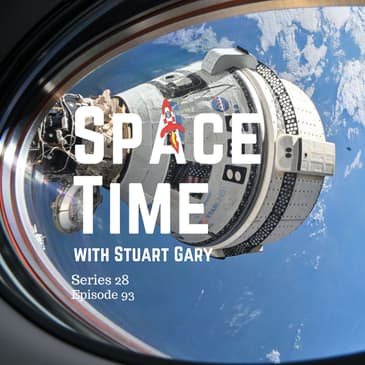
Boeing's Starliner spacecraft faces further delays, now pushed back to at least 2026 before it can carry humans into space. Ongoing technical issues have plagued the project, including helium leaks and thruster control problems. NASA is working closely with Boeing to address these challenges, but the timeline for crewed missions remains uncertain as SpaceX continues to lead in transporting astronauts to the International Space Station.
www.spacetimewithstuartgary.com
✍️ Episode References
Astrophysical Journal Letters
https://iopscience.iop.org/journal/1538-4357
NASA's Commercial Crew Program
https://www.nasa.gov/exploration/commercial/crew/index.html
Gilmour Space
https://gilmourspace.com/
Become a supporter of this podcast: https://www.spreaker.com/podcast/spacetime-space-astronomy--2458531/support.
00:00 A new study says the evolution of life may well have origins in outer space
00:47 Gilmour Space's Ares 1 orbital rocket crashed two seconds after launch
10:37 A new study says the evolution of life may have origins in outer space
11:28 Astronomers find 17 complex organic molecules in distant planet forming disk
19:35 New study finds images can shape public opinion regardless of true facts
22:06 World Meteorological Organization says megaflash stretched 829km in 2017
00:00:00 --> 00:00:02 Stuart Gary: This is space time series 28 episode 93
00:00:03 --> 00:00:05 for broadcast on the 4th of August 2025.
00:00:06 --> 00:00:09 Coming up on Space Time, Australia's first orbital uh,
00:00:09 --> 00:00:12 rocket launch in years fails seconds after
00:00:12 --> 00:00:15 liftoff. A new study says the evolution
00:00:15 --> 00:00:17 of life may well have its origins in outer space.
00:00:18 --> 00:00:20 And Boeing's trouble plagued Starliner
00:00:20 --> 00:00:23 spacecraft delayed until at least 2026.
00:00:24 --> 00:00:27 All that and more coming up um, on SpaceTime.
00:00:28 --> 00:00:31 Voice Over Guy: Welcome to SpaceTime with Stuart Gary
00:00:47 --> 00:00:49 Stuart Gary: Well they say space is hard and
00:00:49 --> 00:00:52 Gilmour Space have just learnt that lesson with their ERIS
00:00:52 --> 00:00:55 1 orbital rocket test launch crashing back to the ground
00:00:55 --> 00:00:58 just seconds after liftoff. Following days
00:00:58 --> 00:01:01 of delays due to bad weather conditions, launch day
00:01:01 --> 00:01:04 dawned fine and sunny with spectacular clear blue
00:01:04 --> 00:01:07 skies, few fluffy white clouds in the distance and
00:01:07 --> 00:01:10 the Bowen Spaceport on tropical North Queensland's Pacific
00:01:10 --> 00:01:13 coast looking spectacular. The 23
00:01:13 --> 00:01:16 meter tall 3 stage Eris Rocket appeared to
00:01:16 --> 00:01:19 lift off nominally. However just two
00:01:19 --> 00:01:21 seconds after launch. One of the Eris rocket's four
00:01:21 --> 00:01:24 hybrid Cirrus main engines appeared to fail.
00:01:24 --> 00:01:27 The launch vehicle continued to climb on the remaining three engines
00:01:27 --> 00:01:30 clearing the tower. But then a second engine also
00:01:30 --> 00:01:32 appeared to shut down about five seconds later.
00:01:33 --> 00:01:36 Uh, by this stage the launch vehicle had reached an altitude of
00:01:36 --> 00:01:39 just 50 metres and the loss of so much thrust
00:01:39 --> 00:01:42 caused the rocket to stall and begin pitching over and
00:01:42 --> 00:01:45 drifting sideways although still remaining in the
00:01:45 --> 00:01:48 vertical configuration. Although images showed
00:01:48 --> 00:01:50 fire still shooting out of the rocket engine nozzles on the two
00:01:50 --> 00:01:53 failed motors they no longer had enough chamber pressure to
00:01:53 --> 00:01:56 develop thrust resulting in them vehicle falling back to
00:01:56 --> 00:01:59 the ground in a massive cloud of white vapor.
00:02:00 --> 00:02:02 The white vapour was the hydrogen peroxide
00:02:02 --> 00:02:05 oxidiser which was used to ignite the solid fuel
00:02:05 --> 00:02:08 component of the hybrid engine. An investigation
00:02:08 --> 00:02:10 reviewing the flight data is now underway with special
00:02:10 --> 00:02:13 attention focusing on the oxidiser pumps.
00:02:13 --> 00:02:16 The good news is no one was injured in the crash, there was
00:02:16 --> 00:02:19 no environmental impact and the launch tower and ground
00:02:19 --> 00:02:22 facilities were undamaged. Gilmour
00:02:22 --> 00:02:24 Space says the launch vehicle had suffered an extended 18
00:02:24 --> 00:02:27 month delay on the pad waiting for final government
00:02:27 --> 00:02:30 approvals and of course the weather. The company
00:02:30 --> 00:02:33 says the launch experienced smooth operations throughout the
00:02:33 --> 00:02:36 terminal countdown. It says there was a successful
00:02:36 --> 00:02:38 auto sequence in ignition of all four first stage
00:02:38 --> 00:02:41 hybrid rocket engines with 23 seconds of total
00:02:41 --> 00:02:44 engine burn time as well as the 14 seconds of flight.
00:02:44 --> 00:02:47 And there was a successful integration of operations
00:02:47 --> 00:02:50 between the launch vehicle itself and ground systems
00:02:50 --> 00:02:53 for flight software and GNC performed as expected.
00:02:54 --> 00:02:56 There was extensive flight data collected during the test
00:02:56 --> 00:02:59 and a safe execution of launch and range
00:02:59 --> 00:03:01 operations. Company CEO uh Adam
00:03:01 --> 00:03:04 Gilmour says mission managers learnt a tremendous amount that will
00:03:04 --> 00:03:07 go directly towards improving the next launch vehicle which is
00:03:07 --> 00:03:10 currently still in production. Gilmour says only
00:03:10 --> 00:03:13 six nations currently launch into orbit on a regular
00:03:13 --> 00:03:16 basis and uh, just a handful are developing sovereign capabilities
00:03:16 --> 00:03:18 to join them. He says Test Flight one
00:03:18 --> 00:03:21 marks several national firsts. It was the
00:03:21 --> 00:03:24 first integrated launch of a fully Australian built orbital
00:03:24 --> 00:03:27 class rocket and the first use of a licensed commercial
00:03:27 --> 00:03:30 orbital spaceport in the country. All core systems
00:03:30 --> 00:03:33 including propulsion, avionics, software and
00:03:33 --> 00:03:35 infrastructure were designed and manufactured by
00:03:35 --> 00:03:38 Gilmour Space, supported by a team of over 200
00:03:38 --> 00:03:41 staff and 500 Australian suppliers.
00:03:41 --> 00:03:44 Gilmour says they'll try again with the ERIS II
00:03:44 --> 00:03:47 test flight in coming months. The 30
00:03:47 --> 00:03:50 ton Aris rocket is designed to launch payloads
00:03:50 --> 00:03:53 of up to 300 kg into low earth orbit. But
00:03:53 --> 00:03:56 for this first test flight, the only payload on board was a
00:03:56 --> 00:03:59 jar of Vegemite, a, uh, favourite Australian sandwich
00:03:59 --> 00:04:02 spread. And images show that it appears to
00:04:02 --> 00:04:04 have survived as
00:04:04 --> 00:04:07 well as the four hybrid Cirrus main first stage engines.
00:04:07 --> 00:04:10 A single Cirrus hybrid engine is used for the second
00:04:10 --> 00:04:13 stage, while a conventional liquid oxygen and kerosene
00:04:13 --> 00:04:16 fuelled engine is used on the upper or third stage.
00:04:16 --> 00:04:19 Astrophysics professor Jonti Horner from the University of
00:04:19 --> 00:04:22 Southern Queensland described the test as actually being the best
00:04:22 --> 00:04:25 first launch he's ever seen. Horner says it's all
00:04:25 --> 00:04:28 a key part of how new rockets and spaceflight
00:04:28 --> 00:04:31 technologies are developed and teams learn a lot more from
00:04:31 --> 00:04:33 what goes wrong than what goes right.
00:04:33 --> 00:04:36 Jonti Horner: To be honest, they'll have an incredible wealth of data from
00:04:36 --> 00:04:39 this day. We'll have cameras everywhere, all the sensor feedback
00:04:39 --> 00:04:42 and everything else. And I'd expect them to be able to,
00:04:42 --> 00:04:45 even though they're already building that second rocket, to be able
00:04:45 --> 00:04:47 to take advantage of what they've learned from this first
00:04:47 --> 00:04:50 attempt, uh, and next time should be bigger, better,
00:04:50 --> 00:04:53 faster. We'll probably still not make it to space. I think they'd be
00:04:53 --> 00:04:56 overwhelmingly surprised if the next time they test it
00:04:56 --> 00:04:59 they get into orbit, but they'll be able to apply what they've learned
00:04:59 --> 00:05:02 from this one, do a better job next time. And it's this progression
00:05:02 --> 00:05:05 towards finally having the commercial product that they want that
00:05:05 --> 00:05:07 is able to reliably put things into orbit on demand.
00:05:08 --> 00:05:10 Stuart Gary: Gilmour says that all the avionics, all the core
00:05:10 --> 00:05:13 systems, the software had all performed exactly as it was
00:05:13 --> 00:05:16 meant to. So they would have gleaned a ream of
00:05:16 --> 00:05:17 information from that launch.
00:05:18 --> 00:05:21 Jonti Horner: No, absolutely. And I think when one engine failed your rocket would
00:05:21 --> 00:05:24 naturally tip over because it's no longer balanced, but it's dead
00:05:24 --> 00:05:27 vertical. Because the kind of attitude control jets that they've got
00:05:27 --> 00:05:29 on there did a really incredible job keeping it
00:05:29 --> 00:05:32 upright essentially. And that to me is probably the kind of
00:05:32 --> 00:05:35 thing that is really gold in terms of the knowledge
00:05:35 --> 00:05:38 that they get for the Gilmores because they show that all those
00:05:38 --> 00:05:41 other systems worked well. Because if you think back to those early
00:05:41 --> 00:05:44 footage of them, they always show this in comedic form
00:05:44 --> 00:05:47 in cartoons, on tv when they're building a rocket, you get
00:05:47 --> 00:05:49 those old footage of rocket launch failures from the 50s
00:05:49 --> 00:05:52 and 60s. And um, one of the really common themes is rocket goes up
00:05:52 --> 00:05:55 and falls over and crashes. So for this one to go up and
00:05:55 --> 00:05:58 um, something go wrong, but it instead hovers and
00:05:58 --> 00:06:01 tacks sidewards. That's actually a really good sign that a
00:06:01 --> 00:06:03 lot of the systems are working really incredibly well and are very
00:06:03 --> 00:06:04 well engineered.
00:06:04 --> 00:06:07 Stuart Gary: For me, space is hard and I guess Gilmour Space
00:06:07 --> 00:06:10 have found that out. But I guess they also always knew that.
00:06:10 --> 00:06:13 Jonti Horner: I think if you look at the comments they were making in the run up to the
00:06:13 --> 00:06:16 test, they were saying they'd be delighted if they just got off the ground.
00:06:16 --> 00:06:19 And for me, you know, I look back to being a kid in
00:06:19 --> 00:06:22 the 80s and 90s getting really obsessed about
00:06:22 --> 00:06:25 astronomy and space. And at that time you had all this footage
00:06:25 --> 00:06:27 from the dawn of the space age, of all of the many and
00:06:27 --> 00:06:30 various ways that both the Soviets and the Americans failed to
00:06:30 --> 00:06:33 launch a rocket. And they were always very explosive and very
00:06:33 --> 00:06:36 cataclysmic and we've seen that kind of same model play out
00:06:36 --> 00:06:39 with the development of commercial launch capacity over
00:06:39 --> 00:06:42 the last decade or so. And every time SpaceX introduces
00:06:42 --> 00:06:45 a new rocket, for example, it gets tested to
00:06:45 --> 00:06:47 destruction. They have their rapid unscheduled
00:06:47 --> 00:06:50 disassemblies going on all the time. And in light of that,
00:06:50 --> 00:06:53 I think in my memory of all the rocket launchers I've
00:06:53 --> 00:06:55 seen, and I stress I'm not a total mad space
00:06:56 --> 00:06:59 expert like some people are, I don't watch every single launch, but this
00:06:59 --> 00:07:02 is about the best first launch I've ever seen. It was for me
00:07:02 --> 00:07:04 a really wonderful success. Rather than the failure
00:07:04 --> 00:07:07 that some group of people on social media seem to try and want to paint
00:07:07 --> 00:07:08 it as.
00:07:08 --> 00:07:11 Stuart Gary: The idea of orbital launches from Australian soil
00:07:11 --> 00:07:14 isn't really new. We were launching rockets from the
00:07:14 --> 00:07:16 Woomera rocket range into orbit in the 1960s
00:07:16 --> 00:07:19 and early 70s. These included Australian built
00:07:19 --> 00:07:22 satellites, US and British rockets. In fact, at one
00:07:22 --> 00:07:24 stage Woomera was the second biggest
00:07:24 --> 00:07:26 spaceport in the world.
00:07:26 --> 00:07:29 Jonti Horner: Only Cape Canaveral was, that's sadly
00:07:29 --> 00:07:32 ancient history. That was before I was even born. Because
00:07:32 --> 00:07:34 once that stopped there's been this enormous long period
00:07:34 --> 00:07:37 where we've not really been involved, to be honest. I think
00:07:37 --> 00:07:40 this though is a slightly different beast in that this is a
00:07:40 --> 00:07:43 ah, real attempt to have a commercial program
00:07:43 --> 00:07:45 where you've got Australian built rockets
00:07:45 --> 00:07:48 launching from within Australia. So keeping everything in
00:07:48 --> 00:07:51 house. And to me that's really serving two kind of
00:07:51 --> 00:07:54 simultaneous benefits. From a commercial point of view it means that uh,
00:07:54 --> 00:07:56 people in Australia who want to build a satellite and get it
00:07:56 --> 00:07:59 launched don't have to export that satell,
00:07:59 --> 00:08:02 have to pay somebody in another country to launch from another country,
00:08:02 --> 00:08:05 ship yourself there. So you're not exporting wealth in
00:08:05 --> 00:08:08 that sense. At the same time it also means that people
00:08:08 --> 00:08:11 overseas will be able to look at Australia as providing
00:08:11 --> 00:08:14 a launch option for them. And so commercially we may well have
00:08:14 --> 00:08:17 packages being launched to space that are built outside
00:08:17 --> 00:08:20 Australia. And so we're instead importing wealth, we're importing
00:08:20 --> 00:08:23 money as this commercial thing. I think that's a niche that uh, the
00:08:23 --> 00:08:26 Gilmores have identified. They're looking at launching satellite up
00:08:26 --> 00:08:29 into low earth orbit where there are more people who have satellites
00:08:29 --> 00:08:31 to launch than there uh, are rockets available, launch
00:08:31 --> 00:08:34 them at the minute. There's a real kind of bottleneck there. So that's really
00:08:34 --> 00:08:37 promising from Australia. From a commercial point of view it also
00:08:37 --> 00:08:40 gives you that kind of sense of sovereignty, sovereign capacity
00:08:40 --> 00:08:43 that you're not reliant on other countries. But to me, I think
00:08:43 --> 00:08:45 probably the thing I get most excited about this is
00:08:45 --> 00:08:48 simply the kind of inspiration, the idea that
00:08:48 --> 00:08:51 young kids in Australia who are excited about space
00:08:51 --> 00:08:54 and excited about rockets. Historically, if they
00:08:54 --> 00:08:57 wanted to become rocket scientists, you know, if they wanted to work with
00:08:57 --> 00:09:00 rockets and um, make their career out of that, they had to go
00:09:00 --> 00:09:03 overseas. And we have this brain drain where you had some of the
00:09:03 --> 00:09:06 and brightest having go to the US or to Europe
00:09:06 --> 00:09:09 in order to pursue that dream, in order to pursue that career. Whereas
00:09:09 --> 00:09:12 now we're showing that in regional Australia even people
00:09:12 --> 00:09:15 have the opportunity to follow that career, follow that and make
00:09:15 --> 00:09:18 it a pathway that they can stay in Australia and do so. Maybe
00:09:18 --> 00:09:21 we'll see some of the brain drain reverse. We'll get some people back to
00:09:21 --> 00:09:22 Australia who moved away.
00:09:22 --> 00:09:25 Stuart Gary: I think we've seen the potential future when we
00:09:25 --> 00:09:28 look across the Tasman Sea to New Zealand where
00:09:28 --> 00:09:31 rocket lab have done brilliant things. They launch what, once
00:09:31 --> 00:09:32 every two or three weeks now.
00:09:32 --> 00:09:35 Jonti Horner: That's an incredible achievement. And it does feel like Australia.
00:09:35 --> 00:09:38 Israelis playing catch up. I seem to remember when the space agency
00:09:38 --> 00:09:41 was established, people were trotting out facts about how many
00:09:41 --> 00:09:44 other countries had space agencies before we got one. And
00:09:44 --> 00:09:47 I believe we were something like the 83rd. Please correct me if I'm wrong
00:09:47 --> 00:09:50 there, but we were somewhere in the 70s or 80s as a
00:09:50 --> 00:09:53 country that was finally having a space agency. And other
00:09:53 --> 00:09:56 countries have stolen a march on us with this transition from
00:09:56 --> 00:09:59 space being purely a government exercise where you were really only
00:09:59 --> 00:10:01 looking at a few entities like NASA,
00:10:01 --> 00:10:04 European Space Agency, jaxa, uh, the Soviet,
00:10:04 --> 00:10:07 Chinese maybe suddenly you've got companies springing up all around
00:10:07 --> 00:10:10 the world and countries investing in it, new launch facilities all the
00:10:10 --> 00:10:12 time. There was a big stir here in Queensland just on Wednesday
00:10:13 --> 00:10:16 when we saw clouds from a rocket launch in
00:10:16 --> 00:10:18 the evening sky at about 6:30 ah pm and it turned out that
00:10:18 --> 00:10:21 was a Chinese rocket that had been launched from one of their
00:10:21 --> 00:10:24 commercial space launch facilities putting up the Chinese
00:10:24 --> 00:10:27 equivalent of Starlink, their own communications network
00:10:27 --> 00:10:30 that had launched over Australia. And we saw the first
00:10:30 --> 00:10:33 stage separation. The boosters falling away
00:10:33 --> 00:10:35 gave a very distinct show that freaked people out here in
00:10:35 --> 00:10:37 southeast Queensland.
00:10:37 --> 00:10:40 And um, that's going to become more common. Everybody around the world is
00:10:40 --> 00:10:42 getting involved in this because it's gone from being the few
00:10:42 --> 00:10:45 wealthy countries that could afford to do it to being a
00:10:45 --> 00:10:48 commercial enterprise where everybody can get in the game and there's money
00:10:48 --> 00:10:48 to be made.
00:10:48 --> 00:10:51 Stuart Gary: That's Professor Jonti Horner from the University of
00:10:51 --> 00:10:54 Southern Queensland. And this is space
00:10:54 --> 00:10:57 time. Still to come. A new study
00:10:57 --> 00:11:00 says the evolution of life may have its origins in
00:11:00 --> 00:11:02 outer space. And the next test flight for
00:11:02 --> 00:11:05 Boeing's long delayed and trouble plagued Starliner spacecraft,
00:11:05 --> 00:11:08 now delayed until at least 2026.
00:11:08 --> 00:11:11 All that and more still to come on, uh, space time.
00:11:27 --> 00:11:30 Astronomers have discovered complex organic molecules
00:11:30 --> 00:11:33 which are precursors to the sugars and amino acids essential
00:11:33 --> 00:11:36 for life as we know it in a distant planet forming
00:11:36 --> 00:11:39 disk. The findings reported in the Astrophysical
00:11:39 --> 00:11:42 Journal Letters provide more evidence supporting the
00:11:42 --> 00:11:44 idea that the evolution of life may well have
00:11:44 --> 00:11:47 its origins not here on Earth, but in
00:11:47 --> 00:11:50 outer space. Astronomers using
00:11:50 --> 00:11:53 alma, the Atacam, a Large Millimeter Submillimeter
00:11:53 --> 00:11:55 Array radio telescope in Chile, detected
00:11:55 --> 00:11:58 signatures for complex organic molecules, including the
00:11:58 --> 00:12:01 first tentative detection of ethylene glycol and
00:12:01 --> 00:12:04 glycolonitrile in the protoplanetary disk of the
00:12:04 --> 00:12:06 outbursting Protostar UH V883
00:12:06 --> 00:12:09 Orionis. These compounds are considered
00:12:09 --> 00:12:12 precursors to the building blocks of life.
00:12:12 --> 00:12:15 Comparing different cosmic environments reveals that the
00:12:15 --> 00:12:18 abundance and complexity of these molecules increase
00:12:18 --> 00:12:21 from star forming regions to fully evolved planetary
00:12:21 --> 00:12:24 systems. And that suggests that the seeds of
00:12:24 --> 00:12:27 life are assembled in space and are widespread.
00:12:27 --> 00:12:30 Astronomers have already discovered complex organic molecules
00:12:30 --> 00:12:33 in various locations associated with both planetary and
00:12:33 --> 00:12:36 star formation. Complex organic
00:12:36 --> 00:12:38 molecules are those with more than five atoms,
00:12:38 --> 00:12:41 at least one of which is carbon. Many of them
00:12:41 --> 00:12:44 are considered the building blocks of life, such as
00:12:44 --> 00:12:47 amino and nucleic acids and their precursors.
00:12:47 --> 00:12:50 The discovery of 17 complex organic molecules in the
00:12:50 --> 00:12:53 protoplanetary disk of V883 Orionis,
00:12:53 --> 00:12:56 including ethylene glycol and glycolonitrile, provides
00:12:56 --> 00:12:58 a long sought after puzzle piece in the evolution of these
00:12:58 --> 00:13:01 molecules between the stages preceding and following
00:13:01 --> 00:13:04 the formation of stars and their surrounding
00:13:04 --> 00:13:05 protoplanetary disks.
00:13:06 --> 00:13:09 Glycolonitrile is a precursor to the amino
00:13:09 --> 00:13:12 acids glycyl and alanine as well as the nuclear
00:13:12 --> 00:13:14 base adenine. These findings are pointing
00:13:14 --> 00:13:17 a straight line of chemical enrichment, increasing
00:13:17 --> 00:13:20 complexity between interstellar clouds of gas and
00:13:20 --> 00:13:23 dust and fully evolved planetary systems.
00:13:23 --> 00:13:26 The transition from a cold protostar uh, to a young
00:13:26 --> 00:13:29 star surrounded by a disk of dust and gas is
00:13:29 --> 00:13:31 accompanied by a violent phase of shock gas,
00:13:32 --> 00:13:35 intense radiation and rapid gas ejection.
00:13:35 --> 00:13:38 The thing is, it was always thought that these energetic processes
00:13:38 --> 00:13:41 would wind up destroying most of the complex chemistry
00:13:41 --> 00:13:44 assembled during these early stages. So the
00:13:44 --> 00:13:46 study's authors set out a so called reset
00:13:46 --> 00:13:49 scenario in which most of the chemical compounds required to
00:13:49 --> 00:13:52 evolve into life would have to be reproduced in
00:13:52 --> 00:13:55 circumstellar disks while forming comets, asteroids and
00:13:55 --> 00:13:58 planets. One of the study's authors, Canber Schwartz
00:13:58 --> 00:14:01 from the Max Planck Institute in Germany, says it now appears
00:14:01 --> 00:14:04 the opposite is actually true. The results suggest
00:14:04 --> 00:14:06 that these planetary disks are inheriting complex
00:14:06 --> 00:14:09 molecules from earlier stages and the formation of
00:14:09 --> 00:14:12 complex molecules can thus continue during the
00:14:12 --> 00:14:14 protoplanetary disk stage. In fact,
00:14:14 --> 00:14:17 the period between the energetic protostellar phase
00:14:17 --> 00:14:20 and the establishment of a protoplanetary disk would on its
00:14:20 --> 00:14:23 own be too short for complex organic molecules to form
00:14:23 --> 00:14:26 in detectable amounts. It means that the
00:14:26 --> 00:14:29 conditions which predefined biological processes must
00:14:29 --> 00:14:32 be more widespread rather than simply being restricted
00:14:32 --> 00:14:35 to individual planetary systems. Astronomers
00:14:35 --> 00:14:38 have already found the simplest organic molecules, such as methanol,
00:14:38 --> 00:14:40 uh, in dense regions of molecular gas and dust clouds
00:14:40 --> 00:14:43 which predate the formation of stars. Under
00:14:43 --> 00:14:46 favourable conditions, they may even contain complex
00:14:46 --> 00:14:49 compounds comprising ethylene glycol, one of the species
00:14:49 --> 00:14:52 now discovered in V883 Orionis.
00:14:52 --> 00:14:55 Astronomers recently discovered that ethylene glycol
00:14:55 --> 00:14:57 could form through the ultraviolet irradiation of
00:14:57 --> 00:15:00 ethanolamine, another molecule that was recently Discovered
00:15:00 --> 00:15:03 in space. The findings support the
00:15:03 --> 00:15:05 idea that ethylene glycol could form in these
00:15:05 --> 00:15:08 environments, but also in later stages of
00:15:08 --> 00:15:11 molecular evolution in areas where ultraviolet
00:15:11 --> 00:15:14 irradiation is dominant. We know that
00:15:14 --> 00:15:17 more evolved agents Crucial to biology, Such as
00:15:17 --> 00:15:20 amino acids, sugars and nucleobases that make up
00:15:20 --> 00:15:23 both RNA and DNA, are, ah, present in asteroids,
00:15:23 --> 00:15:25 meteorites and comets within our solar system.
00:15:25 --> 00:15:28 The chemical reactions that synthesize these complex
00:15:28 --> 00:15:31 organic molecules Occur under cold conditions,
00:15:31 --> 00:15:34 Preferably on icy dust grains that later accrete
00:15:34 --> 00:15:37 to form larger objects. Hidden in those mixtures
00:15:37 --> 00:15:40 of rock, ice and dust, they usually remain undetected.
00:15:41 --> 00:15:44 So accessing those molecules Is really only possible either
00:15:44 --> 00:15:47 by grabbing the object and digging them out with space probes,
00:15:47 --> 00:15:50 or through external heating, which evaporates the ice.
00:15:50 --> 00:15:53 Uh, in our solar system, the sun heats comets,
00:15:53 --> 00:15:56 Resulting in impressive tales of gas and dust,
00:15:56 --> 00:15:59 as well as comas, Essentially gaseous envelopes that
00:15:59 --> 00:16:02 surround the cometary nuclei. And through
00:16:02 --> 00:16:05 this method, Astronomers use spectroscopy to
00:16:05 --> 00:16:07 pick up the emissions of freed molecules.
00:16:08 --> 00:16:10 And these spectral fingerprints Are helping astronomers to
00:16:10 --> 00:16:13 identify molecules previously buried in ice.
00:16:14 --> 00:16:17 And when you think about it, it was really a similar heating process
00:16:17 --> 00:16:19 which is occurring on V883 Orionis.
00:16:20 --> 00:16:22 The Central Star in the system Is still growing by
00:16:22 --> 00:16:25 accumulating gas from the surrounding disk until it
00:16:25 --> 00:16:28 eventually gathers enough mass to reach sufficiently high
00:16:28 --> 00:16:30 core temperatures and pressures to ignite nuclear.
00:16:32 --> 00:16:34 During these growth periods, the infalling gas Heats
00:16:34 --> 00:16:37 up and produces intense outbursts of radiation.
00:16:38 --> 00:16:41 Schwartz says these outbursts are strong enough to heat the
00:16:41 --> 00:16:43 surrounding disk, in the process releasing complex
00:16:43 --> 00:16:45 molecules, including ethylene glycol and
00:16:45 --> 00:16:48 glycolonitrile and radiate at radio
00:16:48 --> 00:16:50 frequencies, which ALMA can then detect.
00:16:51 --> 00:16:54 This is space time still to come.
00:16:54 --> 00:16:57 Boeing's trouble plagued Starliner spacecraft delayed
00:16:57 --> 00:16:59 until at least next year and later in the science
00:16:59 --> 00:17:02 report, the biggest lightning flash ever
00:17:02 --> 00:17:05 recorded on planet Earth. All that and more still
00:17:05 --> 00:17:07 to come on space time.
00:17:22 --> 00:17:25 NASA says Boeing's trouble plagued Starliner
00:17:25 --> 00:17:28 spacecraft May be delayed until at least next year and won't
00:17:28 --> 00:17:30 be carrying humans when it does finally return into the
00:17:30 --> 00:17:33 skies. The announcement came as SpaceX was
00:17:33 --> 00:17:36 preparing to launch its 19th manned Dragon capsule
00:17:36 --> 00:17:39 carrying Crew 11 astronauts to the International Space
00:17:39 --> 00:17:42 Station on the Falcon 9 rocket from launch pad
00:17:42 --> 00:17:44 39A at the Kennedy Space center in Florida.
00:17:45 --> 00:17:47 SpaceX and Boeing were supposed to share the duties,
00:17:47 --> 00:17:50 Transporting crews to and from the space station as
00:17:50 --> 00:17:52 part of NASA's Commercial Crew Program.
00:17:53 --> 00:17:56 SpaceX began flying astronauts aboard Dragon in
00:17:56 --> 00:17:58 2020. But the ongoing plague of problems
00:17:58 --> 00:18:01 with starliner Means that It's really not ready to
00:18:01 --> 00:18:04 carry people again until the second crew rotation
00:18:04 --> 00:18:07 slot, which won't be until near the end of 2026.
00:18:08 --> 00:18:11 See, there have been a string of technical issues over several
00:18:11 --> 00:18:13 years with Starliner. And even when continuing
00:18:13 --> 00:18:16 problems with the unmanned test flights were finally sorted out, well,
00:18:16 --> 00:18:19 sort of. And Starliner was cleared for an eight day
00:18:19 --> 00:18:22 manned mission to the space station last June, there were
00:18:22 --> 00:18:25 helium leaks in the spacecraft. There are also thruster
00:18:25 --> 00:18:28 control problems with the propulsion system during the ascent of the
00:18:28 --> 00:18:30 space station. And these all combined to
00:18:30 --> 00:18:33 force NASA to scrub the use of Starliner for the
00:18:33 --> 00:18:36 return to Earth. And that stranded its crew on
00:18:36 --> 00:18:39 station for over nine months. That was until they could
00:18:39 --> 00:18:42 finally hitch a ride back to Earth aboard a Dragon
00:18:42 --> 00:18:44 capsule. As for the Starliner spacecraft, well,
00:18:44 --> 00:18:47 it turns out it did return to Earth safely, landing at the White
00:18:47 --> 00:18:50 Sands Missile Range in New Mexico in September. But
00:18:50 --> 00:18:53 without the crew. Boeing and NASA
00:18:53 --> 00:18:56 took a close look at the latest problems with Starliner. They've,
00:18:56 --> 00:18:59 uh, elected to find a new sealant material to address the
00:18:59 --> 00:19:02 helium leaks. And they're looking at several hardware changes in order
00:19:02 --> 00:19:05 to try and deal with what's been determined to be overheated
00:19:05 --> 00:19:08 thrusters. The hardware will draw heat away from
00:19:08 --> 00:19:11 the thrusters and they'll also install thermal barriers around
00:19:11 --> 00:19:14 them, which hopefully will solve the problem. Needless
00:19:14 --> 00:19:17 to say, only time will tell this
00:19:17 --> 00:19:18 space, time
00:19:33 --> 00:19:34 and time.
00:19:34 --> 00:19:37 Now to take a brief look at some of the other stories making news in Science
00:19:37 --> 00:19:39 this week with a Science report.
00:19:40 --> 00:19:43 A new study warns that you could be breathing in tens of
00:19:43 --> 00:19:45 thousands of microplastic particles every day.
00:19:46 --> 00:19:49 Microplastics are particles less than 10 micrometers
00:19:49 --> 00:19:52 across. That's smaller than a speck of dust
00:19:52 --> 00:19:55 and seven times thinner than the width of a strand of human
00:19:55 --> 00:19:58 hair. A ah report in the journal plos One
00:19:58 --> 00:20:01 collected air samples from apartments and cars in
00:20:01 --> 00:20:03 order to see how common microplastics were in the
00:20:03 --> 00:20:06 atmosphere. The authors found that 94% of
00:20:06 --> 00:20:09 the particles they detected fell in the microplastic size
00:20:09 --> 00:20:12 range, which means they're small enough to be easily inhaled
00:20:12 --> 00:20:15 deep into human lungs. Now, when combined with
00:20:15 --> 00:20:17 other published data, the authors estimate that the average adult
00:20:17 --> 00:20:20 is probably inhaling around 68 of these
00:20:20 --> 00:20:22 superfine particles every day.
00:20:24 --> 00:20:27 Well, we've all seen those horrific images of children,
00:20:27 --> 00:20:30 just skin and bones that look like they've been starved nearly
00:20:30 --> 00:20:32 to death. What the perpetrators of those images
00:20:32 --> 00:20:35 didn't tell you is that these children are actually suffering
00:20:35 --> 00:20:38 from genetic diseases including cerebral palsy and
00:20:38 --> 00:20:41 cystic fibrosis. But they were deliberately being
00:20:41 --> 00:20:44 portrayed as suffering from starvation in order to have a
00:20:44 --> 00:20:46 huge influence on public opinion and among
00:20:46 --> 00:20:49 journalists and political leaders who had access to the real
00:20:49 --> 00:20:52 facts about those images but uh, thought not to mention them.
00:20:53 --> 00:20:55 The observations highlight a new study reported
00:20:55 --> 00:20:58 in the journal PLOS One, which found that 100
00:20:58 --> 00:21:01 Instagram posts with higher user engagement and higher
00:21:01 --> 00:21:04 relevance had different effects to different socio
00:21:04 --> 00:21:07 political movements. The movements they looked at were
00:21:07 --> 00:21:10 Black Lives Matter, women's marches, climate change
00:21:10 --> 00:21:13 and anti war demonstrations, and they
00:21:13 --> 00:21:16 found that the images being portrayed by these groups can
00:21:16 --> 00:21:18 shape public opinion regardless of the true
00:21:18 --> 00:21:21 facts. After first manually categorising
00:21:21 --> 00:21:24 whether each image was positive or negative, the authors then used
00:21:24 --> 00:21:27 machine learning to analyze comments about each image
00:21:27 --> 00:21:30 as being either positive or negative. They found
00:21:30 --> 00:21:33 a strong alignment between the sentiment scores for the image
00:21:33 --> 00:21:35 and the sentiment of later comments, especially when they
00:21:35 --> 00:21:38 related to anti war demonstrations, possibly due to the
00:21:38 --> 00:21:41 emotionally charged nature of the images and the lack of
00:21:41 --> 00:21:43 knowledge about their real origins or context.
00:21:44 --> 00:21:47 However, uh, the authors also found that images related to climate
00:21:47 --> 00:21:49 change protests showed less correlation,
00:21:50 --> 00:21:52 possibly because they relied on users being more informed and
00:21:52 --> 00:21:55 therefore better educated about the issue.
00:21:55 --> 00:21:58 The findings support the idea that images have a strong
00:21:58 --> 00:22:01 influence on public sentiment on sociopolitical events,
00:22:01 --> 00:22:04 regardless of the real facts involved in the case.
00:22:05 --> 00:22:08 The World Meteorological Organization says a uh, megaflash
00:22:08 --> 00:22:11 stretching 829km has set a
00:22:11 --> 00:22:14 new world record for the longest lightning flash ever
00:22:14 --> 00:22:17 recorded. The megaflash occurred back in October
00:22:17 --> 00:22:20 2017 during a major thunderstorm, and it
00:22:20 --> 00:22:22 extended from eastern Texas right through to near
00:22:22 --> 00:22:25 Kansas City. That's the equivalent of the distance between
00:22:25 --> 00:22:28 Sydney and Melbourne. Uh, this particular flash
00:22:28 --> 00:22:31 wasn't identified in the original 2017 analysis of the
00:22:31 --> 00:22:34 storm, but it was only discovered when researchers re examined
00:22:34 --> 00:22:37 the thunderstorm's details. The new record, which
00:22:37 --> 00:22:40 was confirmed with the help of satellite technology, is some
00:22:40 --> 00:22:43 61 km greater than the previous record, which
00:22:43 --> 00:22:46 also covered parts of the southwestern United states back
00:22:46 --> 00:22:48 on April 29, 2020.
00:22:48 --> 00:22:50 This is Space Time
00:23:05 --> 00:23:08 and that's the show for now. Space Time is
00:23:08 --> 00:23:11 available every Monday, Wednesday and Friday through Apple
00:23:11 --> 00:23:14 Podcasts, itunes, Stitcher, Google
00:23:14 --> 00:23:16 Podcast, Pocket Casts, Spotify,
00:23:16 --> 00:23:18 acast, Amazon Music,
00:23:18 --> 00:23:21 bitesz.com, soundcloud, YouTube Music,
00:23:21 --> 00:23:24 your favorite podcast download provider, and from
00:23:24 --> 00:23:26 spacetimewithstuartgary.com
00:23:27 --> 00:23:29 spacetime's also broadcast through the National Science
00:23:29 --> 00:23:32 foundation on Science Zone Radio and on both
00:23:32 --> 00:23:35 iHeartradio and TuneIn radio. And
00:23:35 --> 00:23:38 you can help to support our show by visiting the Space Time
00:23:38 --> 00:23:41 Store for a range of promotional merchandising goodies
00:23:41 --> 00:23:44 or by becoming a SpaceTime Patron, which gives you
00:23:44 --> 00:23:47 access to triple episode commercial free versions of the
00:23:47 --> 00:23:50 show, as well as lots of bonus audio content which doesn't
00:23:50 --> 00:23:53 go to air, access to our exclusive Facebook group,
00:23:53 --> 00:23:55 and other rewards. Just go to
00:23:55 --> 00:23:58 spacetimewithstuartgary.com for full
00:23:58 --> 00:23:58 details.
00:23:59 --> 00:24:02 Voice Over Guy: You've been listening to SpaceTime with Stuart Gary This
00:24:02 --> 00:24:05 has been another quality podcast production from
00:24:05 --> 00:24:05 bitesz.com