
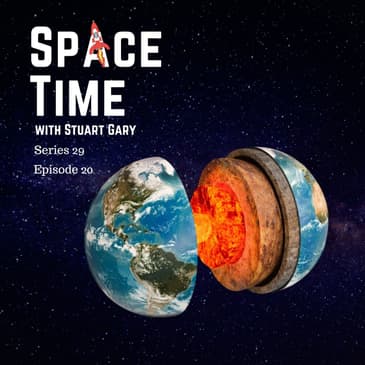



Earth's Core Contains Vast Hydrogen Reservoir
A recent study published in Nature Communications indicates that Earth's core may hold up to 45 oceans' worth of hydrogen, challenging the long-held belief that water on our planet primarily came from asteroids and comets. Utilizing advanced laboratory techniques, researchers simulated the extreme conditions of the core to uncover its surprising hydrogen content, suggesting a significant internal source of water far beyond previous estimates.
Neutrinos from the Sun's Core
A new dark matter experiment has successfully detected neutrinos originating from the Sun's core, marking a significant milestone in our understanding of these elusive particles. The LZ experiment at the Sanford Underground Research Facility captured signals from Brian 8 solar neutrinos, providing valuable data on solar processes and setting new limits for dark matter research. This breakthrough highlights the potential of neutrino studies in unraveling the mysteries of both dark matter and stellar dynamics.
Complexity of Martian Volcanoes
New findings published in Geology reveal that young Martian volcanoes are far more complex than previously thought. Researchers have discovered that these volcanoes were shaped by long-lasting and evolving magma systems rather than single eruptions. By analyzing surface features and mineral compositions from orbit, scientists have reconstructed the intricate eruptive history of these volcanic systems, shedding light on the Red Planet's geological past.
www.spacetimewithstuartgary.com
✍️ Episode References
Nature Communications, Geology
Become a supporter of this podcast: https://www.spreaker.com/podcast/spacetime-with-stuart-gary--2458531/support.
(00:00:00) New study reveals Earth's core may contain vast amounts of hydrogen
(00:08:30) Breakthrough in solar neutrino detection from the Sun's core
(00:16:45) Insights into the complex eruptive history of Martian volcanoes
(00:25:00) Science report: The link between caffeine consumption and reduced dementia risk
(00:32:15) Study on the frequency of passionate love experiences in humans
Versus Spacetime Series twenty nine, Episode twenty for broadcast on the sixteenth of February twenty twenty six. Coming up on space Time, the true composition of the Earth's core and you look at Neutrino's originating from the Sun's core And what do we now know about volcanoes on Mars? All that and more coming up on space Time. Welcome to space Time with Stuart Gary. A new study suggests that the planet Earth's core contains up to forty five ocean's worth of hydrogen. The findings, reported in the journal Nature Communications, challenges the idea that most of Earth's water was delivered from asteroids and comets during events like the Late Heavy bombardment around three point nine to four billion years ago. Scientists have long known that Earth's core is mostly composed of hydrogen a little bit of nickel, but its density isn't high enough for it to be simply iron a nickel. Some other lighter elements must also be present, and one of the primary suspects is a huge reservoir of hydrogen. After all, it is by far the most common element in the universe. Now, in order to work out exactly what's going on, in the planet's core. You can't just go down there, so you've got to try and reproduce those sorts of temperatures and conditions in a laboratory. To do that, the authors used a laser heated diamond anvil, which can simulate the pressure and temperature of the planets in a core. They then used atom probe tomography to then produce a three dimensional compositional nanoscale map which identified levels of silicon, oxygen, and hydrogen rich nanostructures formed during quenching. This is what allowed them to determine the percentage of hydrogen in the core, and the results suggests the core contains somewhere around syrup at zero seven to zero point threety six weight percentage of hydrogen, and that's equivalent between nine and forty five earth ocean's worth of water, far more than could have been brought in by any asteroid meteor comet. This is space time still to come, a new look at neutrino's originating from the Sun's core, and what do we now know about volcanoes on Mars. All that and more still to come on space time. A new dark matter experiment has provided scientists with a rare opportunity to study neutrinos emanating from the very core of the Sun. Dark matter is a mysterious invisible substance. A big problem is situs have no idea what it is. They're best Upath suggests that it's a type of matter known as WHIMPS, which stands for weekly interactive massive particles, which is the name suggests involves extremely weakly interacting sabotomic particles that only react with normal baryonic matter. That's the stuff you and me and planets, cars, trees, houses, and stars are made of through gravity. But scientists no dark matter exists because they can see its gravitational influence on normal matter, stopping galaxies from flinging apart as they revolve and bending light from distant objects through a process called gravitational lensing. So there are numerous experiments being undertaken both on Earth and in space to tryin unravel dark matter secrets. One of those is the lux Zeppelin or LZ experiment at the Sanford Underground Research Facility, one and a half kilomet is down a deep mind shaft in South Dakota. The onl Z experiment uses a detector comprising giant tank good with some ten tons of ultrapure ultra cold liquid xenon. The idea is if a dark matter whimp were to pass through the tank and collide with a nucleus of one of the xenon atoms in the liquid, it would cause that nucleus to recoil in the process releasing a tiny bit of energy. The record produces two signals that the detector's photo amplifier sensors would be able to record. One signal is a tiny flash of light that occurs when the xenon recoll releases a handful of photons. The second is a small stream of electrons which then subsequently converted into light inside the detector and again become visible at the light sensors. The strength of those signals varies depending on how much energy the particle deposits, and that gives scientists a means of probing the colliding particle's mass as well as some of its other properties. But the ELSA experiments also been able to pick up signals from another weekly interacting subatomic particle called a neutrino. Neutrinos are the most common forms of matter in the universe, but there are also extremely weakly interacting. In fact, right now, more than a billion of them are passing through you every second. You don't even notice them. They produced in high energy events such as supernovae, atomic reactors, and the course of stars. They come in three types, not as flavors. There are electron neutrinos, meuon neutrinos, and town neutrinos. Amazingly, these neutrinos can all transmute from one form to another, so an electron neutrino can shoot out from the center of a star but change and be detected here on Earth as a muon or town neutrino. The unique neutrino signals picked up by the l Z experiment showed that this particular particle originated from the core of the Sun. It marks the first time the Elze experiments peeked up signals from this source, in the process, setting a new milestone in sensitivity. One of the studies authors was Robert James from the University of Melbourne. James led the statistical analysis that confirmed that the particle was a boron eight soul and neutrino interacting through neutrino nuclear scattering. Now what this means is it's set a new dark matter exclusion limit for masses above five Giger electron vaults. That's roughly the mass of five protons. James says the real challenge was muddling the old Zie detector in such a low energy regime for the first time, but he says the results were extremely rewarding, providing a new look at neutrinos from a specific source, the boron eight solar neutrinos produced by fusion in the Sun's core. The data is a window into how neutrinas interact and the nuclear reactions in the stars that produce them, but the signal also mimics what scientists expect to see from dark matter interactions. You see the background noise sometimes called the neutrino fog could start to compete with dark matter interactions as researchers look for lower and lower mass particles. Reaching into the neutrino fog for the first time highlights ells these performance with the ability to sense incredibly tiny amounts of energy from individual particle interactions. James says it's the first time that this nutrina signal's been observed at a level of signifying statistical significance. So the ELGI experiment is an experiment that's primarily designed to detect dark matter, although as this recent result of our shows, we can do a lot more with it than just dark matter. But what it. Essentially boils down to is we've got a very large volume of liquid zenon in what we call a duel phase time projection chamber, so it's mostly liquid genon. It's about five and a half tons that we actually utilize, and then a small sort of layer of gaycier seneon on the top. This is all deep underground because we want to basically shield this detector from background radiation things that would sort of light it up and make it as sort of radio pure and quiet as possible so that we can use it to look for dark matter. And the way it operates essentially is particles will pass through the detector. Ambient radiation the way we've set it up should be quite rare, but we still get particles coming through from radioactivity of the detector components. Things like that, in addition to these neutrinos from the Sun and then intrinsic radio contaminance in the xenon as well, that we can get rid of to some degree but not entirely, but when one of these particles passes through, it basically lights up the detector, so it produces a signal that we call the S one signal, and that's basically a light signal that's just due to the way that genon responds when you put energy into it. So we detect that with two arrays of photo multiplier tubes, which are basically just light detectors at the top and bottom of this liquidene and volume. And then what we also do is we apply in electric fields and that basically when you get particle interactions, you get ionization and excitation as well as the scintillation lights, and the electric field basically sweeps some of those electrons up into the gas layer at the top, and as the electrons are accelerated through that gas layer, they produce another signal. We call that the S two signal. And we can basically use the relative and absolute ratios of these two signals to tell us something about the sort of particle that interacted. Did it interact with the nucleus of one of the zeno atoms, or did it interact with some of the orbital electrons, and also tell us a bit about the energy scale of the interaction. And this is really important because it allows us to distinguish between interactions with the nuclei and interactions with the electrons. And we're using this thing to look for dark matter and the sort of primary design driver if this instrument somebody called the wimp, and a wimp would be expected to interact with the zeno nuclear And so that's why having these two signals is really important, because it helps us to sort of further distance angle background radiation and other sources of background but aren't dark matter from what a dark matter signal might look like. And we basically just wait for a really long time. We let this detective run acquire data, and then we look at it and we sort of model the various backgrounds that we know are there. We put in various models what dark matter might look like at different masses and different interaction cross sections, and we use that ideally to look for dark matter. We've not seen any hints of dark matter yet, but in the absence of a dark amount of signal, we can use this to sort of rule out what dark matter isn't and start to hopefully eventually hone in on and what it is. We know that there's a sort of halo, a galactic halo of dark matter in our galaxy, and we're sort of passing through it, and so dark matter particles are really coming sort of from all directions. And just because of the fact that they interact so weakly with normal matter, we don't expect for most of the dark matter candidates we're looking for, we don't expect them passing through the Earth to actually have much of an effect. We expect them to scatter so infrequently that they'll just pass straight through the Earth and hopefully with a small probability interact in our detector of zenon. But once you look for some more exotic dark matter candidates, those very large, very heavy dark matter with very large interaction cross sections, which are also theoretically well motivated in some senses, those do scatter as they pass through the Earth, and so there you do have to take that attenuation into account. How tough is it to look for something that you have absolutely no idea what it is really it's not on the standard model. Yeah, it's very difficult. I mean, they're a viable candidate spanning tens of orders of magnitude, which is absolutely crazy when you really stop and think about it, and so you have to build experiments that work in very different ways to kind of try to fully explore this potential mass range that dark matter could be. So, you know, whimp have been historically very one motivated Canada, and there's still a lot of wind parameter space that we haven't ruled out yet, and so that's what these big liquidine on detectors like LZ are designed for. But increasingly you're seeing these sort of smaller scale tabletop experiments being built. You know, whether you're looking for some cahering interaction from say a light mediator with some optically levited nanoparticle, or whether you're looking at cryogenic bilometers. All sorts of things that have been done to probe that lower mass region as well. And there have been some pretty wild ideas proposed how we might probe sort of the heaviest potential candidates all the way up at sort of the plank mass, but I think those are a long way off from being realized that, Yeah, you have to get creative, and you have to you have to try new technologies and be prepared to fail sometimes as well, it's. Not failing, it's just finding a new limit, a new area that's now ruled out. Yeah, yeah, exactly. Yeah. Sometimes when you're trying to communicate this to the public, you know, they come back and they say, well, you didn't find anything again, you know, what's the point. But exactly as you say, you do learn. You do learn something every time. You do slowly, but surely we're honing in on what could be dark matter, and yeah, I very much hope that in my lifetime we see something a bit more conclusive. A long time ago, there was this issue of the missing neutrinos, and after a while we discovered that these were coming from the Sun, and part of the l ZE detectors work is involved seeing these and studying them as well. Yeah, exactly. So missing neutrino problem was a so called problem a few decades ago where a guy called Ray Davis built an experiment in the same cabin where the Elvy experiment now fits. So it's kind of a funny coincidence, but they were looking to detect neutrinos from the Sun and the experiment that they designed was detecting capable of detecting a specific flavor of neutrina, and they basically saw fewer neutrinos than they're expected to see, and so for a while they were quite puzzled, and the solutions of this problem actually turned out to be something called neutrino ospillations. Neutrinos are produced in one particular flavor depending on the k process that produced them, but then as they sort of propagate through space, they often between flavors. And so when you detect a neutrino, you have a probability that depends on energy of the neutrinos and distance and things like this, and also some fundamental parameters like the mass differences between the neutrinos. You have probabilities to observe those neutrinos in a different flavor than they were produced. That's just kind of a prediction of quantum mechanics. And so actually the reason why they were seeing what they were seeing was inconsistent with what they expected was because these neutrinos were oscillating. So they makes that out as a meon utrina, but then oscillate into a taw or electron neutrino exactly. So the ones produced in the sand that producers electro and neutrinos, and then they oscillate with some probability to become, yeah, potentially a tower of meal on neutrino, as you say, And so that problem was kind of resolved. Now, what it is that we're looking for, or we were looking for, we found it is a particularly rare process where we get these ornate solar neutrinos interacting directly with the nucleus of one of the zeno atoms in our secta. So when I say borin eight neutrinos, what do I mean? I basically it refers to neutrinos that are produced from a particular decay in the Sun where positron decay basically of boor and eight, which is just an isotope's present in the Sun, and it produces an excited state of rillium ate and a positron and an electron neutrino. And we kind of know what the energy spectrum of these neutrinos should be, so what sort of energy profile they should have as they're emitted from solar models and things like that. But there's kind of quite a bit of tension between So there are different different ways that you can set up your solar model because is what we call the high metholicity solar model and the low metholicity solar model, and they both have different predictions sort of the amounts of different neutrinos that are produced from these interactions in the sun. And so what we did was we basically provided one of the first measurements of the interaction of those bor and eate neutrinos with a nucleus for a process called coherent elastic utrino nuclear scattering, which is a very rare process and it's actually very similar to the sort of interaction that we would expect a wimp with that matter of wimp to have with a nucleus. So, yeah, the reason why this is interesting is sort of too far, you know. Number One, it's sort of the first signal that we've measured with this detector that would look very close to a dark matter signal, So it's kind of almost a trial run, if you like, so what a dark matter detection might look like. But secondly, it actually allows us to start to constrain the flux of these born eate neutrinos, and doing that is very important because number one, as we start to be able to measure these neutrino fluxes and will start to become sensitive to other serlein neutrino fluxes as well from other reactions. Other nuclear reactions in the symbol starts become sensor to some of the other ones as well as we build larger and more sensor detectors, and that helps us to a start to hopefully work towards solution to this solar abundance problem, the high metallisty or the low metholicity. And secondly, it actually allows us to look for potential non standard and neutrino interactions. So if what we observe when we measured one of these fluxes was very different from expectation, could also hint at potential new physics in the neutrino sector. Other experiments also help contribute to this helps us to start to pin down these neutrino fluxes more and more pically, And as other experiments start to pin down these bloxes, that actually allows us to become more sensitive to dark matter, because we will eventually get into a regime where because these neutrino signals look so similar to dark matter, they actually start to become the main background to a dark matter search. And so as other sort of dedicated neutrino experiments start to pin down those blotses more and more precisely, that allows us to become more sensors. So there's quite a few different angles to these neutrino physics searches. But what this really is is this is sort of the first demonstration of using one of these detectors to do this to a level that exceeded a certain threshold of significant of statistical significance that we start to talk about a significant observation. Does the flax or the red of neutrinos streaming out from the Sun tell us something about what's happening can be used as an early warning system? Yeah, so I think you're referring to the supernova neutrinos. When nineteen eighty seven A occurred, there was this huge flood of neutrinos coming from the progenitor star because the trinos flew straight out, they didn't bounce off anything else because they're so weakly interacting, and they hit the detectors on Earth hours before the first photons did. Yeah, exactly. So detectors like LVE are part of this thing called the super and over neutrino early warning system, and so there's kind of a whole network of these detectors and LV is one of them. There will be sensitive for these bursts of neutrinos if a pup and over explosion happened close enough to us, and so yeah, we're sort of primed and ready to go with that. For LV, we're part of that system, and if we detect a strong burst of neutrinos, then yeah, all of these sort of parts of this system will spring into actions and calastronomers, you know, point your telescope in this directions because we think you're going to see a burst of photons from a super ever. Seen supernovae are in fact neutrino explosions, not photon explosions. There are so many more of them. Yeah, detectors like ours that are able to detect a. Neutrinos, but at this stage we can't use utrina flux to tell us much about what's happening inside the sun. The sort of level of detection that we will take all of doing with detectors like LV at the current scale. No, as we accrue more data, we'll be able to start to say more and more. But it's really the next generation detectors that are going to be large enough to actually start to say useful things. About these nutriento bloxes and what might be happening in the fun. Let's doctor Robert James from the University of Melbourne and this is space time still to come what do we now know about volcanoes on Mars? And later in the science report and you study finding how often humans fall passionately in love or that and more still to come on space time and you study is found that young volcanoes on the red planet Mars were far more complex than previously thought. A report in the journal Geology shows that rather than forming during a single, short lived eruption, these volcano were shaped by long lasting and evolving magma systems deep below the Mussian surface. To fully understand how volcanoes work, scientists study the volcanic products that erupt on the surface because these can reveal the hidden magmatic systems feeding volcanic activity. The new study, using high resolution morphological observations and mineral analyzes provided from orbit, have revealed that some of the red planet's youngest volcanic systems experienced a far more intricate eruptive history than what scientists had previously thought. One of the studies authors, Badzos Pi Teric from the Atomikovich University says a long lived volcanic system located south of pavanas Mons is one of the largest of the Mussian volcanoes. By combining detailed surface mapping with orbital mineral data, Pieterican colleagues were able to reconstruct the volcanic and magmatic evolution of this system in unprecedented detail. Pateric says the results showed that during the Red planet's most recent volcanic period, magma sistem beneath the surface remained active and complex. The volcano didn't just erupt once it evolved. Over time, its conditions in the subsurface changed. The study shows the volcanic system developed through muldiple eruptive phases, transitioning from early fissure fed lava inmplacement to later point source activity that produced cone forming vents. Although these lava flows all appear different on the surface, they were all supplied by the same underlying magma system. Each eruptive phase preserved a distinct mineral signature, allowing scientists to trace how the magma changed through time. By Teric says, these mineral differences tell scientists that the magma itself was evolving and This likely reflects changes in how deep the magma originated and how long it was stored beneath the surface before erupting. Because direct sampling of Marchan volcanics is currently not possible, studies like this provide a rare insight into the structure and evolution of the red planets in this space. Time and time out to take a brief look at some of the other stories making US and science this week with a science report. A new long term study shows that consuming caffeinated tea or coffee is linked to a lower risk of dementia. The findings were reported in the Journal of the American Medical Association, based on monitoring of a large cohort of the US health workers for up to forty three years. Participants reported their average dietary intakes every two to four years, and researchers found those who drank more caffeinated tea or coffee were around ten to twenty percent less likely we've been diagnosed with dementia over that period of time. The risks seem to be most reduced by having one or two cups a day of tea or two to three cups of coffee, with no added benefit for higher amounts. They also have found the drinking decaffeinated coffee wasn't linked to any reduced dementia risk, indicating that it's the caffeine which is likely key to the possible protective effects of one of our favorite beverages. Falling passionately in love is one of the most talked about human experiences, celebrated in songs, movies, literature, and in art across all cultures. Passionate love is widely considered the hallmark of romantic relationships and his well documented psychological and behavioral effects. Yet until now, researchers overlooked a surprising basic question, how many times do people actually experience true passionate love over their lifespan well. A new study reported in the journal Into Person surveyed ten thousand and thirty six American adults, finding that some fourteen percent had never experienced passionate love, twenty eight percent experienced at once, thirty percent experienced it twice, seventeen percent three times, and eleven percent four or more times. Overall, experiences of true passionate love were similar across homosexual, heterosexual, and bisexual participants. In fact, romantic love remains a major priority for most people Data from the Kinsey Institute showed that sixty percent of US singles described themselves as being very romantic, and a majority indorse ideas like love at first site and destiny. The Australian Air Force has completed construction of its new MQ four C Triton hangars at the Tender Air Force Base near Katherine in the Northern Territory. Based on the earlier Global Hawk, the MQ four C Triton is built by Northrop Grumman. Australias purchased an initial four of these high altitude jet powered aircraft for long range maritime surveillance patrols and intelligence gathering operations. The drones are also equipped for electronic and anti sir warfare, working alongside Air Force's man A Poseidon maritime surveillance aircraft. The three hundred and fifty six million dollar Air seven thousand Phase one D project includes purpose built facilities to support the MQ four C Tritan, including a new hangar, supporting infrastructure and ground crew accommodation. While based at Tyndall, the Tritons themselves will be remotely flown by pilots at the Number nine Squadron at the Edinburg Air Force Base near Adelaide in South Australia. Ricky Gervay's opening monologue at the twenty twenty Golden Globes probably set it best. Well, you say you woke, but the companies you work for I mean unbelievable, Apple, Amazon, Disney. If Isis started a streaming service, you'd call your agent, wouldn't you. So if you do win an award tonight, don't use it as a platform to make a political speech. Right, You're in no position to lecture the public about anything. You know nothing about the real world. Most of you spent less time in school than Greta Thumberg. So if you win, all right, come up, accept your little award, thank your agent and your God and foth okay man. After the recent Grammy's debacle, who can argue? But now Demi Moore is giving her two cents worth on the famous Roswell UFO craft story, claiming the whole thing's real. So a bit of background. The original story involved an alleged extraterrestrial spacecraft slamming into the ground on a farm during a violent thunderstorm, before briefly skipping back into the air and finally crashing hard into the ground in the bank of a dry gully several kilometers away yar a remote New Mexican town called Corona. The date was July the fourth, nineteen forty seven. The next morning, a local farmer named mac Brazl was inspecting one of his fields to see if the previous night storm it caused any damage, when he suddenly came across a huge debris area containing lots of wreckage covering the entire paddock. The debris included weird metal beams as light as bulster would and covered with strange, indecipherable writing he described as hirag gal epics. There were also unusual metal panels that could be bent and crunched up, only to return to the original shape when released, without showing any signs of creasing. Later that day, Brassel visited his uncle Hollis Wilson, telling him about the strange debris he had found. Now, Brazil didn't have a radio, and he hadn't read any newspapers recently, so he wasn't aware of a nationwide press coverage a few days earlier, on June the twenty fourth, when a pilot called Kenneth Arnold saw what he claimed were nine silver colored unidentified flying discs traveling in Unison the Mount Rainier in Washington State, moving at almost two thousand kilometis per hour and performing maneuvers will be on the capabilities of any known aircraft. Now, what Arnold had seen was probably a squadron of military jets. Jets were still very new at that time. Back then, they were usually left in their silver color, although you'd think that as a pilot, Arnold would have been up to date with a lotused aviation. News coverage of Arnold's report sparked a wave of over eight hundred similar sightings across America. Anyway, Wilson told Brazil about Arnold's report and suggested that the debris he found on his farm could have been from a flying disc, as hundreds of reports had been made during the fourth of July weekend and there was a three thousand dollars reward on offer for any proof. So the next day Brazil drove down to the nearest big city, which was Roswell, New Mexico, and reported his fine to the local Chavez County Sheriff, George Wilcox. Wilcox promptly phoned the nearby Roswell Army Air Force Base, which at that time happened to be home to the five or ninth Bomb Group of the eighth Air Force, which was the only unit in the world at that time capable of delivering nuclear weapons. The base assigned Major Jesse Marcel and Captain Sheridan Chavette to return with Brasel and gather the material from the ranch. Meanwhile, based Commander Colonel William Blanchard notified the Eighth Air Force's commanding officer, General Roger Rami of the findings. Then, on July the eighth, for some inexplicable reason, the Roswell Army Air Force bace IS Public Information Officer Walter Hout issued a press release stating that the military had recovered a flying disc in it Roswell. The local Roswell radio station KSWS quickly broke the story and relayed the details to the associated press, and it was from this that the legend of Roswell was born. Now sometime later, there were reports that the spacecraft's final craft site in the Dry River Gully had been located by the military, and that several alien bodies were recovered and taken away for autopsies. The story goes that the spacecraft in all the wreckage was quickly forensically cleaned up by the military and initially taken to the right Patterson Air Force Space in Ohio, before eventually being moved to Area fifty one at the Knellis Air Force Space on Groom Lake in Nevada. Later, the Air Force retracted the original UFO's story, instead claiming it was nothing more than a weather balloon. However, years later, the air was finally admitted the wreckage was actually part of a top secret experiment called Project Myrgle, which used long trains of weather balloons, reflectors, and electronic devices to try and use atmospheric acoustics to listen in on Soviet nuclear weapons tests. They confirmed that both the original UFO story and the later weather balloon story were all part of a deliberate government disinformation campaign designed to cover up the true nature of Project Mergel. As for the alien bodies, well, it turns out there were crash test dummies as part of early trials in the nineteen fifties designed to develop jet aircraft dejection seats. But as the Skeptics timendum explains, Demi Moore is certain that she know it's the truth. Demi Moore was apparently born in Roswell, well after the Roswell intiment. That was in what his servantry was born I think in the early sixties. But she said that. There long after Roswell. No, yeah, not the huge amount of years after Rosnell, but enough to actually sort of said she wasn't around what had happened, Okay, but she says that it's a thing in the air in Roswell, uh huh. And she said that in her youth it was something that people just didn't talk about it. It was as if it was a secret. Well it might be in the fact that it had been explained the balloon. In any case, why Roswell, I don't know, because Rosa was about one hundred kilometers from where this thing crashed on someone's farm in the place called Corona, New Mexico. Rose was a long way, but this guy took it to Roswell as the biggest town. Therefore, Roswell has claimed it as it's sort of incident, even though it didn't happen anywhere near them. They're not. They have museums and they have themed restaurants and things in Roswoltcuting to the L O. R. E Law the alleged UFO. It wasn't a flying saucer. It was shaped more like a sting ray actually hit the ground at a farm near Oswell, skipped on the ground, lost a lot of material, and then flew again for a little while before finally crashing at Corona. Right, Okay, that's interesting. What it is is that de meanmore might be promoting a new film that's coming out. You've got a film coming out called Strange Arrivals. It's funny that based on the Betty and Barney Hill abduction story, and she's playing She's playing Betty in that film, so there might be an ulterior mode. I might hate to suggest that. She also makes comments that Roswell has the largest landing strip of America. It doesn't matter. But apart from that, yep, I mean was an expert on Loswell incidents. A new avote. That's the skeptics timendum, and this is Spacetime, and that's the show for now. Spacetime is available every Monday, Wednesday and Friday through at bytes dot com, SoundCloud, YouTube, your favorite podcast download provider, and from space Time with Stuart Gary dot com. Space Time's also broadcast through the National Science Foundation, on Science Own Radio and on both iHeartRadio and tune in Radio. And you can help to support our show by visiting the Spacetime store for a range of promotional merchandising goodies, or by becoming a Spacetime Patron, which gives you access to triple episode commercial free versions of the show, as well as lots of bonnus audio content which doesn't go to weir, access to our exclusive Facebook group, and other rewards. Just go to sp Spacetime with Stewart Gary dot com for full details. You've been listening to space Time with Stuart Gary. This has been another quality podcast production from bytes dot com.