
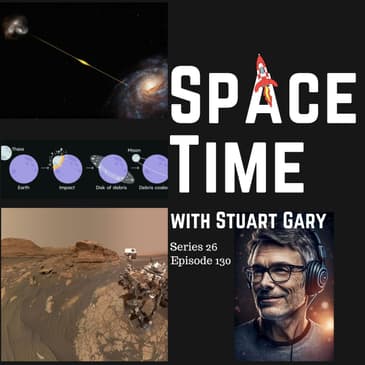



Become a supporter of this podcast: https://www.spreaker.com/podcast/spacetime-with-stuart-gary--2458531/support.
00:00:00
This is Space Time series 26 episode, 100 and 30 for
00:00:04
broadcast on the 30th of October 2023. Coming up on Space Time,
00:00:09
the most distant Fast Radio Burst ever seen. A new study
00:00:14
shows the Moon's 40 million years older than previously
00:00:17
thought. And NASA's Mars Curiosity rover finds more
00:00:21
evidence of ancient rivers on the Red Planet. A key signal for
00:00:25
life. All that and more coming up on Space Time.
00:00:30
Welcome to Space Time with Stuart Gary.
00:00:50
Astronomers have identified the most distant Fast Radio Burst
00:00:53
ever detected the ephemeral cosmic blast which has been
00:00:57
cataloged as FRB 2022 6, 10 A occurred some 8 billion light
00:01:02
years away. The immense blast reported in the journal science
00:01:07
released as much energy in a millisecond as our sun generates
00:01:11
in 30 years.
00:01:13
The discovery was made by ascap the Australian square kilometer
00:01:17
array pathfinder radio telescope. A collection of 36 12
00:01:21
m parabolic dishes spread across the western Australian outback.
00:01:26
The study's co lead author, Stewart Ryder from Macquarie
00:01:29
University says the event smashed the team's previous
00:01:32
distance record by 50 per cent.
00:01:35
Its source was eventually pinned down by the European Southern
00:01:38
Observatory's very large telescope to a small group of
00:01:41
merging Galaxies. Fast radio bursts occur at very specific
00:01:46
wavelengths and usually at cosmic distances. And the spiral
00:01:50
arms of Galaxies usually billions of light years away.
00:01:54
The first was discovered in 2007 in data from the Parkes radio
00:01:58
telescope in the central West of New South Wales. Since then,
00:02:02
hundreds more have been detected. In fact, we now know
00:02:06
that these short ultra bright flashes of radio energy happen
00:02:09
all over the sky hundreds of times a day, some flashes last
00:02:13
just milliseconds, but others will over a second and they can
00:02:17
span a wide range of radio luminosity.
00:02:20
The very first burst detected were all singular events
00:02:24
occurring once at a specific location. But they're never
00:02:27
again, that suggests they were being caused by some sort of
00:02:31
cataclysmic event such as a supernova explosion, marking the
00:02:34
death of a giant star.
00:02:36
But astronomers are now detecting many fast radio bursts
00:02:39
that are repeating from the same location and that's just a very
00:02:43
different origin. The lead contender is a highly magnetized
00:02:47
neutron star called a magnetar. But things like feeding black
00:02:51
holes and glitching neutron stars have not yet been ruled
00:02:54
out.
00:02:55
Now, if there are actually two different kinds of fast radio
00:02:58
bursts, it means there could be two separate causes for these
00:03:01
mysterious deep space blasts or it could simply be that all fast
00:03:05
radio bursts are repeaters. But with some a lot more active than
00:03:09
others.
00:03:10
This new discovery also confirms a Fast Radio Burst can be used
00:03:14
to measure the missing matter between Galaxies, thereby
00:03:17
providing a new way to weigh the universe. Current methods of
00:03:21
estimating the mass of the universe are giving conflicting
00:03:24
answers and they're challenging the standard model of cosmology.
00:03:28
But if we count up all the normal matter in the universe,
00:03:30
all the atoms that we are made out of and planets and stars and
00:03:34
dogs, cats, horses and cars, then we find more than half of
00:03:38
what should be there is still missing and that doesn't even
00:03:41
include dark matter. The authors think that this missing matter
00:03:44
is composed of ionized hydrogen gas hiding deep within Galaxies.
00:03:49
And in the space between Galaxies, the long sinuous
00:03:52
filaments which connect Galaxies to nodes and super nodes which
00:03:56
make up the cosmic web like structure of the universe. The
00:04:00
problem is if hydrogen gas is hot and diffuse, then it's
00:04:03
impossible to see using normal techniques and that's where fast
00:04:07
radio bursts come in because they can sense ionized material.
00:04:11
See even in space that's very nearly perfectly empty, fast
00:04:14
radio bursts can still detect electrons. And if there are free
00:04:18
floating electrons, then there should be an equal number of
00:04:21
free floating protons. The new discoveries represent the limits
00:04:25
of what's achievable with telescopes today.
00:04:27
Although astronomers will soon have some new tools to help them
00:04:30
detect even older and more distant bursts in order to even
00:04:34
better pin down their source Galaxies and measure the
00:04:37
universe's missing matter. The international square kilometer
00:04:40
array observatory is currently building two massive radio
00:04:44
telescope arrays, one in South Africa and the other in
00:04:47
Australia.
00:04:48
It'll be the world's biggest radio telescope and capable of
00:04:52
finding thousands of fast radio bursts, including very distant
00:04:55
ones that can be detected with current facilities. And the next
00:04:59
generation of large optical telescopes, the European
00:05:03
Southern Observatory's extremely large telescope.
00:05:05
The ELT a 39 m telescope currently under construction in
00:05:10
Chile's Atacama Desert will be one of the few optical
00:05:12
telescopes capable of studying the source Galaxies of fast
00:05:16
radio bursts even further away than FRB 2022 6 10 A still for
00:05:22
now. Stewart Ryder says this current discovery has rewritten
00:05:26
the textbooks.
00:05:27
So this is a project that Australia is really at the
00:05:30
cutting edge of and that is using groundbreaking telescopes
00:05:33
such as the Australian square kilometer ray pathfinder
00:05:36
telescope that's operated by CS Ro in the West Australian
00:05:39
Desert.
00:05:40
And one of the great things that this telescope can do that very
00:05:43
few others can is to not just be sensitive to these fast radio
00:05:47
births which come from all around several 1000 per day, but
00:05:50
look in the right place at the right time and you don't have a
00:05:52
wide field of view like ascap, you've probably missed most of
00:05:55
them.
00:05:55
But having tracked one, the secret to know more about them
00:05:58
is to be able to pinpoint exactly where they came from.
00:06:01
And that's something that currently only ascap and one or
00:06:03
two other facilities around the world are capable of doing.
00:06:06
Now, one of the important reasons for that is because at
00:06:09
this stage, there could be two different types of fast radio
00:06:13
bursts, single event ones and repeaters. And we're not sure if
00:06:17
the single event ones are just really slow or whether they are
00:06:21
just one off things. And if that 's the case, it could be two
00:06:24
separate sources for them. So there are a lot of mysteries
00:06:26
associated with the FRB. Well, there certainly are.
00:06:29
Yes. And indeed, this particular one that we've just found that I
00:06:32
just published as far as we know, it hasn't emitted any
00:06:35
repeat burst, certainly in the 12 months or so that we've been
00:06:38
looking at that patch of sky, but we can't stare at that one
00:06:41
patch of sky all the time, hoping to see another repeat
00:06:44
burst.
00:06:44
But at the moment, it doesn't seem like a small fracture. 5%
00:06:48
or less of fast radio bursts are seen to repeat at some point in
00:06:52
the following few years. And so it's raised the possibility that
00:06:55
in fact, there may be more than one way to form a Fast Radio
00:06:58
Burst or the objects that give rise to them.
00:07:00
But we're, at the moment, we're still just very much in the
00:07:03
classification phase and trying to work out whether in fact,
00:07:05
maybe all fast radio bursts will repeat if we could watch them
00:07:09
often enough. And for long enough, how do.
00:07:12
You produce 30 years worth of sun type energy in a nano?
00:07:16
Yeah, that's a good question. Well, one of the thing, the
00:07:20
secret to that is given how short these, these births are,
00:07:24
typically they are no more than a few 1000 of the second in
00:07:27
duration.
00:07:28
That really limits the physical scale of whatever object that
00:07:31
gives rise to them in the sense that if you had an object, the
00:07:34
size of the sun, it couldn't put out a single pulse of emission
00:07:36
that strong in such a short amount of time because of its
00:07:39
physical size. So we know that whatever emits these birth can
00:07:42
only be a few tens of kilometers across.
00:07:44
And so that, that's it's really bizarre because there are a few
00:07:47
very few objects that are even that small. So that's why the
00:07:50
current most popular theory for what causes fast radio bursts
00:07:53
like this one is that they come from the surfaces or somewhere
00:07:56
around the, the outer parts of neutron stars, which are
00:08:00
extremely dense states of matter.
00:08:01
They are the leftover core from a supernova explosion. But in
00:08:04
particular, if the star that exploded and then collapsed at a
00:08:07
very strong magnetic field, that magnetic field will get
00:08:10
amplified when the neutron star shrinks down.
00:08:14
And so it's possible that eventually when the magnetic
00:08:17
field on these neutron stars gets tangled and then have to
00:08:20
rearrange a bit like they do on their own stun, but on a much,
00:08:23
much weaker scale. But when that magnetic reconnection happens,
00:08:27
you could get potentially a lot of energy released in a very
00:08:30
short space of time over a very, very small scale.
00:08:33
So that's the best working theory that we have. But we
00:08:35
haven't really been able to get close enough into any of these
00:08:37
objects to really ascertain if it was definitely a magnetar or
00:08:41
not, what you guys did.
00:08:42
After discovering the initial burst, you put in the VLT at
00:08:46
that location. What did you see?
00:08:48
Yeah. So once we finally narrowed down the position of
00:08:51
this particular Fast Radio Burst to the sort of one arc second
00:08:55
accuracy. So that's something like 1, 2/1000 the size of the
00:08:58
full Moon.
00:08:59
And at that point, we then transmitted those coordinates to
00:09:02
our colleagues at the European Southern Observatory who operate
00:09:05
the world's most powerful suite of telescopes in Chile. They
00:09:07
have a set of four telescopes each of which has an 8 m mirror.
00:09:11
We call that the very large telescope.
00:09:13
And we had already arranged or requested and been granted
00:09:18
permission to use those telescopes to do to do two
00:09:21
things. First of all, to use one of the telescopes to take an
00:09:24
image of the field where the birth happened. Because we
00:09:27
weren't sure if there was a galaxy there or not.
00:09:30
Thankfully when the data came back, the images were processed
00:09:33
and we actually saw funnily enough, not one but perhaps
00:09:37
three Galaxies, any one of which could, could have given rise to
00:09:40
that particular burst.
00:09:42
But we then followed that up with another of the telescopes
00:09:47
in which we used it to take what 's called a spectrum. And we
00:09:49
spread the light out from actually those three separate
00:09:53
separate Galaxies. And it turned out that they all had the what
00:09:57
we call the red shift.
00:09:58
Their light had been stretched by the expansion of the
00:10:00
universe, but it all been stretched by a factor two in all
00:10:03
three cases. And so that told us that not only were these three
00:10:06
Galaxies close together, apparently on the plane of the
00:10:10
sky, but in fact, they all had to be a pretty similar distance.
00:10:13
And so for that reason, we think they're almost certainly a group
00:10:16
of Galaxies that are so close together, they're probably in
00:10:18
the process of gravitationally interacting with each other,
00:10:21
possibly even given enough time, they will come together and
00:10:24
merge into one single galaxy. But for now, we believe this is
00:10:27
definitely the host system where the first burst came from.
00:10:30
And from that red shift that we measured, that tells us that
00:10:32
the, that we see coming from those Galaxies. And indeed the
00:10:36
radio pulse that we saw as a fast road of birth had to have
00:10:38
been traveling for almost 8 billion years to reach us here
00:10:41
on Earth. That's just mind boggling. I mean, that's twice
00:10:44
the age, almost twice the age of our own. When you look.
00:10:47
At something like these Galaxies, can you actually tell
00:10:51
what they are whether they're elliptical or spiral or
00:10:54
irregular or whatever?
00:10:55
Sometimes. Yes, if they are close enough and we take nice
00:10:58
deep images with the very large telescope in chalet. If you're
00:11:02
lucky, you might be able to make out what is fairly clear spiral
00:11:05
arm structure. In a few of the more nearby cases as they get
00:11:08
further and further away our ability to see that level of
00:11:11
detail from the best ground based telescope diminishes.
00:11:14
In a few cases, we've used the Hubble space telescope instead
00:11:17
to take images which can be even sharper. But even at the
00:11:20
distance of this most recent most distant cast radio burst,
00:11:23
the Hubble space telescope images that we've just obtained
00:11:26
of that system don't yet show any clear spiral arm structures
00:11:30
or even what we call tidal or other evidence that these
00:11:33
Galaxies are definitely undergoing a merger.
00:11:35
But given how far away these objects are and just how faint
00:11:38
that structure would be. It's not really a surprise that we
00:11:41
can't yet tell whether the particular Galaxies in this
00:11:44
system are spiral Galaxies like our own milky way or indeed
00:11:48
whether they are older Galaxies who stopped forming stars quite
00:11:51
some time ago is.
00:11:52
Knowing sort of what the galaxy looks like, and knowing from
00:11:56
what part of the galaxy, the Fast Radio Burst emerged that
00:11:59
would help you narrow down the sort of likely sources. If it's
00:12:03
an area full of lots of young stars, then that's where you're
00:12:06
going to find big stars that are going through their life cycles
00:12:09
really quickly and are likely to become neutron stars. And.
00:12:12
Exactly. Yep. Yep. And so that's certainly a scenario that we
00:12:16
have seen already in a few of the more nearby fast radio
00:12:19
bursts, we have been able to match up their locations to the
00:12:22
spiral arm region very close to where stars are likely to have
00:12:25
been formed. Recently. In this particular case, though, as I
00:12:28
say, the Galaxies in involved are just too far away for us to
00:12:31
be able to make that level of detail.
00:12:33
But it is interesting though that whenever we've seen
00:12:36
Galaxies closer to us that are undergoing this type of mergers
00:12:39
or interactions, inevitably, there will be an elevation in
00:12:42
the amount of star formation that is happening as the gas
00:12:45
clouds in these Galaxies get smashed together.
00:12:47
Inevitably, some of them will begin to form stars, we get more
00:12:51
stars being formed. And as a result, ultimately, there'd be
00:12:53
more supernova explosions and that is more likely to lead to
00:12:57
magnetar object, which we believe are the most likely
00:13:00
point of origin for the birth of that. But we just don't have the
00:13:05
smoking gun that we would want to say Yes, it was definitely a
00:13:08
magnetar.
00:13:08
Another thing you've been able to do with this observation is
00:13:12
help work out what's happened to all the missing normal baron
00:13:16
matter in the universe. This has been one of the big questions.
00:13:18
We're not talking about dark matter here. We're talking about
00:13:21
the atoms and stuff that you and I are made out of these
00:13:24
observations of fast radio bursts is helping with that as
00:13:27
well.
00:13:27
Yeah, a lot of really remarkable things about B radio birth is
00:13:31
that they carry with them a imprint if you like of all of
00:13:35
the pre electrons that they pass on their way from the galaxy
00:13:38
where they occurred to us here on Earth. And what that does is
00:13:42
it actually slows down the signal arriving at lower
00:13:44
frequencies.
00:13:45
And so that arrives later and the more of these free electrons
00:13:48
it encounters, the more that signal gets stretched out to
00:13:50
lower lower frequencies and later and later arrival times.
00:13:54
So already from when we first detected this particular bird,
00:13:57
because it was so stretched out, we surmised that it probably had
00:14:02
come from a great distance. That 's the most distant Earth ever.
00:14:05
But it turns out there's more than one way to encounter free
00:14:08
electrons. Sometimes it's all the stuff between Galaxies and
00:14:11
sometimes it might be much more local to the birth. But to be
00:14:13
absolutely sure, that's why we had to go through the telescope,
00:14:16
the very large telescope and get a measurement for the distance
00:14:19
of the host galaxy independent of the electron density that the
00:14:23
South Australia burst passed through.
00:14:24
And that was really the key finding that yes, it definitely
00:14:27
was the most distant and oldest burst that we've ever found.
00:14:30
Given that that pulse that we saw, as I say, it enables us to
00:14:33
measure all of those free electrons, those free electrons
00:14:36
had to come from atoms. And so for every electron that we, that
00:14:39
we detect, that means there's many more atoms out there.
00:14:42
And we think that these atoms, the reason why they have free
00:14:44
electrons is that they're very, very hot and that electrons are
00:14:47
then free to wander away from the the normal from the atom
00:14:50
that they would normally be circling around. And because
00:14:52
this gas is so hot but very, very thinly spread out, there's
00:14:55
just no way that we've been able to detect it at any other
00:14:58
wavelength until now.
00:14:59
So fast radio births have been key to reassuring us that what
00:15:03
we have referred to as missing matter because when we tried to
00:15:06
look for it, we couldn't see it, but really, it actually should
00:15:09
have been called unseen matter. But now thanks to all of that
00:15:12
missing has been found and all is right with the.
00:15:15
Universe that missing matter is most likely ionized hydrogen. I
00:15:18
take it that is either inside some Galaxies or in the
00:15:22
intergalactic space between the Galaxies along the the filaments
00:15:26
that make up the cosmic web of the universe.
00:15:28
Yes, that's right, that we believe it's what constitutes
00:15:31
that cosmic web, as you say, the filaments where the gas tends to
00:15:34
cluster because of gravity. But that would then surround it in
00:15:37
large, effectively voids or rather the empty regions. So
00:15:40
whenever we look at the fast birth come from different
00:15:42
directions, we notice that the density that the average density
00:15:46
of this material fluctuates quite a bit.
00:15:48
And that gives us confidence that although we don't know
00:15:50
quite where those bursts, sorry, where that material is
00:15:53
distributed along our line of sight. But given how much it can
00:15:57
fluctuate even over a small patch of sky suggests that the
00:16:00
stuff between the Galaxies is actually quite lumpy in its
00:16:03
distribution.
00:16:04
And again, this is the kind of pattern that was predicted from
00:16:07
the Big Bang model for the beginning of our universe. So it
00:16:10
's nice that from a totally different phenomena whose origin
00:16:14
we don't still completely understand. But already it is
00:16:16
telling or confirming for us pretty fundamental things about
00:16:19
our universe.
00:16:20
That's astronomer Stuart Ryder from Macquarie University. And
00:16:24
this is Space Time still to come. A new study of events at
00:16:28
lunar rocks shows that the Moon 's actually 40 million years
00:16:32
older than we previously thought.
00:16:34
And a new analysis of data from NASA's Mars Curiosity rover
00:16:38
suggests that many of the craters in Mars today could once
00:16:42
have hosted lots of flowing rivers and where there's flowing
00:16:45
water habitability is always a possibility. All that and more
00:16:50
still to come on Space Time.
00:17:09
A new study of lunar rocks brought back by the Apollo 17
00:17:12
mission showed that the Moon is actually some 40 million years
00:17:16
older than previously thought. The findings reported in the
00:17:20
journal geochemical perspectives, letters suggest
00:17:23
that the Moon must have accreted from ejection debris some 4.46
00:17:27
billion years ago, 40 million years earlier than the 4
00:17:31
billion years previously thought to reach their conclusions.
00:17:35
Scientists used the North Western University's atom probe
00:17:38
demography facility which was able to nail down the exact edge
00:17:41
of the oldest Zircon crystals found in samples brought back by
00:17:45
astronauts in 1972.
00:17:48
The study's lead author Philip Heck from the field museum in
00:17:51
Chicago says radiometric dating works a little bit like an
00:17:54
hourglass in an hourglass sand flows from one glass bulb down
00:17:59
into the other with a passage of time indicated by the
00:18:02
accumulation of more and more sand in the lower bulb.
00:18:06
Radiometric dating works in a similar way by counting the
00:18:09
number of parent atoms and the number of daughter atoms they've
00:18:12
transformed into the passage of time can then be calculated
00:18:16
because the transformation rate that is the half life of the
00:18:19
element is well known. According to the giant impact theory, a
00:18:24
Mars sized planet which astronomers have called thea
00:18:27
collided with the early proto Earth.
00:18:29
Some 4.5 billion years ago, melding the two bodies together
00:18:32
to a massive molten magma ocean which eventually differentiated
00:18:36
and cooled, forming the present day Earth ejected from that
00:18:40
impact was flung into space. This eventually coalesced and it
00:18:45
crater to form the Moon initially like the Earth.
00:18:48
The lunar surface was also molten. And as it cooled, Zircon
00:18:52
crystals began to form the atom by atom analysis. Using atom
00:18:57
probe demography allowed the study's authors to count how
00:19:00
many atoms in the Zircon crystals have undergone
00:19:03
radioactive decay.
00:19:04
See, when an atom undergoes radioactive decay, it sheds a
00:19:08
proton and neutrons transforming into different elements.
00:19:12
Uranium, for example is as protons and neutrons decays into
00:19:16
lead. And because we know the rate at which uranium decays
00:19:19
into lead, we can work out when that Zircon crystal was formed.
00:19:23
X says it's important to know when the Moon formed because the
00:19:26
Moon plays an important role in our planetary systems. It
00:19:30
stabilizes the Earth's rotational axis. It's the reason
00:19:34
there are 24 hours in the day. And the reason we have tides, in
00:19:38
fact, without the Moon, life on Earth would look very different.
00:19:42
This is Space Time. Still to come.
00:19:45
The Curiosity rover finds new evidence suggesting Mars was
00:19:49
once a planet loaded with rivers. And later in the science
00:19:52
report, a new study warns that the world is now heading towards
00:19:56
six global tipping points beyond which the planet systems will no
00:20:01
longer be able to cope all that and more still to come on Space
00:20:05
Time.
00:20:21
A new analysis of data from NASA 's Mars Curiosity rover suggests
00:20:26
that many of the craters on the Red Planet today could once have
00:20:29
hosted habitable rivers. The findings reported in the journal
00:20:33
Geophysical Research Letters are based on numerical models which
00:20:37
simulate erosion on Mars over millennia.
00:20:41
The study is the first to map erosion of ancient Martian soils
00:20:44
by training a computer model on a combination of different
00:20:48
satellite data Curiosity images and three dimensional scans of
00:20:52
the Strat gray that is the layers of rock or strata
00:20:55
deposited over millions of years beneath the Gulf Of Mexico's sea
00:20:59
floor.
00:21:00
The analysis provided a new interpretation for common
00:21:03
Martian crater formations which until now had never before been
00:21:07
associated with eroded river deposits. The authors found that
00:21:11
common formations inside craters or bench and nose landforms are
00:21:16
in fact most likely remnants of ancient river beds.
00:21:19
The study's lead author Benjamin Cardenas from Penn State says
00:21:23
scientists are finding evidence that Mars was likely a planet of
00:21:26
rivers. He says the data is showing signs of this all over
00:21:30
the Red Planet.
00:21:31
Prior studies of satellite data from Mars had already identified
00:21:35
erosional landforms called fluvial ridges as being possible
00:21:38
candidates for ancient river deposits using data collected by
00:21:43
the Curiosity rover inside Gale Crater in the Martian Northern
00:21:46
Hemisphere.
00:21:47
The authors found signs of river deposits that are not associated
00:21:50
with fluvial ridges but rather bench and nose land forms that
00:21:54
have never been linked to ancient river deposits before
00:21:58
Denis says, this suggests there could be undiscovered river
00:22:01
deposits elsewhere on the Red Planet. And that an even larger
00:22:04
section of the Martian sedimentary record could have
00:22:07
been built up by rivers during a habitable period.
00:22:10
In Martian history on Earth river corridors are important
00:22:14
for life for chemical cycles, for nutrient cycles and of
00:22:18
course for sedimentary cycles and everything is now pointing
00:22:22
to these rivers behaving in a similar way on Mars Cardenas
00:22:26
says the research indicates that Mars could have had far more
00:22:30
rivers than previously believed and that certainly paints a more
00:22:34
optimistic view of ancient life on Mars if it ever existed
00:22:38
there.
00:22:39
In fact, he says it offers a new vision of Mars one in which most
00:22:43
of the planet once had the right conditions for life to exist
00:22:47
this Space Time and time.
00:23:06
Now to take a brief look at some of the other stories making news
00:23:09
in science this week with the science report, a new United
00:23:13
Nations report is warning that the world is now heading towards
00:23:17
six global warming tipping points past which the planet's
00:23:21
systems will no longer be able to cope, resulting in the risk
00:23:24
of catastrophic impacts or collapse.
00:23:27
The six interconnected risk tipping points are accelerating
00:23:30
extinctions, groundwater depletion mountain glacier,
00:23:34
melting space debris, unbearable heat and an uninsurable future.
00:23:39
The report points out that here in Australia alone,
00:23:42
approximately 520 homes are now predicted to be uninsurable
00:23:48
by 2030.
00:23:49
Primarily due to increasing flood risk leaving people
00:23:52
without an economic safety net if and when disaster strikes and
00:23:57
that's opening the door to cascading socio economic impacts
00:24:00
in high risk areas. The authors say that once these tipping
00:24:04
points are crossed, it'll be difficult to go back.
00:24:09
Well, it's a question we've often asked ourselves. Now, a
00:24:12
new study is looking at why people like fatty food so much
00:24:16
and it suggests it may be the texture.
00:24:19
The findings reported in the journal J Neuro, I looked at
00:24:22
volunteers' brains while they sampled and placed monetary bids
00:24:26
on liquid foods with different levels of fat and sugar. They
00:24:30
found a brain region called the orbital frontal cortex was
00:24:34
responsive to oily smooth textures produced by fatty
00:24:37
liquids on the surface of the mouth.
00:24:39
The authors found that people with orbital frontal cortexes
00:24:43
that were more sensitive to texture seemed to eat more fat
00:24:46
and to offer more money for the fatty foods. The authors say
00:24:50
this brain region responding to smooth textures might be guiding
00:24:54
your eating behavior.
00:24:56
They say that future research could look at redesigning foods
00:25:00
that seem fatty through texture but are tricking our brains into
00:25:03
preferring healthier lower fat foods.
00:25:07
At a time when marine life is disappearing from the world's
00:25:10
oceans. Researchers are celebrating the discovery of a
00:25:13
new species of coral reef fish in the southern waters of the
00:25:16
Great Barrier Reef named the Lady Elliot shrimp gobi.
00:25:20
The previously unknown fish was found as part of a University Of
00:25:23
The Sunshine Coast led project that's been mapping the changing
00:25:27
biodiversity on and around Lady Elliot Island. A tiny coral Cay
00:25:31
at the southern end of the Great Barrier Reef, you can read all
00:25:34
about the tiny fish and its discovery in the journal of the
00:25:38
Ocean Science Foundation.
00:25:41
Scientists have discovered a casual link between spiritual
00:25:45
people and a decision not to take vaccines. Sociologists,
00:25:50
researching the role of religion in vaccine attitudes and
00:25:53
behaviors found that with all else being equal, people, with
00:25:56
the lowest belief in some sort of intervening higher power
00:25:59
tended to be vaccinated at least 88 per cent of the time.
00:26:03
In contrast, those with the highest belief in an intervening
00:26:06
higher power were found to have been vaccinated. Only 73% of the
00:26:10
time Tim Mendham from Australian Skeptics says the findings show
00:26:14
that both religious people and new A GB types seem to have
00:26:18
lower vaccination rates.
00:26:20
What they found, what studies have found out was that in three
00:26:23
years after the start of the COVID Pandemic, about one in
00:26:25
five Americans still hadn't received a single dose of any
00:26:28
COVID vaccine. And they're trying to find a reason for
00:26:30
that. That's a big number, right?
00:26:32
Seeing as Australia, you're getting up towards, you know, 95
00:26:35
per cent of the first vaccine, which is about what you want
00:26:38
numbers for herd immunity. The second third vaccines probably
00:26:41
didn't get the same number. People become complacent and
00:26:43
apathetic towards it after a while. Which is sad because you
00:26:46
get quite how many people are dying and still are. But about
00:26:49
one in five Americans have not even had one dose.
00:26:51
They're trying to find out why. So there have been studies of
00:26:53
religion and religious beliefs about their attitude towards
00:26:57
conspiracy theories and especially vaccines and COVID
00:27:01
vaccines and what they found out in the studies, they were
00:27:03
looking at their religious beliefs and then threw in
00:27:05
questions about various scientific things.
00:27:07
They found out that those who see the as either the inspired
00:27:10
or the actual word of God, we're less likely to see vaccines in
00:27:14
general and the COVID vaccine in particular as safe and
00:27:16
effective. And the reason is largely because God will look
00:27:20
after you, right? And therefore doing something you don't need
00:27:22
to do it.
00:27:23
In other words, God will look after it. You know, you don't
00:27:25
need a vaccine no matter whether you believe it or not, you don't
00:27:27
need to. And then there are the people who on the other side of
00:27:31
the coin, who you might call spiritual people who believe in
00:27:34
New Age things, nature of spirits and that sort of stuff
00:27:38
who would say vaccines aren't natural.
00:27:40
So I won't use it because it's dangerous and therefore frog is,
00:27:44
I don't understand that. Yeah, I know, but this is your typical
00:27:48
hippie sort of mentality that says that I won't take a vaccine
00:27:51
because it's not natural. And the religious group, the
00:27:54
standard religious group will say I won't take the vaccine
00:27:57
because God's got to look after me anyway.
00:27:59
So why take something extra? And what they found out was that
00:28:01
these sort of attitudes extend into conspiracy theories and all
00:28:05
sorts areas. Therefore, what they're saying is that there's a
00:28:08
link between religious belief or spiritual belief and low vaccine
00:28:11
rates.
00:28:12
And certainly the low vaccine rates is being well established
00:28:16
in Australia because you get areas of high hippie populations
00:28:19
which have a low vaccine rate. But there's also this issue of
00:28:22
religious people and I think America would be stronger than
00:28:25
it is in Australia. Perhaps. Certainly Europe, it's less
00:28:28
strong there, but it still exists and probably it's growing
00:28:31
as well.
00:28:31
That's Tim Ham from Australian Skeptics and that's the show for
00:28:51
now. SpaceTime is available every Monday, Wednesday and
00:28:55
Friday through Apple Podcasts, itunes, Stitcher, Google podcast
00:28:59
podcasts, Spotify, Acast, Amazon music bytes dot com, Soundcloud,
00:29:05
YouTube, your favorite podcast download provider and from Space
00:29:09
Time with Stuart Gary dot com.
00:29:11
SpaceTime is also broadcast through the National Science
00:29:14
Foundation on Science Zone Radio and on both iheartradio and Tune
00:29:19
in radio and you can help to support our show by visiting the
00:29:22
SpaceTime store for a range of promotional merchandizing
00:29:25
goodies or by becoming a SpaceTime patron which gives you
00:29:29
access to triple episode commercial free versions of the
00:29:32
show as well as lots of bonus audio content, which doesn't go
00:29:35
to air access to our exclusive Facebook group and other
00:29:38
rewards.
00:29:39
Just go to Space Time with Stuart Garry dot com for full
00:29:42
details. And if you want more Space Time, please check out our
00:29:46
blog where you'll find all the stuff we couldn't fit in the
00:29:48
show as well as heaps of images, news stories, loads of videos
00:29:53
and things on the web. I find interesting or amusing.
00:29:55
Just go to Space Time with Stuart Garry dot tumblr dot com.
00:29:59
That's all one word and that's Tumblr without the E you can
00:30:03
also follow us through at Stuart Gary on Twitter at SpaceTime
00:30:07
with Stuart Gary on Instagram through our SpaceTime YouTube
00:30:11
channel and on Facebook. Just go to Facebook dot com forward
00:30:14
slash Space Time with Stuart Gary.
00:30:17
You've been listening to Space Time with Stuart Gary. This has
00:30:21
been another quality podcast production from bys dot com.