



Become a supporter of this podcast: https://www.spreaker.com/podcast/spacetime-with-stuart-gary--2458531/support.
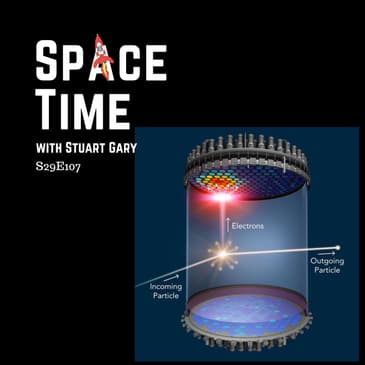
This is Space Time, Series 29, Episode 107, full broadcast on the 7th of September, 2026. Coming up on Space Time... Have scientists finally glimpsed a hint of dark matter? A new scenario describing how the Earth's moon was born? And Starship's first orbital test flight slated for next week. All that and more coming up on Space Time. Welcome to Space Time. With Stuart Garry. A new analysis by the Lux Zeppelin experiment has recorded a particle interaction with scientists having a great deal of difficulty trying to explain. This single event doesn't meet any known background signals for normal matter. Now, this result doesn't yet meet the statistical threshold required to claim the discovery, but it's the most compelling hint yet of that mysterious invisible substance known as dark matter ever reported. Now, if this anomalous event is caused by dark matter, the WIMP, that is Weakly Interactive Massive Particle, that caused it would most likely have a mass of at least 200 gigaelectron volts. That's more than 200 times the mass of a proton. It would also suggest a specific type of interaction between WIMPs and ordinary matter beyond the simplest model. The findings have been reported on the pre-press physics website archive.org and in the journal Physical Review Letters. For the better part of a century, people have been trying to understand dark matter. It's important because it makes up roughly 85% of all the mass in the universe. But it's never been directly detected. We only know it exists because of its gravitational interaction with regular matter. And determining exactly what it is remains one of the biggest questions in science. The Lux Zeppelin, or LZ, experiment is an international collaboration of 250 scientists and engineers from 39 institutions. The detector is managed by the U.S. Department of Energy's Lawrence Berkeley National Laboratory and operates almost 1.6 kilometers below the ground at the Stanford Underground Research Facility, situated inside an operational mine in South Dakota. The experiment uses 10 tons of ultra-pure liquid xenon to search for dark matter, and it's optimized to look for WIMPs. The team are intrigued to see this event in the data, in the very region where they expect dark matter to show up, and the competing backgrounds are very low. They're not claiming to have seen dark matter, at least not yet. But they have seen something really interesting, and they want to share that with the rest of the scientific community in order to get their input. The LZ collaboration studies experimental data in batches. In this new result, researchers analyzed 220 live days of data collected between March 2023 and April 2024. The collaboration had previously searched this dataset, looking for faint signals from the simplest kinds of WIMP interactions. And the new analysis searched for a broader range of possible WIMP interactions, ones that could deposit more energy in the detector. You see, ELSI is especially sensitive to such signals, while also minimizing false positives. This was a detailed study in a region that hadn't been explored within this dataset before. The authors spent months of additional efforts to try and understand all the possible causes of background events. The study's lead author, Sam Erickson from the University of Bristol, says the team understands the detector and the background so well that even a single outstanding event like this one is important. The authors expect dark matter events to be extremely rare, so only a handful could mark the first detection of WIMP dark matter. But the LZ results have not reached the 5 sigma significance. That's the statistical threshold considered a discovery in physics. The new analysis, however, is 2.6 sigma, meaning there's approximately a 0.5% chance that the event could be explained by known backgrounds. With additional data, researchers will be able to test whether the finding continues to grow in significance or fade away. LZ searches for dark matter by looking for signature flashes of light from energy deposited in the detector. The collaboration leverages multiple methods to prevent or account for particle interactions caused by normal matter. This includes more than a kilometer of rock that shields the detector from cosmic rays from space, a water tank and outer detectors that protect the central detector from background neutrons, and a suite of computational tools that disentangle particle interactions and reject dark matter mimics. The simple fact is, dark matter and dark energy are two of the biggest questions remaining in science's understanding of the standard model of particle physics, the cornerstone which explains the universe as we know it. This report from NASA TV. The dark universe, as some call it, represents some of the biggest unknowns in the cosmos. But what are these mysteries? What don't we know? Enter dark matter and dark energy. Despite the similarities in name, the two are actually not the same at all. They're both called dark because we can't see them. What is dark matter? What is dark energy? Dark matter is mass we see out there in the universe, but we can't see it because it gives off or absorbs light. We can only see its effect through the gravity it has on other matter, like stars and galaxies. The way that we know dark matter is there is a result of many different indirect kinds of evidence. The motion of things in the universe is mainly affected by the gravity of the things around them. And what we see is that when galaxies or stars are orbiting something massive, they're all moving far too fast for their speeds to be explained just by the mass of the things that we can see in the optical. In the 70s, an astronomer called Vera Rubin was doing her PhD observing how stars rotate inside of galaxies. she found that stars are going around galaxies way too fast. And so she said, oh, there must be some other matter there, actually quite a lot of mass there that I'm not seeing, making it possible for the stars to rotate so quickly in galaxies and not fly off. We study dark matter through a number of techniques, but for me, the most exciting technique is called gravitational lensing. It's when the light from a distant galaxy changes comes towards us and it passes by the dark matter of a galaxy or cluster of galaxies and the path of that light is bent and therefore the image we see of that distant galaxy is distorted and we can tell through those distortions how much dark matter is out there. Dark energy is sort of an umbrella term for a lot of different theories or ideas that are all trying to explain the same one fact. That the universe is expanding, but not only is it expanding, but that expansion is speeding up. We have really good measurements of the expansion of the universe over cosmic time. In a universe with just mass and gravity, that expansion should slow down due to gravity, but instead we see it speeding up. And so that's how we know that there's dark energy out there. In the 90s and maybe also the 80s of the previous century, people started to hypothesize that there may be something else than matter in the universe. And then in the late 90s, there were two teams of astronomers who were observing distant supernova explosions who discovered that the universe is expanding in an accelerated fashion. There's a number of techniques that we use to study dark energy. We want to measure two things about the universe. We want to measure first how the universe has expanded in the past. And we do that by looking at either exploding stars or we look at the positions and motions of galaxies. Another way we study dark energy is by looking at galaxies and clusters of galaxies. Their evolution is governed by an interplay between attractive gravity pulling things together and repulsive dark energy pushing things apart. We're even more uncertain about the nature of dark energy than we are about dark matter. And that means that in order to study it, we have to make a map of the universe on the largest scales. And this is something we're only now just beginning to do very accurately. We're basically making enormous three-dimensional maps of how galaxies are distributed in the universe, of how we think matter is distributed in the universe. We launched the Euclid Space Telescope, the Nancy Grace Roman Space Telescope, and then we also have SPHERICS. And all three of them will be making these three-dimensional maps of the universe that will enable us to study dark matter on the one hand and dark energy on the other. They're going to gather data that's going to allow us to much better constrain the properties of dark matter and dark energy. But in doing so, we take surveys of big areas of the sky. We're going to have data sets that will be useful for decades to come for questions about the evolution of galaxies, the formation of stars, and other questions that we haven't even thought of yet. If you want to know what's going to happen to the whole universe in the distant future, or you want to start answering questions about you know, how things came to be. Dark matter and dark energy are the majority of what the universe is made up of today. And you can't really start to approach these most basic questions about reality unless you have some clue about what most of the universe is made up of. And in that report from NASA TV, we heard from NASA's Chelsea Good and astrophysicist Jason Rhodes, Dela Markovic and Eric Huff from JPL. This is Space Time. Still to come, a new scenario to describe the birth of the Earth's moon and Starship's first orbital test flight slated for next week. All that and more still to come on Space Time. A new study claims the Earth's moon could have formed within just five hours of the giant planetary collision which formed the Earth-moon binary system. The findings reported in the Astrophysical Journal letters are based on a re-evaluation of the temperatures of the materials involved in that Earth-shattering impact. Astronomers generally agree that a Mars-sized planet, which they've named Theia, crashed into the early Proto-Earth around 4.5 billion years ago. That impact melted both worlds into a giant magma ocean, and that ocean gradually differentiated as it cooled, eventually forming the Earth as we know it today. And ejected debris flung into orbit by that collision ultimately coalesced to form the moons. But new computer simulations are factored in something that wasn't included in the original calculations, namely the material strength of the two colliding planets. And these new impact simulations could change how scientists understand the moon's formation and help constrain the timing of the event. One of the study's authors, Aideen Denton from the Southwest Research Institute in San Antonio, Texas, says the new calculations showed that the pre-existing geology of the Mars-sized proto-moon matters. She says that when you simulate the Earth and Moon as colliding bodies with geologic properties, it changes how the Moon forms out of that impact. Earlier studies of the giant impact scenario have ignored material strength, which was thought to be insignificant for such a high-energy event. But Denton and colleagues revisited this hypothesis, incorporating temperature-dependent geologic strength for the first time. Something that's really important when you're studying collisions between smaller bodies, like asteroids, or say the formation of the Pluto-Sharon binary system. But she admits she wasn't sure whether or not it would matter for the moon. But when Denton and colleagues did the simulations, they found that it actually matters a lot. You see, hotter bodies are weaker than cooler ones, and the authors found that moon formation is sensitive to the temperature of the colliding bodies. It turns out some scenarios can produce a fully intact moon within hours of the impact, while others produce a protolunar disk around the Earth that ultimately forms the moon over time. Because protoplanets generally start off hot and cool with age, this establishes an important new connection between the timing of the giant impact and the nature of the moon's initial state and assembly. Denton says depending on how hot the Earth and the Moon are prior to the collision, the impact can destroy Theia and produce a massive disk of debris that eventually forms the Moon. But when she used the same parameters as original impact modelling, down to the equal temperature structures inside both bodies, the intact Moon emerged within just five hours. While intact moon outcomes have been seen in prior simulations, the new findings were the first to show that material strength and temperature play a crucial role as to whether the moon forms intact or whether it's secreted from material processed in a protolunar disk. These surprising new results imply a potential connection between the physical properties of the moon today, including perhaps its volatile content and the thermal state of the Earth and Theia at the time of the giant impact. As with prior models, explaining the close compositional makeup of the Earth and Moon remains an open scientific question. A possible explanation is that Thea and the proto-Earth form from a common region in the protoplanetary disk, while Mars, which is compositionally distinct from the Earth and Moon, formed further away. This is space-time. Still to come, Starship's first orbital test flight, slated for September 15th, and later in the science report, an Australian-developed nuclear reactor designed to fit on the back of a truck has been ignored by the Albanese Labor government in Canberra, but praised by Washington. All that and more still to come on Space Time. SpaceX looks set to undertake its next Starship test flight on September the 15th, and this one is likely to be a full orbital flight. See, until now, all Starship test flights have remained suborbital. That's simply so that the spacecraft remains in full daylight for the entire duration of the mission, thereby providing scientists and engineers with the best possible visual data of the vehicle's performance. But SpaceX has now informed the FCC that its September 15 flight will deploy the first operational versions of the new V-3 high-capacity Starlink satellites, and that means a higher orbital altitude. The V-3 satellites launched during the last test flight, 13, were never designed to remain in orbit, and simply followed Starship re-entering the Earth's atmosphere over the Indian Ocean. These new V-3 satellites are important for SpaceX. They have more than 10 times the capacity of today's Starlink satellites and will bring fibre-like satellite internet speeds. There's also speculation that SpaceX may use this mission to attempt to catch Starship back at the launch tower. That'll be a first. Until now, only the super-heavy boosters have been trialled returning to the launch tower. The two vehicles for Test Flight 14, Ship 41 and Booster 21, have now both completed their static fire tests and are now in final pre-launch preparations. Meanwhile, Ship 40, which survived Test Flight 13 in July, is continuing west on the deck of the 48,000-tonne semi-submersible vessel Forte, bound for Brownsville, Texas, by way of the Cape of Good Hope, with the arrival now expected to be on October 8th. This is Space Time. And time now to take a brief look at some of the other stories making news in science this week with a science report. There's more confirmation today that people who use cannabis are more likely to develop psychosis. The findings reported in the journal Biological Psychiatry show that psychotic symptoms are likely to appear years earlier in people already prone to psychotic episodes compared to non-users. The authors analysed 149 studies involving more than 71,000 people, mostly in Europe, North America and Australia. The new findings have prompted calls for greater health warnings about what is now one of the most widely used drugs in the world. An Australian-developed nuclear reactor designed to fit on the back of a truck has been praised by US President Donald Trump, but ignored by the Albanese Labor government because of Canberra's no-nukes policy. The deployable energy microreactor can run for five years without refueling and has become only the third advanced reactor within the U.S. Department of Energy reactor pilot program to reach self-sustained criticality. Deployable Energy's CEO and co-founder Bobby Gallagher says micro-reactors are essentially transportable batteries designed to provide reliable electricity and heat for remote and off-grid applications, such as mining operations, remote critical infrastructure projects, defense facilities, and future AI or hyperscale data centers needed for reliable around-the-clock energy. Instead of simply being a sign of old age, a new study has found that memory loss begins much earlier than previously thought. A report in the journal Cerebral Cortex shows forgetfulness shifts as you age, and that shift can begin as early as middle age. The authors tested 60 adults aged between 18 and 74, showing them faces paired with various objects and scenes. After a five-minute rest period, participants completed a memory test during an MRI hippocampal activity scan in which they were asked to pick the correct object or scene for each face. This test mirrors how memories are formed. First, the brain records the new memory. Then, over a short period, the hippocampus replays the memory to stabilize it. And later, the brain retrieves the memory when it's needed. In comparing how younger and older people assess memories, the authors found that when young adults make mistakes in memory tests, it's usually because their brains were not activating the original memory patterns, which was expected. However, when older adults made a mistake, their brains showed strong reactivation of those memory patterns. And the more they reactivated the hippocampus, the more likely they are to make these memory errors. So, instead of that reactivation pattern being associated with better memory, it's associated with those errors. A new study has found that a well-known red waterfall in eastern Antarctica is actually a sign that the region was once inundated with seawater. Known as Blood Fall, a feature on the edge of the Taylor Glacier, are renowned for their crimson water, caused by iron-rich brine hidden beneath the glacier. To better understand how the salty water ended up there, scientists collected samples of the water, the sediment, and the air in the area in order to examine the bacteria, viruses, and fungi living there. The authors say that while the microbes in the surrounding area were the sort you'd expect to find in freshwater environments, the organisms in the red ice were more closely linked to marine environments. The findings, reported in the journal Nature Geoscience, supports the theory that during past warm periods, the sea covered the glacier before seawater was trapped there as sea levels eventually dropped. Around the world, the growing problems of time-wasting scams and phishing exercises have continued to grow, with 7 out of 10 people now having to deal with these pests on a regular basis. The sceptic's Tim Mendham says there are some simple rules you should follow in order to keep safe. There's a high prevalence of scammers and spammers out there. A study by the Global Anti-Scam Alliance found 7 in 10 adults worldwide have encountered a scam in the last year with 13% facing these threats at least once a day. Yeah, I love cold callers. I like to see how long I can keep them waiting on the line. You start by putting them on speaker and saying you've just got something on the stove and you'll be right back. Then you come back every few minutes or so, very apologetic, asking them to hold on just a little bit longer, just for another second or two. So far, I think my record's about seven minutes. Well, I don't know about you, Stuart, and I don't know about your listeners. I get spam and scam messages every day on my phone. I have a landline and a mobile, and I don't answer them these days because I don't know who they're going to be. Yeah, you scam on calls, don't you? Yeah. You do. And I sort of say, if it's a serious call, they'll leave a message or text me. If the name doesn't come up, obviously, if the name comes up, I know them, right? So that's a head start. If I don't know who they are, it's just a phone number. My telephone company kindly sort of says suspected spam when these things happen. Maybe they gauge it by how many calls are going out from this company at all at the one time. And if I look back at them, yesterday, I got three. Today, so far, I've got one. Day before, two. And that's just on my mobile phone. I get them on the landline and I get them online. There's emails and things. companies masquerading to doing a survey, offering a service when they turn out to be not be. There are various things you can do. Obviously, you can sort of check out an email address to see if the URL of the email is shonky, dodgy, whatever, weird. Scroll over a link to see where it's actually going to. And without clicking the link, you just got to be careful these days, unfortunately, which is so annoying. And of course, even worse are the phishing exercises out there where people purport to be from another company just so they can get money out of you, claiming you haven't paid your bill yet and you're about to be cut off. I get those all the time about this offer or a positive one, an offer or a sum of you owe, you have to pay within one day or you have to claim this within one day. The Reader's Digest used to do that years ago. You may well have won $ 20, 000. I used to see messages from the Reader's Digest on the envelope saying, you may be missing out on $ 100, 000 or something, you know, this sort of stuff. And I thought, if this goes to some poor old person, and I actually got it from a poor old person, that is a terrible thing to do, to scare people. But that's what a lot of the messages are, scaring or offering incentive. Unfortunately, if you don't know who they are, don't click on the links, mobile phones, your package couldn't be delivered. Yeah, so that's a big one too, the mobile phone. Yeah, click on this link to see where it is. Bingo, you've just told them that you exist, you are a person and you're vulnerable. And worse than that, you may well have opened the door to a virus entering or some malware entering your computer by simply clicking on the link. That's all you have to do. I must be one of the few people in the world who doesn't do banking over the phone. But some of them are very convincing. Some of them look very good. I've got some bills allegedly from Telstra that really did look like Telstra. And even the address is so similar to Telstra, it's the wrong type of A or something like that, that you realize that it's not Telstra at all. It's It's a scam. Yeah, or you see a company name and the O is actually a zero. The slight differences at the front, et cetera. Yeah, happening more and more and more and more. It's like you can't trust the Nigerian prince anymore. I haven't seen a Nigerian prince for ages. I think they've been pushed out of the market by all sorts of other people. There are certain countries, obviously. There's a big story about scamming factories. in Thailand or Laos or Cambodia or something. They've got hundreds of people who have been basically kidnapped who are there sort of phoning up people to, you know, how do you do? My name is William. I mean, you don't sound like a William, but never mind. And I will make you this offer. Or is it probably with your computer or whatever? It's a sad indictment of our modern age. That's a skeptic's timendum. And this is Space Time. And that's the show for now. Space Time is available every Monday, Wednesday and Friday through Bytes.com, SoundCloud, YouTube, your favorite podcast download provider and from spacetimewithstuartgarry.com. Space Time is also broadcast through the National Science Foundation on Science Zone Radio and on both iHeart Radio and TuneIn Radio. And you can help to support our show by visiting the Space Time store for a range of promotional merchandising goodies. or by becoming a Spacetime patron, which gives you access to triple-episode commercial-free versions of the show, as well as lots of bonus audio content which doesn't go to air, access to our exclusive Facebook group, and other rewards. Just go to spacetimewithstuartgary.com for full details. You've been listening to Spacetime with Stuart Gary. This has been another quality podcast production from Bytes.com.