

Our guests: Alex Zaharov-Reutt from techadvice.life Tim Mendham from Australian Skeptics And Senior science writer and Sky and Telescope magazine contributor Jonathan Nally 🌏 Get Our Exclusive NordVPN deal here ➼ www.bitesz.com/nordvpn . The discounts and bonuses are incredible! And it’s risk-free with Nord’s 30-day money-back guarantee! ✌ If you’d like to support the podcast and gain access to bonus content by becoming a SpaceTime crew member, you can do just that through The Big Bang editions on Patreon, Spotify and Apple Podcasts. Details on the Support page on our website https://www.bitesz.com/show/spacetime/support/ For more SpaceTime and show links: https://linktr.ee/biteszHQ If you love this podcast, please get someone else to listen too. Thank you…
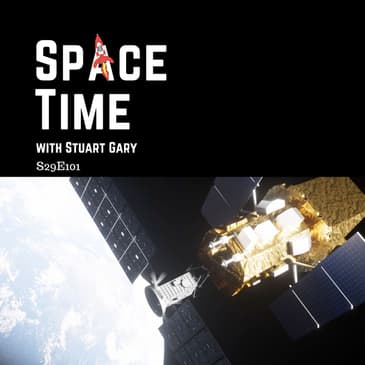
This is Spacetime Series twenty nine, episode one hundred and one, for broadcast on the twenty fourth of August twenty twenty six. Coming up on Space Time, NASA forced to scrap its Swift rescue mission, the Milky Way's first big galactic collision, and Understanding the stuff Adams Are made of. All that and more. Coming up on space Time. Welcome to Space Time with Stuart Gary. NASA has been forced to abandon its planned rescue mission to save the Swift Gamma ray space telescope. Ongoing attitude control problems with the Link rescue craft mean the mission has been scrapped and Swift will now be allowed to fall back to Earth in an uncontrolled disscent in the next couple of months, burning up in the atmosphere. Swift was designed to provide astronomers with an early warning system for the detection of the most powerful explosions in the universe, gamma ray bursts. These events only last a matter of seconds before quickly fading away, and Swift provided the necessary heads up needed to allow astronomers to swing more powerful telescopes towards the direction of the blasts. Swift was launched in November two thousand and four on a six hundred kilometer high orbit, which was thought to be high enough to allow it to remain operational for its primary two year mission, and so it wasn't equipped with any onboard proportion systems. However, the mission has been so successful, detecting around one hundred gamma ray bursts every year, that managers just kept the mission going for twenty one years. However, the current climax of the Sun's eleven year solar cycle has been more violent than anticipated, sending powerful solar flares and chronal mass ejections towards the Earth and causing the planet's atmosphere to wobble, expanding and contracting with each new space weather event, and that led to increased atmospheric drag on the spacecraft, accelerating its orbital decay. The Link rescue craft was meant to rendezvous with Swift. The maneuver around the orbital telescope, find a good attachment point, and then use its three robotic arms to capture and gradually boost Swift back up into a higher orbit. The Link spacecraft was floating into orbit on July the third, aboard a Northrop Grumm and Pegasus Excel rocket which was drop launched from the underbelly of especially modified Lockheed L ten eleven Trista airliner forty thousand feet above the South Pacific Ocean. Mission managers established communications with Link and conducted in orbit checkouts over the following weeks. However, the Link spacecraft suddenly experienced a major anomaly, sending the vehicle into an uncontrolled multi axis spin, tumbling widely in orbit, and sporadically losing communications with mission managers on the ground. While the rescue vehicles operators Catalyst Space were able to get some control over the spacecraft, it wasn't enough to save the mission, and so NASA have taken the decision not to proceed with a rescue attempt. This is space time still to come, the Milky Way's first big galactic collision and understanding the stuff that Adams are made of. All that and more still to come on space time, Astronomers have discovered what was probably the first major galactic collision involving our home galaxy, the Milky Way, cannibalizing a dwarf galaxy called the Low Energy Craken Heracles or LKH. Less than two billion years after the Big Bang, the Milky Way grew to its current size by consuming, merging with, or cannibalizing smaller galaxies. In fact, that's how all galaxies grow now. New data from NASA's Hubble Space telescope has shown definitive evidence of a dwarf galaxy merging with the young Milky Way in the earliest phases of its evolution. The findings, reported in the journal Nature Astronomy, extend sciences understanding of our galaxy's history by some one point eight billion years. The most recent massive merger in our galaxy's history took place with a sagittarist dwarf galaxy beginning more than six billion years ago and still happening today. Looking back into the even more distant past, astronomers learned that the Milky Way consumed another dwarf galaxy called the Guy Sausage and Soladus about ten billion years ago. This ancient merger greatly affected the structure of our galaxies disc of stars. Lots of other smaller mergers have occurred between these two major events, but of course our galaxy's history doesn't stop there. Both observations and computer simulations have suggested another much larger merger preceded these two, though the exact specific so this event have been heavily debated. Now Hubble's uncovered definitive evidence of the earlier merger, which occurred around eleven point eight billion years ago, that's just two billion years after the Big Bang. The Sturdies. Lead author David Massari from the Astrophysics and Space Science Observatory in Bologna, says, while the Milky Way's our home galaxy, we don't fully understand how our house was built. Using NASAs Hubble space Telescope, together with astronomical surveys and data from other spacecraft like the European Space Agency's Guy emission, Bazarian colleagues have been piecing together the early history of our galaxy. Of course, the further back in our galaxies history scientists attempt to look, the more difficult it becomes to fully understand what's going on. When the Milky Way was young, it was much smaller and much closer in size to the galaxies it was crashing into. It was also more chaotic, and it's possible that science of mergers have been erased over billions of years, and it was into this murky past that Hubble has been peering. The authors used Hubble to study the Milky Way's globular clusters, immense roughly spherical collections of tens of thousands to millions of stars. Globular clusters contain some of the oldest stars in our galaxy, and they get act as cosmic archaeological sites preserving stars from other galaxies the Milky Ways collected. Thanks to the high resolution and deep Hubble imaging, the authors rather to measure about the age and metallicity of these clusters with unprecedented precision. Astronomers refer to all elements on the periodic table other than hydrogen and helium, which were formed in the Big Bang as metals. And metals are created in stars either during their lifetime or when they die, and so the greater the metallicity of a star, the older it is. Thanks to the high resolution and deep Hubble imaging coupled with the measurements from GUY, this made it possible to distinguish a population of globular clusters that appear to be very different from the others. And these are the clusters that were born in the ancient dwarf galaxy LKH, and they tell both how big this galaxy was and when it was cannibalized by the Milky Way. The authors analyzed Hubble observations of thirty nine globular clusters from the inner twenty thousand light years of our galaxy, where evidence of the most ancient mergers should be preserved. They expected this sample to contain globular clusters that form within the young Milky Way, as well as those collected from the Gius Sausage and Solidus dwarf galaxy about ten billion years ago. Using Hubble's sensitive observations that determine each cluster's precise age and associated metallicity, Missourian colleagues determined there was a third population of globular clusters within the inner regions of our galaxy. They found these clusters are older than the group collected in the Gia, Sausage and Solidus merger, but younger than those born in the original Milky Way, regardless of their metallicity. These clusters therefore came from a separate, even earlier merger in which our Milky Way absorbed, cannibalized, if you will, a dwarf galaxy containing roughly five hundred million times the mass of our Sun, a significant fraction of our galaxy's total mass at the time. They named this dwarf galaxy Low Energy crackn Heracles or LKH in honor of three earlier research papers that championed the idea of a merger early in our galaxies history. Now, when you think about it, such a large merger so early in the Milky waste formation history would have had profound implications for the evolution of our galaxy. Zuri says that some past studies have argued that this earliest phase of our galaxies evolution was defined by stars born only in our own galaxy, but he says this shows that stars born in external galaxies also need to be considered. This is space time still to come understanding the stuff Adams are made of. Later in the science report, successful phase three trials of a new Australian developed personalized mRNA cancer vaccine. All that and more still to come on space time. New observations made at the Large Hadron Collider the Ward's Biggus atom smasher, are revealing some of the basic fundamental physics of our universe. The new measurements are challenging long standing hypotheses of how gluons behave inside atomic nuclei. Gluons are force particles that bind subatomic elemental particles called quakes together inside protons and neutrons making up the nucleus of atoms. Now, new research by the Alis experiment turns large hadron collider is showing how two rival explanations for how gluons behave inside atomic nuclei can now be experimentally distinguished. The researcher, reported in the journal Physical Review Letters, provides the first multi dimensional measurements of incoherent JSI photonuclear production as a function of both interaction energy and momentum transfer. Sagement gives scientists their clearest view yet of how gluons act at high energies. One of the studies authors, Daniel Tapia Takaki from the Allis Collaboration at CERN, the European Organization for Nuclear Research, says that although quarks are often described as the fundamental building blocks of matter, nearly all the mass of the visible universe, from the atoms in your body to the matter inside stars, actually comes from the energy carried by gluons, the strong nuclear force that binds quarks together. Understanding how gluons behave inside nuclei is therefore essential to understanding how matter itself acquires its mass and structure. The study of how gluons fluctuate within nuclei with more spatial resolution than ever previously possible. The authors used an experimental technique called incoherent JSI furt nuclear production. Tapia Dakaki says the measurements were performed using data collected during run two of the large Adrin Collider. We're fast moving lead nuclei pass close to one another without directly colliding. In these encounters, intense electron magnetic fields surrounding the nuclei behaved as beams of high energy photons. When one of these photons strikes another nucleus, it can briefly produce a particle called JSI, whose production provides a sensitive probe for the underlying gluon structure. Unlike other measurements that average over the entire nucleus, incoherent JSI production is sensitive to local fluctuations in gluon density, allowing scientists to probe structures smaller than a proton. And these intense glu on fields, present inside every nucleus, make up nearly all of the visible matter in the universe, yet their collective behavior remains one of the greatest challenges in modern physics. Tapi Takaki says these experiments using incoherent production is sort of like switching from a blurry image to a high resolution microscope. It allows scientists to see how gluons fluctuate and organize themselves inside atomic nuclei. By varying the momentum transfer, the experiment effectively changes the focus of the microscope. At resolutions of zero six, zero three, and zero two femptometers, allus progressively probe smaller and smaller origins inside the nucleus. The finest resolution corresponds to structures only a quarter the size of a proton. At these extraordinary scales, physicists have observed evidence that the gluons begin to behave collectively, a phenomenon known as gluon saturation. The authors measured incoherent jside production across a wide range of photon nucleus energies from twenty right up to six hundred and thirty three billion electron vaults. At the same time, they also examined how the interaction changes with momentum transfer, which corresponds to how finely the nucleus is being probed. The results revealed a striking pattern at the smaller special scales explored, the production rate of J side particles was significantly suppressed, with a statistical significance of about three standard deviations. This suppression challenges a long standing explanation known as nuclear shadowing, which is successful describe previous measurements. Now in that framework, glawns inside the nucleus partially overlap and obscure each other, similar to layers of clouds blocking out sunlight, reducing the probability of certain particle production processes. The new measurements indicate that conventional nuclear shadowing alone can't fully explain the observed data. Instead, the observations are consistent with a different phenomenon known as gluon saturation, which is predicted by the theory of quantum chromodynamics, which describes the strong nuclear force the peer. Takaki says that in this regime, lawns become so densely packed that they begin interacting strongly with one another, limiting how many can exist in a given region. The project is just one of hundreds of experiments being undertaken by CERN, the European Center for Nuclear Research CERN. Is the world's largest particle physics research laboratory. It covers six square kilometers scattered over twelve sites either side of the Franco Swiss border near Geneva, in thirty four kilometers of tunnels and caverns the size of cathedral at over one hundred metres underground. CERN hosts facilities for experimental physics. Scientists from all over the world work here in international collaborations to study and understand the mysteries of the universe, stars, planets, sees, air, humans. Everything around us is made of matter. Matter is made of atoms. Atoms are made of electrons orbiting around a nucleus, which in turn is made of protons and neutrons. Inside these we find quarks. In CERN's newest accelerator, the Large Hadron Collider, particles collide at nearly the speed of light to study the quarks and other particles. Many of these particles only existed in the early universe for a fraction of a second after the Big Bar, when all the energy transformed into matter. In CERN's accelerators, we can recreate conditions that existed just after the Big Bang and shed light on such questions as why do particles have mass, what is the nature of dark matter in the universe, why did matter triumph over antimatter in the first moments of the universe, making our existence possible. What was the state of matter just after the Big Bang? For gigantic instruments called particle detectors study the data from the LHC collisions in search of the answers to these fundamental questions. The experimental and theoretical study of these conditions allows us to understand the fundamental laws of nature and to unveil the ultimate mysteries that govern our universe. In the course of their research, certain scientists have often come across discoveries that have affected our everyday life. The technology used for particle detectors is at the origin of security scanning equipment and several medical applications, and the World Wide Web was invented at Cerne in nineteen ninety by the British scientist Tim berners Lee. The web soon grew beyond the world of particle physics and has become our primary repository of information, changing and improving the way people interact and communicate. To treat these massive amounts of data produced by the Large Hadron collider, physicists, together with experts from industry, are building a web of cooperative computing called the Grid. The grid will allow thousands of research centers and universities to share their data, storage resources and computing power, transforming the Internet into a giant global supercomputer and building capacity for the science of tomorrow. This is Space Time and Time out to take a brief look at some of the other stories making news in SIENS this week with the Science Report. Australia's recorded its first case of H five N one bird flu in a mammal on the mainland. Authoroady say the virus was found in a dead long nose first seal at Beachport on the South Australian Limestone Coast, three hundred kilometers south of Adelaide. The infection likely came from contact with nearby six sea birds. The Australian mainland had been bird flu free until the current outbreak began in June. There have now been over three hundred positive H five N one bird flu events recorded on Australia since the outbreak began, with one hundred and ninety four of those in South Australia alone. Federal Agriculture Minister Julie Collins says the concerning development wasn't unexpected. The viruses jump from birds into mammals was always coming, with thirteen three hundred and fifty nine fur sealed pups dying on the Australian territory of Herd Island a year ago, wiping out seventy five percent of the local sealed juvenile population. Researchers have found that wildfires, especially those that happen in areas that are used for mining agriculture where people live, could increase the levels of arsenic in nearby drinking water. A report in the journal p and As reviewed twenty studies on fires across the world, including Australia, finding sixteen showing an increase or likely increase in arsenic in bodies of water following a bushfire. They say runoff was the most common pathway for the arsenic, and while most average values didn't exceed drinking water standards, they found six of the studies showed that it did. They found the highest concentrations seven times the recommended maximum, was measured in water after a fire near an old mining operation, and higher values were seen downstream of bird agricultural and urban areas. Maderna and Merrick have an own successful phase three trials of a new Australian developed personalized mRNA melanoma cancer vaccine. The successful trials I mean the treatment could be made available to oncology patients within two years. The NMA vaccine works by being tailor made to each individual using the unic blueprint of their individual tumor cells, in order to help immune cells better recognize and eradicate those cancer cells. The company says their trial shows statistically significant and clinically meaningful improvements in the amount of time patients went without cancer science or symptoms, returning or spreading. The phase three trials involved one one h and thirty seven patients split between the personalized m r and A vaccine combined with the current standard immunotherapy drugs, and a control group that use just the standard immunotherapy drugs on their own. A new study warns that the more plastic pollution sable shearwaters on Lord Howe Island consumers young seabirds, the less likely they are to survive at sea and safely return to their colony as spreading adults. The findings, reported in the journal p and As, examined fifteen years of data looking at how plastic ingestre by marine wildlife affects organisms at a population level. The birds belong to Lord Howe Islands, Ned's Beach Rookery in the South Pacific Ocean, six hundred kilomts east of Tai on the New South Wales Mid North Coast. The authors found that up to twenty percent of fledglings and ingested more than a grammar plastic and consuming that much plastic was associated with at least an eleven percent reduction in the probability of birds surviving to return and breed at the colony, and birds that ingested more than five grams of plastic were almost always never seen again. A new study has shown that more than ninety percent of rainforests in the Blue Mountains west of Sydney may be hiding in plain sight wrongly catalog as eucalypt forests. A report in the Journal of Vegetation Classification and Survey claim scientists have uncovered previously unrecognized phire sensitive rainforest communities tucked away deep in the region's rugged gullies, with rainforest extent found to be three to four times greater than what official maps indicate. The newly identified rainforests support ancient Gondwanian plant lineages, rare species and previously unknown populations of critically endangered scrub turpentine. A rainforest is a tall, dense forest that gets very high amounts of rain each year, usually more than eight hundred to two thousand, five hundred millimeters that's seventy to one hundred inches on the old scale. These lush ecosystems cover only a small part of the Earth's surface, but home to more than half of the ward's plant and animal species. Ghostbusters claim the uncovered at ghost haunting a long abandoned pub in Merry, Old England. The Old Crying Tree pubb at Gate Ache in the Liverpool is by no means the first English drinking establishment to claim it's haunted, and it almost certainly won't be the last. Originally built as a Victorian manor house in the eighteen eighties, the listed building on Grange Lane was formerly known as the Crying Tree Barren Grill. It's recently changed owners after being vacant since twenty fourteen, with plans to turn it into a children's daycare Neur Street now approved by the local council, but the skeptics Ten Menum says ghost hunters claim it's a paranormal hotspot, and they've even photographed an apparition at the top of the stairs. It seems to be the de rigueur of pub landlord that they have to be haunted. To add some characters. They are full of spirits. Yeah. The latter story was about a famous creepy house that supposedly had ghosts in it. And the reports are by independent people who have to be paranormal researches and ghost hunters who tend to go into these things believing in ghosts in the paranormal even though they say they yet to be convinced. It doesn't take a lot of events or episodes or evidence to convince them that these things are real. This is a house in place called Gate Acre. It's a pub, and they say, yes, it's definitely haunted because I've seen things there. This person says, you don't find many apparitions in our fields, and this was an apparition at the top of a stairwheel or some oether. It looks like a stain on the wall, but I say it wasn't a stain on the walls, just a dark shape, indetermined shape. They say, you don't find many apparitions in that field. They are very rare, and I've had about three been doing it for two years, the highly experienced ghost unt. The weird thing is they haven't got a clue as to why this one particularly appeared in this place called the Crying Tree Pub, and they said, I've caught one in the graveyard before, I've caught one at another place where I don't member of the second place. You think if you only seen them three in your life, that you would have been membered where they were. But never mind, these stories are a little. Bit yes, quite likely, but finding ghosts in pubs to every pub in the UK has a resident ghosts which knocked over pipe classes and this sort of stuff, or move furniture, and this one was just. A shape or something moving. They'll move very quickly. Evidence is not very good. Fuzzy photos sometimes you see a ghostly shape and half the time they're fake. So another UK pub report of an indeterminate, vague ghost produced by someone who's a believer in ghosts and is willing to see anything and doesn't remember where they actually saw ghosts of the past. Sad to say, I'm probably more cynical and skeptical of that one. Not very convinced that's. The Skeptics timendum, and this is space Time, and that's the show for now. Spacetime is available every Monday, Wednesday and Friday through at bites dot com, SoundCloud, YouTube, your favorite podcast download provider, and from space Time with Stuart Gary dot com. Space Time's also broadcast through the National Science Foundation, on Science Own Radio and on both iHeartRadio and tune in Radio. And you can help to support our show by visiting the Spacetime Store for a range of promotional merchandising goodies, or by becoming a Spacetime Patron, which gives you access to triple episode commercial free versions of the show, as well as lots of bonnus audio content which doesn't go to wear, access to our exclusive Facebook group, and other rewards. Just go to space Time with Stuart Gary dot com for full details. You been listening to space Time with Stuart Gary. This has been another quality podcast production from bytes dot com.