


In this episode of SpaceTime, we delve into the latest discoveries in astrophysics and the challenges faced by space agencies worldwide.
Ancient Supernova Offers Clues to Dark Energy
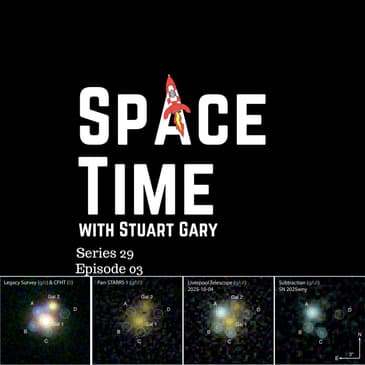
Astronomers have made significant strides in understanding dark energy, the enigmatic force driving the universe's accelerated expansion. A newly observed supernova, located 10 billion light years away, has been gravitationally lensed by a foreground galaxy, allowing scientists to analyze multiple images of the same explosion. This phenomenon could help determine the Hubble constant, shedding light on the universe's expansion rate and its ultimate fate, which ranges from a Big Crunch to a Big Rip.
Sterile Neutrino Hypothesis Nearly Ruled Out
After over a decade of research, scientists have come close to ruling out the existence of the sterile neutrino, a proposed particle that could explain anomalous neutrino behavior. Data from the Micro BooNE experiment at Fermilab has shown no signs of sterile neutrinos, providing a pivotal moment in particle physics that narrows the search for new theories beyond the standard model.
China's Reusable Rocket Setback
China's efforts to develop a reusable rocket faced a significant blow as its Long March 12A failed on its maiden flight. Although the rocket's first and second stages performed as expected, the first stage failed to return successfully, highlighting the challenges in achieving reusability akin to SpaceX's Falcon 9. This setback underscores the competitive nature of the global space industry as China strives to enhance its capabilities.
www.spacetimewithstuartgary.com
✍️ Episode References
Astrophysical Letters
Nature
Fermilab Reports
Become a supporter of this podcast: https://www.spreaker.com/podcast/spacetime-your-guide-to-space-astronomy--2458531/support.
(00:00:00) This is Space Time Series 29, Episode 3 for broadcast on 7 January 2026
(00:00:47) Discovering dark energy through a unique supernova
(00:12:30) Ruling out the sterile neutrino hypothesis
(00:20:10) China's reusable rocket faces a major setback
(00:25:00) Science report: Climate change impacts, endangered species, and digital privacy concerns
This is Spacetime Series twenty nine, Episode three, for broadcast on the seventh of January twenty twenty six. Coming up on Space Time, the ancient supernova which may hold a key to the universe's mysterious dark matter, the long hypothesized sterile neutrino finally ruled out at least almost, and China fails in its latest attempt to develop a reusable rocket. All that and more Coming up on space Time. Welcome to space Time with Stuart Gary. Astronomers studying a gravitationally lend supernova may be a step closer to cracking one of the great secrets of dark energy, that mysterious force believed to be causing the universe's accelerated expansion rate. Dark energy makes up around sixty eight percent of the universe's total mass energy budget, but its exact nature is unknown, as is its influence on the evolution and ultimate faith The Cosmos Scientists know it's caused an accelerated expansion of the universe ever since the Big Bang thirteen point eight billion years ago, but some more recent studies are our suggesting the dark energy's expansion rate is slowing down and may even be reversing dark energy is important for determining the universe's ultimate fate. Right now, there are four possible outcomes. Either, the rate of expansion will slow down and eventually reverse, resulting in gravity becoming the dominant force in the universe. That'll cause the universe to eventually start to contract again, ultimately ending in everything coming together again in a big crunch. The second alternative is a steady state, in which the accelerated expansion of the universe due to dark energy peters out and the universe reaches a sort of steady equilibrium, much the way it does now. The third option is the big freeze. That's where the universe's accelerated expansion due to dark energy continues. Eventually, all the galaxies will be so far apart from each other they'll disappear from view beyond the cosmic horizon, leaving the universe looking very cold, dark, and empty. The fourth possibility, and personally I think the most frightening, is that dark energy's power will increase, causing the accelerated expansion become even more extreme. Ultimately, not only will other galaxies disappear from our view, but so too will neighboring stars in our own galaxy, and after that star systems themselves might be torn apart, and the ultimate expression of all that could will be on the subatomic scale, where objects are ripped apart into their constituent atoms, and even atoms are torn apart into their constituent nuclei in surrounding electrons, and theoretically it could even see the quarks and gluons in side protons and neutrons also being torn apart, and this ultimate for the universe is known as the Big rip. Now, astronomers observing a unique exploding star that went supernova some ten billion light years away hence ten billion years ago, may provide some new clues. A report in the journal Astrophysical Letters says light from this incredibly bright event, known as the superluminous super and ova, was bent and magnified by the gravity of a full ground galaxy to make it appear even brighter. One of the studies authors, Jacob Wise from john Laws University, says no one's ever found a super and ova quite like this one before, and the nature of the system means that maybe how to help solve some of the big problems of astrophysics, such as the nature of dark energy, a force driving the expansion of the universe. The lensing galaxy is in direct line of sight between the super and Ova had logged as SN twenty twenty five wny and the Earth, and the manner in which its gravity is affecting light from the super and Ova as it travels towards our viewpoint is key to the puzzle. You see light from this distance super and Ova is being split into modible images, and when light is lens the different paths the light follows to get to Earth don't necessarily all travel over the same distance, so light moving along different paths takes variable amounts of time to reach us. The case of a super anderv that shines for months on end, it means that we can see the different images of the same source altogether at the same time, but each one is probing a different time in the Supernerva's evolution. Why says. What's exciting about that is that the amount of time difference between different images depends on the expansion rate of the universe. In our plans to measure these time differences precisely in order to determine how fast the universe is expanding, the so called Hubble constant different ways of measuring that rate are giving different results, a problem known as hubble tension. Measurements of the cosmic microwave background radiation that's the afterglow of the Big Bang, recorded when the universe cooled enough for the first atoms to form some three hundred eighty thres and years after the Big Bang, suggests the universe is expanding at a rate of somewhere between sixty seven and sixty eight kilometus per second permeger parssic, but telescope observations by hable of the expansion based on measurements of the need by universe looking at stars used as cosmic distance leaders like safy at variables and type one eight supernervae suggest an expansion rate more like between seventy and seventy six kilomtus per second per mega passik Why says studies of lensed supernervae like this one could indicate which of these two numbers for the hubbled constant is the more accurate. What we have discovered is a super and ova that is over ten billion light years away with a galaxy in the foreground. That means that it has been it has been gravitationally lensed, and so instead of seeing just one image of the super and Ova, the light has been bent so that we actually see three or even more images. What's significant about that is that the light from each image is getting to us with a different travel time, So with that we can use that to measure quite accurately the expansion of the universe. At first, I didn't believe that what I was seeing was real. I thought my eyes were just blurry. I basically rubbed my eyes and then it was still there, and so then I thought, oh, this is probably just an artifact on the telescope. Maybe there was high winds and it wobbled. But then I took a look at the data that we got in two weeks previous and it was still there, and so then that really convinced me this is actually real, and so I immediately notified my collaborators in Stotcolm and he noticed the wider astronomical community that night that we had actually found this. This is the first time that this has been sin with what we call seeing limited ground based observations, So that means that you don't need a space telescope or what we call adaptive optics to actually resolve the individual images. So this is almost like a proof of concept that this can be done with even mid range telescopes. So the feeling of that was just sheer disbelief that I'd found this. This is only been seeing less than ten times in the entire history of astronomy. So since we found this, we've had every single major observatory in the entire Northern Hemisphere and Hubble and James Webb looking at this thing. But the LT discovered at first. Just being involved in this sort of magnitude of a of a discovery is amazing, and it's really pushing me to stay in this field and get a post doc. Kind of made me realize that this is why I'm doing this. This is amazing. I still don't really believe it. It's taken a while to think in. That's Jacob Wise from John Moore's University and this space time still to calm, Physicists finally ruled out the existence of the long hypothesized steerile neutrino well or most and China fails in its latest attempt to develop a reasonable rocket or that and more still to calm on space time, after collecting and analyzing data for more than a decade, scientists have finally debunked the long held hypothesis about a mysterious particle called the sterile neutrino. Their findings, reported in the journal Nature, come from the micro Bernie or microbooster neutrino experiment at the United States Department of Energies FERMI National Accelerated Laboratory in Illinois. FERMI Lab. Using a powerful liquid argon detector and data from two neutrino beams, researchers were able to rule out the existence of a single sterile neutrino with some ninety five percent certainty. One of the studies authors, Andrew Massbaound from Rutgers University, says the results represent a key turning point in physics. He says scientists can now rule out a prime suspect, but that doesn't quite solve the mystery. Neutrinos are incredibly weakly interacting subatomic particles. In fact, they're so weakly interacting there are literally billions of them passing through you right now and you don't even notice them. They created in powerful environments like the cause of stars, exploding stars known as supernovae, and innuclear reactors. The standard model of particle physics, the cornerstone of our understanding of the universe, states that there are three types of neutrinos, electron neutrinos, muon neutrinos, and tau neutrinos, and these different particles, known as flavors, can change from one to another a process called oscillation. So an electron neutrino may leave the core of the Sun, but by the time it reaches detectors on Earth, it may have converted into a muon or toawl neutrino. The problem is, in past experiments, searchers saw neutrinos that appeared to change in ways that didn't fit the standard model, and to explain this, they proposed a fourth type, a sterion neutrino, and unlike the others, it would be more difficult to detect because it wouldn't interact with matter at all except through gravity Microbooni. Scientists tested this idea by observing neutrinos from two different beams and measuring how they oscillate. Now, after ten years of data collection and analysis, the authors found no sign of sterile neutrinos, thereby closing the door on one of the most popular explanations for strange neutrino behavior. Massbaum says getting these uncertainties right is crucial because it allows scientists to make strong, reliable statements about what their data is really showing. And this is important because it rules out a major theory about new physics. See, the Standard model can't explain everything. It doesn't explain dark matter, or dark energy, or gravity for that matter. So scientists have long been searching for clues that go beyond the Standard model. And eliminating one possibility that sterile neutrino helps them focus their search on other ideas, ideas which could eventually lead to breakthroughs in a better understanding of the universe. This is space time still to come. China fails in its latest attempt to develop a reusable rocket, and later in the Science report, did you know that your adult toys may be spying on you? All that and more still to come on space time. China's new reusable Lomar's Torve rocket has failed on its maiden flight. The mission blasted into space from the Xuquan Satellite Launch Center in a Mongolia. The rockets first and second stages both performed as planned during the ascent to space, with a second stage successfully reaching orbit. However, the first stage, which was designed to return to Earth, landing vertically at a designated recovery siting Ganzu Province, failed during the return. It's a major setback for China space industry. Beijing striving to develop a fleet of reusable rockets similar but the SpaceX's Falcon nine, Starship and Starship Super Heavy and Blue Origins, New Shepherd and New Glen rockets, all of which are designed for reuse. Having reusable rockets low as launch costs improves efficiency and can increase the frequency of space flights. The seventy point four meter tall long March twelve A is the largest rocket China's ever built, and was designed to carry over six tons into lowerth orbit. Last month, the Chinese commercial space company land Space launched its own reusable rocket, the Zeq three, also from Jaiquan. It also managed to reach orbit, but its first stage booster also failed during its return to worth. This is Space time and Time that Attack. Another brief look at some of the other stories making use in science this week with the Science Report. SITAS say that around seventy percent of the wards population may experience rapid rates of change in temperature and rainfall extremes over the next two decades if we failed to cut carbon emissions fast enough. A report in the journal Nature Geoscience examined projected rates of change in temperature and rainfall extremes over the next two decades using large ensembles of climate model simulations, also finding deep and rapid cuts to emissions could reduce this percentage from seventy percent down to around twenty percent. Without these cuts, large parts of the tropics and subtropics, compassing around seventy percent of the wards population, are expected to see rapid changes in temperature and rainfall over the next twenty years. On northern latitudes, southern and Eastern Asia and Equatorial Africa are expected to see rapid changes in rainfall. Scientists have estimated the numbers of two endangered mammals on Australia's East cursed koalas and Southern Greater gliders living in the Illawarra range of New South Wales. The findings, reported in the Journal of Australian Mammology, used thermal drones to survey forty seven sites in the region, finding just fifty six koalas and one hundred and twenty seven gliders Over a total area of one one hundred and seventy five hectares. The authors calculated the average density of koalas in the region was just zero point one three per hectare and glider density was just zero point one seven per hectare. The scientists say that density information is needed to track further changes in these highly endangered populations. It's been revealed that the US government keeps track of hospital emergency room records the patients have come in for treatment after getting items stuck in their rectums. The American Journal of Emergency Medicine found that between twenty twelve and twenty twenty one, an average of thirty eight, nine hundred and forty eight people each year were hospitalized with foreign objects inserted with the sun don't shine. The average patient with its shall we say malady was aged forty three and seventy eight percent were mail and it's actually not a laughing matter. Forty percent of patients needed to be admitted to hospital. The data is being compiled by the United States Consumer Products Safety Commission. It found that of the various items removed, fifty five point four percent were adult toys other items which people seem to accidentally fall onto include shampoo, bottles, baseballs, turkey basters, uncooked pasta, eggs, doggy q toys, doorknobs, marbles, rocks, flashlights, light globes, battens, screws, nails, bottles, and in one case, a full sized pumpkin spy scentered yankee candle. In twenty twenty three, the Visual Journal of Emergency Surgery published a case study about an Iranian man who needed emergency surgery after he accidentally fell into a large deodorant canister which had somehow traveled all the way up into his digestive tract. Doctors say, the problem then is how do you get it out? Because with things that are really big, you can't just reach up there and grab them and then pull them out. That's because the section becomes a vacuum and pulls it back up in there again and before we go. There are new warnings today that if your adult toys are capable of being connected to the Internet, they may be spying on you. It seems that app connected adult toys could be collecting highly sensitive data, impacting your digital privacy no pun intended or maybe just a little, These app connected devices could be collecting data on your playtime behavior, your preferences, your usage frequency, your intensity settings, as well as your other special interest activities. They could also be gathering data on your location at IP address. Now, most companies that collect data will claim they're doing it to improve their products, but that customer information is often also passed on to data brokers, who will then sell it to anyone who wants it, including the government, private investigators, advertisers, and even your ex With the details, we're joined by technology editor Alex Hahrovrout from Tech Advice Start Life. Well a little bit like I was watching the movie The Running Man, the twenty twenty five version, and in one particular scene, the hero goes into a store. He knows the proprietory of the store and there are these old cathode ray tubes televisions catho rate in cit televisions, and the store owners said, look, those are very popular because these TVs are not watching you back. And we do know that Visio, which is a big TV brand in the US that is not really well known in Australia but. Big in the US. It's reported that make more money from the data that is gathered on what you're watching and the apps you're downloading and the things you're doing, then they make from actually selling the televisions. And there's ac art's automatic content recognition setting that you can get on the major TVs and turn it off. Is doing the same thing. Those devices are capturing data about you, and then they're on selling them, and when you click the I Agree button, you are unknowingly giving them permission to do that. So if this is stretched, well, it would just be the latest device that would be connected to an app of some sort and will be not just collecting the data for your benefit so that you can data mind yourself. But then they're taking that information, even if they are anonymizing it, but they're taking that information, putting it into some sort of database, having some sort of aggregate information out of that, and then on selling it to people who are wanting to either know which particular lubricants are good or which substances may intensify certain feelings. And I mean, look, bring on the battery operated devices that are not connected to the Internet. I think those are going to in the next few years also become quite a popular thing as people decide that they don't. Want TV's are already spying on you. And I think my remote control can listen to what I'm saying too. Got a microphone button there, which means it's got the ability to. Spy on me. Yeah, well, I mean in theory, these things could be hacked into, and then your conversations have been listened to. Televisions over the past twenty years. There was a time when they all had Skype compatibility and they had a camera in them. But you go and have a look these days, all those cameras have been stripped out, and that's obviously because TV's hacked into, and then people were watching you Big Brother style through the television the camera in your television. So the big problem of technology is securing it. And given the fact that even the waunted and incredible Apple is forever putting out updates you every month or two or three, which are closing massive security vulnerabilities that can allow an attacker to effectively get full access to your phone and then use it to listen and spa on you, and which has been done by certain countries against their local dissidents. Well, you know, the biggest problem with technology is keeping it secure. That's Ale Saharavrout from Tech Advice Life, and this is space Time. And that's the show for now. Space Time is available every Monday, Wednesday and Friday through fytes dot com, SoundCloud, YouTube, my favorite podcast download provider, and from space Time with Stuart Gary dot com. Space Time's also broadcast through the National Science Foundation, on Science Own Radio and on both iHeartRadio and tune In Radio. And you can help to support our show by visiting the Spacetime Store for a range of promotional merchandising goodies, or by becoming a Spacetime Patron, which gives you access to triple episode commercial free versions of the show, as well as lots of burnus audio content which doesn't go to weir, access to our exclusive Facebook group, and other rewards. Just go to space Time with Stewart Gary dot com for full details. You've been listening to space Time with Stuart Gary. This has been another quality podcast production from bytes dot com.