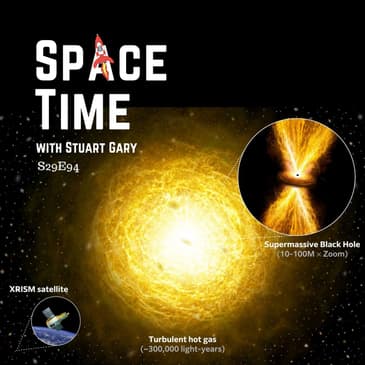


This is Spacetime Series twenty nine, episode ninety four, for broadcast on the seventh of August twenty twenty six. Coming up on Space Time, it turns out black holes are a hundred times more powerful than previously thought. The dramatic collision which flipped our Milky Way galaxy and a successful return to Worth for the crew of the Sawyers M twenty eight. All that and more coming up on space Time. Welcome to Space Time with Stewart Gary. Astronomers have been forced to rewrite their textbooks on the power of supermassive black holes after new observations have shown that these cosmic monsters can generate enough energy to impact galaxies hundreds of thousands of light years away. Scientists previously believe that the impact of winds generated by super massive black holes was contained to the host galaxy, but the new findings reported in the General Nature Astronomy, reveals that the energy produced extends to surrounding galaxies three hundred thousand light years away, one hundred times further than previously thought. The studies lead author Satashi Yomta from Tohoku University says the discovery demonstrates that these explosive winds impact vast expanses of space far beyond the galaxies they inhabit. It Mata says. Black holes are largely known for sucking in matter, but they also eject gas in the form of powerful winds. These winds were thought to be contained within the galaxy, but your Madas study reveals the force is immensely more powerful than previously understood. Your matter and colleagues use the CHRISM X ray space telescope to observe the activity of a quaser cataloged as H eighteen twenty one plus six forty three, located some three point four billion light years away in the direction of the constellation. Draco. Quasars are extremely luminous jets of energy and matter given off material being crushed and stretched in the accretion disk of feeding black holes. The rapidly growing black hole containing the quasa is located in the center of a galaxy caster, where it's driving turbulence and the surrounding hot gas emitting X rays in the process. The authors precisely determine the motion of the gas by analyzing spectroscopic emission lines from iron ions. The observations revealed that the high temperature gas surrounding the black hole isn't remaining static, but violently disperses over a wide area due to turbulence, and they also confirm that the flow of the gas extends far beyond the host galaxy, reaching distances of more than three hundred thousand light years. The amount of energy involved in the turbulence was approximately one hundred times greater than what previous estimates had made, and equivalent to several billion supernova explosions, the blasts that occur when stars reach the end of their lives. You might have says. It's the first time anyone has shown that black holes can influence such a broad cosmic environment, and it demonstrates that black holes are key drivers of gas flow and motion in space, transporting vast amounts of energy materials to very distant regions of the cosmos. This is space time still to come. The dramatic collision that flipped our Milky Way galaxy and a successful return to Earth for the crew of the Sawyer's M twenty eight spacecraft. All that and more still to come on space time. A new study suggest that our home galaxy, the Milky Way, may have undergone a dramatic change in orientation following a head on collision with another galaxy. The findings, reported to the Royal Astronomical Society's conference in Birmingham, help us explain a long standing mystery about our galaxy. Using supercomputer simulations of galaxies like the Milky Way, astronomers found that galaxies with slowly rotating stellar halos are more likely to have experienced a major disc flip. That's where the galaxy's disc changes its orientation by more than ninety degrees. Most of the Milky Way stars are located in the flat spiral disc of the galaxy, and surrounding this disc is a much larger but spars stellar halo, made up mostly of stars that are originally formed in smaller galaxies before being pulled into the Milky Way through galactic mergers. Observations by the European Space Agency's Guian mission have shown that the Milky Way stellar halo rotates very slowly, but astronomers have not understood why. So they analyze the evolution of twenty five Milky Way like spiral galaxies in the rigious squid of cosmological computer simulations, and they followed their development over billions of years. They found that galaxies with the slowest rotating stellar haloes shared two important features. Each experienced a major head on merger or collision with another galaxy, and they also underwent a disc flip during their revolution. The studies lead author Kirol Batrikov from Durham University says astronomers already know that the Milky Way had a massive head on collision in the past with a galaxy known as the Guy Sausage and Soladus, and this new data suggests that may have caused the Milky Way's disc to flip. The Guy of Sausage and Soladus was a massive dwarf galaxy that collided with and was absorbed into the early milky Way somewhere around ten to eleven billion years ago. This defighting galactic merger was the largest single event in the early history of the Milky Way, and it reshaped our galaxy, leaving billions of stars orbiting in a highly elongated sausage shaped path. Identifying a past disc flip gives astronomers a new way to understand how the Milky Way assembled, and it may also provide indirect clues that the motion of its invisible dark matter halo. A disc clip also means most of the Milky Way stars moved on very different trajectories compared to the way they moved today, possibly even our own son Any our stable spot in the galaxy might not have been quite so stable in the past. The study also found that the rotation of the Milky Way stellar halo is closely linked to the rotation of its dark matter halo, and that suggests the two possibly evolve together as the galaxy grew by a creation of the smallst satellite galaxies. This is space time still to come. A successful return to Earth for the crew of the Sawyers M twenty eight. The red super giant antaries, Barnard Star, the second Earestar system to the Sun, and the annual Percied's meteor shower are among the highlights of the August night skies on SkyWatch. The ros Cosmos Sawyers M twenty eight spacecraft has returned safely to Earth, bringing home the expedition seventy four crew who were spent the past eight months aboard the International Space Station. The capsule touchdown of the world in script Kazakhstan stick three and a half hours after the patting the over the outpost. We are covering the return of the Suyu's MS twenty eight spacecraft with NASA astronaut Chris Williams and Ross Cosmos cosmonauts Sergei Kodsvirzkov and Sergei Mikhaye, returning under its main parachute, slowing it down for a touchdown on Earth. We did hear confirmation from the crew that everything was nominal or as expected on board. That's so us MS twenty eight spacecraft suspended under the orange and white parachute, and that main parachute covering an area of one thousand meters. It's slowing the capsule down to about sixteen miles per hour, quite a contrast from the seventeen thousand, five hundred miles per hour this crew was traveling just three hours ago. You course is how do papy me? I am? This is quesche Yas was pretty much us. We read you loud and clear. I love my space kid, but its. Ballistic myths is for seconds. We are in the controlled automatic descent. We see you, guys, uh one feeling great, creature, two feeling good, three feeling amazing. That is good news, guys. Confirmation from the crew themselves that they are are all feeling good, great and amazing. The crew also has a voice and visual with the search and recovery forces. Russian Search and Recovery at vs continue making their way towards the anticipated landing site. Cious search and rescue forces. What's your altitude? Thirty start for them? Our altitude is three kilometers seven fifty meters. Oxidizer jobs figure on. Matter, I apprecail a point at you. As the crew continues drifting down to Earth under that parachute. The aiometric altitude on the INPU panel is three kilometers. The next major milestone, and essentially the final milestone just before landing, is the soft landing engine firing says when six engines will fire to slow the descent rate to one point five meters per second, so just over three miles an hour when soy US is less than one meter above the ground. So the spacecraft now traveling about sixteen miles per hour ahead of those soft landing engines that fire just before touchdown to help ease the return to Earth. And a reminder that radio beacon that you is completely normal. This is establishing communications that begon coming from the spacecraft. You're hearing communications to and from the SWAYUS MS twenty eight spacecraft. Once you're hearing that of Commander Sergei Kidsfirzkov Ross Cosmos cosmonauts speaking with the mission control team in Moscow again. Conditions at the landing site. Visibility about six miles with twenty four mile per hour winds and eighty eight degrees fahrenheit. This is questions. I'm getting to nine hundred meters, hold your arms close to the body and please. Do not speak your globo docture and. This is going to stay true all the way and still handing. Landing now less than thirty seconds away. Crew receiving final instructions as they prepare for. Touchdown reference altitude, braceful landing. Touchdown. Chris Williams, Sergei Mikaev, and Sergi Kispertzhkov have returned to their home planet at five twenty seven am Central time three twenty seven pm in Kazakhstanzois. Is on its side and there is no fire. That's the rescue force is reporting all right, and the helicopters approaching to land. So I heard the call that the Soyus is on its side. This is not uncommon for the Soyuz, and the crew will be extracted from the spacecraft upon the recovery forces arriving at the capsule. The two hundred and forty one day mission launched from the Bike and or Cosmo drove and the Central Asian Republic of Kasek stand back on November the twenty seventh and involved obening the Earth some three thousand, eight hundred and fifty six times, traveling more than one hundred and sixty million kilometers. While on station, the crew were involved in more than two hundred and fifty scientific experiments, including research on new cancer treatments and improving in space manufacturing of materials used in high performance computers and electronics. They also undertook two extra vehicular activities or EVAs NASA speKt for spacewalks. These were designed to prepare for station power system upgrades and to replace a faulty joint in the Canada ARM two robotic arm. For more than twenty five years now, people have lived and worked continuously in space aboard the International Space Station. The Orbiting our Post is helping NASA understand and overcome the challenges of human spaceflight for long duration missions to the Moon and eventually onto Mars and beyond. As part of the Artemis program, However, the space station's future is now limited, with NASA planning to deorbit one hundred and nine meter long four hundred and twenty one our posts sometime in late twenty thirty or early twenty thirty one. It'll be replaced by smaller commercial space stations and a major expansion of China's Tiangong space station, which will double its size this space time and Time Out of turn oives to the skies and check out the celestiousphere for August on SkyWatch. August is the eighth month of the year in the Julian Engagorian calendars. It was originally named six Tillius in Latin because it was the sixth month of the original ten month Roman calendar under Romulus in seven fifty three BCE, when the year started in March. It only became the eighth month when January and February were added to the start of the year in the year eight BCE. It was renamed in honor of the Roman statesmen and military leader Augustus, who had achieved several military victories, including the conquest of Egypt. During the month. Okay, turning to the heavens and the constellation s, the Scorpion is high overhead this time of year, covering almost a third of the August night skies. At the heart of Scorpius, located some four hundred and seventy light years away, is the red super giant Antaries. A light year is a distance of about ten trillion kilometers, a distance of photon can travel in a year at three hundred thousand kilometres per second, the speed of light in a vacuum and the ultimate speed limit of the universe. The name Antaries means rival of Mars, and indeed, when they're close together in the sky, they do look very similar. And Tari's, or Alpha Scorpius that's sometimes called has some twelve point four times the mass and an incredible four hundred and fifty times the diameter of our Sun and is one of the largest known stars in the universe. And Tari's is so big that wordplace where the Sun is at the center of our solar system, it would engulf all the inner planets Mercury, Venus, Earth, and Mars. It's outer surface would rich almost as far as the orbit of Jupiter. And Tari's is a binary system, there's a companion style orbiting with it called Antari's B, a massive spectual type B blue white star at least seven point two times the mass and five point two times the radius of the Sun. It's located about two hundred and twenty four astronomical units beyond the primary star. An astronomical unit is the average distance between the Sun and the Earth, about one hundred and fifty million kilometers or eight point three light minutes. Astronomers describe stars in terms of spectual types, a classification system based on temperature and characteristics. The hottest, most massive, and most luminous stars are known spectro type O blue stars. They're closely followed by spectual type B blue white stars, the n spectual type A white stars, spetual type F whitish yellow stars, spectro type G yellow stars. That's where our Sun fits in, special type K orange stars, and the coolest and least massive of all stars are spectual type M red stars, commonly referred to as red dwarfs. Each spectral classification is further subdivided using a numeric digit to represent temperature, with zero being the hottest and nine the coolest, and a Roman uneral to represent luminosity. Now put all that together, and our sun is a special type G two V or G two five yellow dwarf star. Also included in the stellar classification system are special types LT and Y, which are assigned to feldstars known as brown dwarves, some of which were actually born as spectral type M red dwarf stars, but became brown dwarves after losing some of their mass. Brown dwarfs fitted to a category between the largest planets, which are about thirteen times the mass of Jupiter, and the smallest spectral type M red dwarf stars, which are about seventy five to eighty times the mass of Jupiter or zero point zero eight solar masses. Located near antaries is the spectacular globular cluster Messi four or M four for short, named after the eighteenth century of frenchist ronomoer and commet hunter Charles Messier, It's one of a catalog of one hundred and three fuzzy objects which weren't comets and so were of no interest to Messier, and so he made a list of them so he didn't waste his time looking at them. Other astronomers have since added further celestial objects to the catalog, bringing the turtle to around one hundred and ten. Located some seven thousand light years away, messi at four can be seen through a pair of binoculars, making it one of the closest globular clusters to Earth. Globular clusters are densely packed fees containing thousands to millions of gravitationally bounced stars, which it's thought were either originally all born at the same time in the same stellar nursery, or of the surviving cause of galaxies that have been cannibalized by larger galaxies. They're almost always found orbiting the halo of galaxies. The Milky Way has about one hundred and fifty of them, and they're all usually very ancient, some dating back to around twelve billion years. Located just below the sting of Scorpius are two open star clusters M six and M seven. M sevens the nearer of the two, located about eight hundred light years away, while M six is a more distant two thousand light years. Open clusters are less densely packed than their globular cluster counterparts, with the stars inside them less gravitationally bound and more prone to drifting away over time. Another open star cluster in Scorpius is NNGC sixty two to thirty one, located about six five hundred light years away, just near the stars Zeta Scorpii. NGC sixty two thirty one is a bright, open star cluster containing around one hundred and twenty stars, including a significant population of highly luminous supergiants, numerous white yellow stars, and at least two Wolfrayet stars. Wolfrayets are extremely luminous evolved stars reaching the ends of their lives. Having run out of hydrogen for core fusion. They're no longer on the main sequence and are instead fusing progressively heavier and heavier elements in their cores. This causes them to have surface temperatures of up to two hundred thousand degrees celsius, and such extreme temperatures generate powerful stellar winds. Just behind Scorpius is the constellation Sagittarius, the half man, half horse of Greek mythology, and as we mentioned in last month SkyWatch, the center of the Milky Way galaxy is found in Sagittarius, roughly twenty seven thousand light years away. The name Sagittarius could be traced back beyond the Greeks to the ancient Mesopotamian archer god Nergel. Sagittarius is known for its many nebula and clusters, more than any other constellation. One of the largest and brightest is the globular cluster M twenty two, big enough to be visible to the unaided eye, located about ten thousand, six hundred light years away near the galactic bulge. M twenty two is more elliptical the most globular clusters. It's located just south of the ecliptic that're played in the sky upon which all the planets orbit the Sun, and it contains over seventy thousand stars covering an area of around one hundred light years. It also contains at least two black holes, and he's one of only a handful of globular clusters known to contain planetary nebulae, the puffed off outer gases envelopes of dead sun like stars. Located in the sky next to Scorpius in the western Sagittarius in the east is the constellation of Fayusius, the healer or serpent bearer, often betrayed as a snake coiled around a man in Greek mythology, Opaiucius raises a rind from the dead after he was bitten by Scorpius O Fa Yushius contains several star clusters and other interesting features, including Barnard Star. Barnard Star is the second nearest star system to the Sun, beaten only by the Alphasentaury Triple star system, located some five point nine light years away. Barnard Star is a spectral type M red dwarf, about zero point one four four times the mass of the Sun. Our Sun is around four point six billion years old. At between seven and twelve billion years of ever age, Barnard's Star is considerably older than the Sun and maybe among the oldest stars in the Milky Way galaxy. It's lost a great deal of rotational energy, and its periodic slight changes in brightness indicate that it's rotating about once every one hundred and thirty days. By comparison, our Sun rotates roughly once every twenty nine days. Given its age, Bernard Star was long assumed to be quiercent in terms of stellar activity, but in nineteen ninety eight astronoms observed an intense stellar flare, indicating that Barnard Star is indeed a flare. Star flare stars of variable stars they can undergo unpredictable dramatic increases in brightness, lasting a few minutes. It's believed that the flares of flare stars are analogous to solar flares in the Sun, and that they're generated by stellar magnetic energy stored in the star's atmosphere. Lying just to the west of the scorpion is the constellation Libra at the scales. In Greek mythology, Libra represents the core of Scorpius the scorpion. However, the Romans considered Libra a distinct, separate constellation from Scorpius, and thought them to be the scales symbolizing the equinoxes, the times of the year in March and September, when the Earth gets equal lengths of day and night. That's because two thousand years ago, when all this was made up, the Sun moved into Libre at the time of the September equinox, but due to procession, as the Earth Spentax's wobbles in direction, this point in time has now moved into the adjoining constellation of Virgo. If you look to the south and the southern cross, that's the constellation Centaurus. Another half man, half horse mythical beast Centaurus was the teacher of many of the Greek gods and heroes. He was placed among the stars in the heavens after accidentally being kured by a poisoned arrow fired by Hercules close to the point of star nearest the southern cross. Beta Centauri lies NNGC fifty one thirty nine. Omega Centauri the largest and brightest globular cluster in the visible sky. Because of its brightness, the ancient Greek mathematician and astronomer Claudius Ptolemy originally thought Amiga Centauri was a star. It has a diameter of more than one hundred and fifty light years and contains an estimated ten million stars, giving it some four million times the mass of our Sun. Located some fifteen thy eight hundred light years away, Amiga Centauri is another very ancient globular cluster, around twelve billion years old, and it contains many so called population two stars. These are the second generation of stars to have formed, and were created directly out of the remains of the very first stars in the universe. Stars in the core of Amiga Centauri are so crowded yarreestimated to average only zero point one light years away from each other, and that compares to the nearest start of our sun proximate century, which is some four point two light years distant. Located close to a megasentaurium the sky is the giant lenticular galaxy NNGC fifty one twenty eight Centaurus A, which we see looking like it's split in half by a thick band of dust. The galaxy was discovered in eighteen twenty six by astronomer James Dunlop from his home in what is now the Sydney suburb of Paramatta, a time long before the bright lights of a modern city would make such a discovery impossible. Located some thirteen million light years away, Centaurus is one of the strongest radio sources in the sky and is thought to be the result of a merger between an elliptical and a spiral galaxy. It can easily seen using a pair of binoculars, but you'll need a telescope to make out its spectacular dust lanes. August is also the time of the peak of the annual Percied's meteor shower. The meteors are the debris trail ejected by the comets with tuttle as it travels along its one hundred and thirty three year orbit through the Solar System. As its name suggests, the perseed's radiant that is the point of the sky from which the meteors appear to originate. It lies in the constellation of Perseus. The Perseids one of the oldest known meteor showers, with early Chinese historical records of its activity going back almost two thousand years. They're active between July seventeenth and August twenty fourth, with a peak on August twelfth, with around sixty meteors an hour being visible. The Perseids are very bright and fast moving meteors traveling at speeds of fifty nine kilometres per second. The best scene between midnight and just before dawn, producing long, bright trails and some fireballs. Most Perseids burn up in the atmosphere altitudes of over eighty kilometers. Their best scene from the northern hemisphere, so for southern hemisphere sky watchers look to the north, with the radiant below the northern horizon and joining us Now for the rest of our tour of the August night skies. Senior science writer and sky n tell Uscout magazine contributor Jonathan Nally. Day Stuart well as winter here in AUSTRALAISA, so that means that stargaze is down here have at their disposal the thickest part of the Milky Way and the center of our galaxy to view up there in the night sky. So if you go outside in the mid evening during August to find the Milky Way stretching across the sky from the northeast all the way down to the southwest, and the center of the Milky Way in the region of Sangitarius is pretty much directly overhead for those that roughly the latitude of Sydney. The Milky Way, of course, is just our galaxy scene from the inside. Most of its stars are too far away and dim to be seen individually, so if you add them all up collectively, light adds up to form a sort of hazy band of lights stretching across the sky. It looks really bright and prominent. If you have dark skies throughout the countryside and you've let your eyes adapted to the darkness to the night sky. Takes about twenty minutes or so to get your eyes dark adapted. So if you're out there in the bush or a desert or a rural area. If we call of the bush in Australia, then you should get a really nice view of the Milky Way. If you have even mild light pollution around, then it starts to drown out the haze of the Milky Way, so it might be very dem or hard. It's hard to see. And if you live in heavily light pollute the suburbia, well just forget it. You'ren't going to see the Milky Way, which is a real shame because when I was growing up, you could even in suburbia because there won't have so many lights around. I don't remember when I was growing up in the city. I was in too many decicated too many decades ago to mention. They used to turn all the street lights off late at night. I think partly because there were very few people driving around, and also at the time I think there was a bit of a just general power shortage in our state. Needed to build more power station moving, so there's to conserve a bit of energy and save a bit of coal and turn the lights off later. Melbourne, Yeah, Melbourne, Melbourne, Victoria, Yeah, but I had that in Sydney they were on to the Meltman came in the morning. Yeah, I think. I think in Melbourne at the time. Melbourne was a huge influx of migration after World War two, and that's the stacks of people and it was growing very quickly and they just needed to build small power stations and they at least turned the lights off just to conserve a bit of energy, I think, And I remember blackouts, you know, when there simply wasn't enough power. But anyway, did a little bit off topic the well, blackouts are good for a stargaze and of course, but it's not good for other things. So we were all up to well anyway. So yeah, so the center of our galaxy is really good thing. It's a focus of a lot of attention for as drammas actually, and it's one of the reasons why they were saying and in professional and semi professional observatories located in the southern hemisphere, because when we look in the direction of our galaxy's core, we're actually looking through the densest and deeper section of the Milky Way. So there are lots of things to see what astronomers called deep sky objects. We've got star clusters of both kinds, open and open and golobular we've got bright and dark Nebulay got law, And of course for the professional astronomers, we've got the right sort of year to study it. They can look right into the heart of the Milky Way, into the area where the black hole is that lives right in the core of our galaxy. Our friends in the northern half of the sky, yes, say the United States through in the southern United States, you can certainly see the Sagittarias and see most of the dead, But the further north you go, it starts starting to get really low on the horizon and hard to see or even below the horizon if you're quite far north, because it is a southern constellation. So yes, it's a lucky thing for us down in the southern minisphere that we've got the center of our galaxy nicely overhead. That's partly because just where it is in space compared to us, and of course the tilt of our planet, so we're a bit lucky in that way. Now, further down in the south, we've got the other famous thing that you can see down here, which is the Southern Cross. It's in the southwest at the moment, got halfway up from the horizon and lying on its right hand side. The Southern Cross area is within the Milky Way, the band of the Milky Way and stretching away from the Cross in the line northwards along the Milky Way, there are lots of other really interesting constellations to have a lookout constellation. It's just an area of the sky. In the old days, the constellation was like a stick figure arrangement, you know, joined the dots of stars and it let's a triangle or a this or that, or an animal or some kind or These days, as far as astronomous concerned, it's just an area of sky. But there's lots of lots of interesting constellations along me. You've got Centaurus, which is near the southern Cross. You've got Scorpius, Scorpio. You's got Saburtarius we've mentioned, and another one called Stutum. Now a lot a lot of people outside of astronomy have heard of Centaurus, and fewer still have heard of Scrutem. As the name suggests, Scutum is named after a scooter, but it's not the kind of scooter with two wheels that cool people like me right around on Stewart, you know, it's named after a Scooter s cut a, which is a Latin word for the type of ancient Roman shield, and scooter is Scooter is the constellation of the shield. Now, if you're out there stargazing for long enough, as night goes on and the Earth turns, you'll notice that from our vantage point, the band of the Milky Way appears to shift. So I said earlier on that are stretching across the night sky from the northeast to the southwest. Well, as the Earth turns, the Milkie Way and in the night sky moves seems to move as well. So by the time you get to early morning, it's no longer a right overhead, it's now all the way around the horizon. And that's just simply because our viewpoint has changed. And then the next night of courses the Earth has turned to more it'll be back and roughly the same part of the night sky. So if you're a morning person, there is plenty to see, particularly in the eastern half of the sky. And this includes the constellation of Ryan the Hunter, where it's bright stars rideal and Beetlejuice, and it's very easy to see group of three stars in a row which formed the built of the mythological figures clothing. I always remember as a kid that these three stars stood out, and I didn't know anything about astronomy really or constellations things back then. I just new to do as a part of the sky where there's really three stars and the perfect line, perfectly sort of equally separated, and I always just look for them and now, and of course that is part of the constellation Orion. A little way from Orion, not too far around to the right or the south, you'll find Serious, which is the brightest star in the night sky. And further around to the right you've got the star Canopus, which is the second brightest star of the night's sky. Canopus is quite deep into the southern part of the heavens. So a lot of people look for the equator, don't get a view of it at all because it's down below the horizon for them. Now, so is the planet's scope. For August this year, at least, there's only one we can see actually in the early evening sky, and that's a venus. You simply can't miss it. Wait, stuff get dark, when the sun's gone down, and look in the western half of the sky, and there it is big and bright when I was looking at it just the other night, and it's really quite spectacular. In particular, have a look on the sixteenth if you can, the sixteenth of August, if you got clear weather, and you'll see Venus in the moon quite close together. That should look pretty spectacular. Getting closer to midnight, there's a second planet now, so we've got Saturn rising out of the eastern horizon around about midnight. It just looks like a fairly bright, slightly yellowish star. If you can get a telescope onto it, even a small one, you'd be able to see the rings. It's always pretty good sat and never ever disappoints. You have to wait until about four o'clock in the morning until the next planet makes an appearance, and that's Mars that will come up over the horizon just after four o'clock. It looks like a sort of a reddish orange, medium brightness start. I say it looks like a start. It's not a start. It looks a bit like a start. And the only other planet around at the moment that's easy to see is Mercury. But I say easy to see, but it actually is quite hard to see at the moment, and you only have a week or so to do, so you need to look into the orange pre dawn glow before the sun rises and try and pick it out low on the horizon. Just the first week week and a half of August. It'll be quite low down, looks like a tiny pin prick of life within the pre dawn glow. It's hard to see mercury a lot of the times when it is above the horizon. It is not high above the horizon and not particularly bright, and it can be obscured by trees or buildings or whatever because it never really gets too high other times of the year. Other times it can actually be reasonably prominent and you can see it quite easily, but no pin intended mercury can be a bit mercurial. The easiest part to see. That's because it is so close to the sun. It's never you might call an angel a distance away from the sun and they're not in the sky. It never gets very far from the sun, so you either see it just before dawn or just after sunset, and it's a bit of a harder type during the other plants. But anyway, that's the night sky for August run. That's Senior Science writer and Skye tell Let's Goote Magazine contributed Jonathan Elly. And this is space Time, and that's the show for now. Space Time is available every Monday, Wednesday and Friday through bites dot com, SoundCloud, YouTube, your favorite podcast download provider, and from space Time with Stuart Gary dot com. Space Time's also broadcast through the National Science Foundation on Science and Radio and on both iHeartRadio and tune In Radio. And you can help to support our show by visiting the Spacetime Store for a range of promotional merchandising goodies, or by becoming a Spacetime Patron, which gives you access to triple episode commercial free versions of the show, as well as lots of burnus audio content which doesn't go to wear, access to our exclusive Facebook group, and other rewards. Just go to space Time with Steward Gary dot com for full details. You've been listening to space Time with Stuart Gary. This has been another quality podcast production from bytes dot com.
🚀 We would love your feedback. How's SpaceTime travelling...love it or hate it, we need to hear it all. Take the 1-minute survey and let us know what you think: Click Here