



Become a supporter of this podcast: https://www.spreaker.com/podcast/spacetime-with-stuart-gary--2458531/support.
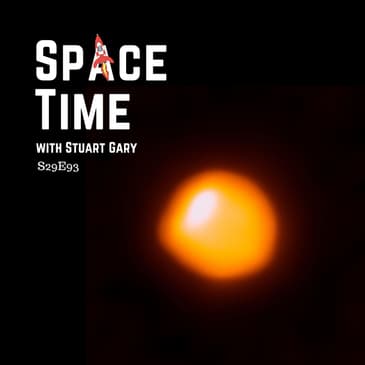
This is Spacetime Series twenty nine, episode ninety three, for broadcast on the fifth of August twenty twenty six. Coming up on Space Time, the strongest evidence yet that Bettlegurs is not alone is the mighty Andromeda galaxy dying and the most volcanically active world in the Solar System. All that and more coming up on space Time. Welcome to space Time with Stuart Gary. Astronomers have finally demonstrated that the red supergiant star Bettlegurs has a binary companion star about two to three times the mass of our Sun. The findings, reported in the journal Astronomy in Astrophysics provides the strongest evidence yet that one of the biggest and brightest stars in the night sky as a faint Stella companion, Bettlegirls b orbiting the primary star located somewhere between five hundred and thirty and six hundred and forty three light years away. Bettle Girls is the brightest star in the constellation of Ryan the Hunter and represents the scorpion sting on Oryan's shoulder. It's the ninth brightest star in the night sky and one of the largest and most luminous stars visible with the unaided eye, commonly called beetlejuice. Don't say it three times. Its name has been tortured through centuries of mispronunciations. It originally started as ipdal Jaza, meaning the hand of the big Man in Arabic, big man being a ryon the hunter. Bettle Girls began its life around ten million years ago as a spectral type O B blue star. Calculations of Bettlegirls's mass range from slightly under ten to a little more than twenty times that of our Sun, with some one hundred thousand times the Sun's brightness and around eleven hundred times its diameter. In fact, if Bettle Girls were placed at the center of our solar system, its surface would extend almost as far out as Jupiter, thereby engulfing the orbits of Mercury, Venus, Earth, Mars, and the main asteroid belt. Bettle Gurls is now a bloated old semiregular variable red supergiant. Red supergiants are the largest stars in the universe in terms of volume, although they're not necessarily the most massive luminous. After spending billions of years fusing hydrogen into helium in their cores, a star's core hydrogen supply eventually runs out, and the balancing act between nuclear fusion pushing out gravity pushing in stomps and gravity wins. The huge mass of the star crashing down on the core causes a dramatic increase in core pressure, consequently temperature that triggers helium in the core to flash, which causes the helium to start fusing into carbon and oxygen. At the same time, the hydrogen rich region around the stellar core has moved down towards the core into a region where temperatures and pressures are high enough for hydrogen fusion into helium to commence in the shell around the core. Meanwhile, the increasing core temperature results in increasing luminosity, and the resulting radiation pressure from shell burning causes the outer diffuse gaseous envelope of the star to expand to hundreds of times its previous radius. As the now bloated star's chromosphere or visible surface, moves further away from the core, it cools down, turning redder. Hence the star becomes a red giant. Sun. Like stars, eventually lose the outer envelope, which continues expanding outwards, forming a planetary nebula. This ultimately exposes the star's white hot stellar core as a white dwarf, which will slowly cool over the eons. However, stars with masses more than a round eight times that of our Sun experience a very different fate. Unlike the Sun, their fusion cycle doesn't end with helium fusing into carbon and oxygen. They've got enough mass to fuse carbon and oxygen in their core into progressively heavier and heavier elements, while shell burning around the core also fuses progressively heavier and heavier elements carbon, nitrogen, oxygen, neon, magnesium, silicon, sulfur, nickel, and eventually iron. These stars have become red super giants. Now, no matter how massive a star is, it can't fuse iron into heavier elements, and so once again gravity wins, causing the entire mass of the start to collapse down onto the core. The collapse is so powerful that the billions of tons of material causes a rebound, and the star explodes as a core collapse supernova so bright it briefly outshines an entire galaxy. The star eventually ends up as either a neutron star or an even stranger object called a black hole. Singularities of infinite density and zero volume. With the lures of physics a science understands them no longer apply, and this will be the fate of Bettle Girls. In fact, it could explode as a core collapse or type two supernova any day now, which in astronomical terms means it could be tomorrow or a million years from now. Whenever it happens. When it does explode, it'll temporarily outshine all the other stars in the galaxy, and it'll be clearly visible in the daytime sky here on Earth, and that'll be a fascinating experience. Star seen by humans to go super and ova in our galaxy was Tiger Star in the year fifteen seventy two, and that was before the invention of the telescope. This new study is lead author Miguel Montagas from the Paris Observatory, says astronomers of look for potential companions as a possible explanation for Bettelegirls's regular changes in brightness. Two studies published in twenty twenty four predicted that the companion would be furthest from Bettlegirls in December of that year, and hence easier to spot, so Montagas and colleagues used the European Southern Observatories very large telescope the VLT in December of twenty twenty four and spent several months observing the star, and eventually they obtained the clearest image ever of what likely is Bettelegirls By. Montager says he was concerned he didn't have the sensitivity in his instruments that detech Bettlegirls b because it was thought to be too similar to the Sun in brightness and so it would be obscured by the primary stars glare. But it turned out to be at least two to three times the mass of the Sun and so it could be directly imaged, meaning the light from the star itself was detected. While there has been some early evidence of the possible existence of a companion star, including a possible direct detection by the Gemini North telescope in Away, this is the strongest evidence for and the clearest image jet of Bettleghost be now to be certain the companion's really there, the authors still need to observe it in a year's time on the other side of the star, but Montegas believes this very little space left for doubt. A few years back, Bettlegoes was the subject of attention from astronomers around the world when it visibly started dimming. It quickly went from being the ninth brightest star in the sky being the twentieth brightest. As we mentioned earlier, as an evolved super giant star, Bettlegoes is expected to explode as a supernova any day now, and so that dimming led some to suspect that this could be what was about to happen, but observations by Montegas and colleagues eventually determined the star was simply being obscured by a cloud of dust. This is space time still to come. Is the mighty Andromeda galaxy dying and the most volcanically active world in our Solar System? All that and more still to come on space time. A new study has found that star formation appears to be winding down in the nearest big neighboring galaxy, Andromeda. The new findings reported in the Astrophysical Journal, based on observations by NASA's Hubble Space Telescope. Astronomer's study Andromeda because it provides them with an opportunity to examine its stellar populations in great detail, leading to a better understanding of the past of galaxies like our own. The Andromeda galaxy M thirty one is located about two and a half million light years away, and like our own Milky Way, it's a spiral galaxy. It's close enough and big enough to be seen with the unaided eye from dark skies. It's the largest member of our local galactic group, with around twice the diameter of our Milky Way, spanning some two hundred and twenty five thousand, two hundred and sixty thousand light years across. That compares to the Milky Ways diameter of between one hundred thousand and one hundred and twenty thousand light years. However, astronomers now suspect the two galaxies probably have similar masses, with both weighing roughly eight hundred billion to one point five trillion times a mass of our Sun. The new observations indicate star formation in Andromeda has undergone a five hundred million year decline, with an even steeper drop in the last forty million years. The findings are based on data from two Hubble surveys, the panchromatic Hubble Andromeda Treasury and the pan chromatic Hubble Andromeda Southern treasury. Together, they've mapped two thirds of Andromeda's disc in ultra sharp detail. In total, the author has measured about two hundred million individual stars across the galaxy, giving them a detailed picture of andromedais past activity. One of the studies authors, Ben Williams from the University of Washington, says astronomers need to measure the individual stars because they're the fossil record of the galaxy's formation, and Hubble is the only telescope that can provide high enough spatial resolution over a large enough area to be able to do that. In Andromeda. The key is that massive stars are bluer and shorter lived, or less massive stars are redder and longer lived. As a result, areas that have experienced recent star formation tend to have a larger fraction of blue stars, or areas with less recent star formation typically have a reader population. So Williams and colleagues divided Andromeda's images into thousands of squares, each spanning roughly three hundred light years per side. They determine the history of star formation within each pixel in order to gain a comprehensive view of the galaxy's past. Previous research showed that the Andromeda galaxy experienced a dramatic burst of star formation around two billion years ago that was likely due to a past interaction or merger with another galaxy, but since then star formation has steadily declined. Astronomers measure the rate of star formation in terms of mass, or the amount of gas and dust converted into stars every year. The authors calculated that five hundred million years years ago, Andromeda form stars at a rate of about one solar mass per year. That's about the same as the Milky Way today. However, formation rate dropped in Andromeda to about half of that figure by about forty million years ago. The current rate is now plummeted even further, to just a fifth of the mass of our Sun per year. They also examined whether that decline was consistent across the entire galaxy, were just concentrated in certain specific areas, and they found that much of the recent star formation occurred in a start forming ring located around thirty two thousand lay years from the galaxy center. As a result, much of the decline they measured was driven by decreasing activity within that ring, rather than being the result of reduced material from which new stars can form. The authors think the declines are more likely to be a natural winding down from its previous, more active state. Williams and colleagues also investigated whether there was any connection between the decreasing activity and Andromeda. At its proximity to the satellite galaxy Messia thirty two. M thirty two separated from Andromeda by about sixteen thousand light years in the plane of the sky. However, it's three D location in space is uncertain. As a result, astronomers are unsure if or when it might have interacted with Andromeda in the past. Survey data from the panchromatic hubble Andromeda Southern Treasury allowed the authors to study the history of star formation and Andromeda in and near M thirty two, and they found this area showed signs of decreased star formation compared to other regions. The timing of this decrease, which the study finance began roughly sixty million years ago, could help constrain when M thirty two interacted with Andromeda's disc The authors say they can't explicitly say they're seeing a decrease in star formation because of M thirty two, but hey, it's right there, and it's definitely the most likely suspect. This is space time still to come, the most volcanically active word in the Solar System, and later in the science report, a new study wards that mining is now a threat and more than twelve thousand species across the planet. All that and more still to come on space time. NASA's Guno spacecraft has provided the first measurements of the temperature below the surface of Jupiter's volcanic moon Io. The findings, reported in the Journal of Geophysical Research Planets, shows significant heating within the shallow subsurface of what is the most volcanically active world in our Solar System, collected during two close flybys. The data also shows that most of Io's surface is remarkably smooth and composed of material with very low density. Io's extreme volcanism is powered by tidal heating. See the Moon's constantly being stretched and squeezed by the immense gravity of its host planet Jupiter as it travels in its slightly elliptical orbit around the gas giant, then the refurther grap vitational tugs during its journey from its sister Jovian moons. Io is the innermost and smallest ob Jubiter's for Galilean moons, but the three thousand, six hundred and sixty kilometer wide world is still slightly larger than the Earth's moon. Until now, virtually everything astronomers know about Io's tidal heating has come from infrared observations, which can really only sense the temperature of the surface. But these latest findings are based on data collected by Juno's microwave radiometer. JUNO Principal investigator Scott Bolton from the Southwest Research Institute in San Antonio, Texas, says the surprising discovery that we can see below the rocky Moon's surface as important implications for studding volcanoes here on Earth. He says June's taught scientists that if they look with a microwave radiometer instrument near a volcano on Earth, they might see similar signatures in the subsurface temperature gradients, providing new information and our Earth volcanoes work. Juno's microwave radiometer was designed by Bob to peer beneath Jupiter's cloud tops in order to investigate the dynamics and composition the gas giants deep atmosphere. Its six microwave antennas act as a single instrument simultaneously detecting microwaves at a range of different wavelengths. During Jurney's extended phase, It's provided scientists an opportunity observe three of the planets, so called Galilean moons, gain he made, Europa and Io. So far, only Callisto has been left out of the study. They're called Galilean moons because they were first observed by Galileo Galilee when he turned his telescope onto the orb of Jupiter. Seeing the Moon's orbiting around Jupiter, Galileo realized that the Earth and all the other planets in the Solar System were simply doing the same thing around the Sun, a discovery which ended with him not only being sentenced to house detention by the Catholic Church for the rest of his life, but he was also forced to renounce his discovery on pain of death. Yet even then, under his breath he whispered, and yet it moves, referring to Earth orbiting around the Sun rather than the Earth's centric view of the universe favored by the Catholic Church at the time. Bolton says each wavelength within the microwave radiometer explores different depths providing a new way to characterize the deb atmosphere of the giant planets, as well as the subsurface crusts of icy and rocky moons. At Gannymeat in Europa, Geno explored tens of kilometers below the surface, assuming that ice shells were mostly pure water, but the ability to probe the volcanic rock on Io was an unexpected discovery. During flybys on de seven thirtieth in twenty twenty three and February thirty, twenty twenty four, the Genos spacecraft came within fifteen hundred kilometers of iOS surface. Bolton and colleagues. Found that everywhere they looked, they saw temperature increases of roughly five degrees celsius every few centimeters, a fast steeper gradient and solar heating alone can explain, and that suggests only two likely explanations. Either the heat is right steadily through a conductive crust, or the signal could be coming from cooling lava flows cap by roughly ten meters of solidified crust, covering about ten percent of the Moon's surface at any given time. Bolton says Io provides a unique window matter how tidal heating works throughout the cosmos a fundamental process providing energy and heat to worlds that could be orbiting far from the hearth star. This process not only it creates the most volcanically active world in our Solar system, but it also fuels the subsurface oceans on the ice moons of the giant planets like Europa, Enceladus. And Ganny Made. Another major insight gained from Juno's two flybys of Io is just how smooth the little world is. For these findings, the Moon was known for its tall mountains, but the new observations indicate that apart from this visible topography, the surface features expansive smooth patches that can stretch for hundreds of kilometers or more. Because Uno flew by overlapping regions of Io at different angles, you alsos are able to map just how the surface reflects marcrowaves, showing them just how flat this distant world really is. But of course Io has an ever changing geography. Living on Io, you wouldn't have weather reports, you'd have geological reports, with lava lakes forming in the north, mountain building in the south, ground solidification in the west. This report on Geno's mission to Jupiter comes from NESTV. Humanity has had its eyes on Jupiter for surgeries. First telescopes and in recent decades, eight deep space pros were used to examine the largest planet in the Solar System. Equipped with unique sensors. JUNO looked deeper into the planet's structure than ever before to find out the answers to basic questions about Jupiter's makeup and how it formed. Juno's looking for how Jupiter formed and really how planets are made in general. We're very much looking for the recipe for planets. The special thing about JUNO is is we're really looking at one of the first steps, the earliest time in our Solar System's history, right after the Sun formed. What happened that allowed the planets to form? And why are the planets slightly different composition than the Sun. Jupiter is so far away from Earth, then, even when it's at as closest to us, it will still take a radio signal moving at the speed of light about thirty four minutes to cross the distance. Pretty challenging missions, pretty challenging payloads. I'd say it's pretty robust. So it's those kind of challenges with making sure you do all the little things necessary to maximize the opportunities that you get. Aside from distance, Jupiter offers unique challenges to a spacecraft, such as a radiation field rivaled in intensity only by the Sun. We have a box in the middle of the spacecraft that we call a vault, and it's made out of titanium, and that shield all the electronics from these hazardous radiation and we're very much an armoured tank going to Jupiter. Justice JUNO is building on the knowledge gained with past missions to Jupiter. Future missions will build on Juno's findings. If we could start to understand the role that Jupiter played and how the planet formed and how that eventually governed the creation of all the other planets and Earth and maybe even life itself, then we know a little bit about how to look for other Earth like planets maybe orbiting other stars, and how common those might be, and the roles that those giant planets that we see orbiting the other stars play. Really, all these missions that LSPs involved in, the NASSAS involved in are all precursors to the bigger picture of getting humans out beyond low Orth orbit to Mars, to an asteroid and be honest. And in that report, from MESSATV. We heard from JUNA Principal investigator Scott Bolton from the Southwest Research Institutions, San Antonio, Texas, as well as GUNO Launch Director Omar Bayes and JUNO Mission Manager John Culvert, both from NASSA. This is Space Time and time out to. Take another brief look at some of the other stories making US and science this week with a science report. A new study warns that mining is now a threat to more than twelve thousand species across the planet, which includes almost six thousand that are already listed is threatened. The findings, published in the journal Cille Report Sustainability, overlaid the space where mining occurs across the planet and noted that twenty eight percent of the ranges of threatened species overlap with those areas that are being mined. The authors say at least one hundred species have some seventy five percent of their ranges overlapping in these areas. That's despite mining not being recognized as a threat by the International Union for Conservation of Nature. They also found that future planned mining sites could expose over three thousand threatened species to the risks involved around mining sites, eighty three percent of which don't have a mining related threat designation. A new study claims taking fecal capsules could help people with insomnia get a good night's sleep. A report in the Journal of Internal Medicine claims a trial involving forty people who had chronic insomnia disorder were given either a placebo or an antibiotic trip and to clear their gut microbiome, and then fecal pills to recolonize their intestinal tract. After a month, the participants receiving the fecal pills showed greatly improved sleeping patterns compared to those on the placebo. The subjects taking the pills also reported feeling that their sleep had improved for up to six months after taking them. Well. Despite Australia's air being relatively unpolluted compared to other parts of the world, a new study is found that there's a clear link in the Great Southern Land between air pollution exposure and the risk of ending up in hospital with lung and hard issues. The findings, reported in the journal Public Health Research and Practice, used national air pollution estimates from twenty sixteen and hospitalization data from one thy one hundred and fifty five Public Health areas between twenty sixteen and twenty seventeen, representing some twenty three million, two hundred and thirty six thousand and forty six people. The authors found higher exposure to pollution particles smaller than two point five nanometers together with nitrogen dioxide was consistently linked with increases and hospitalizations for these issues. A new study has. Found that people who spent an excessive amount of time online tend to be more stressed, have worse moods, and neglected other parts of their lives. A report in the General plus one monitored the daily Internet use of some nine hundred German adults for two weeks. The authors found temptation was the biggest thing pushing subjects to go online. However, although excessive Internet users had worse moods, spending time online didn't improve how they felt. Telstra, Australia's largest telco, is expanding its relationship with Elon Musk's Starling broadband satellite network. Right now, the starting constellation includes some teny four hundred and thirteen satellites in low Earth orbit, and Telstra wants to take advantage of that. With the details of the new Telstra Starlin deal We're joined by technology editor Alex saharov Royt from Tech Advice Start Life. Yeah, well the calling of the first for Australia satellite to mobile connectivity expands from text to apps. Now before you suddenly think, oh, you know I can get a high speed bandwidth from the sky, No, this is for low data uses. And they were the first launch satellite messaging in Australia. This was to send messages beyond the range of their mobile network. But now they're rolling out access to select satellite apps to eligible consumer and small business customers. So this is where their collaboration with Stalin. There's now a selection of satellite optimized apps and this includes things like navigation apps, Apple Maps, Google Maps, all trails, messaging apps including I Message, What'sapp, Facebook Messengers, Signal and Google Messages. You've also got weather apps Apples Weather, ACU Weather and Google Weather, and then also Google Fitness and of course the Mind telstra app. And these are apps that have been specifically optimized to send and receive data over what is effectively intermittent satellite connectivity. Over what'sapp. You can do voice and video calls, but it's going to drop out. You just want to send text messages, but eventually you will have a lot more direct to device capability from updated Stylink and other satellites are designed to connect directly the mobile phones and give a proper higher bandwidth experience. And this will work with iPhone thirteen on newer the new Samsung Galaxy S twenty six, and it will expand to some of the older Galaxy range by the end of the year. It's really for people who are outside of the mobile network, and it will mean that over the next few years you will have a lot more services connecting directly to satellites without needing a special SAT phone. And it's kind of put into question what you need to be connected to your local provider forman there will come a time when starling elon must well just have a global plan, and you're already talking about wanting to buy existing telcos for their spectrum or bidding on spectrum services so that he can have terrestrial and satellite connectivity. And imagine if you just had a global plan through Staralink that worked with any phone would pretty cool. During the thirteenth test flight or the Starship. On board that starship, we're twenty test versions of the Starlink Version three satellites. They're a little bit bigger than the current version two and they're the ones that will in fact allow every cell phone to become a satellite phone for voice, video, everything. And that's how close we are. We just need to get more of those satellites up there. And look, the thing about the satellites is that I mean, I remember when three or four years ago Elon was talking about launching version two satellites. So here we are in twenty twenty six is launching version three. And these satellites they're not permanent fixtures in space. They slowly get out of all but I mean the only supposed to last five or six years before they have to be de orbited. Anyway, that's why it keeps launching the new satellites all the time and replacing them with more advanced ones which have these extra capabilities every time I launched a new one. As you just explained, well after a certain period of time, there'll be a Version four and a Version. Five, and that's part of what Starship's all about. Whereas a Falcon nine can launch maybe twenty twenty eight satellites in a single bounce, the Starship will launch sixty at a single go sixty satellites each launch. That's pretty yeah, it is. And that's how, of course, you build out the constellation quickly. I mean, we did have the situation where a couple of months ago Jeff Bezos Blue Origin satellite, which was meant to launch a bunch of the next gen Amazon Leo satellites that nd N and Australia onced upgraded sky Muster network with And I mean that explosion blew up a whole stack of those satellites and blew out most of the launch pad with it. I was reading that it normally takes twelve to eighten months to rebuild a launch pad, but Blue Origin is determined to get it up by the end of the year, by December twenty twenty sixth. The Russian said that problem too. A couple of months ago, when a Sawyers launch destroyed the launch pad. The Sawyers was fine, the rocket was fine, the launch pad it had gone to whatever launch pad heaven there is. Yeah, thank god. It will be at least two years before they could get people back into space, because this was their only launch pad designed to carry manned spacecraft. Yet in nine months they completely replaced it and they were back up and running. So Jeff Bezos saying he'll do it before the. End of the year, Yeah, I believe that. Yeah. Well, I mean what I read was it'll be approximately six months and it's going to be just enough launch pad for the launch. I mean, I'm sure they'll keep upgrading it, but you need to get the Amazon Leo satellite constellation up and running, and to do that you need another rock. Dude. I remember as a kid watching James Bond Double seven Moonraker and thinking to myself, how ridiculous private people having their own launch systems. Now it's happening. It's no longer science fiction yesterday. Science fiction is today science fact. Absolutely absolutely. That's Alexeharov Rout from Take Advice, Start Life, and this is space Time, and that's the show for now. Spacetime is available every Monday, Wednesday and Friday through at bytes dot com, SoundCloud, YouTube, your favorite podcast download provider, and from space Time with Stuart Gary dot com. Space Time's also broadcast through the National Science Foundation, on Science Own Radio and on both iHeartRadio and tune in Radio. And you can help to support our show by visiting the Spacetime Store for a range of promotional merchandising goodies, or by becoming a Spacetime Patron, which gives you access to triple episode commercial free versions of the show, as well as lots of bonnus audio content which doesn't go to weir, access to our exclusive Facebook group, and other rewards. Just go to space Time with Stuart Gary dot com for full details. You've been listening to Spacetime with Stuart Gary. This has been another quality podcast production from bytes dot com.